
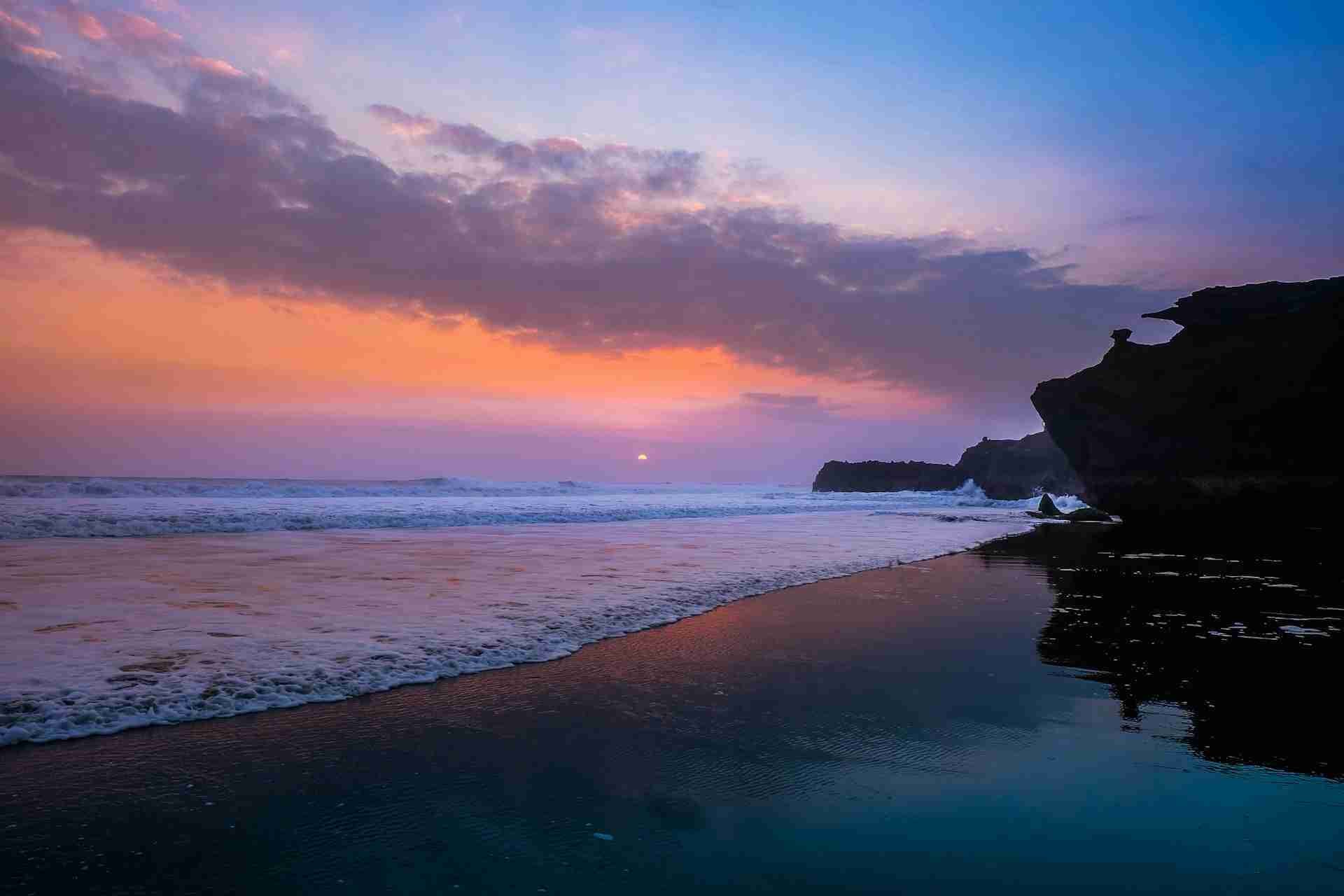
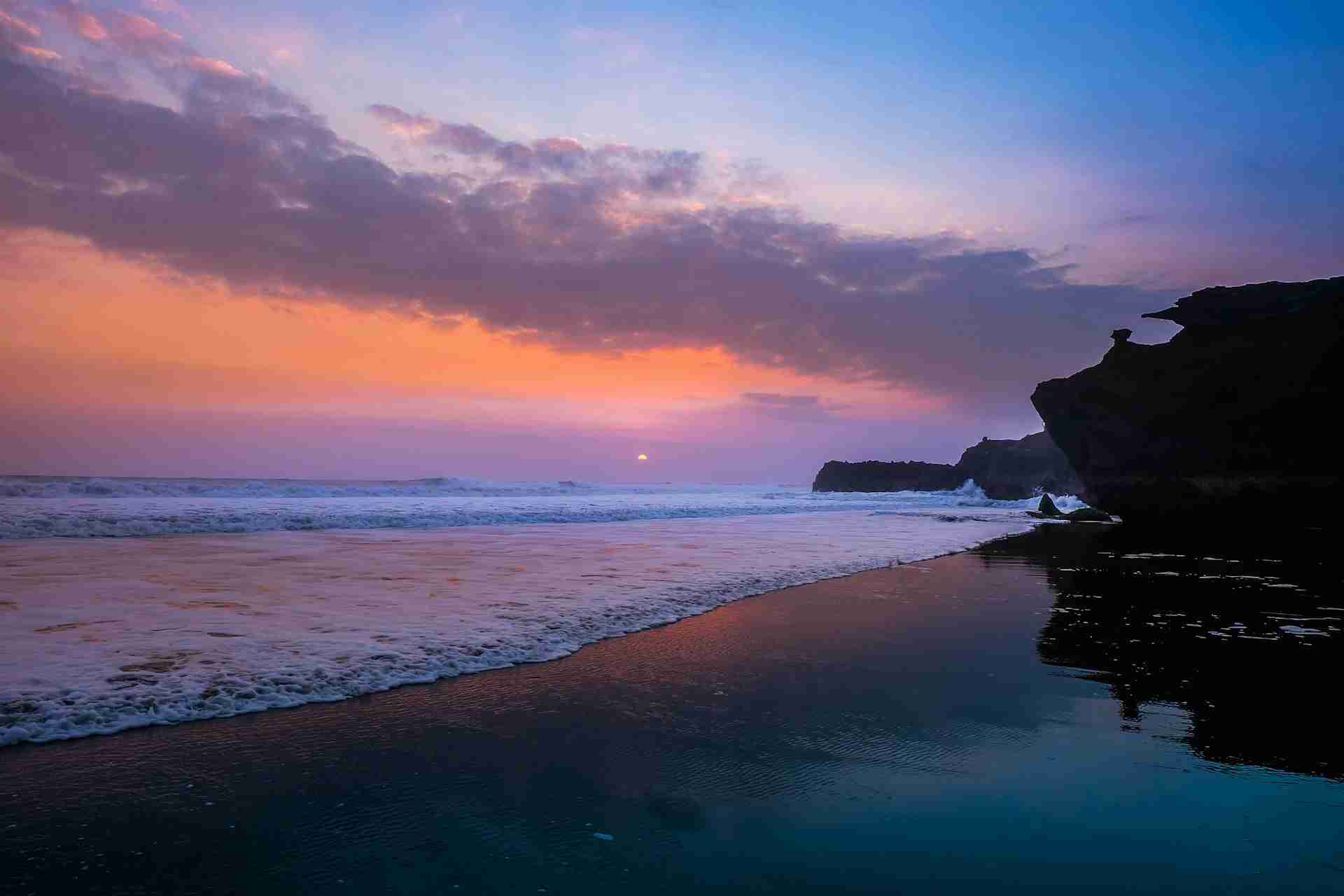
Pantai Kelating stretches quietly along Bali's lesser-visited southwest coast, offering a striking landscape of black volcanic sand, windswept shoreline, and endless ocean horizon. Framed by palm groves, the beach remains largely undeveloped, giving photographers a chance to capture Bali's coastal beauty without the distractions of crowds. The interplay of light and dark sand, especially at low tide when the beach reflects the sky, creates dynamic compositions that shift dramatically with weather and time of day. This is a place where the raw elements of land, sky, and sea meet in open, minimalist forms, rewarding photographers who are patient with changing conditions.
Best Photography Opportunities
• Reflections on Wet Sand at Low Tide
As the tide recedes, a broad stretch of wet black sand mirrors the sky and clouds, creating seamless horizons that are ideal for minimalist landscape photography. Use a wide-angle lens to exaggerate the depth and pull the eye toward the vanishing line. Early morning offers soft gradients in the sky, while sunset produces vivid color reflections across the surface. Position your tripod low to the ground to maximize the reflective quality of the sand, and wait for small waves to leave behind smooth patterns that guide the composition.
• Long Exposures of Ocean and Sky
The beach's open horizon and constant wave action are perfect for long exposure work. Use a neutral density filter and tripod to smooth the motion of the sea and soften clouds as they move overhead. These exposures are most effective during overcast days or after sunset when contrast is manageable and the atmosphere carries muted tones. A slightly elevated viewpoint can help separate the sea from the sand while maintaining balance in the frame. Time your shots to catch receding waves pulling away from rocks or shoreline debris for added motion.
• Traditional Sea Temples Along the Coast
Several small sea temples dot the cliffs and rocky outcroppings near Kelating, often surrounded by ceremonial offerings and local activity. These structures are especially photogenic in soft sidelight or during religious festivals when the scene fills with color and movement. Use a standard or short telephoto lens to isolate architectural details against the ocean backdrop. Be respectful when photographing temple grounds, and avoid disrupting ceremonies or walking through sacred areas. The contrast between weathered stone and shifting sea light adds depth and cultural context to coastal compositions.
• Textured Foregrounds with Volcanic Sand and Driftwood
The black sand here is often scattered with organic debris including driftwood, shells, and volcanic stones that lend themselves to strong foreground elements. Shooting with a wide lens and deep depth of field allows you to place these textures in the lower third of the frame, anchoring open sky or ocean beyond. Morning light adds side contrast to bring out detail, while overcast days help emphasize form without harsh highlights. These compositions benefit from careful placement and balance between texture and open space.
• Golden Hour Silhouettes of Palm Trees and Figures
The edge of the beach is lined with coconut palms and occasional riders on horseback or locals walking along the shore. As the sun drops behind the ocean, silhouettes form cleanly against the glowing sky. Use a telephoto lens to compress the scene and isolate figures or trees against the horizon. A fast shutter speed helps retain edge clarity as the light fades. These scenes are ideal for mood-driven compositions and work well as standalone images or part of a storytelling sequence.
Best Time to Visit
The dry season from May through September provides the clearest skies and most reliable sunsets for beach photography. During these months, winds are lighter in the early morning and evening, reducing haze and allowing for sharp, contrast-rich compositions. Sunrise and sunset are equally productive, with the western exposure favoring golden hour light as it drops into the sea. Morning sessions offer solitude and cooler air, while evening brings dramatic sky color and the occasional presence of local activity.
During the wet season from November to March, the beach becomes more dynamic, with heavier surf and cloud movement that can add drama to long exposures and storm-driven compositions. Even when skies are overcast, the reflective surface of the sand remains a strong element. Tide is a critical consideration year-round. Low tide exposes more foreground and provides mirror-like surfaces, while mid to high tide increases wave activity for motion-focused photography. Check tide charts in advance and plan to arrive early to scout safe, elevated vantage points.
How to Get There
Pantai Kelating is located in the Tabanan Regency of Bali, roughly an hour and a half drive from central Denpasar or the Ubud area, depending on traffic. The most reliable way to reach the beach is by private car or motorbike. From the town of Tabanan, follow signs west through rural rice field roads toward Kelating village. The final stretch includes narrow local roads that pass through agricultural areas before reaching the beach.
Parking is available near the end of the road, where small warungs and local homes line the edge of the beach. There are no formal facilities or entry fees, and the beach is open to the public year-round. The approach to the beach includes a short walk down a sloped path, but it is easily manageable with gear. There are no safety barriers or marked paths near the rocky sections, so caution is advised, especially near the waterline during high surf.
Cell coverage is available but can be weak, so offline maps are recommended. Bring all necessary supplies, including water, snacks, and sun protection, as there are limited services on-site. Early arrival ensures space to work without interruption and gives time to observe the tide and light conditions before shooting.
Recommended Photography Gear
A wide-angle lens is essential for capturing expansive sand reflections, tidal patterns, and layered sky compositions. A standard zoom such as a 24 to 70 millimeter lens offers flexibility for both wide scenes and detail shots of driftwood or sea temples. A telephoto lens in the 70 to 200 millimeter range is useful for isolating silhouettes or compressing background elements such as waves and clouds.
A sturdy tripod is necessary for long exposure work and twilight sessions. A 6 to 10-stop neutral density filter allows for slower shutter speeds to blur wave movement or soften cloud transitions. A circular polarizer can help manage glare on wet sand and enhance color saturation in reflected skies. Bring a microfiber cloth to regularly clean salt spray off your lens and filters.
Footwear with good grip is recommended for walking on wet or uneven sand. A weather-resistant camera bag is useful for protecting gear from sand and humidity. Extra batteries and memory cards are essential, as shooting conditions are highly dynamic and can change quickly with light and tide.
Nearby Photography Locations
Just north of Kelating, this beach features rock formations, sea caves, and temple ruins that add visual interest. The waves here are powerful and lend themselves well to dramatic long exposure scenes, especially at sunset.
Located inland in Mengwi, this royal water temple offers tiered pagodas and lotus-lined moats. It is best photographed in soft morning light or just after rainfall when the stone pathways are wet and reflective.
A short drive inland, this UNESCO-listed landscape features expansive rice fields sculpted across hillsides. Early morning light reveals layers of mist and contour lines, and overcast days bring out the green tonal range.
South of Kelating, this quiet black sand beach offers a similar atmosphere with less dramatic rock formations. Its openness and minimal human impact make it ideal for simple, horizon-focused compositions and peaceful silhouettes.
Tucked in the central highlands, this forest-covered temple complex provides moody, quiet imagery with moss-covered shrines and dense foliage. It pairs well with a Kelating shoot as part of a full-day west Bali photography itinerary.
Pantai Kelating is a place of quiet drama and elemental form, offering a raw and reflective counterpart to Bali's busier beaches. For photographers willing to work with the rhythm of tide and sky, it is a rewarding location full of texture, space, and shifting light.
Comments
Loading comments…