
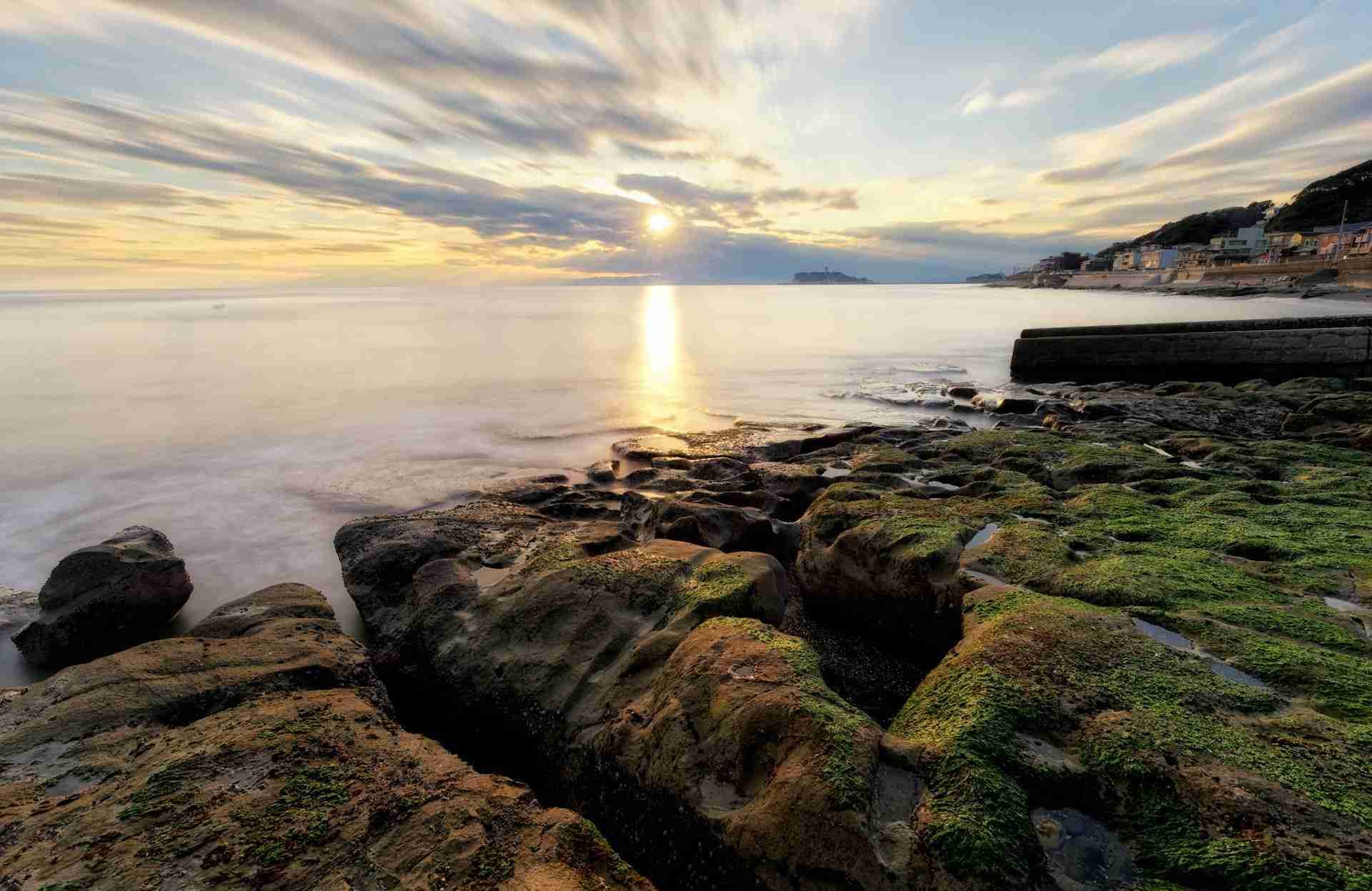
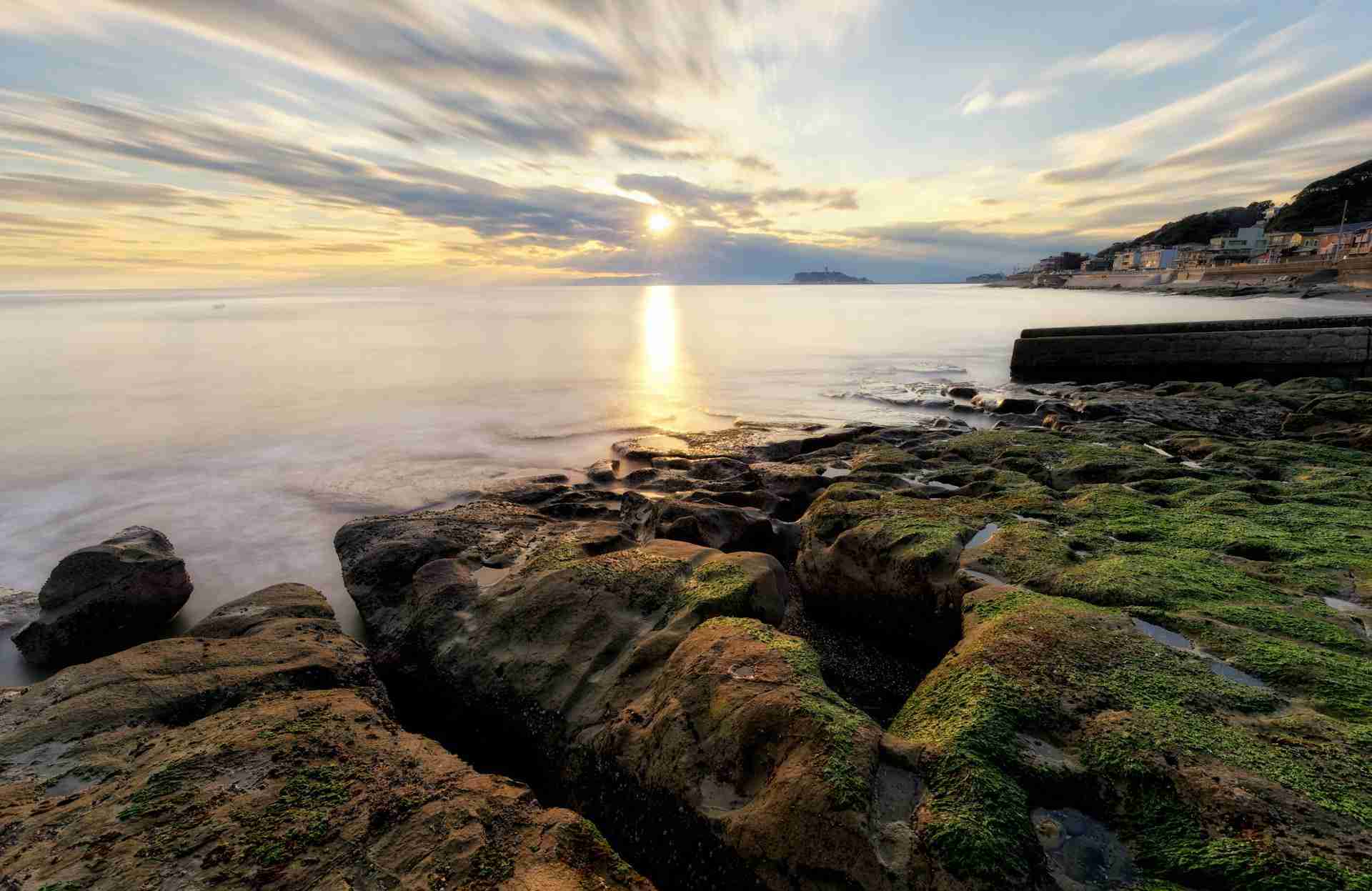
Cape Inamuragasaki lies at the western edge of Kamakura's Shichirigahama coastline, offering one of the a beautiful view across Sagami Bay. This small rocky headland is best used for layered compositions. Coastal rocks anchor the foreground, shifting ocean textures define the midground, and on clear days Mount Fuji's rises off in the distance. Its proximity to both the sea and the mountains creates constant variation in weather and light, from glowing sunsets to misty backlit scenes in winter. While popular with locals and tourists alike, the cape still offers quiet, meditative frames for those who understand timing and patience. Photographers who know how to balance large-scale elements with fleeting atmospheric conditions will find Inamuragasaki to be a location of both challenge and subtle reward.
Best Photography Opportunities
• Mount Fuji at Dusk
The most iconic composition from Cape Inamuragasaki aligns Mount Fuji with the setting sun, framed over the sea just beyond the curve of the coastline. On clear winter days, the air is crisp enough to render the mountain in high detail, especially during golden hour when the last light grazes the summit. The transition into blue hour often brings strong color bands across the sky, reflected in the water below. A telephoto lens between 100 and 200 millimeters helps isolate the mountain while still including elements of the coastline or silhouetted surfers. Windless evenings are best for cleaner horizons and stiller water.
• Rocky Shoreline Textures
At low tide, the cape's intertidal rocks are exposed, forming tide pools, textured ledges, and reflective wet surfaces. These areas are excellent for low-angle compositions that place rock textures in the foreground while framing the ocean and sky above. Golden hour light brings out the subtle greens of sea moss and browns of wet stone. Longer exposures soften the wave motion while retaining structure in the rocks. A tripod with adjustable legs helps with stability on uneven surfaces, especially when positioning near tidal flow.
• Surfer Silhouettes at Sunset
Cape Inamuragasaki is popular with local surfers, and their presence adds human scale to wider coastal frames. Just before sunset, backlight silhouettes the figures as they wait in the water or walk along the beach. Composing with surfers in the lower third of the frame, while allowing Fuji or the glowing sky to dominate the upper sections, results in a strong narrative composition. A medium zoom allows quick reframing as subjects shift in and out of position. Shutter speeds between 1/200 and 1/500 seconds work well for balancing motion and shape.
• Evening Reflections in Wet Sand
The beach area east of the cape offers smooth, wet sand that becomes highly reflective after sunset. As light fades and artificial lights begin to glow behind the coastline, the sand mirrors the color of the sky in soft gradients. Wide-angle lenses are effective here to exaggerate the foreground and pull in as much reflection as possible. A low camera position enhances depth, especially when the tide is pulling back and leaving thin layers of water. These images often work well in both color and black and white.
• Long Exposure Cloud and Wave Studies
On days when Fuji is obscured or visibility is poor, the coastline still supports strong minimalist compositions through long exposure work. Using neutral density filters, photographers can blur cloud movement over the water and soften wave patterns against the cape's silhouette. The rocky curve of the cape itself becomes a strong graphic element. These shots benefit from stable tripod use and careful balancing of exposure settings to preserve detail in the sky and water simultaneously.
Best Time to Visit
The clearest views of Mount Fuji occur from late autumn through early spring, particularly between November and February. These months bring cool, dry air that sharpens visibility across Sagami Bay and enhances light quality at both sunrise and sunset. Winter skies are often most colorful just after sundown, when Fuji reflects ambient light and the sea darkens into subtle gradients.
Sunset is the most productive time to shoot here, as the cape faces west and captures the full range of evening color and shadow. Arriving at least one hour before sunset allows time to scout tide conditions and compose for changing light. Mornings are typically quieter but often place the sun behind the scene, which flattens depth and renders Fuji in silhouette.
Summer brings warmer water and hazier air, which can obscure Fuji for days at a time. However, the humidity can lead to dramatic cloudscapes and more active skies during golden hour. Tides vary daily, so checking tide charts ahead of time is essential for planning access to the rock platforms.
How to Get There
Cape Inamuragasaki is located in Kamakura City, Kanagawa Prefecture, along the coast of Shichirigahama. The most direct access is via Inamuragasaki Station on the Enoden (Enoshima Electric Railway) line. From the station, the cape is a five-minute walk downhill toward the sea, following signs for Inamuragasaki Park.
No entry fee or permit is required to shoot from public paths, the beach, or the rocky shore. Small public parking areas are available near the station and along Route 134, but they fill quickly on clear afternoons and weekends. Most photographers prefer to arrive by train to avoid traffic and parking limitations.
The area is fully accessible by foot, with paved walkways and beach access via stairs and ramps. The rocks along the shore can be slippery, especially in the wet season, so proper footwear is recommended. There are benches, a public restroom, and vending machines in the park area, making it easy to set up for extended shooting sessions.
Recommended Photography Gear
A sturdy tripod is essential for long exposures, low-light shooting, and stability on uneven rocks. A mid-range zoom such as a 24 to 70 millimeter lens works well for framing the coastline, capturing Fuji at a distance, and adapting quickly as the light shifts. A telephoto lens in the 100 to 200 millimeter range is necessary for isolating Mount Fuji across the bay or compressing surfers and sky layers into a clean composition.
A wide-angle lens is useful for low-angle work at the shoreline, particularly when working with tide pools or reflections. Circular polarizers help cut glare from wet rocks and enhance sky contrast, especially in late afternoon. Neutral density filters in 6 or 10 stop strength are helpful for long exposures of clouds and water movement. Bring extra lens cloths or wipes, as sea spray can accumulate during windy conditions.
Remote shutter release or a built-in timer is important for sharp exposures at slow shutter speeds. A lightweight backpack is recommended for mobility along the beach and rocks, and protective rain covers are useful in the winter season when sudden changes in weather are common.
Nearby Photography Locations
Located just east of the cape, this beach offers wide-open views toward Mount Fuji, with low-angle light that casts soft color over the water. The gently sloping shoreline creates ideal conditions for reflection shots during golden hour and blue hour.
Easily visible from Inamuragasaki and reachable by train or car, Enoshima offers elevated views of Sagami Bay, as well as temple structures, lighthouses, and dramatic cliffs. The late afternoon light here often sweeps across the water and glows behind the island's buildings.
Situated inland between Inamuragasaki and Kamakura Station, this hillside temple is surrounded by landscaped gardens, wooden terraces, and seasonal flower displays. In spring and autumn, the temple provides excellent color and texture for vertical compositions and tighter studies.
A quieter alternative to the more popular beaches nearby, Zaimokuza offers simple seascapes, gentle tidal movement, and distant views of Mount Fuji without the crowds. It is especially well-suited for long exposures and minimalist frames during sunset.
Areas around Komachi-dori and the approach to Tsurugaoka Hachimangu Shrine offer rich street scenes, traditional storefronts, and photogenic urban layers. Early morning light and low foot traffic make this a productive location for street and travel photography in soft light.
Cape Inamuragasaki continues to draw photographers for its blend of coast, mountain, and shifting light. Whether you are framing Mount Fuji through sea spray or studying the lines of rock and tide, the cape's visual simplicity and compositional variety make it one of the most rewarding locations on the Shonan coast.
Comments
Loading comments…