
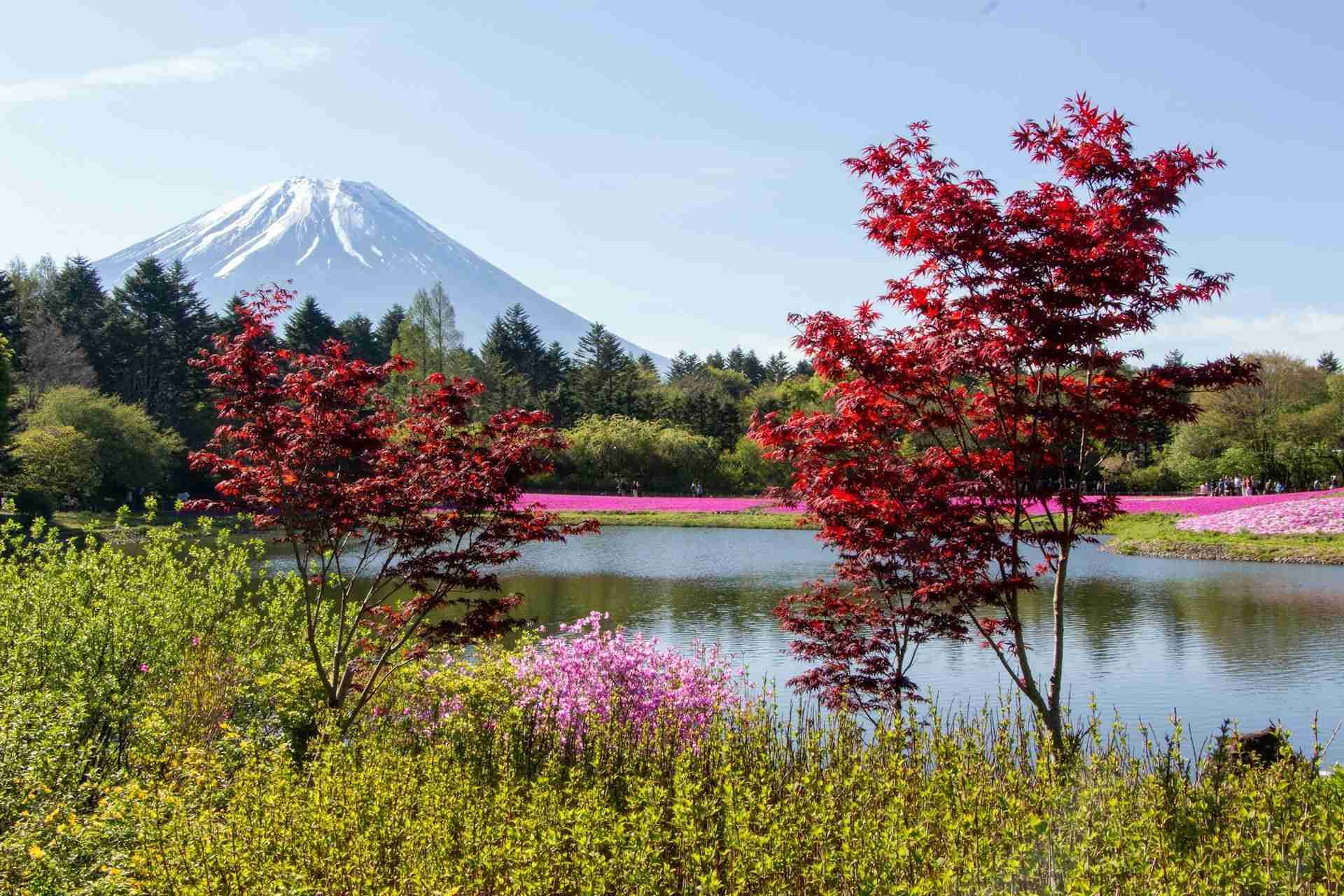
Held each spring near the base of Mount Fuji, the Fuji Shibazakura Festival transforms the foothills of Yamanashi Prefecture into a painterly canvas of pink moss phlox. The event is centered around Fuji Motosuko Resort and includes the charming Peter Rabbit English Garden, which provides curated flower beds, classic wooden structures, and quiet garden pathways with a distinctly Western cottage atmosphere. With Mount Fuji rising in the distance and rows of vivid blossoms in the foreground, this location is a seasonal favorite for landscape photographers seeking bold color, clean framing, and a sense of orderly natural design. While the festival is visually intense, the right timing and angle can yield surprisingly subtle compositions within the larger spectacle.
Best Photography Opportunities
• Mount Fuji Framed by Shibazakura Fields
The classic wide-angle shot from the main viewing platform shows Mount Fuji rising behind sweeping fields of pink moss phlox, known locally as shibazakura. This composition benefits from clear skies and early morning light, which warms the flowers and catches snow on the mountain's upper slopes. A wide lens in the 14 to 24 millimeter range captures the full breadth of the flower beds while allowing Fuji to sit quietly in the distance. For best results, use a tripod to fine-tune the horizon and work with symmetry or natural leading lines in the planted rows. Cloud cover can add atmosphere, but be patient, as Fuji is often hidden by midday haze.
• Peter Rabbit Garden Close-ups and Storybook Details
Within the Peter Rabbit English Garden, curated plots of flowers surround wooden benches, trellises, and statues inspired by Beatrix Potter's characters. These scenes are ideal for environmental close-ups and gentle storytelling compositions. Use a standard zoom or short telephoto lens to isolate garden elements against out-of-focus phlox backgrounds. Early morning light filters softly through trellises and onto stone paths, creating shadow texture and gentle highlights. Consider using a shallow depth of field to highlight statues or garden signs while blurring the field beyond, creating a dreamlike impression that contrasts with the dramatic mountain shots nearby.
• Aerial Perspective of the Festival Layout
For photographers with access to elevated positions (within permitted areas), a more graphic composition emerges by looking down across the patterned flower beds. From slight hills or designated raised decks, you can capture the geometric planting patterns that form waves of pink, white, and purple. These compositions benefit from mid-morning light when colors are strong and shadows are still present. A mid-range zoom lens helps compress the design into cohesive patterns. Be careful to avoid crowd-heavy zones in your frame by scouting areas with minimal foot traffic or using a longer focal length to isolate cleaner portions of the scene.
• Reflection Shots with Garden Elements
After rain or early in the day, small puddles and wet surfaces throughout the garden may reflect Fuji, garden signage, or statues. These fleeting reflections allow for creative framing opportunities, particularly when working with low camera angles and short focal lengths. Use manual focus to ensure precision, and set your exposure carefully to retain both highlight and shadow detail. Including petals, garden stones, or moss around the reflection adds a sense of placement and texture. These images often work well in portrait orientation and offer a quieter, more contemplative contrast to the wider scenic shots.
• Macro and Detail Photography Among the Moss Phlox
Beyond the wide views, the shibazakura fields offer surprising micro-landscapes at ground level. Use a macro or close-focusing lens to photograph petal clusters, dew droplets, or color transitions between planting sections. Early morning is ideal for this work, when blossoms are freshest and the light is soft. Kneel low and frame tightly to exclude distracting backgrounds, or shoot slightly upward from a crouched angle to include a wash of distant pinks behind your subject. A polarizer helps manage petal reflections and deepen color. These images are ideal for adding variation to a series that otherwise leans heavily on landscape.
Best Time to Visit
The Fuji Shibazakura Festival typically runs from mid-April to late May, but peak bloom usually occurs between the final week of April and the first two weeks of May. Visiting within this window increases your chances of seeing the flower beds in full color and Mount Fuji with snow still present on the upper cone.
Early morning is the best time to arrive. The gates open shortly after sunrise, and this is when the light is warm, the crowds are thin, and visibility of Mount Fuji is most reliable. As the day progresses, haze often obscures the mountain, and foot traffic becomes dense across the garden paths. Cooler temperatures in the morning also help preserve the flowers' freshness for macro and close-up work.
Clear days provide the iconic view of Fuji, but partially cloudy conditions can create more complex skies and interesting light interplay on the garden surfaces. After light rain, the petals shine with added saturation, and small reflective puddles offer bonus opportunities. Wind should be monitored as well; gentle breezes are ideal for movement, but stronger gusts can disrupt macro shots and shake blossoms during longer exposures.
How to Get There
The Fuji Shibazakura Festival is held at Fuji Motosuko Resort, located in the Fuji Five Lakes region of Yamanashi Prefecture. From Tokyo, take the JR Chuo Line to Otsuki Station, then transfer to the Fujikyuko Line and ride to Kawaguchiko Station. During the festival season, special shuttle buses run between Kawaguchiko Station and the festival grounds, with multiple departures throughout the day.
If you are driving, parking is available on-site but fills quickly during weekends and holidays. Early arrival is strongly advised. Signage and facilities are available in both Japanese and English, and the entire event area is designed to be walkable, with paved paths throughout.
There is an entrance fee to access the festival grounds, which includes both the flower fields and the Peter Rabbit English Garden. Tripods are allowed but may be restricted in heavily trafficked areas or near narrow garden paths. Drones are prohibited due to airspace regulations near Mount Fuji and visitor safety concerns.
Recommended Photography Gear
Bring a versatile kit to make the most of the location's mix of wide landscapes and small details. A full-frame camera with a high-resolution sensor will help capture the intricate textures in both flower fields and distant mountain detail. A wide-angle lens in the 14 to 24 millimeter range is essential for Mount Fuji compositions, especially when including large areas of foreground phlox. A standard zoom (24 to 70 millimeters) is useful for garden and medium-distance work, while a macro or short telephoto lens in the 90 to 135 millimeter range is ideal for floral detail and subject isolation.
A tripod is valuable for pre-sunrise setup, long exposures, and precise framing but should be used with discretion in busy areas. A polarizer is critical for managing glare on flower petals and increasing saturation, particularly on bright days. Bring a lens cloth for wiping off early morning condensation or pollen buildup. ND filters can help slow shutter speeds when working with wind-blown blossoms or capturing moving clouds above Mount Fuji.
Footwear should be waterproof or at least resistant, as the garden paths may be damp after overnight watering or rainfall. Pack extra batteries, as live view and macro shooting tend to deplete power more quickly. A compact camera bag or shoulder sling is preferable for moving smoothly through crowds and narrow paths.
Nearby Photography Locations
• Lake Motosu Shoreline
Just minutes from the festival grounds, the lake offers sweeping reflections of Mount Fuji, especially during early morning calm. It's ideal for long exposures, sunrise color, and soft gradients in the water.
Located in nearby Fujiyoshida, this famous pagoda overlooks Mount Fuji and is surrounded by cherry blossoms in April. The steep stair climb rewards you with one of the most recognizable compositions in Japan.
Set along Lake Kawaguchiko, this park has seasonal flower beds and wide views of Mount Fuji across the water. It's quieter than the festival and offers clean, horizontal compositions with simple foregrounds.
This historical shrine sits along the base of Fuji and offers natural framing of the mountain through torii gates and tree canopies. It's a peaceful contrast to the visual intensity of the flower festival.
• Panorama Dai Viewpoint
For elevated vistas, this viewpoint offers a high-angle look across the entire Motosuko region, with Mount Fuji centered in the distance. It's a strong late afternoon or sunset location with layered hills and low light drama.
Photographing the Fuji Shibazakura Festival at Peter Rabbit English Garden is about finding moments of order within abundance. With the boldness of massed color, the softness of curated garden elements, and the presence of Mount Fuji as a steady anchor, it's a rare chance to work across scales—from mountain vistas to dewdrops on petals. For photographers who appreciate structure, clarity, and a touch of whimsy, this seasonal festival is a powerful visual experience.
Comments
Loading comments…