
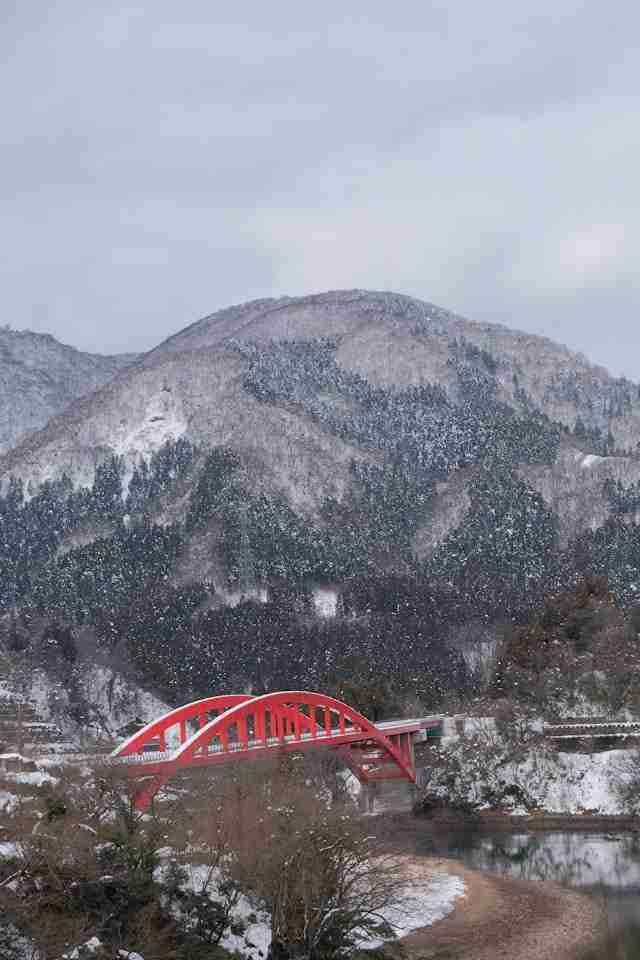
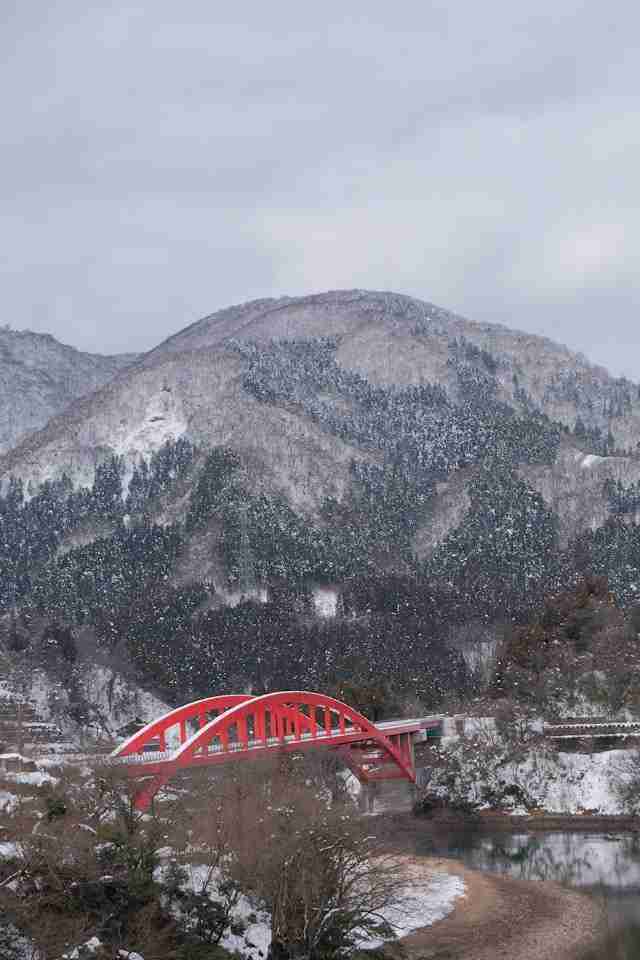
Suspended gracefully over the deep gorge of the Jinzu River, Kankobashi Bridge connects the Nirehara and Imozu districts in the northwest of Toyama City with a striking visual flair. Completed in 1974, this 186-meter-long steel deck truss bridge—specifically a Drunger-type structure—is as much a marvel of engineering as it is a visual anchor in the landscape. Painted in a brilliant, saturated red, the bridge forms a dramatic counterpoint to the lush green forest that clings to the slopes of the valley and the open blue skies above. Whether shrouded in morning mist, framed by autumn leaves, or glowing under late-afternoon sun, Kankobashi offers photographers a dynamic subject that fuses structural geometry with natural splendor. It's a place where color, form, and elevation converge into compelling visual compositions.
Best Photography Opportunities
• Southern Hillside Overlook with Full Bridge View
: The hillside south of the bridge offers a sweeping, elevated vantage point ideal for capturing the entire arc of the bridge as it stretches across the Jinzu River gorge. From this position, the bold red structure cuts horizontally through a backdrop of layered forest and riverbank, forming a dynamic contrast with the muted earth tones around it. Use a wide-angle lens to include foreground vegetation, especially in spring and autumn when color shifts bring additional visual interest. In the early morning, mist rising from the river can add a sense of atmosphere and scale, softening the valley and giving depth to your composition.
• Low-Angle Shot from the Jinzu Riverbank
: Accessing the rocky riverbank beneath the bridge provides a powerful low-angle perspective that emphasizes the truss design's complexity and the bridge's towering form. This is an ideal spot to use a mid-range zoom or even a tilt-shift lens to experiment with converging lines and vanishing points. During golden hour, sunlight rakes across the underside of the bridge, creating long, angled shadows and accentuating the repeating geometry. Including elements like driftwood or river stones in the foreground adds texture and context to a composition that already plays strongly with structure and depth.
• Framed Views with Seasonal Foliage
: From the east and west trails, you can find excellent vantage points where the bridge can be framed by overhanging branches or vibrant foliage, especially in autumn. This composition style is ideal for drawing attention to the color harmony between the man-made and the natural, with the red bridge echoing or contrasting against leaves in shades of amber, crimson, and gold. Use a longer lens to compress the scene slightly, making the foliage feel enveloping and emphasizing the bridge as a ribbon of engineered elegance amid nature. Overcast skies work well here, helping foliage colors pop without introducing harsh light.
• Skyline Silhouette and Abstract Geometry
: For photographers seeking a more minimal or modern composition, isolate segments of the truss bridge against a clean sky. From a distance along the northern approach or with a telephoto lens from the opposing hillside, you can create abstract images that emphasize the repetition of steel forms. Midday with a polarized blue sky works beautifully, or shoot in monochrome to accentuate the bridge's silhouette against bright cloud banks. This approach works especially well for series work or as architectural studies within a larger landscape portfolio.
• Twilight and Reflection Compositions from the Northern Access Road
: As the sun sets behind the hills, the ambient light cools, creating the perfect setting for long-exposure shots from the northern road, which offers partial reflections of the bridge on calmer sections of the river. A tripod is essential here, as longer shutter speeds can smooth the water's surface while drawing out color gradients in the fading sky. The bridge's red paint takes on a richer, deeper tone as daylight fades, contrasting beautifully with the cool blues and purples of twilight. For added interest, frame passing vehicles as light trails across the bridge if traffic allows.
Best Time to Visit
Kankobashi Bridge is photogenic year-round, but the mood and aesthetic of the landscape shift significantly with each season. Spring is ideal for misty mornings and budding greens, which complement the bridge's red tones and soften the lines of the gorge. Morning light from the east highlights the entire truss structure and the surrounding slopes, casting long shadows that add dimensionality.
Summer offers bold, clean light and vibrant greens, which make the red bridge visually pop against a rich palette. While the midday sun can be harsh, early morning and late afternoon provide directional light perfect for structural detail and rich contrast. Humid days may yield a touch of haze, which can be used to flatten perspective and soften distant elements.
Autumn is arguably the most photogenic season at Kankobashi. The surrounding forest turns into a multicolored tapestry that harmonizes and contrasts with the bridge's red paint. Cooler air often leads to morning mist hanging low in the gorge, adding an ethereal quality to wide landscape compositions. This is the ideal time for photographers seeking richness of color and atmospheric light.
Winter strips the valley of its foliage, offering a starker, more graphic look. The skeletal trees and subdued tones allow the bridge's structure to stand out in high contrast. Snow occasionally dusts the surrounding hills, adding an extra dimension to minimalist or monochrome imagery. Soft overcast light in winter also favors long exposure work along the river.
Regardless of season, visiting in the first two hours after sunrise or just before sunset provides the best directional light, gentle color gradients, and reduced contrast. These times also reduce interference from local traffic, allowing for clean, uninterrupted shots.
How to Get There
Kankobashi Bridge is located approximately 30 minutes by car from the center of Toyama City. To reach it, take National Route 41 north before turning onto local access roads leading to the Nirehara or Imozu districts. Signage is limited in English, so having offline maps or GPS navigation is recommended. Both ends of the bridge have small, informal parking areas suitable for short visits.
Public transportation is limited but possible via local bus routes departing from Toyama Station. The closest stops will require a 20 to 30-minute walk to reach the bridge, so comfortable footwear is advised. These rural routes run infrequently, so check schedules in advance and plan accordingly.
There are no entrance fees to visit or photograph the bridge. It is a functioning road bridge, so be mindful of traffic when photographing from the deck. Early morning offers both optimal lighting and minimal vehicle presence. Trails leading up the hillsides on either side provide additional perspectives and are accessible by foot.
Recommended Photography Gear
A wide-angle lens (16–35mm) is essential for capturing the full expanse of the bridge within the landscape. It's especially effective for compositions from hillside viewpoints or beneath the bridge where leading lines and vanishing points dominate the frame.
A mid-range zoom (24–70mm) allows for quick transitions between wider environmental shots and tighter structural details. This is ideal for moments when light shifts quickly or when moving between trails and riverbanks.
A telephoto lens (70–200mm or greater) is perfect for abstract compositions, isolating structural elements, or compressing layers of foliage and truss lines. It's particularly useful when shooting from a distance or framing the bridge against sky or mountain backdrops.
A tripod is recommended for early morning and twilight shooting, especially when using long exposures for reflections or light trails. A circular polarizer enhances sky contrast and helps manage reflections on water, while a 6-stop ND filter enables smooth exposures of cloud or river movement.
Nearby Photography Locations
: Just upstream from the bridge, the Jinzu River narrows and flows through a dramatic, tree-lined gorge. The steep walls and overhanging vegetation make it an ideal location for moody, mist-laden compositions. Photographers can capture vertical slices of water and rock, or shoot from high ground to emphasize the river's flow through a forest corridor.
: Nestled within a forested slope not far from the bridge, this quiet Shinto shrine offers tranquil grounds surrounded by old-growth trees and mossy stone lanterns. The peacefulness of the site lends itself to contemplative, low-contrast compositions, especially when framed with the surrounding forest and filtered morning light.
: Approximately 45 minutes south of Kankobashi, this vast hydroelectric reservoir is flanked by mountain ridges and pine forests. The lake provides perfect mirror reflections on calm mornings, while the dam structure itself offers strong symmetry and leading-line compositions from multiple viewing platforms.
• Tateyama Mountain Range Viewpoints
: A scenic drive inland leads to elevated lookouts over the Tateyama peaks, often snow-capped well into late spring. Use a telephoto lens to compress the layers of forest, foothills, and jagged peaks. These views are ideal in the soft light of dawn or late afternoon, when low clouds drift across the alpine skyline.
• Toyama City Waterfront and Kansui Park
: Back in the urban center, Kansui Park is a well-maintained waterside area that offers clean lines, glassy reflections, and modern architecture. It's a great location for twilight and night photography, with pedestrian bridges and canals reflecting city lights and distant silhouettes of the Japanese Alps.
Kankobashi Bridge rewards those who see in both structure and atmosphere. Whether capturing its vivid paint beneath drifting fog or studying the stark geometry against a winter sky, this bridge offers not just a visual anchor, but a rich, evolving subject. Surrounded by forest, river, and mountain, it becomes a dialogue between human design and the powerful natural contours of Toyama's landscape.
Comments
Loading comments…