
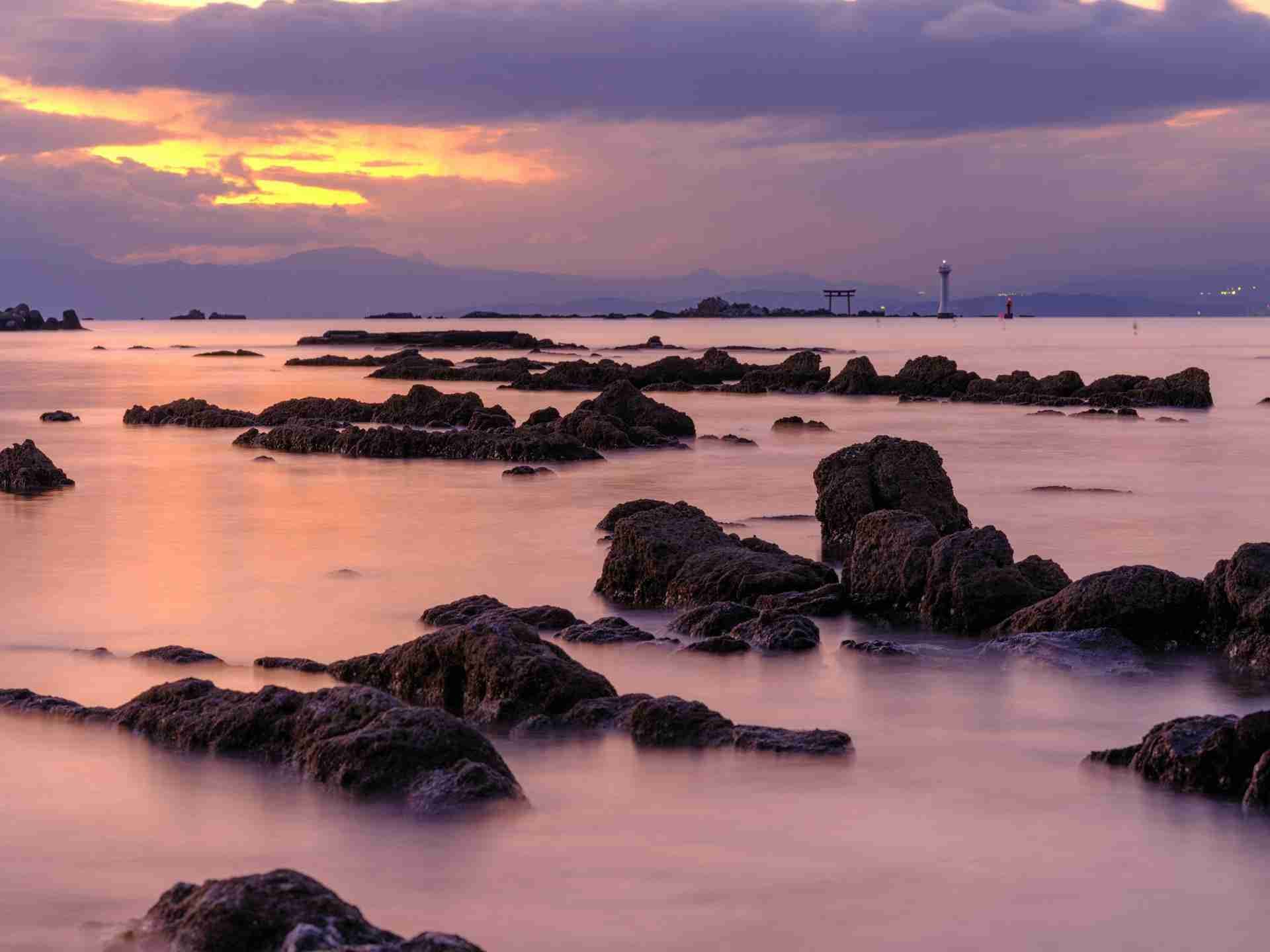
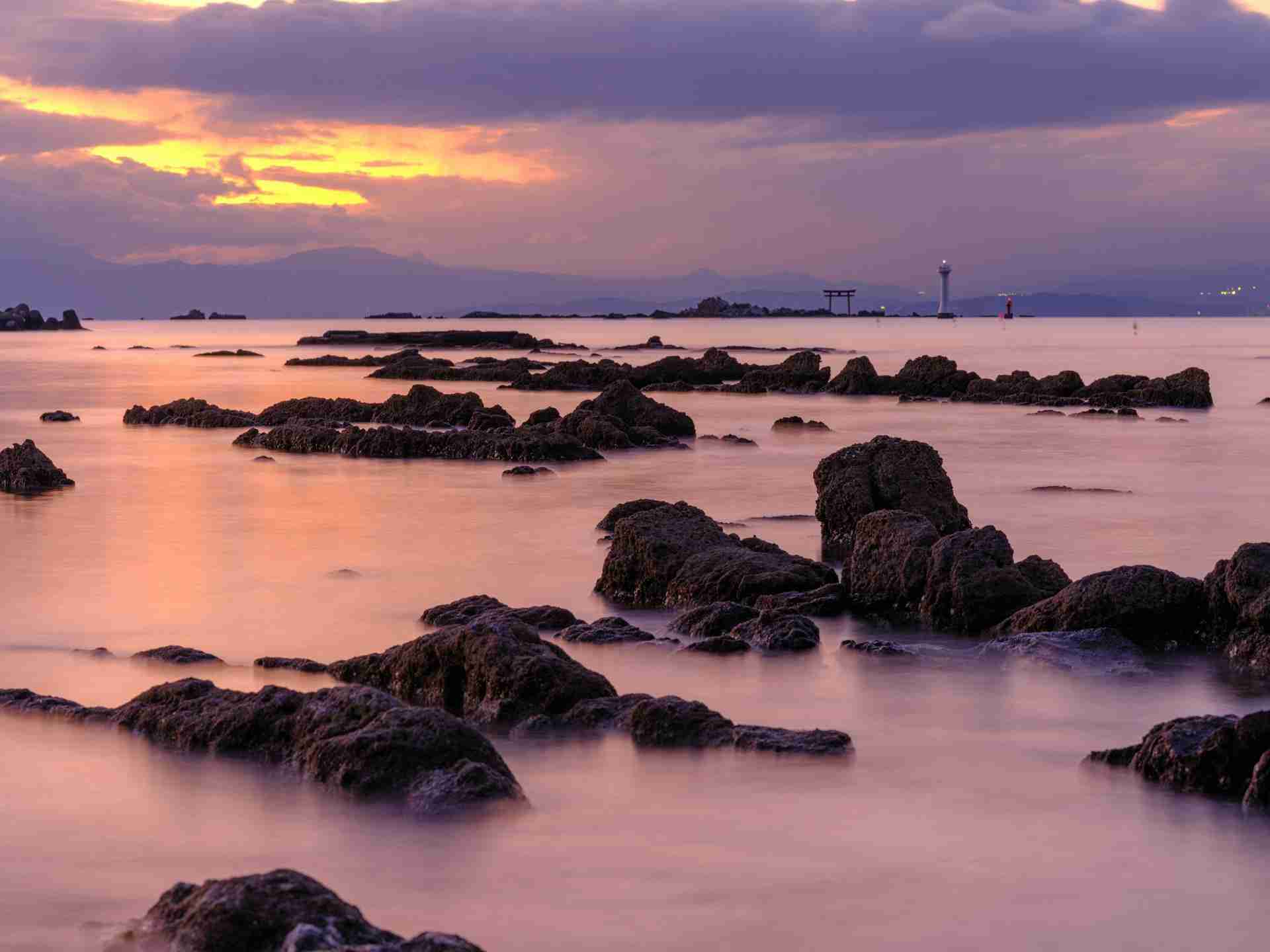
Tucked along the Sagami Bay coastline in the quiet seaside town of Hayama, Shin-nase Beach offers a minimalist landscape of pale sand, volcanic rock, and gentle waves under shifting skies. Unlike more developed beaches nearby, this stretch remains peaceful and largely undeveloped, bordered by low residential houses and distant views of Mount Fuji on exceptionally clear days. The beach faces southwest, which makes it a prime location for golden hour and sunset photography, with soft light spilling across the water and tide lines. The shoreline is dotted with exposed rocks and small tidal pools, creating a subtle, organic geometry that works well for foreground framing. For photographers looking for clean compositions, subtle color shifts, and a slower rhythm of coastal life, Shin-nase Beach is both accessible and surprisingly rich.
Best Photography Opportunities
• Sunset Reflections Across Wet Sand
As the sun dips low over Sagami Bay, the light reflects off the wet sand left behind by the outgoing tide, creating a mirror-like surface that catches every tonal shift in the sky. Shooting toward the horizon, photographers can use the reflection as a foreground to double the visual impact of the colors above. A tripod and long exposure smooth out the waves, enhancing the mirror effect while adding texture to the shoreline. Move slightly to one side to include silhouetted rocks or distant boats to prevent the composition from becoming too static. These reflections are at their strongest during low tide just after the sun has passed below the horizon, when soft pastels replace direct light.
• Low-Angle Foregrounds with Volcanic Rock
The dark, sea-worn volcanic rocks scattered across the beach offer rich opportunities for wide-angle compositions with strong foreground presence. Set your tripod low to the ground and place a prominent rock near the bottom of the frame to lead the viewer's eye out toward the open water. Timing your shot as a wave recedes will create natural leading lines in the sand or reveal glistening wet surfaces that catch the last light of day. These compositions benefit from small apertures to maintain depth of field from front to back, and a polarizer helps control glare on the wet rock surfaces. Morning or afternoon light brings out detail in the stone texture without flattening the scene.
• Overcast Minimalism and Tonal Subtlety
Shin-nase Beach shines even without dramatic light. On overcast days, the soft, even lighting creates a gentle gradient across the sky and water, ideal for minimalist compositions where mood takes precedence over contrast. Use a telephoto lens to isolate a single rock, boat, or shoreline curve against the sky, and keep the composition spare to highlight form and spacing. Slight adjustments in exposure compensation help maintain tonal balance, especially when working in raw format to recover subtle highlights and shadows. These quiet moments often yield the most timeless images, where simplicity and patience reveal more than dramatic light ever could.
• Boats and Horizon Lines at Dusk
Local fishing boats often drift just offshore or are moored in the distance, adding scale and story to twilight frames. After the sun sets, the sky retains soft gradients of lavender and orange that contrast beautifully with the dark silhouettes of these vessels. Shoot with a longer lens to compress the scene and isolate the boats against the pastel backdrop, and experiment with placement along the lower or upper third of the frame to test balance and rhythm. A narrow aperture helps keep both boat and background in acceptable focus, while slow shutter speeds capture subtle movement in the water without overwhelming the scene. Look for solitary birds or sea buoys to add a narrative element.
• Textures of Tidal Pools and Washed Shells
Closer inspection of the beach reveals shallow tidal pools, scattered shells, and patterns in the sand shaped by receding water. These make for detailed close-up work, especially in the soft early morning light when footprints have yet to disturb the textures. Use a macro or short telephoto lens to isolate these small subjects and experiment with top-down compositions for graphic studies. Reflections of sky or light in the water's surface can add another layer of interest. A small reflector or gentle fill flash can help lift shadows without overwhelming the natural mood of the scene.
Best Time to Visit
The most photogenic light at Shin-nase Beach occurs in the late afternoon and into sunset, especially during the spring and autumn months when the sun sets further south along the horizon and casts longer shadows across the beach. During these times, the air is generally clearer, with less haze, and the weather is more stable, offering a reliable combination of color and light quality.
Winter provides the best chance of spotting Mount Fuji across the bay, particularly in the early morning when the sky is crisp and the mountain rises clearly above the horizon. These moments are rare but striking, and are best captured with a telephoto lens and a slight elevation from the beach's edge. Low tide times, especially in the evening, expose more foreground features such as rock formations and pools, which are crucial for building layered compositions.
Summer afternoons often bring more cloud build-up and humidity, creating hazy sunsets or flat skies. However, these conditions can lend a painterly softness to wide compositions, particularly when paired with the reflections left by outgoing waves. Avoid midday visits, as the light becomes harsh and flat, and the beach may be busier with local visitors. Wind is generally light, but can increase toward sunset. Calm evenings provide the clearest reflections and easiest tripod work, while breezier conditions add texture to the water for more dynamic exposures.
How to Get There
Shin-nase Beach is located in Hayama, a coastal town in Kanagawa Prefecture just south of Zushi and north of the more famous beaches in Kamakura. From Tokyo, take the JR Yokosuka Line to Zushi Station, then transfer to a Keikyu bus bound for Hayama (Shibasaki or Horiuchi stops offer the closest access to Shin-nase). The beach is a short five- to ten-minute walk from the nearest bus stop and is easy to locate using local signs or navigation apps.
For drivers, paid parking is available near the Hayama Marina or along Route 134, though spaces can be limited on weekends. Once parked, follow the residential streets down toward the coastline. The beach is public and freely accessible, with no entrance fee or restriction on photography. Tripods are allowed, and the relatively quiet atmosphere means you can work undisturbed during most hours of the day. Public restrooms and vending machines are available nearby, but food and supplies should be brought with you if you plan to stay through sunset.
Recommended Photography Gear
A wide-angle lens in the 16 to 35 millimeter range is essential for capturing shoreline scenes that include sky, rock, and reflective sand. This lens works well for establishing shots and compositions where foreground elements guide the viewer's eye into the distance. A mid-range zoom such as a 24 to 70 millimeter lens is ideal for general scenes, sunset color, and tighter framing when including background boats or silhouettes.
A telephoto lens between 70 and 200 millimeters is helpful for isolating Mount Fuji when visible, as well as compressing boats or abstracting horizon lines. For macro or detail photography, a dedicated macro lens or a sharp short telephoto allows you to explore shells, water textures, and tide patterns without needing to crop heavily in post.
A lightweight but sturdy tripod is key for long exposures during twilight or blue hour, and a shutter release or camera app helps reduce vibration. A circular polarizer is useful for controlling reflections and enhancing contrast on wet surfaces. Bring a microfiber cloth to manage salt spray or condensation if working near the water's edge, and pack a lens hood to minimize side light flare during golden hour.
Because the beach is quiet and exposed, a compact gear setup is preferred. Wear shoes with good grip for moving between sand and rock, and bring weather protection if photographing in winter or under shifting skies. Neutral density filters are optional but can be used to slow shutter speeds even in full daylight, particularly if you want to smooth the motion of waves or clouds.
Nearby Photography Locations
Just a short walk north, Isshiki Beach offers a wider shoreline and broader views across Sagami Bay. It's particularly effective for wide-angle sunset photography and long exposures of waves moving over flat sand.
This marina features clean architectural lines, docked boats, and geometric reflections in still water. It's a great place for early morning photography when the water is calm and the sky begins to light behind the harbor.
• Morito Shrine and Coastal Torii Gate
To the northeast, Morito Shrine sits on a rocky outcrop with a photogenic torii gate positioned in the surf. The gate is especially striking during high tide and sunset, and offers opportunities for silhouette compositions.
Further south along Route 134, this rocky coastline features dramatic boulders, cliff lines, and occasional Mount Fuji views. It's less developed and rewards exploration with unique formations and tide-swept textures.
To the north, Zushi Beach has a livelier energy and open views toward Enoshima and the Miura Peninsula. It's ideal for wide, social compositions or layered sunset images with human elements and gentle wave action.
Shin-nase Beach is a place for patient composition, soft shifts in tone, and the quiet rhythm of water and stone. It invites a slow approach to photography, where light moves subtly and beauty lies in the details of the sand, sky, and sea. For those who prefer working with calm subjects and open space, this beach offers a deeply rewarding coastal experience.
Comments
Loading comments…