
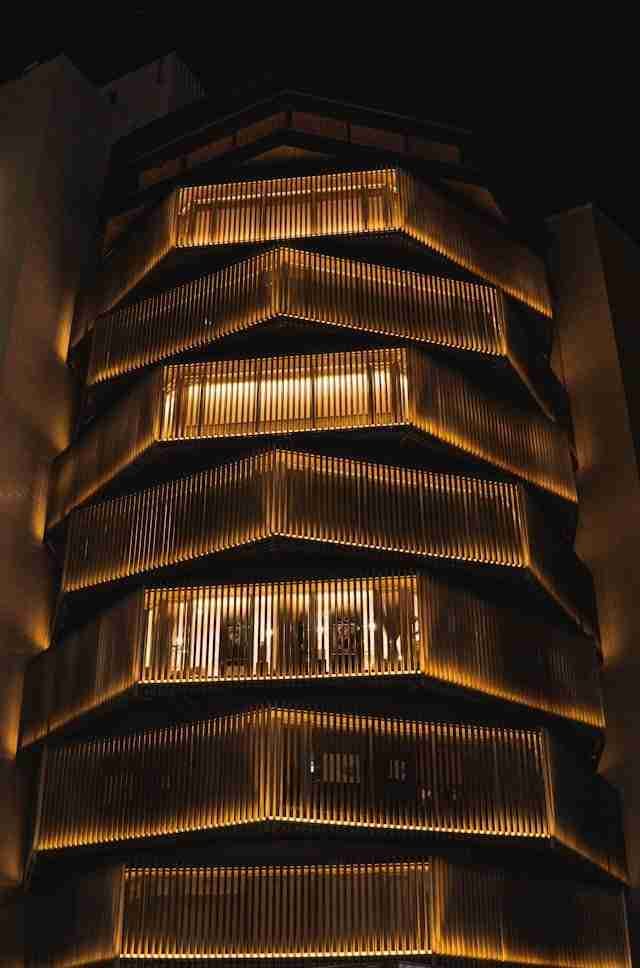
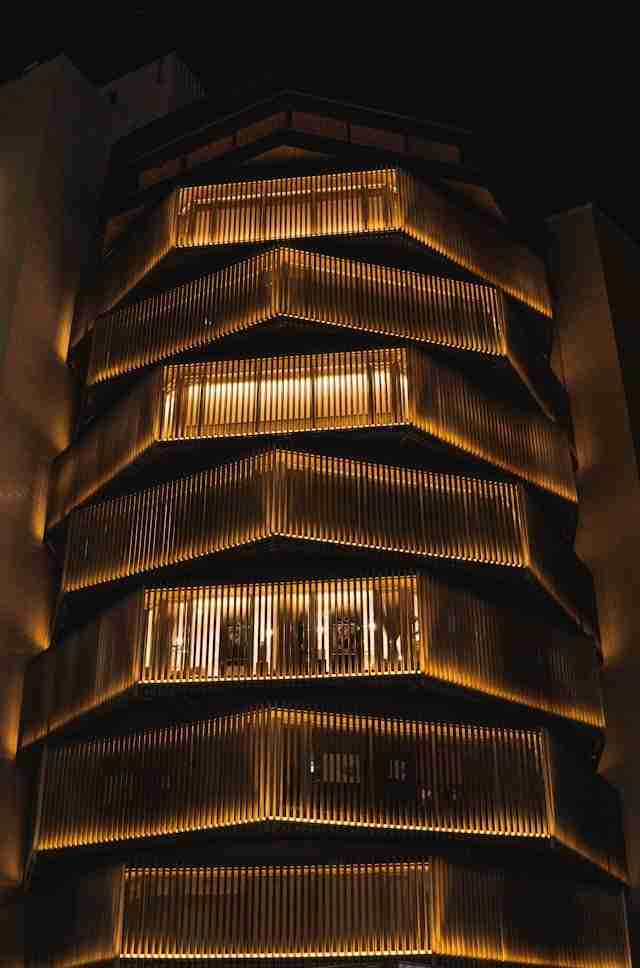
At the edge of Tokyo's hyper-urban Shinjuku district, just steps from the eastern exit of Shinjuku Station, Yasuyo Hall quietly asserts itself as a relic of Showa-era architecture. Often overlooked during the day due to its muted gray facade and tight proximity to taller, flashier structures, this octagonal tower-like building—nicknamed for its resemblance to a stack of mechanical nuts—becomes an unexpectedly compelling photographic subject when night falls. With over 50 years of presence at one of the city's busiest intersections, Yasuyo Hall invites a slower, more observant approach to urban photography. Its unique form, textured surface, and ability to transform with light make it a small but rewarding study in contrast, scale, and the layered character of Tokyo's ever-evolving cityscape.
Best Photography Opportunities
• Twilight Facade with Ambient Street Light
Yasuyo Hall is at its most visually distinct during the blue hour, when the warm artificial lighting begins to glow against the cooling tones of the evening sky. This contrast reveals the subtle geometry of its stacked octagonal segments and casts soft shadows between each "nut-like" layer. Use a longer focal length to compress the building against surrounding signage or frame it with foreground street elements for context.
• Nighttime Isolation and Neon Backdrop
As the surrounding buildings light up, Yasuyo Hall emerges from its daytime camouflage. Shooting at night allows you to isolate the structure's texture against the busier neon chaos of Shinjuku. A wide aperture and slightly underexposed settings preserve the highlights on the facade while maintaining the saturated color cast from nearby signage.
• Low-Angle Urban Geometry from the Sidewalk
A street-level, low-angle perspective looking upward exaggerates the building's stacked, industrial design. Use a 24mm or wider lens to capture the building's vertical presence as it rises above pedestrian traffic. Including signage, vending machines, or passing people in the lower frame gives a sense of scale and context.
• Black-and-White Textural Studies
Yasuyo Hall's weathered facade, repeated geometry, and contrast with glass-and-steel neighbors make it an excellent subject for black-and-white interpretation. Shoot during overcast daylight or under diffused night lighting to emphasize texture and shape without distraction. Grain and high contrast processing work well to evoke the building's mid-20th-century aesthetic.
• Reflections in Nearby Windows or Puddles
On rainy days, the reflective surfaces of surrounding glass walls or street puddles add another dimension to your composition. Frame Yasuyo Hall's octagonal silhouette in window reflections, or use ground-level puddles for symmetrical, inverted views. This is especially effective in dim light when color tones deepen and movement from traffic creates additional visual layering.
Best Time to Visit
While accessible at all times, Yasuyo Hall is most photogenic in the early evening, particularly during twilight and into night. During the day, its gray concrete exterior blends into the surroundings, making it more challenging to isolate visually. As the city lights come on, the structure begins to stand out—especially under the glow of street lamps and neighboring neon signage.
Winter evenings provide the clearest skies and earliest twilight hours, while summer nights offer more ambient activity and color. Rainy days and wet pavements add texture and mood, making even daytime visits worthwhile when the atmosphere is right. Because of its location near Shinjuku Station, foot traffic is constant—arriving just after the evening rush allows you to capture light trails and motion blur without overwhelming crowds.
How to Get There
Yasuyo Hall is located near the eastern exit of Shinjuku Station—one of the busiest train hubs in the world. Once you exit east, walk toward the Kabukicho area along Yasukuni-dori. The building sits at a prominent intersection but can be easy to overlook due to its modest height and subdued tone. Look for the stacked octagonal silhouette nestled between commercial signage and high-rises.
Photography is allowed from public sidewalks and crosswalks, but always be mindful of pedestrian traffic and local business operations. A compact, mobile kit is best, given the tight urban environment. A tripod can be used with care during quieter hours or for short exposures, but handheld setups or monopods are more discreet and effective in the busy street setting.
Exploring the Surrounding Area
The area around Yasuyo Hall is quintessential Shinjuku: a dense tangle of glowing signage, narrow alleys, and contrasting architecture. Just a few blocks north lies Kabukicho, Tokyo's famous entertainment district, which offers countless opportunities for urban storytelling, portraiture, and night photography. Blade Runner-esque lighting, steam vents, and architectural juxtapositions abound here.
To the south and west, the skyscraper district provides a sharp contrast with clean-lined, glass-and-steel office towers—ideal for high-key compositions or reflecting city lights after dark. Between these extremes are back alleys, stairwells, and older commercial buildings that still hold the patina of past decades.
The dynamic lighting, vertical lines, and constant flow of people make this a rich environment for both composed architectural shots and spontaneous street photography. Yasuyo Hall serves as a grounding visual anchor in a district defined by speed and spectacle.
Nearby Photography Locations
Just west of the station, this narrow alleyway is lit by paper lanterns and lined with smoky yakitori stalls. Perfect for atmospheric, low-light street photography and capturing the warmth of post-work gatherings.
• Kabukicho Gate and Don Quijote Tower
The neon-lit gate into Kabukicho is iconic, and the surrounding area is filled with bold signage and visual energy. Shoot at night to capture the glow and chaos in motion.
A short walk east, Golden Gai is a cluster of tiny bars and narrow passageways. Its layered architecture and signage offer rich detail and texture, especially when photographed during rain or fog.
For a high-level view of the city, head west to the government building's observation deck. Sunrise and twilight offer dramatic skies over the sprawl of Tokyo with Mount Fuji visible on clear days.
Tucked behind the bustle of Shinjuku, this peaceful Shinto shrine offers seasonal beauty, from cherry blossoms in spring to lantern-lit paths in autumn. A quiet counterpoint to the area's urban density.
Yasuyo Hall may be modest in scale and subdued in color, but it offers photographers an architectural gem that rewards attention, light, and timing. Set amid one of Tokyo's busiest districts, it stands as a quiet reminder of mid-century vision and urban endurance—a building that disappears by day and re-emerges by night, waiting to be seen, understood, and framed with intention.
Comments
Loading comments…