
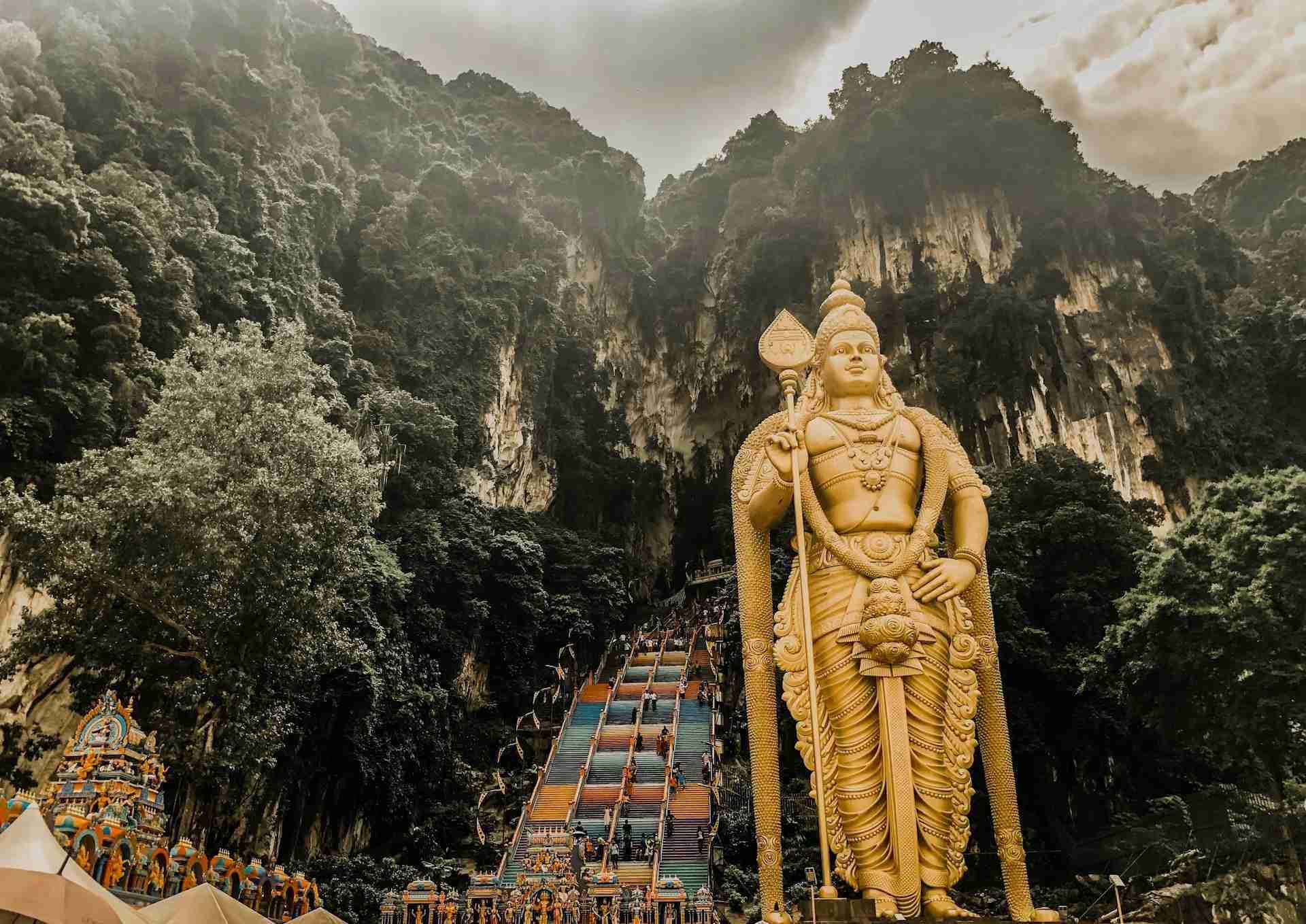
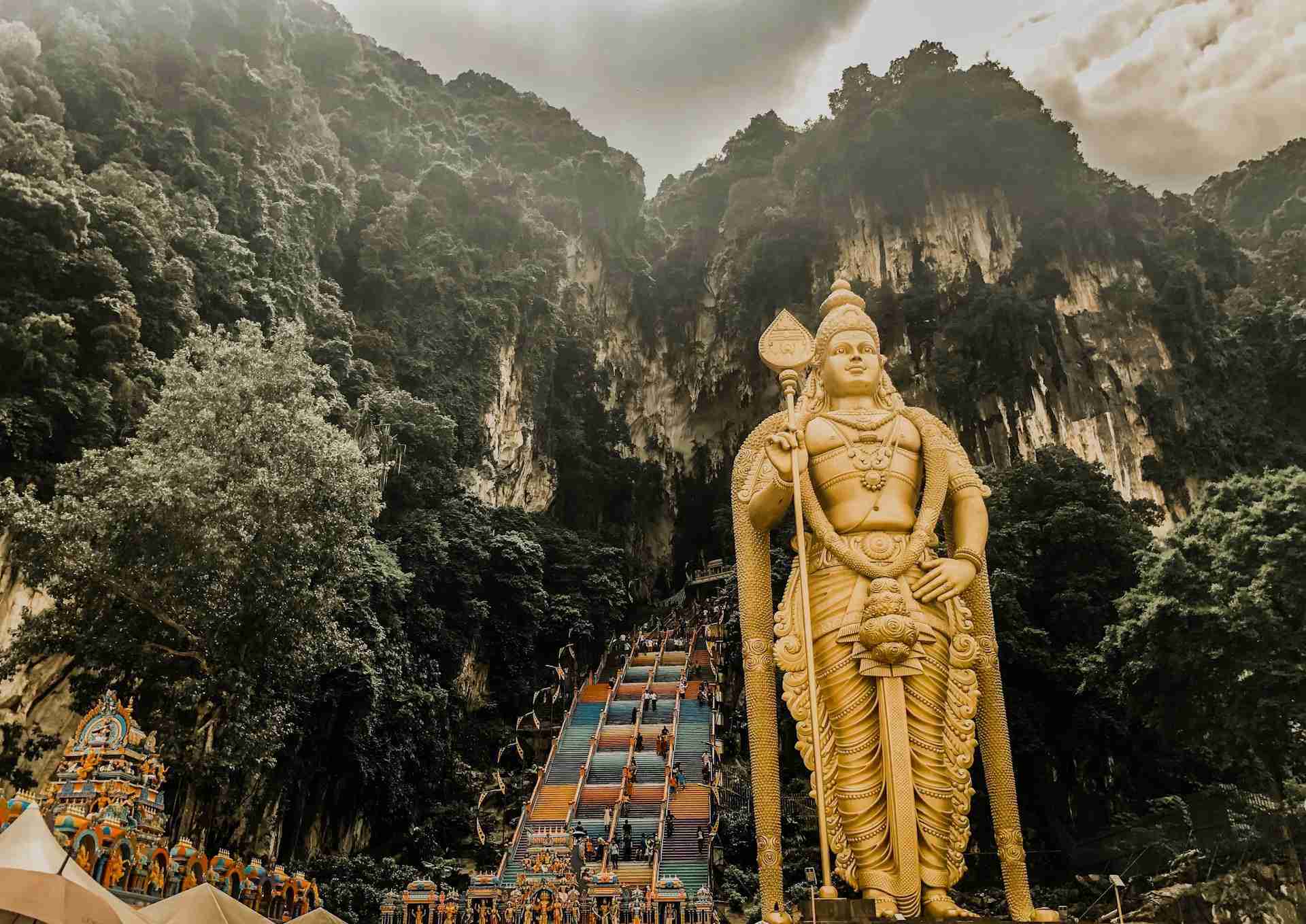
Rising dramatically from the forested outskirts of Kuala Lumpur, Batu Caves is a fusion of geological wonder and cultural spectacle. This limestone hill complex, carved over millions of years, houses a network of caves that serve as one of the most important Hindu pilgrimage sites outside India. Anchored by the towering golden statue of Lord Murugan and a colorful stairway that climbs into the main Temple Cave, the site offers an electrifying palette of color, texture, and vertical scale. For photographers, Batu Caves combines architectural, spiritual, and natural elements in a setting where light plays constantly across stone, statues, and crowds, making timing and perspective critical.
Best Photography Opportunities
• Grand staircase and Lord Murugan statue from the base plaza
From the moment you approach Batu Caves, the scene is dominated by two vertical elements: the brilliant, 42.7-meter-tall golden statue of Lord Murugan and the 272-step staircase painted in a vivid spectrum of colors. This is the definitive wide-angle composition—one that demands early arrival to avoid crowds and harsh midday light. A focal length between 16mm and 24mm allows you to capture both the height of the statue and the rising rhythm of the staircase without cropping the top. Use human figures climbing the stairs as scale indicators; their movement adds life and helps convey the monument's size. On overcast days, the colors remain saturated without excessive glare. In the early morning, sunlight illuminates the statue from the side, producing rich shadow textures that emphasize its sculptural depth.
• Interior light shafts inside the Temple Cave
The Temple Cave is a vast, cathedral-like space cut into limestone, and its upper chamber opens to the sky in several places. Between 9:00 and 11:00 a.m., these skylights can produce dramatic shafts of light that filter down through mist and incense. This effect is fleeting and highly dependent on humidity, but when conditions align, it transforms the interior into a stage of golden illumination and shadowed ritual. Shoot from a low angle to elongate the beam vertically or include a person or priest within the shaft for spiritual resonance and visual hierarchy. Use a fast lens and wide aperture if shooting handheld, or stabilize with a monopod for better framing flexibility. Bracketing may be necessary to manage the dynamic range between bright openings and dark recesses.
• Devotees and ritual during Thaipusam
The Thaipusam festival draws over a million devotees each year and is the most spiritually charged moment at Batu Caves. Photographing it demands a careful balance between documentation and respect. Focus on the facial expressions of participants bearing kavadis, the color and texture of ceremonial dress, and the subtle interactions between family members, priests, and observers. A mid-range zoom or fast prime allows for context-rich environmental portraits. Be mindful of lens choice when photographing rituals such as piercing, as crowd density can be overwhelming. Shoot in soft, directional light or under tents and canopies where color saturation is high but contrast is manageable. Compositions that frame subjects through prayer flags or the arch of the cave entrance can subtly layer narrative and setting.
• Colorful shrines and detail in the Cave Villa
This more tranquil part of the Batu Caves complex often gets overlooked, but for photographers it's a treasure of ornate statuary, reflective pools, and storytelling murals. The shrines are painted in vivid pastels and gold leaf, contrasting with dark stone and shaded alcoves. Overcast conditions work well here, softening reflections and enhancing tonal detail. Work with a polarizing filter to control glare on painted surfaces or still water, and use a standard zoom to move fluidly between tight details—like a statue's hand holding a lotus—and wider shrine views framed by carved archways. Late afternoon light from the west casts a warm glow across the sculpture bases and introduces dramatic edge light on statuary contours.
• Cliffside compositions and macaques along the stairway
The limestone cliffs surrounding Batu Caves are alive with natural texture and resident macaques. These monkeys offer opportunities for wildlife photography in an architectural context, but they require quick reflexes and a longer focal length. Compositions that include both the animals and the painted stairway or shrine backgrounds create unique juxtapositions of nature and devotion. Early morning is best for side-lit shots that define the rock face and produce catchlights in the monkeys' eyes. Watch for behavior—leaping between railings, eating offerings, or interacting with visitors—and use a fast shutter speed to freeze motion. The cliffs themselves can be isolated in abstract compositions as well, emphasizing jagged formations and the interplay of light and shadow across the stone.
Best Time to Visit
Batu Caves offers striking visual opportunities throughout the year, but the quality of light and overall atmosphere vary significantly depending on the time of day, weather conditions, and seasonal events. Photographers aiming to capture clean, undisturbed compositions or dramatic lighting effects must time their visit with care.
Early morning, between 7:00 and 9:00 a.m., is the optimal window for exterior photography. At this time, the sun rises from the east and bathes the staircase and Lord Murugan statue in soft, side-raking light. The low angle enhances relief in the carved details of the statue and highlights the colorful steps with gentle contrast. Morning is also the quietest time to shoot, before the arrival of tour groups and local visitors. The air is cooler, shadows are long and expressive, and the light is neutral—ideal for maintaining natural color tones in painted structures.
From 9:00 to 11:00 a.m., light enters the Temple Cave through its open ceiling, creating photogenic shafts of sunlight that illuminate mist, dust, and incense smoke in the chamber below. This is the best time for atmospheric, interior compositions—particularly when the cave is quiet enough to observe individual worshippers in silhouette or within the light beam. These conditions are enhanced on humid days or following rain, when light visibly interacts with the moisture in the air.
Midday, from 11:00 a.m. to 2:00 p.m., is the harshest time for photography. The sun is directly overhead, flattening surfaces and creating strong contrast between bright open areas and deep shadows inside the cave. Reflections off painted surfaces may become overly harsh, and color balance can be compromised by high UV exposure. This period is better suited for detail work inside shaded shrines or for scouting compositions rather than serious shooting.
Late afternoon, from 4:00 to 6:00 p.m., reintroduces directional light to the complex, especially on the western-facing side walls and cliff structures. This time of day is less ideal for photographing the front of the statue or staircase, as they are in shadow, but works well for backlighting subjects and photographing monkeys and cliff textures under warm-toned light.
Seasonally, the Thaipusam festival, which occurs in January or early February based on the lunar calendar, offers unmatched human drama, color, and cultural depth. While the crowds are intense, the photographic energy is unparalleled—ideal for those with experience in festival and street photography. For architectural or environmental work, the dry season from May through August offers the clearest skies and most reliable lighting conditions. During the wet season, from October through December, dramatic weather is more common—often yielding dramatic clouds, filtered light, and moody conditions, though with greater risk to gear and mobility.
How to Get There
Batu Caves is located approximately 13 kilometers north of Kuala Lumpur's city center. The most efficient route is by train: take the KTM Komuter from KL Sentral to Batu Caves station, which is the final stop on the line and just a short walk from the entrance.
Taxis and ride-hailing services such as Grab are also widely available and affordable, especially early in the morning or if carrying gear. Limited on-site parking is available but fills quickly on weekends and during festivals.
Entrance to the Temple Cave is free, while access to smaller attractions like the Cave Villa or guided tours of the Dark Cave (when operational) may require a separate fee. Tripods are generally tolerated outside of peak times but should be used with awareness of foot traffic and religious activity. Drones are not permitted without prior authorization.
Recommended Photography Gear
Photographing Batu Caves calls for a kit that balances wide-angle capability with responsiveness to changing light. A wide-angle zoom (16–35mm) is essential for capturing the scale of the staircase, the full frame of Lord Murugan's statue, and the interior breadth of the Temple Cave. A mid-range zoom (24–70mm) provides flexibility for event coverage, portraiture, and framing shrines or motion along the staircases.
A telephoto lens (70–200mm) is especially useful for isolating cliffside subjects, compressing temple elements, or capturing wildlife from a distance. For interior low-light work, a fast prime lens (35mm or 50mm f/1.8 or faster) will enable handheld shooting without pushing ISO too high.
A small tripod is useful for longer exposures inside the cave, but it may be impractical in crowded conditions. A circular polarizer can help control reflections on polished stone or saturated shrine surfaces. Include a microfiber cloth to manage lens fog or humidity buildup, and a lightweight rain cover for your bag in case of sudden tropical showers.
Be prepared with sturdy, closed footwear for climbing the steep staircase, and keep all gear secured—especially when macaques are active.
Nearby Photography Locations
Located within Kuala Lumpur, this multilevel Chinese temple features sweeping staircases, vibrant ornamentation, and elevated views over the city skyline. Best visited at sunrise or just after for warm light and clear skies.
A grand mosque featuring blue domes and symmetrical arcades, it offers strong architectural compositions, especially in early morning or during blue hour. Less crowded and more open than Batu Caves, it complements the visual intensity with calm formality.
• Petronas Twin Towers and KLCC Park
The most recognizable urban icon in Malaysia, this site offers opportunities for wide skyline shots, water reflections, and nighttime long exposures. Ideal for balancing your portfolio with contemporary architecture.
A natural site just north of Batu Caves, this series of forest waterfalls provides long exposure opportunities, wildlife, and lush tropical scenes in a quieter setting. Go early to avoid both crowds and harsh light filtering through the trees.
A managed forest reserve offering canopy walks, jungle trails, and macro opportunities in dense vegetation. It's excellent for natural textures, layered compositions, and quiet, shaded shooting conditions.
Batu Caves challenges photographers to work with contrast—between sacred ritual and everyday life, color and stone, movement and stillness. It's a space where architectural structure, spiritual expression, and raw natural form are constantly interacting. For those willing to arrive early, adapt to shifting light, and photograph with intention, it offers powerful and layered visual narratives worth revisiting again and again.
Comments
Loading comments…