
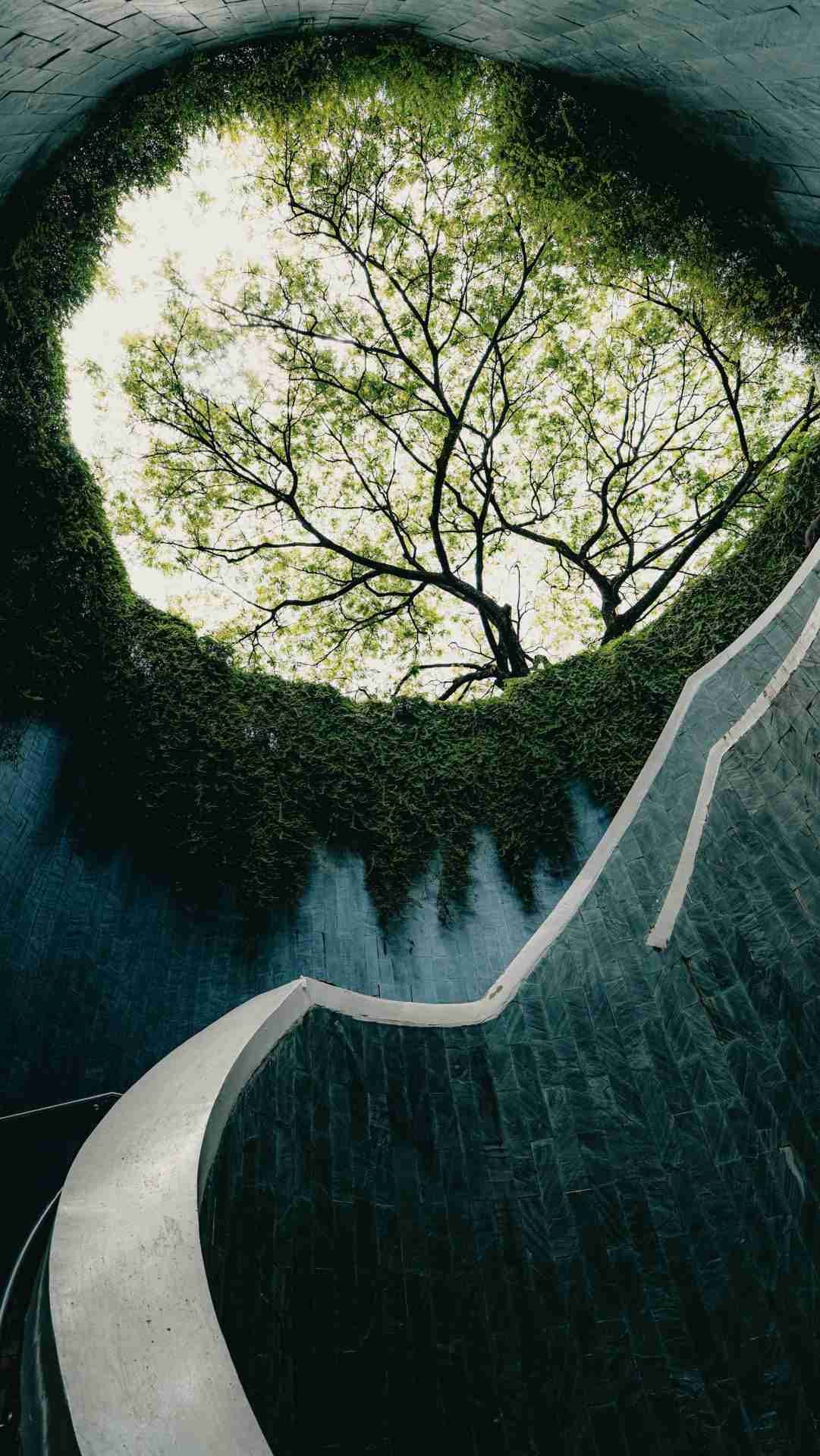
The tree tunnel at Fort Canning Park is one of the most distinctive photo spots in central Singapore. Located just below the park's main hill, this spiral staircase forms a natural frame where lush greenery curves around a circular opening toward the sky. Light filters down in soft patches, and the tunnel's shape allows for both symmetrical wide shots and creative vertical compositions. It's a location that offers strong structure, shifting natural light, and a balance between built form and plant life. Whether you are shooting straight up through the opening or capturing the gentle curve of the stairs, this site is about timing, angle, and mood.
Best Photography Opportunities
• Looking Up from Inside the Tunnel
The classic shot comes from standing inside the base of the staircase and pointing your camera directly upward. This frames the rim of the tunnel like a circle or a spiral, depending on your positioning. The tree canopy above filters the sunlight, which changes tone and brightness throughout the day. A wide angle lens is essential here to capture the full curve. Late morning or mid afternoon works well, when the sun hits at a sharp angle but still spills over the rim. Keep your composition centered and experiment with subtle tilts to control the shape of the curve.
• Staircase Curve with Human Scale
This location also works well when incorporating a figure walking up or down the staircase. Human scale adds depth and interest to the spiral shape, especially when placed near the center of the curve. A mid range zoom lens lets you adjust framing without needing to reposition too much. Use a fast shutter speed to freeze motion or slow it slightly to show movement without losing clarity. Because of the tunnel's natural shadow, exposing for the highlights above helps keep the subject silhouetted in a clean way.
• Shadow and Texture Detail Along the Wall
The tunnel walls are made of stone, with moss and fine surface textures that catch the light throughout the day. These walls curve upward and give strong diagonal lines in side compositions. Use a narrow aperture to keep the stonework sharp, and position yourself so that sunlight grazes across the surface. These tighter shots are ideal for layering texture and building variety into a set that includes both wide and close perspectives.
• Vertical Panorama or Stitched Frame
Given the extreme vertical field of view, this location is perfect for a stitched vertical panorama. Start at the bottom and tilt upward in overlapping frames, then combine them later for a higher resolution result. This method allows for more precise control of light exposure in the bright sky area versus the dark tunnel walls. A tripod helps keep alignment, though careful handheld work can also succeed if your shutter speed is fast enough and overlap is consistent.
• Twilight and Blue Hour Possibilities
Although the tunnel is most commonly photographed in daylight, it can also be compelling at dusk. Soft ambient glow from the park's paths gives the interior subtle warmth, while the sky above turns cool and soft in tone. Use a tripod and slower shutter speed, and plan for a subject holding a light source if you want to build a focal point within the composition. This is less common and more experimental but works well for photographers interested in atmosphere and low light interpretation.
Best Time to Visit
Late morning offers the best combination of light and tree cover. Around 10 to 11 am, sunlight begins to hit the tree canopy from a good angle, filtering light down through the leaves and into the tunnel without creating harsh contrast. The circular rim glows during this window, giving you clean separation between wall and sky. Early morning can be too dim, and midday light is often too direct and flat.
In the afternoon, as the sun shifts, the tunnel wall picks up directional light that helps with texture and detail shots. Cloudy days work well for even exposure, especially when shooting vertical compositions that include a large portion of bright sky. Singapore's weather is often humid, so bring lens cloths and watch for condensation if moving between air conditioned and outdoor environments.
Because this is a popular spot for both tourists and local photographers, weekdays are quieter. Arriving early helps avoid crowds and gives you more time to experiment with angles and settings. Rainy mornings can sometimes clear by midday, leaving wet stone and soft diffused light that adds new depth to your shots.
How to Get There
Fort Canning Park is located just above Clarke Quay and Dhoby Ghaut in central Singapore. The tree tunnel itself is situated along a walking path near the Dhoby Ghaut side of the park. The closest MRT station is Dhoby Ghaut, which connects to the North South, North East, and Circle Lines. From the station, follow signs for Fort Canning Park and take the escalator up to the park entrance. The tunnel is a short walk from there, near the junction of the pedestrian underpass and the circular staircase.
You can also access the park from Fort Canning MRT Station on the Downtown Line, but this approach requires a longer walk across the park's central area. There is no vehicle access directly to the tree tunnel, and parking is limited around the park. The tunnel is open to the public at all hours, and there are no fees or permits required for personal photography. Tripods are allowed, though space is limited and should be used with care when others are present.
Recommended Photography Gear
A wide angle lens is essential for capturing the full circular opening from the base of the tunnel. Focal lengths between 14 and 24 millimeters are ideal. For tighter shots of the stairway or figure compositions, a 24 to 70 millimeter lens provides flexibility and allows you to isolate subject without distortion. A tripod is helpful for precise framing and especially useful if attempting panoramas or long exposure work during low light conditions.
A lens cloth is useful in the humid conditions of the park, and a compact camera bag helps when navigating narrow paths. A polarizing filter can sometimes help reduce glare on the stone walls, but should be used carefully to avoid uneven sky effects. If you plan to include yourself in the shot, a wireless trigger or interval timer is helpful, especially when working at the base of the stairs.
Because light varies quickly in the tunnel, be ready to adjust exposure settings on the fly. Metering for the highlights often preserves the rim of the tunnel without blowing out the sky, and post processing can recover shadow detail if needed. Bring extra batteries, as the humidity and frequent LCD use can shorten runtime.
Nearby Photography Locations
Just a short walk uphill from the tunnel, this open lawn surrounded by trees offers soft morning light and is a good place for quiet landscape or portrait work. The colonial buildings nearby provide contrast in texture and tone.
These areas within Fort Canning offer historic elements, stone paths, and carefully maintained garden beds. The mix of greenery and architecture makes them ideal for detail shots or quiet compositions.
• Clarke Quay Riverside Walk
Located just below the park, this riverside path gives you colorful urban scenes with reflections on the Singapore River. It is a strong option for evening or night shooting after time spent in the park.
At the base of the hill, the museum's classical architecture pairs well with dramatic lighting in late afternoon. The arched doorways and detailed windows offer opportunities for architectural framing and contrast studies.
Just across the road from Fort Canning, this park features a large reflective pool and modern sculpture elements. It is well suited for clean symmetrical compositions or early evening photography with soft directional light.
The tree tunnel at Fort Canning is more than just a popular Instagram spot. With its natural framing, vertical scale, and changing light, it offers real creative opportunities for photographers who take the time to experiment with angle and timing. While the shot looking up is the most famous, this location rewards those who explore it with patience and curiosity.
Comments
Loading comments…