
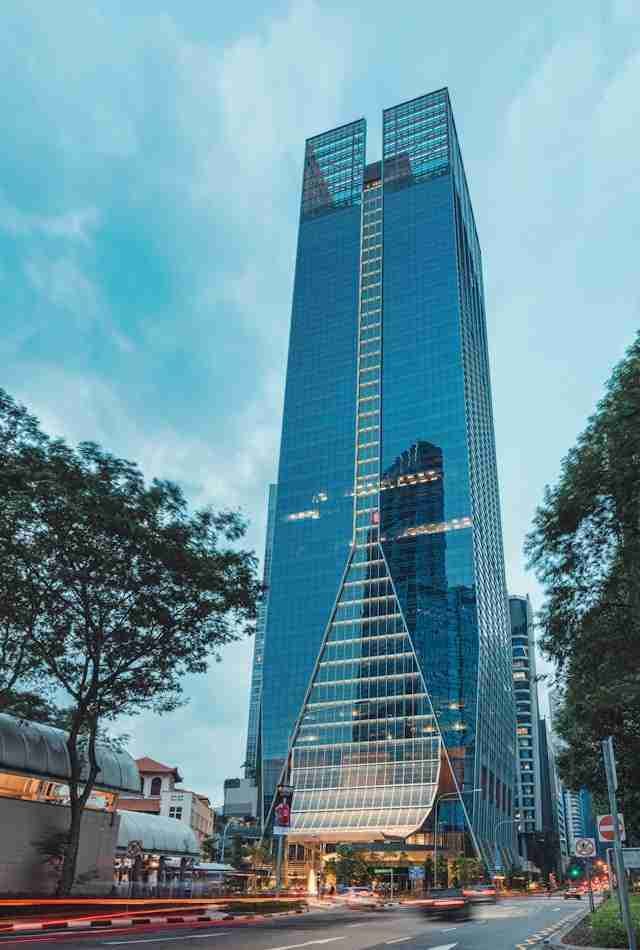
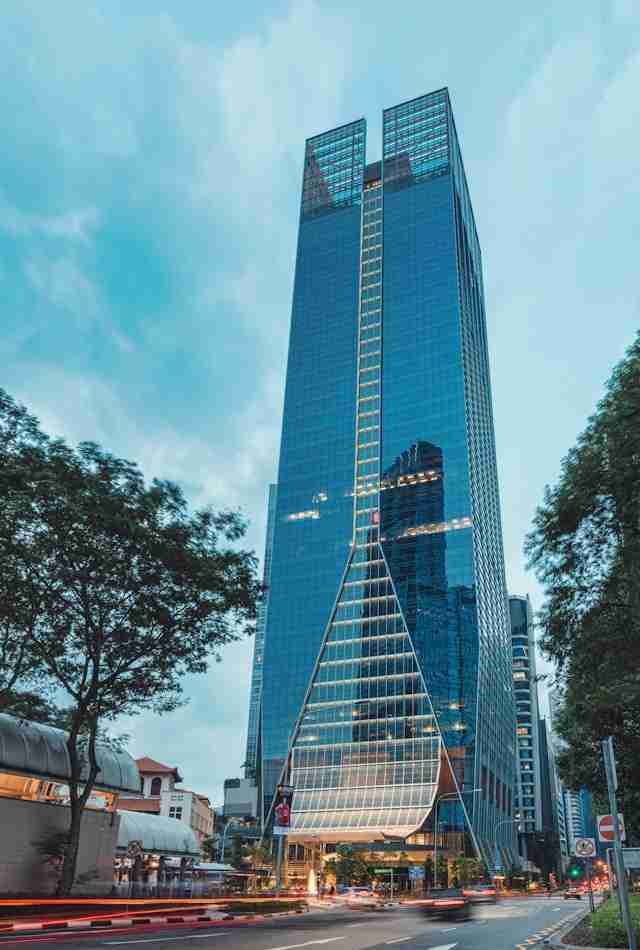
Frasers Tower, located in the heart of Singapore's central business district along Cecil Street, is a sleek architectural statement that fuses cutting-edge design with ecological intelligence. Completed in 2018, this 38-storey skyscraper rises with clean, crystalline lines and a dynamic façade of glass, steel, and vertical fins. Designed by DP Architects, the tower was conceived not only as a corporate headquarters but also as a model of workplace wellness and sustainable construction. For photographers, Frasers Tower presents an ideal blend of modern urban form, intricate façade detail, and environmental integration—providing opportunities for both graphic architectural studies and broader cityscape compositions.
Anchoring a prime corner plot and framed by Singapore's lush tropical landscaping, the building is uniquely positioned to be photographed in varying light and weather conditions. Its reflective surfaces shift with the sky, and the sharp articulation of its structural lines creates an ever-changing interplay of light, shadow, and depth. Whether approached for minimalist abstraction or full urban context, Frasers Tower is a rich photographic subject for those exploring the evolution of Singapore's skyline.
Best Photography Opportunities
• Crystalline Façade from the Street Corner
One of the most compelling ways to frame Frasers Tower is from the intersection of Cecil and Telok Ayer Streets. From this vantage point, the tower rises vertically in symmetrical balance, with its structural fins and angled glass planes converging toward the sky. A wide-angle lens (16–35mm) helps exaggerate the sense of height and drawlines. In early morning or late afternoon, the low sun casts diagonal shadows across the façade, accentuating its textural rhythm. Positioning low on the sidewalk and tilting upward can emphasize the tower's geometric layering while including a sense of street life at its base.
• Mid-Façade Abstraction and Light Play
The tower's double-glazed glass panels and deep vertical fins create a visually complex skin that rewards close study. Use a mid-telephoto lens (70–200mm) to isolate sections of the façade where light and shadow interlock across levels. In bright daylight, the surfaces reflect sky, neighboring buildings, and treetops—creating a kaleidoscope effect that changes by the minute. Overcast conditions flatten reflections and enhance surface detail, ideal for abstract and pattern-based compositions. These shots work well in monochrome, emphasizing contrast and architectural rhythm over color.
• Plaza and Ground-Level Urban Life
The landscaped plaza surrounding Frasers Tower integrates greenery, public seating, and shaded walkways in a rare blend of corporate architecture and human scale. Photographers can work with environmental portraits, architectural detail, or city life imagery—capturing interactions between people and space. Use a 35mm or 50mm prime lens to balance wide context with detail, and frame scenes that contrast the vertical tower with the soft organic lines of the garden and pedestrian traffic. Early morning or dusk provides even lighting across the plaza's ground plane and softens harsh reflections.
• Reflections in Adjacent Glass Buildings
Surrounded by other towers with mirrored façades, Frasers Tower is frequently visible as a reflection in its own architectural neighbors. Look for reflection opportunities from AXA Tower, Capital Tower, or from glass-paneled upper levels of nearby structures. These perspectives can be used to abstract the tower into layered grids of light and color, often creating surreal visual effects. A longer lens helps frame tightly across narrow urban gaps, while a polarizer can control reflection strength and manage glare during midday.
• Nighttime Geometry and Lit Interiors
At night, Frasers Tower transforms into a beacon of light, with glowing office interiors contrasting against the darkened sky and highlighting the rhythmic segmentation of each floor. Shoot from across the street to frame the entire building, or use a telephoto lens to isolate single lit floors or architectural features. The reflective fins catch nearby signage and passing vehicle lights, introducing ambient color into the frame. A tripod is essential for long exposures, especially when capturing light trails or motion blur of nearby pedestrians and traffic. Blue hour is particularly effective here, when ambient city light softens the overall exposure and deepens color contrast between glass, sky, and metal.
Best Time to Visit
Frasers Tower is visually engaging at all times of day, but its glass-heavy design responds especially well to directional light. Mornings are ideal for side-lit façades and clean atmospheric conditions, while late afternoons introduce richer contrast across structural lines. The tropical climate means fast-moving clouds and humidity are common—these can soften light but also introduce glare. Overcast skies provide diffused lighting perfect for detailed façade studies and architectural abstraction.
Golden hour enhances the warm tones in the glass and steel, while blue hour emphasizes contrast between interior lighting and the darkening urban envelope. Nighttime brings out the full complexity of the structure's internal lighting, with office floors, walkways, and exterior elements glowing against the skyline.
Seasonally, Singapore's wet season (November to January) can produce dramatic cloud formations and reflections on wet pavement for moody compositions. Dry season days (June to September) offer the clearest air and best golden hour clarity.
How to Get There
Frasers Tower is centrally located at 182 Cecil Street, easily accessible via Singapore's extensive public transit system. The nearest MRT station is Tanjong Pagar (East West Line), with direct pedestrian access from Exit G leading to the tower's basement and plaza levels. Multiple bus routes serve Cecil Street and Robinson Road, and taxis or ride-hailing services can drop off directly along Telok Ayer or Amoy Streets.
For photographers arriving on foot, the tower is surrounded by pedestrian-friendly streets and green boulevards. The adjacent Telok Ayer Green and historic shop houses add contrast and photographic variety. There are no access fees or restrictions for outdoor photography around the building, and public seating areas allow for comfortable tripod setup or longer shoots. Interior photography is limited to publicly accessible areas unless granted corporate access or press clearance.
Recommended Photography Gear
Bring a versatile kit capable of handling both tight urban spaces and architectural precision. A wide-angle zoom (16–35mm) is key for street-level compositions and exaggerated vertical perspectives. A standard zoom (24–70mm) provides flexibility for framing mid-range façade studies or capturing public activity around the plaza.
A telephoto lens (70–200mm) is especially useful for abstraction, detail isolation, and distant reflections across glass corridors or neighboring towers. For evening and night work, a sturdy tripod and remote shutter release allow for long exposures without vibration. A circular polarizer helps manage harsh reflections on glass and deepen sky contrast, especially in bright tropical light.
Singapore's humidity can affect lens clarity and grip, so carry a microfiber cloth and anti-fog wipes. Weather protection for gear is advisable, particularly during the monsoon months when downpours are sudden and intense.
Nearby Photography Locations
Just across from Frasers Tower, this small park and surrounding heritage buildings provide a compelling visual counterpoint to the tower's modernism. The shophouses feature intricate colonial-era details and pastel tones that add texture and scale contrast to urban frames. Perfect for including in wide scenes or for standalone documentary-style architectural studies.
A short walk north, Guoco Tower is Singapore's tallest building and offers dramatic height and glasswork that interacts visually with Frasers Tower in skyline compositions. The surrounding plaza and roof gardens also offer elevated vantage points and strong lines for minimalist compositions.
A five-minute walk brings you to this preserved cultural district, where vibrant painted façades, narrow lanes, and eclectic architecture make for atmospheric street scenes. These locations are ideal for juxtaposing old and new within a single frame, particularly when including the Frasers Tower silhouette in the background.
Duxton Plain Park is a linear green corridor running between high-rises and historic buildings. It's perfect for shooting elevated lines and pedestrian motion under tree cover. Pinnacle@Duxton, a nearby public housing complex, offers a public-access rooftop skybridge with panoramic views of the city—Frasers Tower included.
A heritage cast-iron market just two blocks away, Lau Pa Sat is excellent for twilight and night photography, especially with light trails and market activity in the foreground. The iconic clock tower and surrounding food stalls offer vibrant color and movement, pairing well with shots of the more stoic Frasers Tower in the background.
Frasers Tower exemplifies the clean ambition of Singapore's contemporary architecture—a structure that's both formally elegant and responsive to its dense urban environment. Whether you're chasing vertical symmetry in the early morning, abstract reflections at midday, or light trails under tropical skies, this building rewards thoughtful framing and repeat visits. In a city that's constantly reinventing itself, Frasers Tower offers a moment of architectural stillness—ready to be interpreted anew with every click of the shutter.
Comments
Loading comments…