
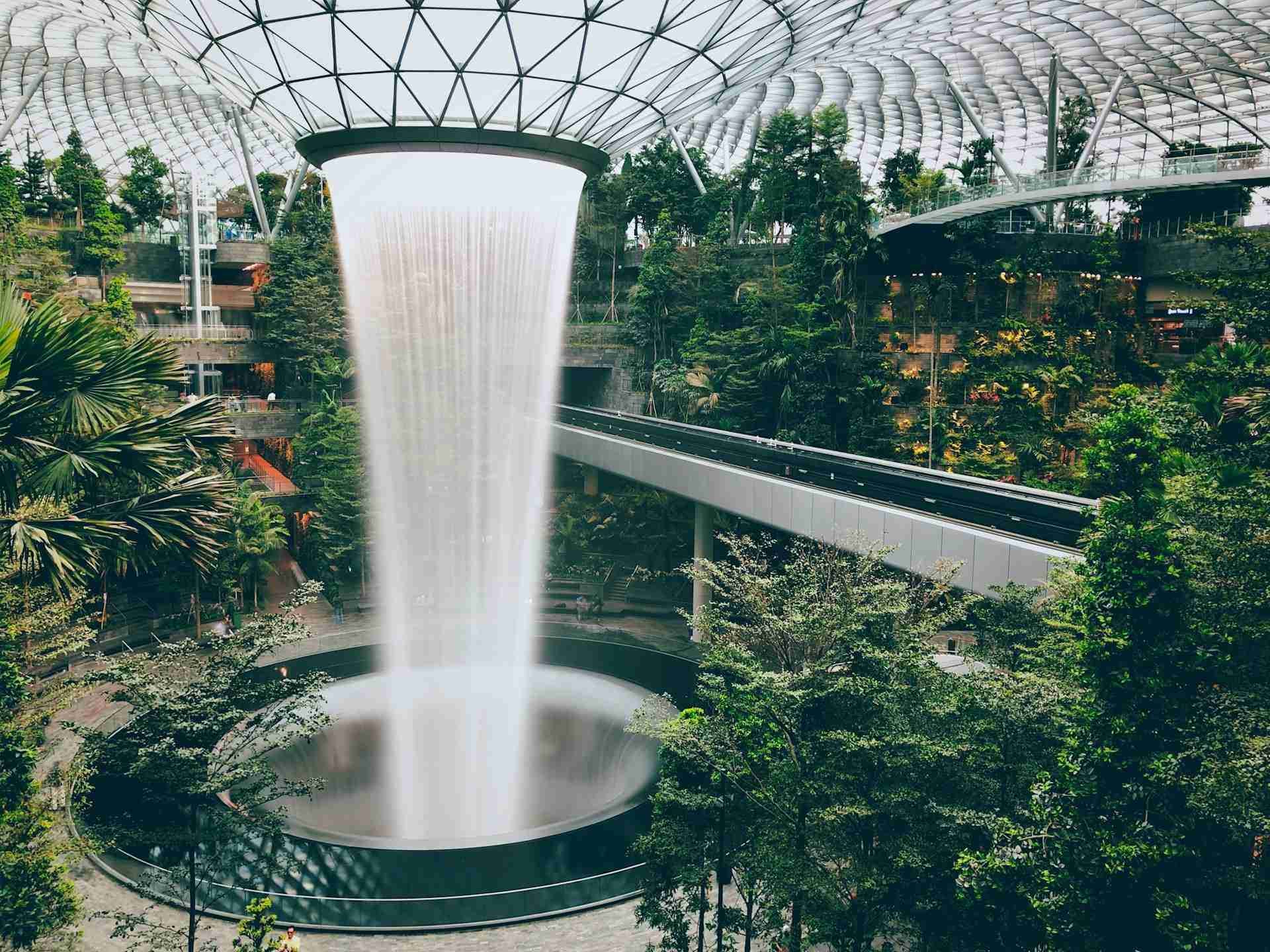
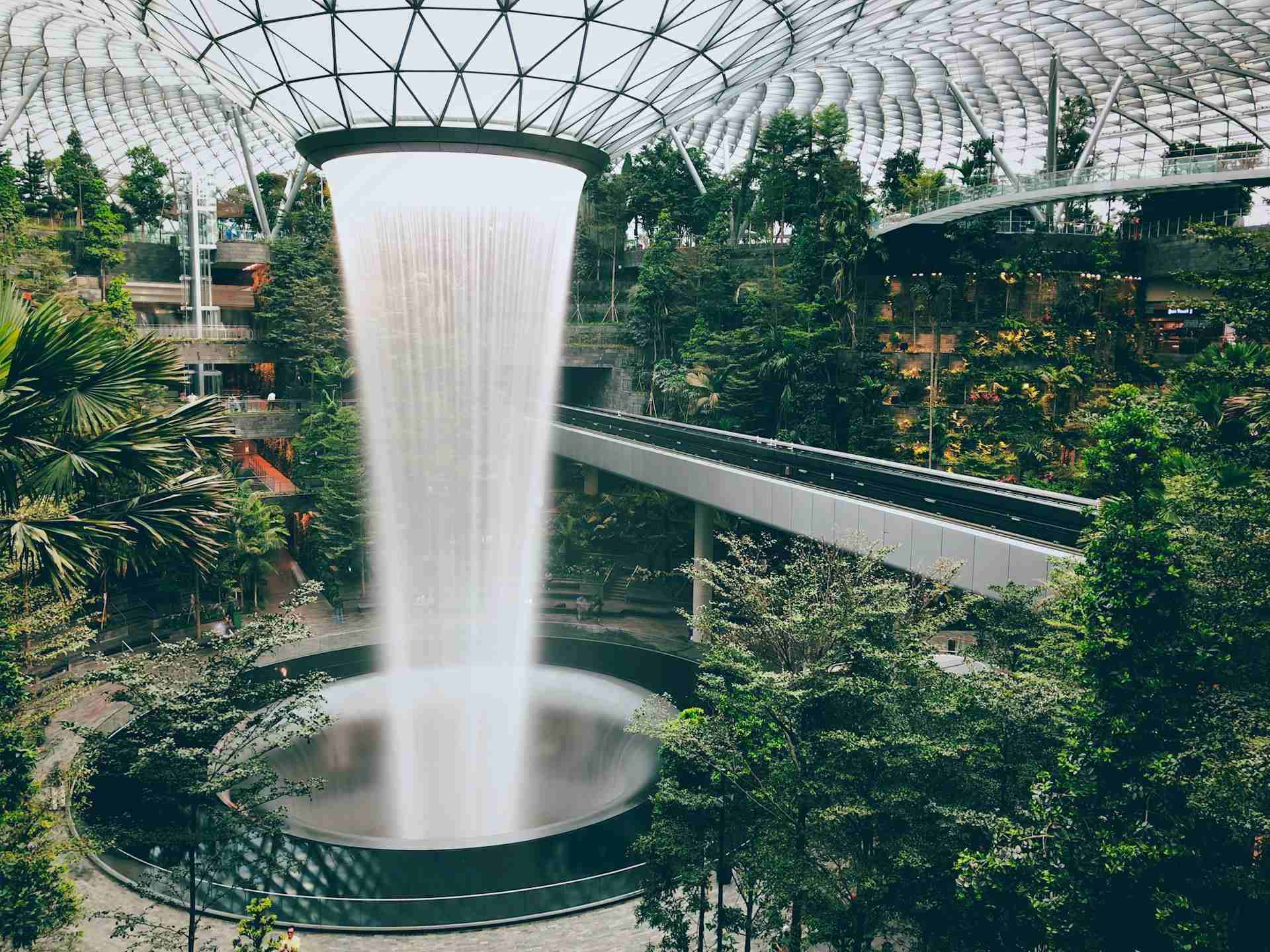
Suspended beneath a soaring dome of glass and steel, the Rain Vortex at Jewel Changi Airport in Singapore is the world's tallest indoor waterfall—and one of the most futuristic architectural subjects a photographer can encounter. At 40 meters high, the waterfall plunges from an oculus at the center of the glass roof into a circular basin, surrounded by the lush indoor Shiseido Forest Valley. Constantly shifting between natural light and artificial illumination, the Rain Vortex offers endless compositional variation, whether it's captured in mid-air with tropical mist or glowing in a kaleidoscope of color during the evening light shows. It's both a spectacle and a study in engineered serenity—a rare subject that combines precision geometry with the raw motion of falling water.
Best Photography Opportunities
• Symmetrical central view from Level 2 or 3 terraces
The most balanced and iconic composition is directly aligned with the waterfall's central axis, viewed from one of the upper levels such as Level 2 or 3. This vantage point places the oculus, falling water, and basin all within frame, framed by the concentric patterns of the dome and forest valley. A wide-angle lens is essential to capture the full height and curvature of the glass roof. Wait for moments when crowds are minimal or position yourself higher to keep foot traffic below the frame. During the day, the combination of natural light and indoor greenery gives the scene a calm, balanced tone.
• Reflections and motion from the ground-level basin
At the base of the vortex, you can shoot up into the falling water, using reflections from polished walkways and glass railings to double the visual impact. A mid-range zoom lens gives you compositional flexibility in tight spaces. Using a slightly slower shutter speed—around 1/15 to 1/4 second—creates a silky motion blur in the water, emphasizing its downward energy without losing clarity in the structure. Including people in the frame adds scale, but framing tighter on the basin and column can abstract the vortex into a near-sculptural form.
• Color and light during the nighttime light shows
Every evening, the Rain Vortex is transformed by programmed light and sound shows, where vibrant colors ripple across the falling water in synchronized sequences. These shows offer strong opportunities for long exposures that blur the light into streaks and gradients. Use a tripod or stable surface on an upper level, and shoot at ISO 100 with shutter speeds between 2 and 10 seconds. Bracketing exposures can help balance the high contrast between bright LED effects and the darker surrounding foliage.
• Architectural abstraction from beneath the oculus
Standing directly underneath the oculus, and pointing the lens up through the glass dome, reveals a hypnotic radial symmetry. Here, the Rain Vortex appears as a negative space within the structure, with the steel supports forming geometric arcs around it. A wide-angle or fisheye lens exaggerates the curvature and creates a dynamic architectural study. On overcast days or during blue hour, the dome glows with ambient light and creates soft gradients ideal for black-and-white interpretation.
• Juxtaposition of natural elements and engineered design
Throughout Jewel's Forest Valley, there are compositional opportunities that contrast plant life with the precision of the waterfall and its surrounding materials. Use depth of field to layer leaves, branches, or orchids in the foreground against the vertical line of water. This technique works well with a standard lens or even a macro setup if working close. Side light in early morning or late evening sessions creates shadow play that emphasizes both natural textures and the curve of the vortex basin.
Best Time to Visit
Photographic conditions around the Rain Vortex shift significantly throughout the day, driven by both natural daylight filtering through the dome and the internal lighting systems. The best time for clean architectural compositions with even light is early morning, shortly after Jewel opens. From opening until late morning, the light is soft and diffused, especially during Singapore's frequent overcast periods. This is also when foot traffic is lowest, allowing for slower exposures and easier tripod use in upper levels or quiet corners.
From midday to early afternoon, sunlight can stream directly through the oculus depending on cloud cover. This can create high-contrast highlights and dramatic beams of light through the mist. These conditions are ideal for backlit compositions or high-key studies of the vortex, but can be challenging for dynamic range control—bracketing is useful during this window.
Late afternoon offers warm sidelight across the dome, while the surrounding forest elements take on richer green hues. This period is excellent for photographing with natural color harmony and for capturing the transition toward evening ambiance. The golden hour before sunset brings reflections and elongated shadows that accentuate the structure's curvature.
Evenings bring a shift toward artificial light, with the Rain Vortex becoming a performance centerpiece. The LED light shows, held hourly in the evenings, introduce bright color dynamics and high-contrast effects. Blue hour immediately before the first show is particularly photogenic—combining a cobalt sky above the dome with the first illuminations inside the structure. Light show sequences run well into the night, offering multiple chances to experiment with color and long exposures.
How to Get There
The Rain Vortex is located at the center of Jewel Changi Airport, which is directly connected to Changi Airport's terminals via pedestrian bridges, Skytrain service, and linkways. If arriving by air, follow signs to Jewel from Terminals 1, 2, or 3. Terminal 1 connects directly to the complex on the Arrivals level, while Terminals 2 and 3 connect via Level 2 bridges.
For those entering from outside the airport, Jewel is accessible by MRT via the East-West Line to Changi Airport station (CG2). From there, follow signs to Jewel, which is less than a five-minute walk through the terminal complex. Jewel is open 24 hours, although specific attractions and vantage points (such as Forest Valley paths) may close earlier in the evening.
Photography is permitted throughout Jewel, and tripods are generally allowed, though some areas may restrict their use during busy hours or performances. For long exposure work, upper levels and quiet spots near the perimeter provide the best stability and space. No entrance fee is required to access Jewel or the Rain Vortex.
Recommended Photography Gear
Shooting the Rain Vortex requires a kit that handles dynamic range, mixed lighting, and both architectural and abstract compositions. A wide-angle zoom (16–35mm) is essential for framing the entire vortex within the dome, especially from Levels 2 to 5. A mid-range zoom (24–70mm) is best for tighter compositions, layered reflections, and working in closer quarters around the basin or forest edges.
A travel tripod is highly recommended for long exposures during light shows and low-light indoor conditions. For handheld shooting, a fast prime (35mm or 50mm f/1.4–f/1.8) offers sharp results and helps manage the high-contrast lighting. A circular polarizer can enhance clarity and control reflections, especially from water and glass, but use cautiously when photographing through curved surfaces.
Bring a microfiber cloth to clean lenses after humid indoor shoots or misty conditions near the basin. A remote shutter release or phone app trigger is ideal for tripod work, particularly during extended exposures in the light show sequences. A compact LED panel may help with controlled fill light on static subjects like foliage or sculpture near the vortex's edge.
Pack light for mobility—while Jewel is spacious, high foot traffic means you'll benefit from a nimble setup. Use a weather-sealed backpack and keep your gear secure when working in crowds or during quick transitions between levels.
Nearby Photography Locations
Located at the top level of Jewel, Canopy Park features foggy gardens, suspended net walks, and mirrored sculptures. These areas offer strong opportunities for abstract compositions, especially during golden hour or with diffused dome lighting.
The terraced indoor rainforest surrounding the Rain Vortex is ideal for nature-meets-architecture compositions. Use layering, depth of field, and shaded natural light for botanical studies with structural context.
One of the world's few airport butterfly gardens, this space offers macro and wildlife opportunities in a tropical enclosure. Great for close-up work with a macro lens or fast prime.
• Jewel's Exterior Facade and Link Bridges
At night, the glass-and-steel dome of Jewel glows from within, and the curves of the architecture are best captured from the adjacent parking structure or the link bridges connecting terminals. Excellent for blue hour or minimalist architectural studies.
This rooftop garden offers a unique outdoor subject within the airport complex. Sunflowers, aircraft views, and sunset light combine for creative silhouette and detail work during the golden hour.
The Rain Vortex is more than an engineered marvel—it's a rare convergence of water, light, and geometry within one of the most dynamic architectural spaces in the world. For the photographer, it presents the challenge of adapting to constant movement and evolving conditions. Whether you're capturing symmetry, atmosphere, or pure motion, the Rain Vortex is a location that rewards precision, patience, and creative flexibility with images that feel both futuristic and timeless.
Comments
Loading comments…