
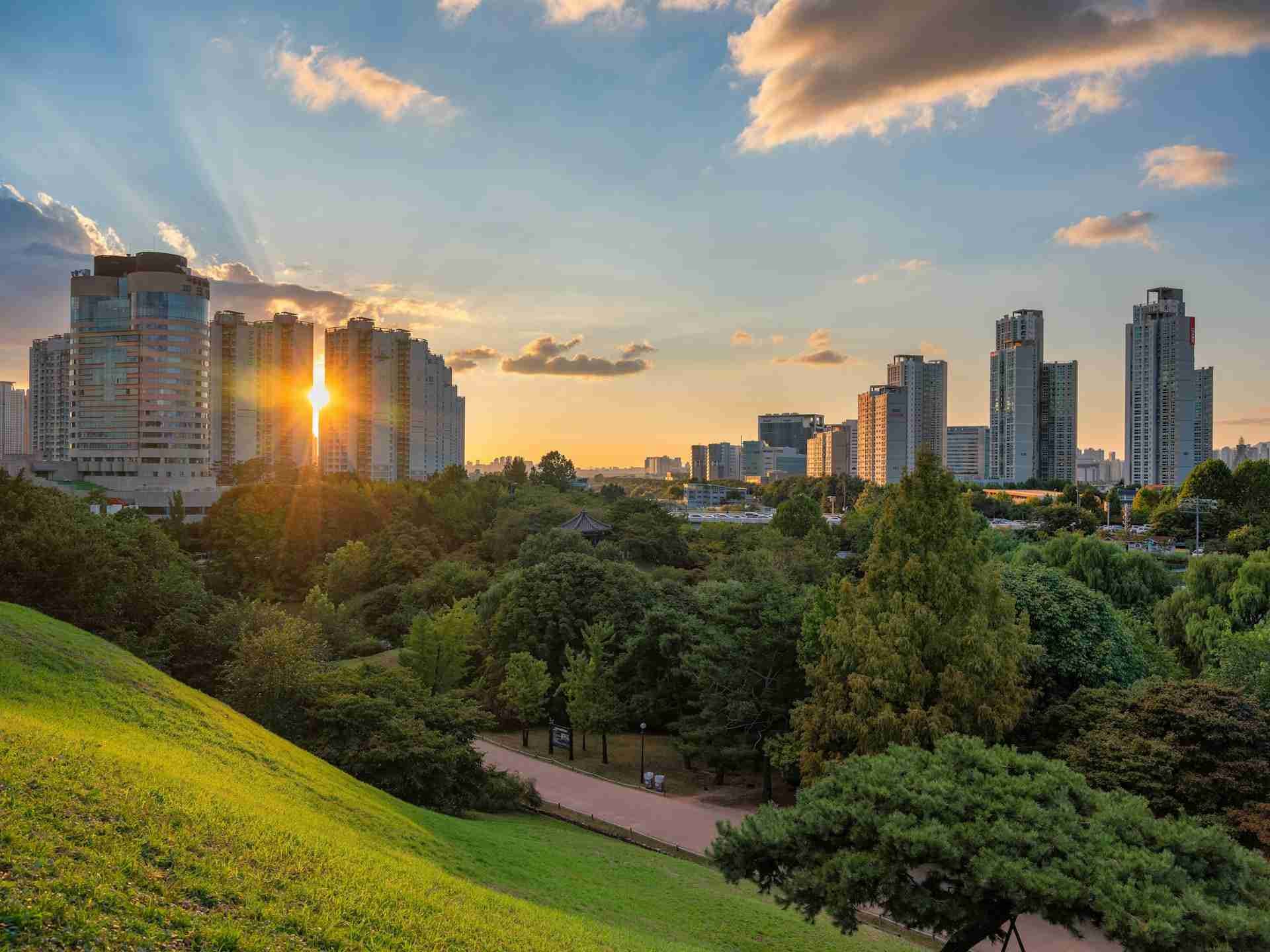
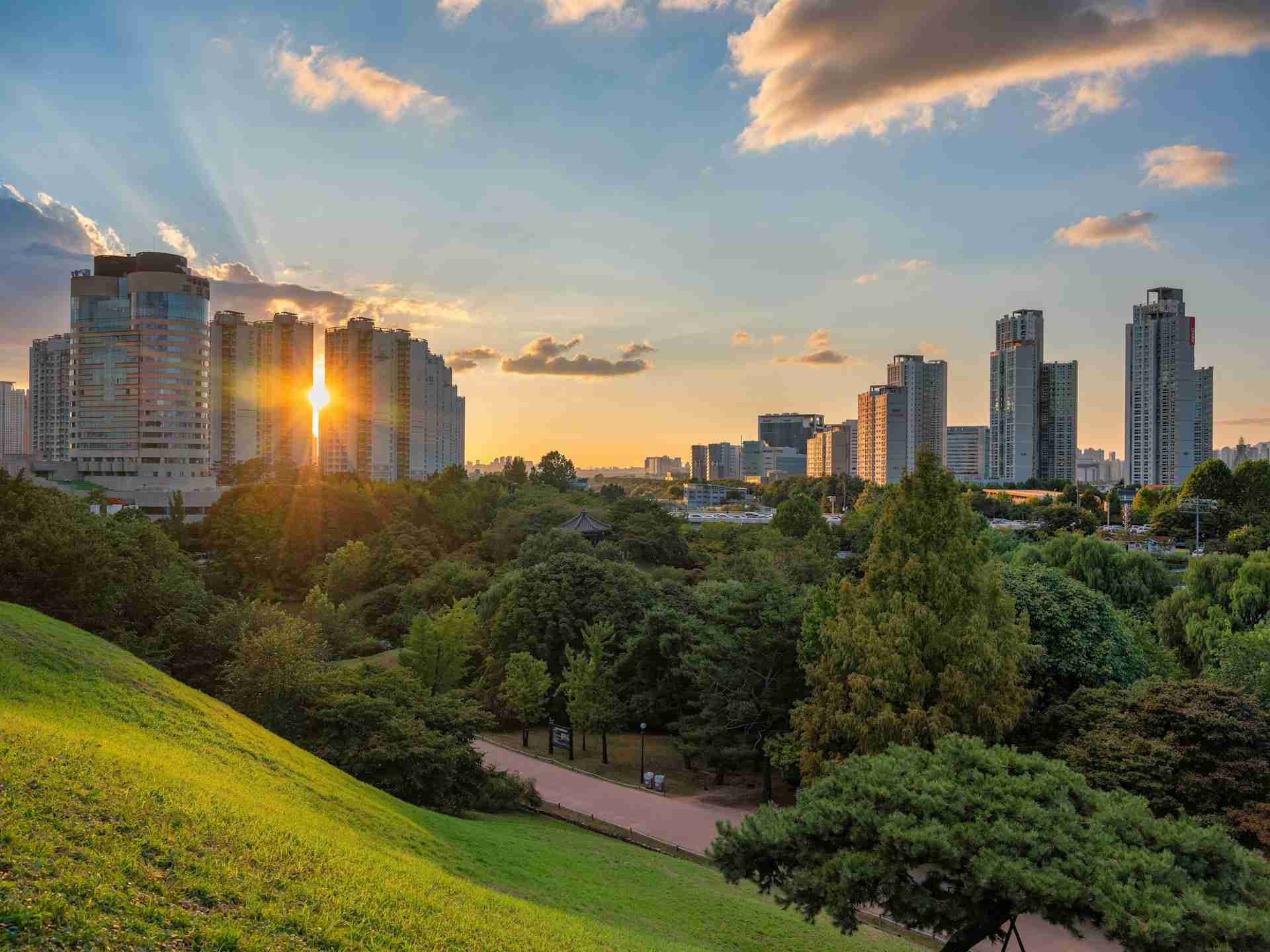
Sprawling across southeastern Seoul, Olympic Park is a dynamic space where history, landscape design, and monumental architecture intersect. Originally built for the 1988 Summer Olympics, the park is now a public green space that blends open meadows, quiet forest trails, vast athletic fields, and large-scale sculptures. For photographers, Olympic Park offers a surprising mix of subjects, from geometric modernist structures and tranquil water features to seasonal floral displays and elevated city views. The wide pathways, architectural symmetry, and natural variation across the park's five zones create a space where you can shoot expansive landscape compositions, minimalist details, or candid scenes of daily life. Whether visiting in cherry blossom season, autumn foliage, or under a fresh coat of snow, the park provides strong visual contrasts and soft transitions between human-made and natural elements.
Best Photography Opportunities
• Peace Plaza and World Peace Gate
The central architectural centerpiece of Olympic Park is the World Peace Gate, a massive postmodern structure with bold geometric lines and mural-covered underpanels. Shooting from a low angle with a wide-angle lens emphasizes its monumentality while drawing attention to the patterns overhead. Early morning or late afternoon light creates long shadows across the plaza's open stone surfaces, revealing subtle textures. Peace Plaza itself offers reflections in the water basin and symmetry that suits centered, balanced compositions. The area is particularly striking at blue hour, when surrounding lights activate and the structure stands silhouetted against a deepening sky.
• Soma Museum of Art and Outdoor Sculpture Park
Olympic Park is known for its extensive outdoor sculpture installations, many of which surround the Soma Museum of Art. These large-scale pieces provide a mix of materials and forms that photograph well in changing light. Abstract shapes can be paired with clouds or tree lines for contrast, and working in overcast conditions softens shadows on polished surfaces. The spacing between works also allows for creative depth-of-field experiments or lens compression techniques. Golden hour light brings warmth to stone and metal sculptures, and reflections from nearby ponds add another compositional layer.
• Lonely Tree on the Mongchon Earth Fortress Hill
One of the park's most photographed subjects is a single tree standing alone on a gentle slope of the Mongchon Earth Fortress, a historical earthen mound preserved within the park. This tree offers minimalist compositions in all seasons—framed by cherry blossoms in spring, dense green in summer, golden leaves in fall, and stark outlines in winter. A telephoto lens compresses the slope for a graphic, clean image, while a wide-angle lens can include sky, paths, or people to change the story. The hill also provides panoramic views of the park, especially in soft morning light or low fog.
• Wildflower Garden and Seasonal Planting Zones
The naturalistic planting areas around the Wildflower Garden shift throughout the year, offering soft, pastel tones in spring and deep color saturation in autumn. Macro lenses are ideal here, particularly for isolating delicate blooms or insects among the foliage. These areas are most productive early in the morning when dew is still visible and foot traffic is minimal. Using a shallow depth of field lets you isolate color fields and render backgrounds into a soft blur. Tripods are useful, but the terrain is mostly flat and accessible, allowing for handheld shooting with natural light most of the day.
• Olympic Lake and its Bridges
The central lake is framed by walking paths, bridges, and gentle landscaping that reflect beautifully during sunrise and golden hour. Reflections of nearby trees and structures ripple across the lake's surface, and a circular polarizer helps control brightness and bring out the tones of sky and water. Longer exposures using a neutral density filter smooth out water texture and cloud movement, especially on overcast days. The bridges themselves serve as strong leading lines, particularly the main pedestrian bridge, which curves gently over the water and is lit in the evening.
Best Time to Visit
Olympic Park offers year-round photographic opportunities, but the atmosphere and subject matter vary significantly by season. Spring is especially popular, with cherry blossoms and magnolia trees blooming throughout the park. The area around Mongchon Fortress becomes particularly photogenic with pink petals falling around the Lonely Tree. Summer brings dense foliage and a more active public presence, which can be great for lifestyle and candid photography, though light tends to be harsh midday.
Autumn is perhaps the best season overall, with rich foliage colors, clear skies, and soft late-afternoon light. The park's varied tree species turn in different tones and timing, allowing for extended shooting opportunities. Winter provides stark compositions, strong architectural lines, and the occasional snowfall that transforms the landscape. Blue hour and golden hour are ideal times year-round due to the park's open skies and reflective surfaces. Mornings are often calmer, both in terms of wind and crowds, which helps with reflections and longer exposures.
How to Get There
Olympic Park is located in the Songpa District of Seoul and is well-connected by public transit. The most convenient access point is from Olympic Park Station on Seoul Metro Line 5 or Mongchontoseong Station on Line 8. Both stations have clearly marked exits that lead directly into the park. Signage throughout the park is bilingual, and detailed maps help orient you to the zones and pathways.
For those carrying heavier gear or planning to shoot into the evening, taxis are easy to hail from designated pick-up points near the entrances. There is limited paid parking available, but public transport is typically the faster and more efficient option. Entry to the park and most of its features is free, including access to the sculpture areas and trails. Tripods are permitted and commonly used throughout the grounds, though it's good practice to be considerate in high-traffic areas.
Recommended Photography Gear
A wide-angle lens in the 16 to 35 millimeter range is useful for architectural elements such as the World Peace Gate, as well as for broad landscape compositions that include sky and water. A standard zoom lens such as 24 to 70 millimeters offers versatility for street scenes, sculpture framing, and tighter environmental portraits. A telephoto lens from 70 to 200 millimeters helps compress layers when shooting across the lake or isolating subjects like the Lonely Tree or distant hills.
A tripod is recommended for sunrise, blue hour, and long exposures across the lake or at night. A circular polarizer is useful throughout the day to manage glare on water and metal surfaces, especially in bright sun. Neutral density filters are helpful when shooting long exposures of water or moving clouds. Macro lenses are valuable in the wildflower gardens and can be paired with a small reflector or diffuser for more controlled natural lighting. Because the park is large and spread out, a comfortable camera bag and extra batteries are essential for extended sessions.
Nearby Photography Locations
Just a short subway ride away, the Lotte World Tower and surrounding lake provide a modern counterpoint to Olympic Park's open space. The lake offers reflections of the skyscraper and seasonal cherry blossoms, while the tower is a prime subject for architectural and twilight photography.
Stretching along the Han River, this section of Hangang Park offers long paths, open river views, and skyline shots of eastern Seoul. It is ideal for late afternoon sessions, especially when light reflects off the water or silhouettes cyclists and joggers along the trails.
Located at the top of Lotte World Tower, this observatory provides aerial views of Olympic Park, the Han River, and the broader urban landscape. Sunset and blue hour are the best times to visit for skyline photography through the glass panels.
In spring, this narrow road beside Seokchon Lake transforms into a tunnel of blossoms. It is one of the best places in Seoul for handheld street photography during blossom season, with dramatic petal falls and soft evening light.
• Songpa Naru Park
Just north of Olympic Park, this smaller green space offers views of sculptures, fountains, and locals enjoying open lawns. It works well as a quick stop for portrait sessions or minimalist scenes with less foot traffic than the main park.
Whether you're focusing on bold architecture, seasonal color, or peaceful nature scenes, Olympic Park gives you the space and variety to try different techniques in one visit. The layout makes it easy to move between quiet, tree-lined paths and wide open plazas, and the changing light throughout the day keeps things interesting. It's a place that works just as well for relaxed handheld shooting as it does for more planned, tripod-based work. No matter your style, the park offers a full day of strong photographic opportunities right in the heart of Seoul.
Comments
Loading comments…