
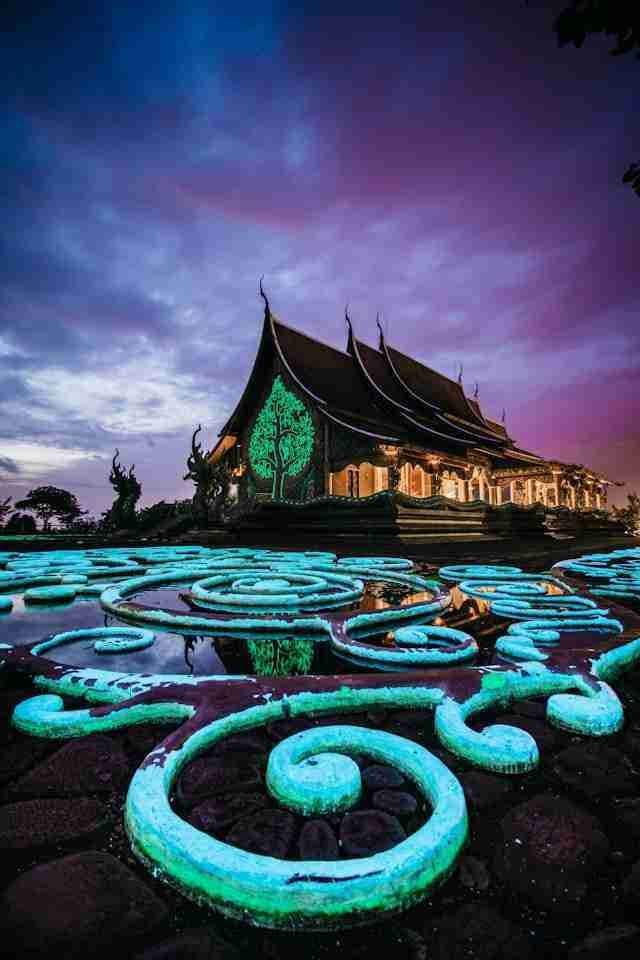
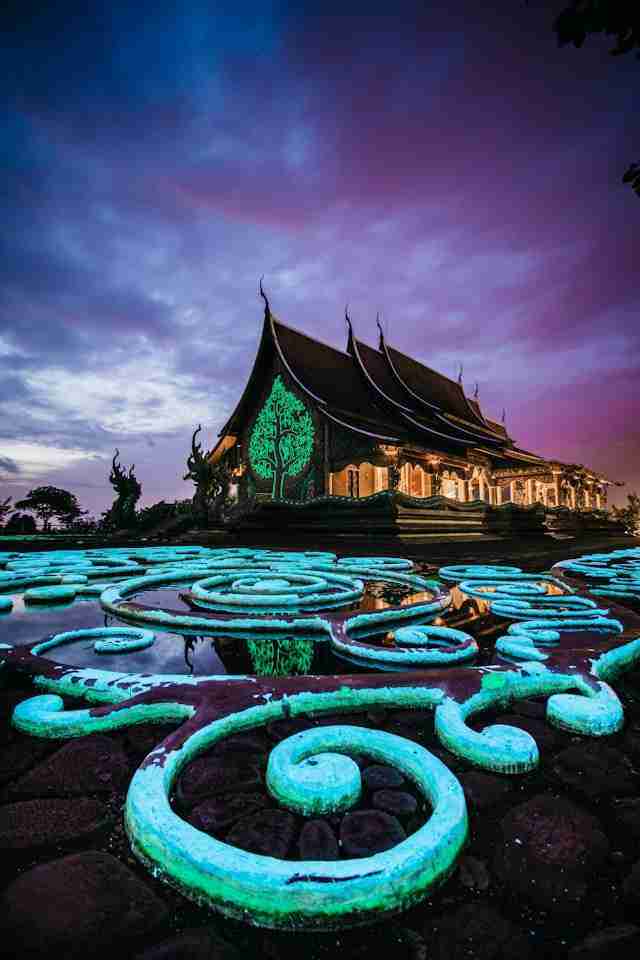
Wat Sirindhorn Wararam Phu Phrao sits on a quiet ridge in Thailand's Ubon Ratchathani province, close to the Laos border. Often called the "Glow-in-the-Dark Temple," it's best known for its glowing tree of life mural that lights up after sunset, along with a series of luminous patterns set into the temple grounds. Built in traditional Lanna architectural style with deep eaves and layered rooflines, the temple offers strong symmetry, clean ornamental detail, and changing light that brings out different qualities throughout the day. For photographers, this is a place that rewards planning. While the glow is the main attraction, the site also offers strong compositions during golden hour and dusk, when the temple lights up against a fading sky and the full design becomes visible without distraction.
Best Photography Opportunities
• Main Façade and Tree of Life at Dusk
The most striking composition here is the back of the temple, where the tree of life mural glows in soft green and blue light. To photograph this properly, arrive before sunset and prepare to shoot just as the ambient light falls away but before full darkness sets in. This balance allows the glow to show clearly without losing the detail of the building. Use a tripod and a standard zoom or wide-angle lens to frame the entire back wall, including the path and surrounding trees if you want added depth. A long exposure helps balance the soft glow with the sky and draws out the color without overexposing the light elements.
• Side Angles and Roof Layers During Golden Hour
The temple's profile is layered and ornate, with its multi-tiered roof rising above finely detailed gables. From the side, especially just before sunset, you can capture warm light grazing the surface and shadows forming under the eaves. Use a mid-range zoom to isolate the layers or shoot wide to include the full structure against the sky. The best side compositions come from the northern approach, where the slope of the land gives you a slightly lower angle and a clean horizon behind the temple.
• Glowing Patterns in the Courtyard Floor
Built into the pavement around the temple are luminous inlays that glow softly at night, forming spirals and floral shapes in stone. These make strong foreground elements when shooting wide, especially when paired with the illuminated tree mural or lit temple roof in the background. Get low to the ground with a wide-angle lens and use a tripod to keep everything sharp during long exposures. Blue hour is the best time for this shot, when ambient light is low enough to see the glow, but the sky still holds color and gradient.
• Interior Details and Ornamental Texture
During daytime hours, the interior of the temple offers strong detail opportunities in gold, wood, and carved surfaces. Use a short telephoto or fast prime lens to capture ornamental elements in soft side light. These tight frames work well when you isolate repeating patterns or subtle contrasts between dark wood and reflective surfaces. Be respectful when shooting inside, and avoid using flash. Low light performance is helpful here, as interior conditions can be dim but stable.
• Wide Contextual Views from the Entrance Path
The temple is raised slightly above its approach, giving you a chance to step back and frame the whole structure with sky, trees, and the surrounding stone plaza. This is a good location for early morning or late afternoon shooting, when light wraps around the temple and the sky adds shape and tone. Use a wide lens to emphasize the depth of the scene and place the structure within its environment. If you shoot from the western edge just before sunset, you can sometimes catch the temple glowing with natural light before the artificial glow begins.
Best Time to Visit
The most productive time to photograph Wat Sirindhorn Wararam Phu Phrao is from late afternoon through the end of blue hour. Sunset light warms the structure, brings out detail in the wood and tile, and allows time to set up compositions before the temple's lighting features come to life. The glow in the murals and ground patterns becomes visible as twilight deepens and holds best visual balance for about 20 to 30 minutes after sunset. Full darkness can flatten the scene, so aim to shoot during the window when ambient light is still present.
In terms of season, the dry months from November through March offer the clearest skies and most stable light conditions. During the rainy season, cloud cover can flatten color and limit the glow's visibility, though it may create interesting reflections in wet stone surfaces. Early evenings are generally quiet during weekdays, but weekends and holidays draw more visitors. Arriving an hour before sunset gives you time to scout angles and adjust as the light changes.
How to Get There
Wat Sirindhorn Wararam Phu Phrao is located near Chong Mek in Ubon Ratchathani province, close to Thailand's eastern border with Laos. From the city of Ubon Ratchathani, the drive takes about 90 minutes by car. Follow Route 217 east toward Chong Mek, then turn south onto a marked access road leading up to the temple complex. The road climbs gently and ends in a parking area near the temple grounds.
There is no entry fee for visiting or photographing the temple, and the site remains open into the evening to accommodate visitors coming to see the glow. A short walkway leads from the parking area to the temple itself. The terrain is paved and level, making it easy to carry a tripod, camera bag, or rolling gear case. Be mindful of cultural norms while photographing. Dress modestly and avoid obstructing pathways or active prayer areas with equipment.
Recommended Photography Gear
A 24–70mm zoom lens is the most versatile choice for this location, allowing you to work from wide to medium compositions as the light changes. A 16–35mm wide-angle lens is ideal for shooting the tree mural, courtyard glow, or full temple views with sky and surrounding space. A 70–200mm lens is helpful if you want to compress the layered rooflines or isolate ornamental details from a distance without entering crowded areas.
A tripod is essential for shooting the glow, capturing long exposures during blue hour, and building low, wide compositions with foreground detail. A remote shutter or timer helps reduce camera shake during longer exposures. Bring a microfiber cloth and a rain cover if visiting during the wet season, as light rain or mist can form quickly in this part of the country. A polarizer is less useful here due to low-angle light and artificial glow, but a lens hood is helpful for managing flare from temple lights or lanterns.
Nearby Photography Locations
Perched above the Mekong River near Khong Chiam, this hilltop temple offers elevated views over the water and into Laos. The viewpoint is especially strong during sunrise, when mist moves through the valley and soft light spreads across the river. A wide lens captures the full sweep of the horizon, while a longer lens helps isolate boats or layered hills across the border. The temple grounds themselves include ornate statues and simple framing elements that work well in side light.
• Sirindhorn Dam and Viewpoint
About 20 minutes south of the temple, this dam offers open views across water and forested hills. Sunset light over the reservoir creates strong color and clean horizontal lines. Use a long lens to isolate layers in the hills or work with wide reflections near the dam road.
Further north along the Mekong River, this park features dramatic cliffs, prehistoric rock paintings, and panoramic sunrise views across Laos. It's an ideal location for early morning landscape work and capturing the character of the Mekong valley.
• Wat Phu Prao Forest Trails
The hills surrounding the temple include forested walking trails that offer filtered light and simple scenes with trees, roots, and temple roofs peeking through gaps in the canopy. These are ideal for quieter compositions and detail-focused work.
• Khong Chiam Riverside Promenade
Situated along the Mekong where the Mun River meets the border, this quiet riverside area blends local life with layered river views and shifting light. Early mornings bring vendors, monks on alms rounds, and long-tail boats moving through calm water, offering a steady flow of subject matter for street and documentary photography. The promenade's clean lines, pastel shopfronts, and occasional street murals give you strong framing tools for wider environmental portraits or tighter detail shots. It's a good counterpart to the temple's quiet stillness, with more movement and human presence.
Wat Sirindhorn Wararam Phu Phrao rewards patience, timing, and an eye for how artificial and natural light interact. While the glow attracts attention, the temple's real strength lies in its layered forms, balanced design, and the steady change that happens over the course of an hour. It's not about rushing to get a single frame. It's about watching the sky darken, the lights rise, and finding the moment when everything fits into place.
Comments
Loading comments…