
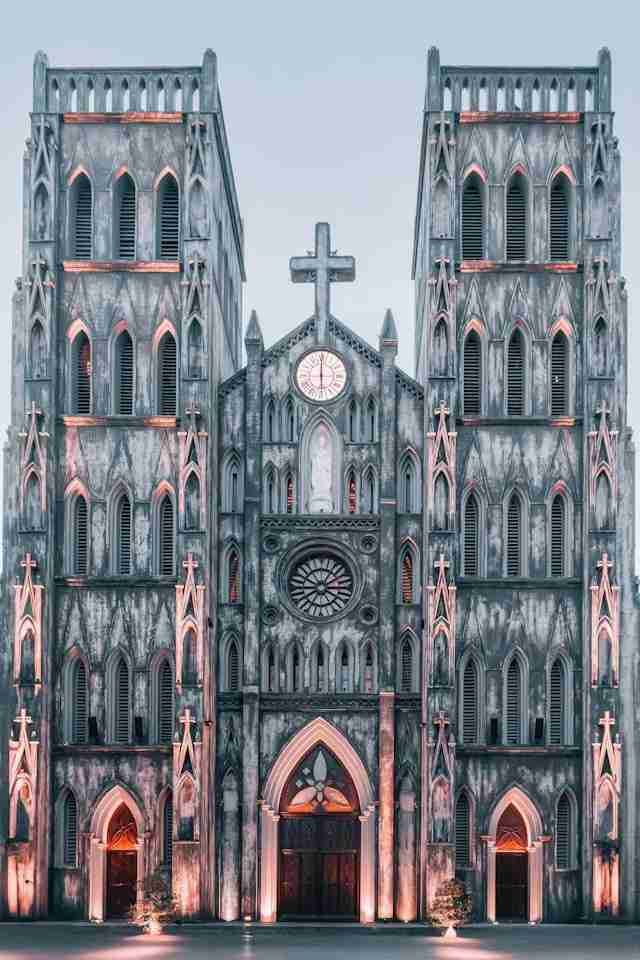
St Joseph Cathedral stands as a testament to 19th‑century Gothic Revival design in the bustling Hoan Kiem district of Hanoi. This grand church invites photographers into a world of soaring towers, colored glass light, and urban contrast. Whether framing its twin towers against a pastel sky or capturing light pouring through its stained windows, the cathedral offers a compelling mix of structure, history, and atmosphere in the very core of Hanoi.
Best Photography Opportunities
• Twin Towers and Entrance Arches
– The cathedral's defining architectural feature is its pair of imposing towers that rise symmetrically above the square, anchored by a central entrance flanked with arched openings. These towers offer the ideal subject for a classic frontal composition, particularly during the early morning when the rising sun hits them obliquely and casts a warm glow on the stone. Step back across Nhà Thờ Street to capture a clean, full-frame view, or incorporate passing scooters and pedestrians for scale and narrative. Late afternoon shadows give added depth to the stonework, while blue hour introduces a surreal quality as warm artificial lighting bathes the base. You can also work from different corners of the square to explore subtle shifts in shadow play across the towers.
• Stained Glass Windows and Interior Light Patterns
– Inside the cathedral, tall stained glass windows imported from France create a kaleidoscope of color and light when the sun filters through. The best time to photograph these patterns is mid to late morning, when light streams through at an angle and reflects off the stone walls and tiled floor. Use a fast prime lens to isolate the shifting light patterns or capture full-scene interiors that include pews and visitors immersed in prayer. Long exposures add a spiritual quality by smoothing movement and emphasizing light. Even without direct sun, the gentle ambient illumination creates a contemplative mood that rewards careful metering and color balancing.
• Rib-Vaulted Ceilings and Lofty Lines
– One of the most rewarding interior compositions lies above eye level. The ribbed vaults of the nave arch gracefully over visitors and offer a layered geometry that is both challenging and rewarding to photograph. A wide-angle lens is necessary here to capture the sweep of the arches in a single frame, while a tilt-shift lens provides clean vertical lines without distortion. Look for intersecting beams of light from high windows or narrow skylights that add drama. Composing from a low central point in the aisle gives the best sense of symmetry and scale. Alternatively, isolate a single rib or section of vaulting for more abstract, texture-focused images.
• The Square at Blue Hour
– As dusk falls and the artificial lighting of the church comes on, the square transforms into a stage of light and movement. This time of day is particularly rewarding for long exposures. The glow from the street lamps mixes with the golden tones that illuminate the church itself, creating a stark contrast with the cobalt blue sky. Reflections from rain-soaked cobblestones double the visual impact of the structure, while ghostly blurs of people and scooters crossing the square add motion to an otherwise still architectural subject. Shooting from low angles near the central walkway allows you to lead the viewer's eye directly toward the cathedral, while framing it with street life elements creates a distinctly Hanoi mood.
• People and Place
– The cathedral is not just an architectural subject; it is a living space woven into the daily rhythm of the city. During the day, the surrounding plaza fills with tourists, street vendors, flower sellers, and locals passing through. This vibrant social mix presents constant opportunities for environmental portraits and candid storytelling. Use a medium telephoto lens to isolate gestures, facial expressions, or small moments such as candle lighting or prayer outside the main entrance. The statue of Mother Mary in front of the church often serves as a focal point for offerings and reflection. Capture how people interact with the structure, or shoot from elevated café balconies across the square to frame human movement within the larger architectural setting.
Best Time to Visit
The experience of photographing St Joseph Cathedral is deeply shaped by the timing of your visit. Early morning offers the most tranquil setting. As the sun rises, the city begins to stir gently, and the cathedral basks in the soft, warm light that enhances the textures of its aged stone and casts long shadows across the square. Photographers who arrive just after dawn will often find the plaza quiet, with only a few locals beginning their day. This peaceful atmosphere allows for clean architectural compositions and slower, more deliberate shooting.
As the day progresses, Hanoi's typical energy returns, and the square fills with scooters, vendors, and tourists. While this can make wide shots more challenging, it presents rich opportunities for street photography. The interplay between the steady presence of the cathedral and the flowing life around it allows for dynamic frames where past and present collide. Late morning light tends to flatten the structure slightly, so consider focusing on tighter details or shadow contrasts inside the church during that period.
Late afternoon reintroduces drama to the scene. As the sun lowers, golden light grazes the twin towers and brings out the intricate carvings and layered tones of the stonework. Shadows lengthen again across the square, creating compelling geometric patterns that work well in both color and black and white. Just after sunset, the cathedral is illuminated from below by warm-toned lights. This artificial lighting complements the dusky sky, making it one of the most photogenic times to shoot the full structure.
Blue hour is especially rewarding if you enjoy long exposure work. The sky deepens into cobalt while the church remains lit, standing in contrast against the surrounding buildings and the soft movement of passersby. This is also the time when reflections on the damp pavement, especially after a rain shower, can double the impact of your compositions.
Seasonally, Hanoi's cooler months from November to February provide clearer skies and more pleasant shooting conditions. The monsoon season from May to September brings overcast days and sudden rains, which can be challenging but also lend themselves to moodier, more atmospheric work. If you are looking to photograph religious ceremonies or interior decorations, major Catholic holidays such as Easter and Christmas add a layer of narrative richness, though these days draw larger crowds and require more patience to shoot effectively.
How to Get There
St Joseph Cathedral is located in Hanoi's Hoan Kiem district, just a short walk west of Hoan Kiem Lake. From the lake's northern end, it takes about five minutes on foot to reach the cathedral, making it easily accessible from many central hotels and cafes. Cyclo rides and taxis frequently pass through the area, and public bus lines such as 9, 14, and 36 have nearby stops at the lake perimeter. For those using a motorbike or bicycle, parking is available along Nhà Thờ Street or side alleys, though spaces can be limited during peak hours or services.
There is no entry fee to access the cathedral, and visitors are generally welcome outside of formal service times. The main doors often open for mass, while side entrances remain accessible at other hours. Though there are no formal restrictions on photography, tripods and flash usage should be avoided during religious services out of respect. Most of the interior can be photographed freely, but discretion is appreciated, especially when locals are at prayer. For photographers interested in capturing mass or religious ceremonies, it is best to observe from a distance or inquire with staff beforehand.
Essential Gear Recommendations for Photographing St Joseph Cathedral
Photographing St Joseph Cathedral effectively requires a thoughtful balance of gear suited for both architectural precision and atmospheric city scenes. A wide-angle zoom lens, such as a 16 to 35 millimeter, will be essential for capturing full interior spaces including the rib-vaulted ceiling, as well as frontal compositions of the exterior from across the square. A tilt-shift lens is particularly helpful for correcting vertical lines when shooting from lower angles or in tighter spaces, ensuring your architectural shots retain clarity and accuracy.
For more intimate compositions and low-light interiors, a fast prime lens such as a 35 millimeter f1.4 or a 50 millimeter f1.8 offers beautiful depth of field and performance under dim lighting without requiring high ISO. This is especially useful when working inside the cathedral or capturing candlelit scenes. A mid-range telephoto (85 to 135 millimeter) allows for detailed shots of stained glass, architectural carvings, or candid portraits across the plaza without intrusion.
A lightweight tripod or compact travel tripod can support long exposures during blue hour or inside the church, though it is best used sparingly during busy hours. Bring a polarizing filter to manage glare from windows and enhance the richness of blue skies. Extra batteries and memory cards are essential, especially if moving between indoor and outdoor shooting sessions. Given Hanoi's humidity and sudden rain, pack a lens cloth and a rain cover to protect gear from moisture. A discreet shoulder bag rather than a bulky backpack allows for easier movement through crowds and tight cathedral spaces.
Nearby Photography Locations
• Hoan Kiem Lake and The Huc Bridge
– Just steps away from the cathedral, Hoan Kiem Lake is a visual counterpoint of tranquility. The Huc Bridge, painted in red and illuminated at night, provides elegant framing options against the water. Early morning mist or late afternoon light adds atmosphere, especially when combined with reflections of the temple or drifting clouds.
– Situated on a small island in the lake, this temple offers rich architectural details and cultural context. Framing the temple through the bridge's arch or capturing its ornate rooflines from the shore provides compositions that contrast Hanoi's religious traditions with the more European sensibility of the cathedral.
– A labyrinth of narrow streets lies just beyond the cathedral, filled with lanterns, weathered doors, and street vendors. These alleys provide a gritty, intimate backdrop that contrasts beautifully with the grandeur of the cathedral. Look for textures, color, and street moments that frame Hanoi's character.
• Streetside Cafés with Balcony Views
– Several cafés across the plaza offer upper-floor seating with views of the cathedral and the street below. This elevated vantage point is ideal for capturing wide-angle shots of the building framed by bustling human activity. Use this space for morning coffee while observing how light and movement evolve.
– About ten minutes away on foot, this historic prison site presents a darker but visually compelling subject. Its heavy stone walls, barred windows, and subdued interiors provide moody compositions that pair well with natural light seeping through narrow corridors, offering a documentary-style contrast to the cathedral's spiritual tone.
St Joseph Cathedral offers more than just visual grandeur—it is a stage where history, ritual, and daily life play out against a backdrop of dramatic architecture. Whether you are drawn to intricate Gothic lines, moments of quiet devotion, or the pulse of Hanoi's streets, this place rewards the photographer who looks beyond the surface and waits for the city's rhythms to unfold.
Comments
Loading comments…