
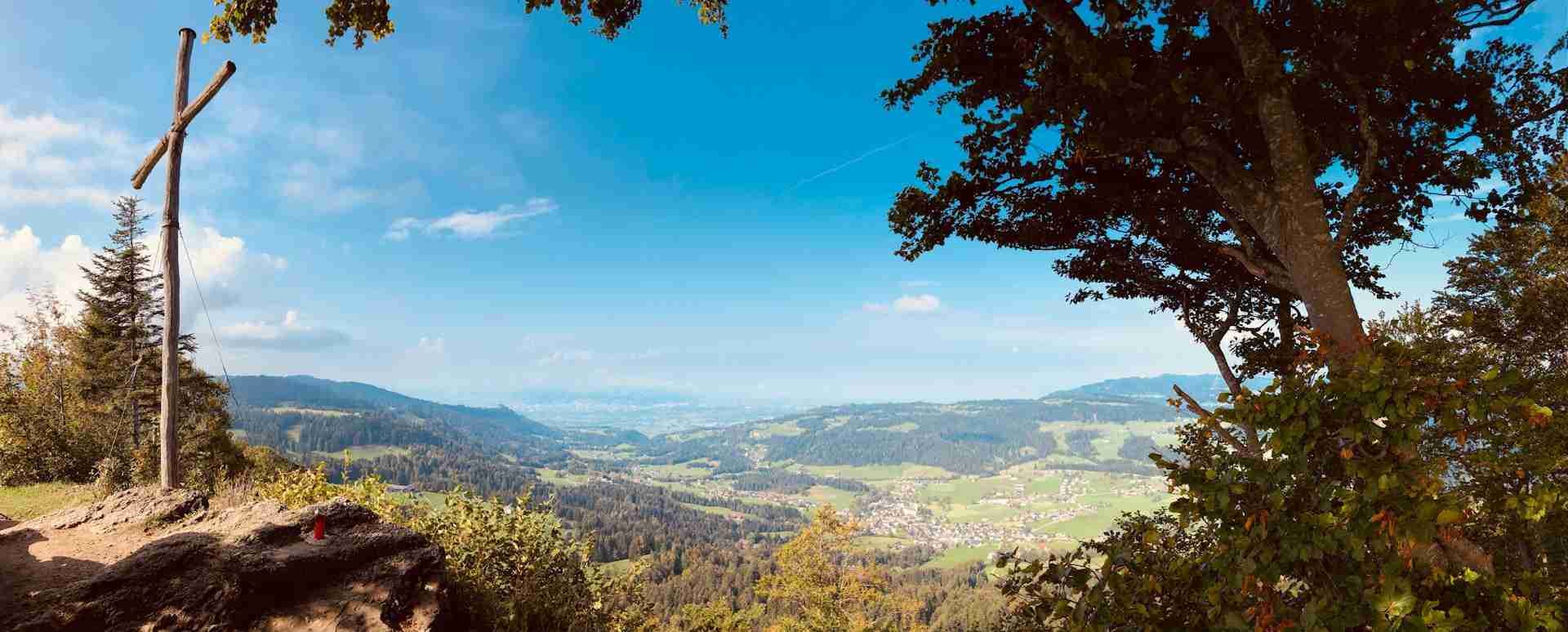
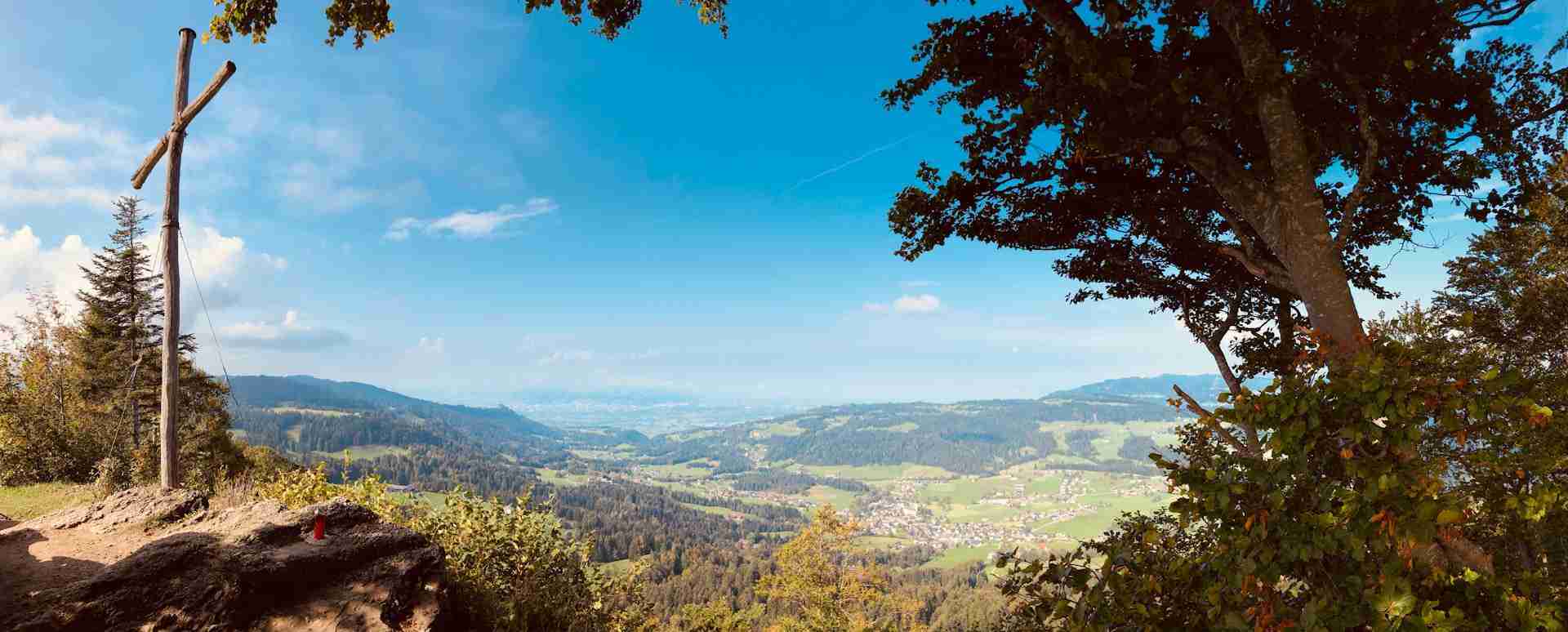
Brüggelekopf rises above the Bregenzerwald as a broad, open summit where lines of land and sky meet with minimal interruption. Located near the village of Alberschwende in Vorarlberg, Austria, this gentle peak offers photographers an opportunity to work with clean ridgelines, layered valleys, and shifting alpine light without the technical challenges of more remote or rugged mountains. The summit is easily accessible, making it ideal for sunrise, sunset, or fog-filled mornings when atmospheric conditions change quickly. From long-lens compression of distant silhouettes to wide-angle frames of rolling grassland and subtle light, Brüggelekopf supports slow, deliberate image-making in an uncrowded setting where form and tone take priority over drama.
Best Photography Opportunities
Wide Ridgeline Views from the Western Approach
As you approach the summit from the west, the trail gradually lifts above the treeline and opens onto a sweeping ridge. This area provides strong environmental frames, especially in the early morning when soft light moves across the slope. A wide-angle lens allows you to work close to the ground and lead the viewer's eye toward the horizon. Grassy texture and scattered alpine wildflowers give useful foreground structure without cluttering the frame. On clear days, distant peaks rise in soft layers beyond the far edge of the meadow. These views work well when shot low with a tripod, keeping lines clean and depth consistent across the field.
Fog Layers and Valley Compression at Sunrise
During early spring and autumn, fog often settles into the lower valleys below Brüggelekopf. From the summit or just below, you can work with long lenses to compress the distant hills and create stacked layers of tone and form. A 70 to 200 millimeter or 100 to 300 millimeter lens is ideal for isolating ridge lines and finding repetition in shape. These images are strongest during sunrise when the fog begins to lift and light filters through at an angle. Use a fast shutter speed to capture clean separation between layers as the fog shifts. These conditions often hold for only a short window, so plan to be in position before first light.
Backlit Grass and Shadow Lines in Late Afternoon
As the sun lowers toward the west, golden light crosses the upper slope of Brüggelekopf and creates strong contrast between lit grass and deepening shadow. This is a good time to isolate small compositions using the path, rock clusters, or scattered pines. A mid-range zoom allows for flexible framing, especially if clouds are present and breaking light into narrow bands. The transition between sunlit and shaded areas adds rhythm to the landscape and helps shape visual flow. Bring a tripod if you want to work with slower shutter speeds during the final moments of sunset.
Minimalist Compositions in Overcast Conditions
Flat light from overcast skies can help simplify the wide openness of Brüggelekopf into clean, tonal compositions. With soft shadow and no direct glare, you can shoot wide scenes with more control over exposure and balance. This is especially effective for black and white work or subtle color frames with a strong graphic component. Position the horizon low or high in the frame to emphasize space and isolation. These are quiet images that benefit from careful framing and attention to negative space.
Night Photography with Skyline and Star Detail
Brüggelekopf offers relatively low light pollution compared to other nearby peaks. On clear nights, it is a strong location for night sky photography, especially during new moon phases. Use a wide, fast lens and a tripod to capture the Milky Way or long exposures with star trails. From the summit, you can also include distant glow from Bregenz or Dornbirn as ambient tone in the lower frame. Make sure to arrive with time to set up before full dark, as the last light often defines the ridge shape in early frames. Keep compositions simple, with one dominant form or skyline shape to anchor the stars above.
Best Time to Visit
Brüggelekopf is productive in nearly every season, but spring and autumn offer the richest conditions for light and structure. In spring, the grasses return in soft green, and snow still clings to distant ridges, adding contrast and color balance to long frames. Fog is common during these months, especially at sunrise when temperature shifts encourage low cloud to form in the valley.
Autumn brings golden fields and lower sun angles, which make side light more dramatic across the open slopes. These conditions favor both wide compositions and detail work. The days remain clear, and the light stays warm from sunrise through late afternoon.
Winter visits are possible when snow is shallow and the trail remains walkable. The summit becomes a clean surface for high-key frames or minimalist compositions. Summer offers the clearest skies and easiest access, though midday light can flatten the scene. Plan for sunrise or golden hour to get the most shape from the land.
How to Get There
Brüggelekopf is located above the village of Alberschwende in the Bregenzerwald region of Vorarlberg, Austria. The simplest access point is the Brüggele Alpenhotel, which sits just below the summit. From there, a marked trail leads upward through open terrain and reaches the peak in about twenty to thirty minutes.
The trail is easy to follow and suitable for moderate walking without technical equipment. Parking is available near the hotel, and the area is accessible by car from Bregenz in under forty minutes. There is no fee to access the trail or summit, and no restrictions on photography. Tripods are allowed, and the open summit makes setup simple from nearly any angle.
Weather can change quickly in the higher terrain, so check local forecasts before visiting, especially during winter or early spring. The route is generally safe, but avoid the trail during strong wind or fog unless properly equipped.
Recommended Photography Gear
A 16 to 35 millimeter wide-angle lens will cover most of the summit compositions, especially for ridge shots and sky-heavy frames. A 24 to 70 millimeter zoom is excellent for golden hour and for combining foreground detail with clean horizons. For isolating valley layers, distant peaks, or tree lines, a 70 to 200 millimeter or longer telephoto lens is essential.
Bring a tripod for sunrise, sunset, and any long exposures. A circular polarizer helps control glare on grass and deepen sky contrast, particularly on bright days. A neutral density filter between three and six stops is useful for slowing shutter speeds during long cloud movement or smoothing wind-blown grass. Include a microfiber cloth to manage morning condensation or mist.
Footwear should support uneven ground and wet grass. Carry your gear in a light, weather-resistant pack with room for layers, water, and basic safety items. The weather shifts quickly at this elevation, so prepare for changing light and possible cold even in summer mornings.
Nearby Photography Locations
Just west of Alberschwende, this ridge offers views over Dornbirn and the lowlands beyond. It works well during sunrise when fog sits in the valleys and the ridge stays sharp against open sky. The area is accessible by car and includes several side paths for building layered compositions.
This peak above Dornbirn is reachable by cable car and provides a steep, forested overlook across the valley. In the evening, lights from below add interest to wide twilight shots. The platforms and trails offer structure for framing and contrast with the natural slope.
This small alpine town has traditional wooden houses, open farmland, and preserved rural detail. It photographs well during soft light in early morning or evening. Use a short lens to capture environmental portraits or narrow focal lengths for framing rooflines and window texture.
Lank and Hochälpele Trails
Just south of Brüggelekopf, this network of trails climbs through varied elevation with views toward alpine lakes and distant ridge lines. These areas offer longer hiking routes and more varied light conditions throughout the day.
Lake Andelsbuch
East of the Bregenzerwald, this small alpine lake reflects strong sky color during sunset and is surrounded by forest and meadow. It works well with simple compositions that pair water and sky. Arrive early to find clean reflections before wind disturbs the surface.
Brüggelekopf does not rely on dramatic height or jagged form. Instead, it offers a place where air, light, and land work together in quiet alignment. For photographers who value clarity, simplicity, and wide open space, it remains one of the most consistent and rewarding ridgelines in Vorarlberg.
Comments
Loading comments…