
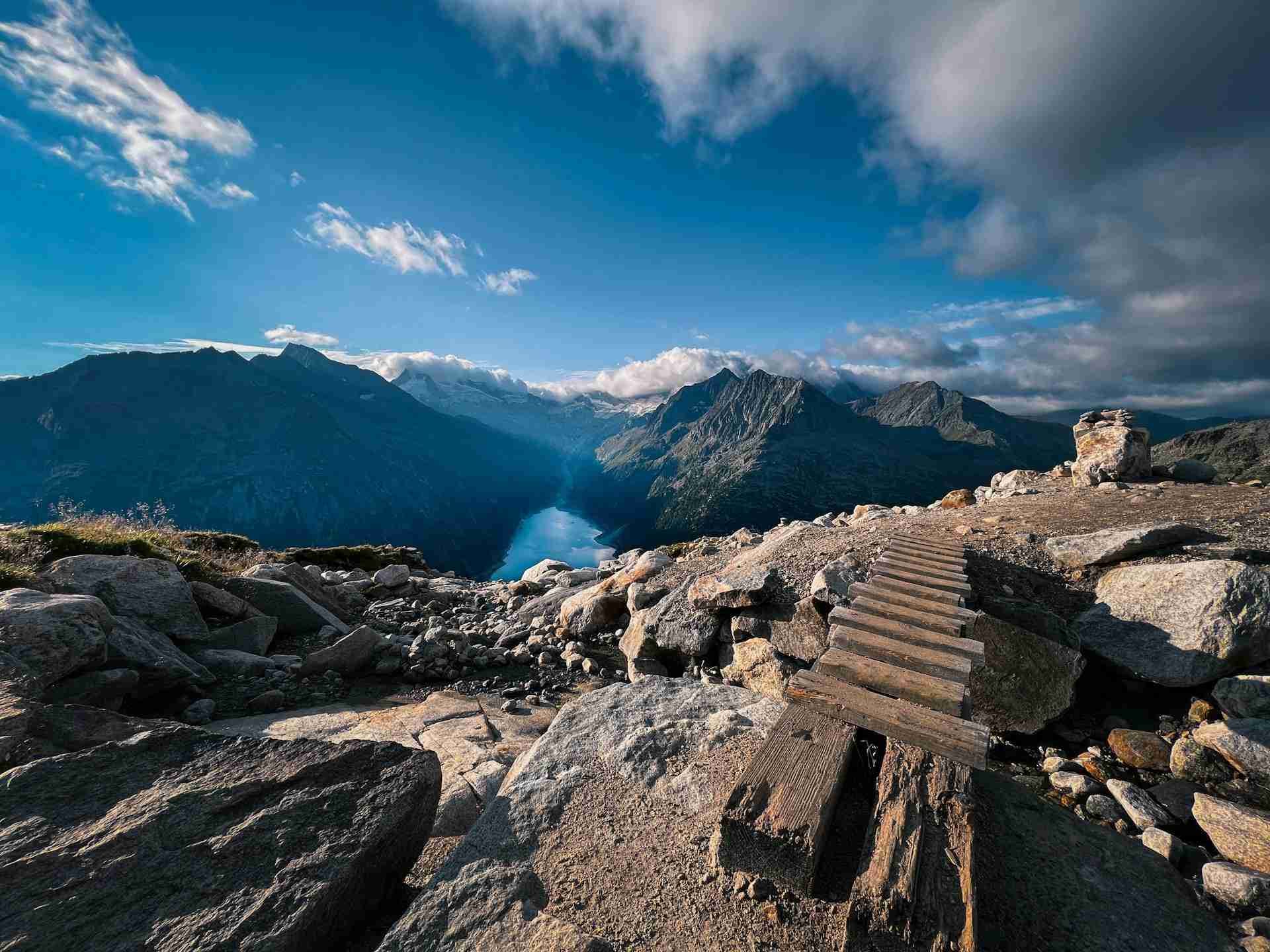
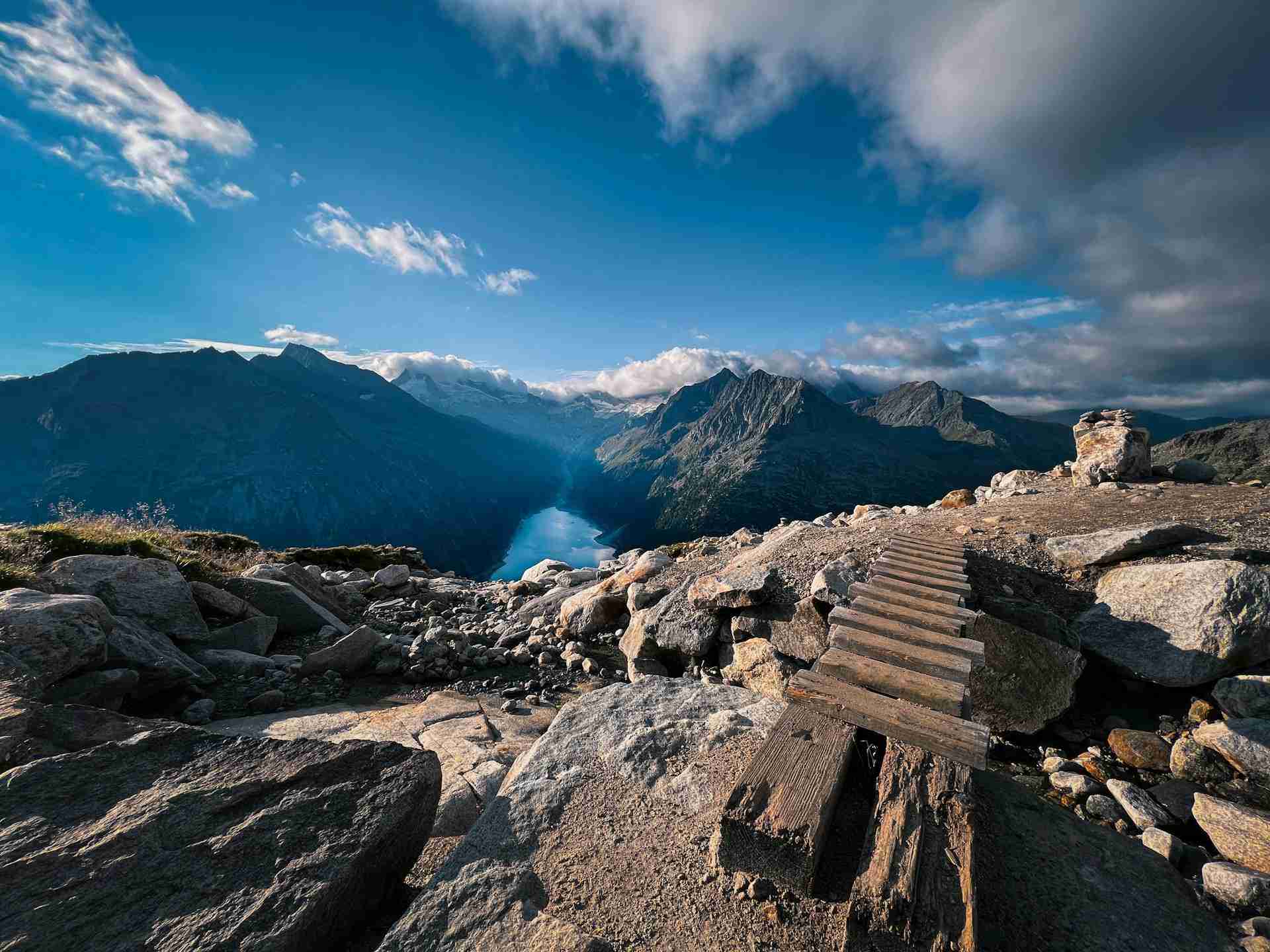
Olpererhütte is a high-alpine refuge in the Zillertal Alps that offers one of the most photogenic vistas in Austria. Perched at 2,389 meters above sea level, it overlooks the vast turquoise waters of the Schlegeisspeicher reservoir, backed by jagged granite peaks that mark the border between Austria and Italy. The hut's surroundings offer more than just a place to rest—this location has become iconic among photographers, hikers, and mountain enthusiasts alike. The dramatic terrain and ever-changing light make it an ideal destination for capturing both classic alpine compositions and more experimental atmospheric frames.
Most visitors come for the panoramic views, but the real photographic draw is the suspension bridge located a short distance from the hut. Spanning a deep gorge, it frames the peaks and reservoir below in perfect symmetry, making it one of the most recognizable scenes in the Alps. Whether you're photographing the structure itself, the hikers crossing it, or the landscape beyond, the visual opportunities surrounding Olpererhütte are as dynamic as the alpine weather. This is a location that rewards thoughtful planning, an early start, and an eye for scale.
Best Photography Opportunities
• Suspension Bridge with Schlegeisspeicher Reservoir
This iconic bridge near Olpererhütte is arguably the most sought-after composition in the region. With the Schlegeisspeicher reservoir positioned directly behind it and the jagged Zillertal peaks in the distance, the scene offers perfect symmetry and a clear focal point. Photographers often frame a single hiker standing in the middle of the bridge to emphasize the sheer scale of the surrounding landscape. A wide-angle lens between 16–24mm works best to capture both the bridge and the sweeping backdrop, while a polarizer enhances the blue tones of the reservoir below. Visit during early morning or golden hour to avoid harsh shadows and crowds, and to take advantage of soft, directional light that defines the ridges.
• Elevated Vantage Point Behind the Hut
For a broader composition that includes the hut, bridge, and valley below, hike the short incline behind Olpererhütte. This elevated position gives a more layered perspective, ideal for showcasing how the manmade structures interact with the natural landscape. From this angle, you can work with leading lines formed by trails and ridgelines, especially in the early evening when warm light falls across the hut's timber roof and the mountain slopes behind it begin to cool in tone. A mid-range zoom lens around 24–70mm offers enough flexibility to frame tight or wide, depending on the foreground interest.
• Long Exposure and Atmospheric Conditions
Due to its elevation and open exposure, the area around Olpererhütte often experiences rapidly shifting weather, which adds a dynamic element to long exposure work. Cloud movement over the peaks or fog spilling into the valley below creates opportunities for layered, ethereal compositions. Shooting from the rock outcrops near the bridge or beside the hut, use a tripod and ND filters to extend shutter speed and blur cloud movement, giving the image a sense of motion and mood. The unpredictable alpine conditions reward photographers who are willing to wait for the moment when sun breaks through mist or cloud layers drift into just the right position.
• Night Photography and the Milky Way
With virtually no light pollution in the immediate area, Olpererhütte is a fantastic base for capturing the night sky. The best compositions face south across the reservoir, where the Milky Way often arcs directly above the peaks. Position your foreground with the suspension bridge or hut to anchor your frame, and shoot with a fast wide-angle lens (f/2.8 or faster). Plan your visit around a new moon between June and August for the clearest galactic visibility. Foreground illumination can be achieved using a low-output headlamp or ambient moonlight when available, though careful balancing is required to preserve the sky's detail.
• Macro and Detail Work Around the Hut
While the wide landscapes dominate attention, smaller scenes around Olpererhütte offer a completely different set of photographic opportunities. Alpine wildflowers, weathered wood, frost-covered rocks, and glacial melt trickles provide rich textures and seasonal variation. A macro or fast prime lens allows you to isolate these elements with shallow depth of field, creating contemplative images that counterbalance the grandeur of the broader views. Misty mornings and overcast skies are especially well-suited for this style, reducing contrast and allowing surface details to take center stage.
Best Time to Visit
The ideal time to visit Olpererhütte for photography is between late June and mid-September, when the trail is typically snow-free and the surrounding alpine flora is at its peak. Within this window, July and August offer the longest daylight hours and most stable weather, though these months are also the busiest. For more dramatic skies and quieter trails, early September is an excellent alternative, offering golden light and the first touches of autumn color on the high alpine vegetation.
Lighting conditions vary significantly with the time of day. Early mornings bring crisp clarity and calm air, ideal for shooting clean reflections and unobstructed mountain ridges. Late afternoon and golden hour offer warm tones across the hut and bridge, with directional light that casts deep shadows and emphasizes terrain contours. Blue hour adds a moody stillness, while nighttime opens the door to astrophotography under some of the clearest skies in the Austrian Alps.
Weather can change rapidly at this altitude, so it's best to plan for both sun and storm. Dramatic clouds, passing mist, or even light snowfall in early or late season can all contribute to powerful atmospheric images. Be aware that access to the reservoir below is typically only possible from late May to mid-October, and snow may linger on upper slopes well into June.
How to Get There
Olpererhütte is accessed from the Schlegeisspeicher reservoir, which is located above the village of Ginzling in the Zillertal Valley. To reach the trailhead, take the scenic Schlegeis Alpine Road, a seasonal toll road that is usually open from late May until mid-October. The road winds up through tunnels and switchbacks, offering several viewpoints along the way before arriving at a large parking area near the dam.
From the parking lot, the trail to Olpererhütte is clearly marked and takes between 1.5 to 2 hours to hike, depending on pace and trail conditions. The path gains approximately 600 meters in elevation and includes rocky sections, switchbacks, and exposed areas. Good footwear and basic alpine preparedness are essential. While the trail is popular, it is not overcrowded early in the day, and hiking up at sunrise or returning in golden hour provides the best photographic conditions.
There is no fee to hike the trail or visit the hut, though the alpine road requires a toll. Overnight accommodation at the hut is available and highly recommended for those wanting to photograph sunrise, sunset, or night skies without descending in the dark. Meals, drinks, and lodging can be booked in advance, especially during peak season.
Recommended Photography Gear
Photographing Olpererhütte and its surroundings requires a well-curated but versatile kit. A wide-angle lens (16–35mm) is crucial for capturing the expansive views of the bridge and the Schlegeisspeicher reservoir. A standard zoom (24–70mm) gives you flexibility to frame environmental portraits, trail scenes, and more balanced compositions that combine subject and setting.
A telephoto lens (70–200mm) allows you to isolate distant ridgelines, compress layered scenes, or pick out hikers and features on the far side of the reservoir. For night and low-light work, bring a fast wide-angle prime and a tripod capable of withstanding wind. ND filters help with long exposures of sky or water, while a circular polarizer can deepen sky contrast and reduce glare on reflective surfaces.
Don't forget a microfiber cloth, weatherproof bag cover, and spare batteries—alpine temperatures and sudden storms can be hard on gear. A headlamp is essential for pre-dawn or night shooting, and snacks or water are helpful for longer sessions near the hut or out on trail.
Nearby Photography Locations
Before beginning your hike or after descending from the hut, spend time along the reservoir's shoreline. The mirrored surface of the lake reflects the alpine walls around it in early morning or late evening, creating tranquil compositions with strong symmetry. Use the stone pathways, dam architecture, or occasional alpine cabins as compositional anchors.
The route continuing from Olpererhütte toward Friesenberghaus opens up more isolated and less traveled terrain. This section of the Berliner Höhenweg crosses high ridgelines and wide-open slopes with continuous views over the Zillertal valley. It's ideal for longer photo hikes and capturing scale with hikers set against immense alpine backdrops.
• Pfitscherjoch and Italian Border Views
Located to the south of Schlegeisspeicher, the historic Pfitscherjoch pass offers a different perspective on the alpine landscape. From here, you can photograph both Austrian and Italian peaks, glacial valleys, and distant ridges under shifting light. The route is longer but relatively gentle, with quiet surroundings perfect for dramatic environmental work.
• Dominikushütte and Lower Dam Views
This lakeside hut sits at the base of the reservoir and provides a good spot for early morning reflections or midday breaks. From here, you can shoot up toward Olpererhütte perched high above, capturing the full vertical relief between lake and peak. It also provides strong foreground interest for wider compositions of the dam and valley.
• Zamsereck Viewpoint
For the adventurous, a steep scramble beyond Olpererhütte leads to Zamsereck, a rocky outcrop offering commanding views over the entire Schlegeis basin. It's the place to go for 360-degree panoramas and complete solitude. The light here changes rapidly, and the elevation allows for dramatic aerial-style perspectives of the valley floor far below.
Whether you're pausing to shoot the stillness of a mountain reflection or bracing against the wind to capture the first stars rising over the peaks, Olpererhütte offers an experience as rewarding as the images you'll carry home. It's a location where every step is part of the story, and every angle reveals another reason why this alpine hut continues to capture the imagination of photographers from around the world.
Comments
Loading comments…