
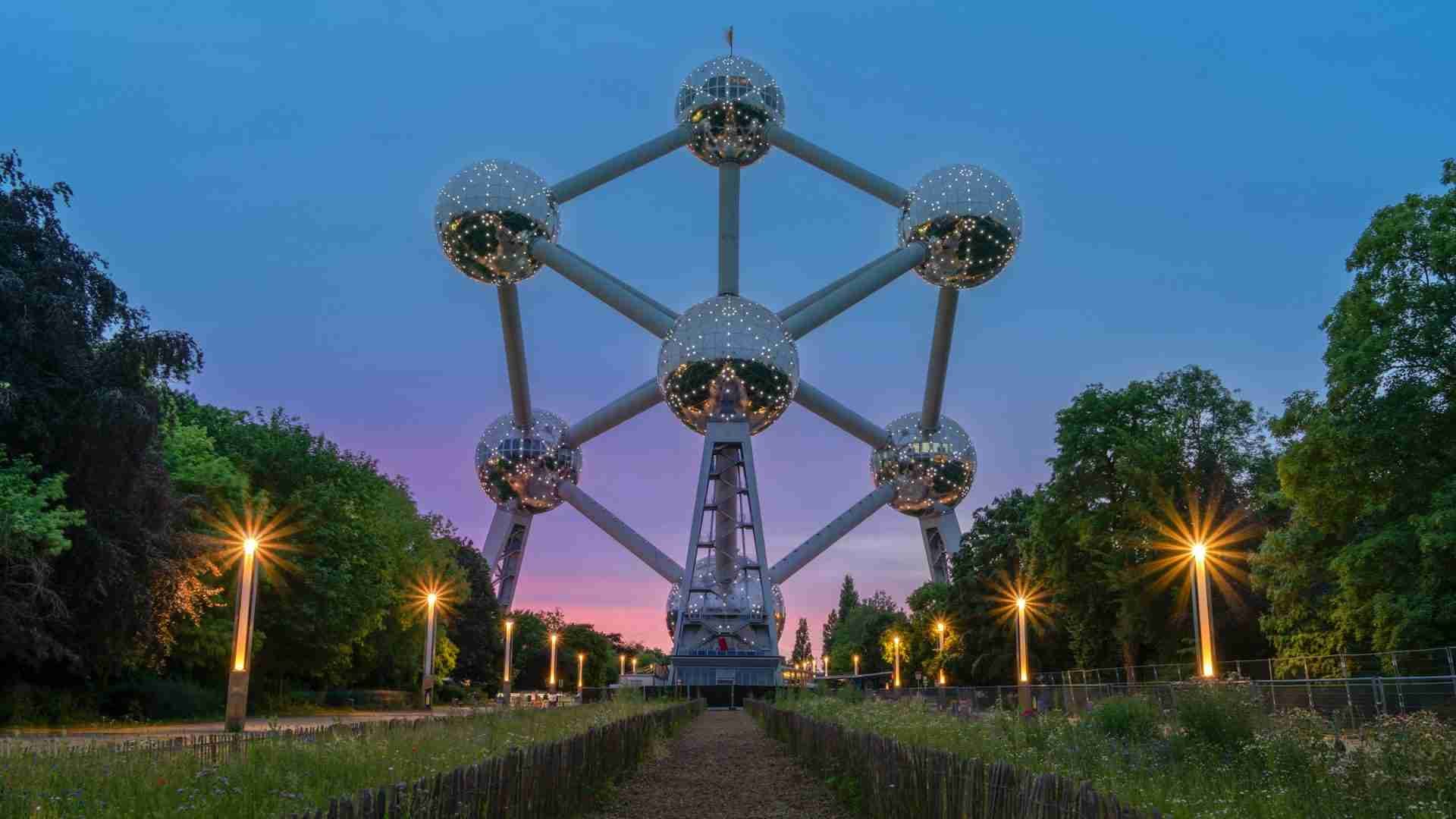
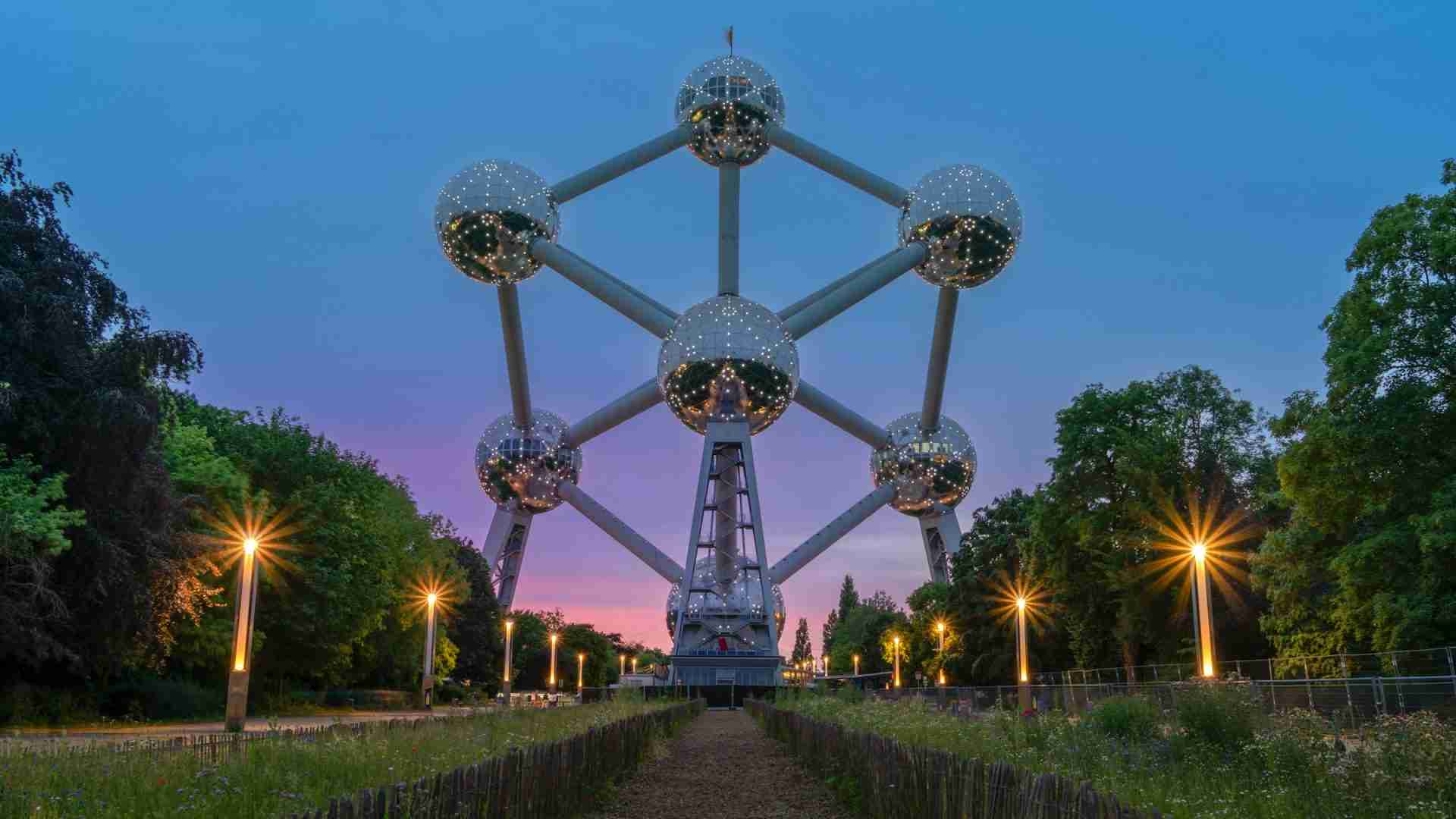
Atomium is one of Brussels' most recognizable landmarks, originally built for the 1958 World Expo. Designed to represent an iron crystal magnified 165 billion times, the structure consists of nine stainless steel spheres connected by tubular corridors. Its scale and symmetry make it immediately striking, especially when viewed from a distance across the surrounding parkland. The polished metal surfaces reflect sky and light in constantly changing ways, which gives photographers a dynamic subject even when standing in one spot. Unlike many historic landmarks in Brussels, the Atomium feels futuristic and geometric, offering a completely different visual language. It is a structure that rewards attention to alignment, scale, and the interaction between curved forms and open sky.
Best Photography Opportunities
• Wide Views Emphasizing the Full Structure
Stepping back across the open lawns allows the entire Atomium to be framed cleanly. From these positions, the nine spheres read clearly as a connected system rather than as isolated elements. Small changes in position alter how the tubes overlap and how symmetrical the structure appears. A moderate wide lens works well, provided verticals are kept under control. These compositions are strongest when the sky has subtle texture without overwhelming the subject.
• Low Angles Highlighting Scale
Photographing from a lower vantage point exaggerates the height and curvature of the spheres. This approach emphasizes the futuristic feel of the structure and strengthens the visual impact of the connecting tubes. Careful framing prevents the spheres from merging awkwardly with one another. Including a small section of foreground lawn can help ground the composition. This perspective works especially well when clouds move across the sky.
• Abstract Studies of Spheres and Reflections
Closer compositions focusing on individual spheres allow you to explore reflections and surface texture. The stainless steel mirrors surrounding trees, people, and sky in distorted patterns that can be used creatively. Longer focal lengths help isolate sections of the structure and remove distractions. Reflections change quickly with light and movement, making it worthwhile to stay in one area and observe. These images shift the focus from documentation to abstraction.
• Framing Through the Connecting Tubes
From certain positions, the tubular corridors can be used to frame other spheres or portions of sky. This layered approach creates depth and reinforces the structure's interconnected design. Slight shifts in angle dramatically change how lines intersect. Even light helps preserve detail across bright metal surfaces. This technique works well when you want to emphasize geometry over scale.
• Night Photography With Illumination
After dark, the Atomium is illuminated, and the spheres glow against the night sky. Long exposures allow you to capture both the structure and subtle ambient light in the surrounding area. A tripod is essential for sharp results. The reflective surfaces take on a different character at night, appearing smoother and more uniform. These images often feel calmer and more graphic than daytime shots.
Best Time to Visit
Early morning and late afternoon provide the most balanced light for photographing the Atomium. Morning often brings softer contrast and fewer visitors, making it easier to compose clean frames. Late afternoon adds warmer tones and directional light that enhance the curvature of the spheres. Midday can create strong highlights on the stainless steel, which require careful exposure control. Overcast conditions are useful for abstract work, as they reduce glare and even out reflections. Night offers a completely different atmosphere once the structure is lit, and blue hour provides a particularly pleasing balance between sky and artificial light. Seasonal differences mainly affect crowd levels and sky conditions rather than the structure itself.
How to Get There
The Atomium is located in the northern part of Brussels within the Heysel area. It is easily reached by public transport, including metro and tram connections that stop nearby. The surrounding parkland provides open space and multiple vantage points without restricted access. There is an entrance fee to access the interior spheres and exhibitions, though exterior photography from public areas is free. Walking paths around the site make it simple to move between viewpoints. Arriving early helps avoid crowds, especially during peak travel seasons.
Recommended Photography Gear
A standard zoom lens covers most needs, from wide architectural views to tighter abstract studies. A short telephoto lens is useful for isolating individual spheres and working with reflections. A tripod is recommended for night photography and blue hour sessions when shutter speeds lengthen. A polarizer may help reduce glare in certain conditions, though its effect on reflective metal surfaces can vary. Keeping the camera level is important to maintain structural accuracy. Since the site is open and accessible, carrying a manageable kit allows flexibility in exploring different angles.
Nearby Photography Locations
Located beside the Atomium, this park features scale models of European landmarks. It offers a different kind of architectural subject in a compact setting.
The surrounding park provides open lawns, tree lines, and seasonal color. It works well for contextual images with the Atomium in the background.
These glass structures introduce intricate metalwork and reflective surfaces that contrast with the Atomium's spherical forms.
The broader area includes additional modern structures and open plazas. It provides alternative vantage points and urban context.
In central Brussels, Grand Place offers ornate historic architecture. It provides a strong stylistic contrast to the futuristic design of the Atomium.
Comments
Loading comments…