
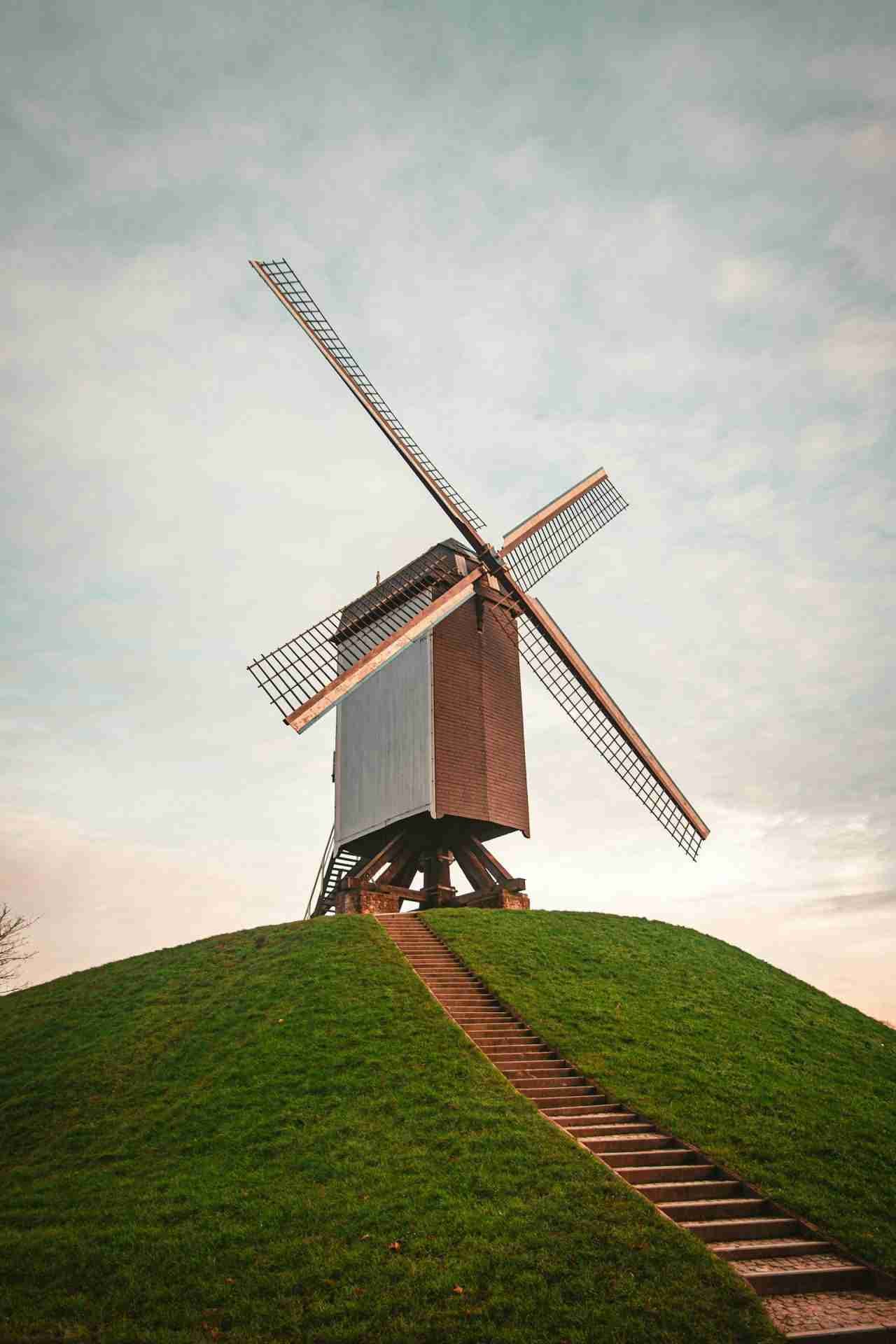
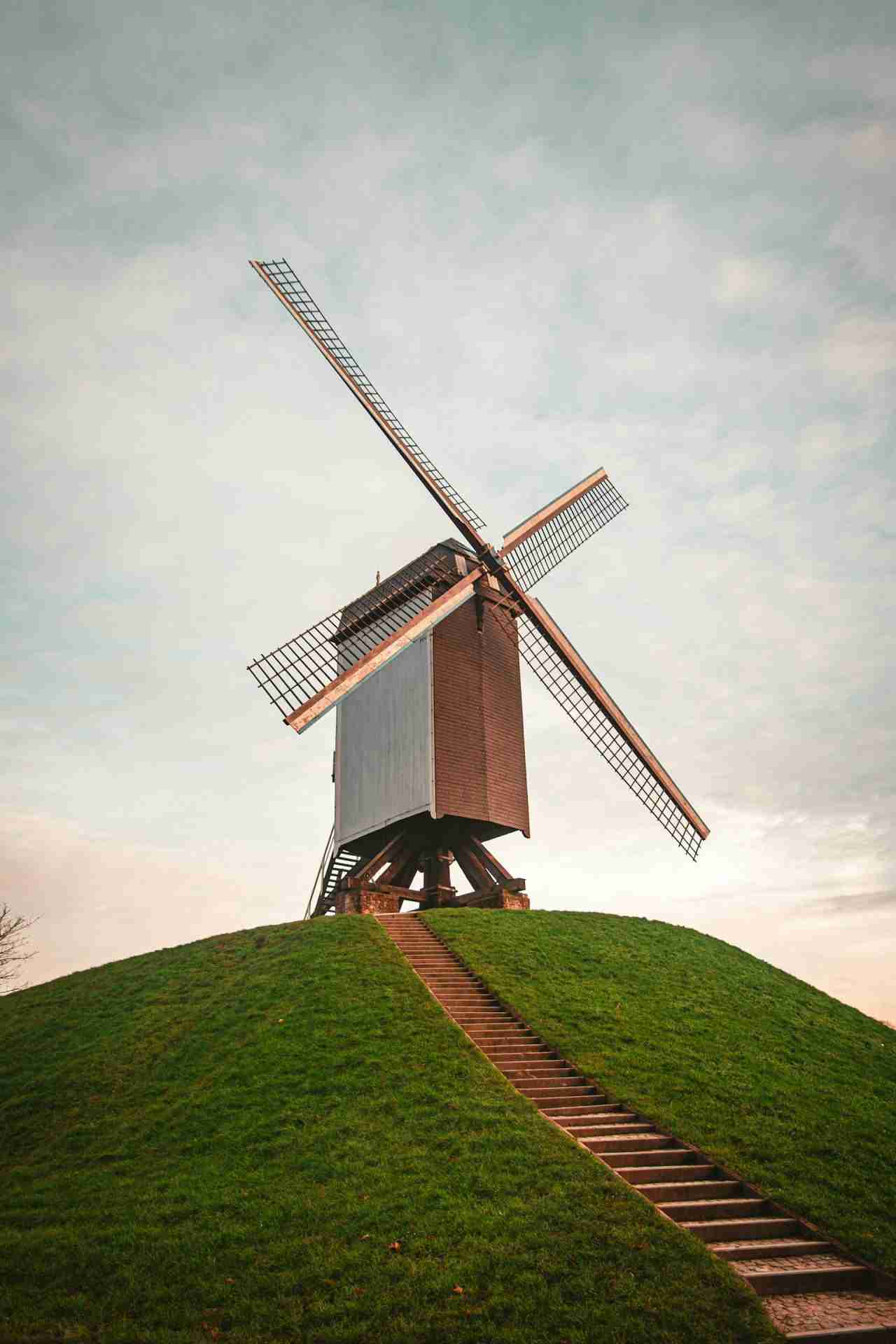
Bonne-Chière Mill, perched just beyond the historic center of Bruges, Belgium, is one of the city's last surviving windmills still standing on its original rampart location. Unlike more densely situated city scenes, this subject is surrounded by open sky, green embankments, and wide footpaths, allowing for clear compositions from multiple angles. The mill's red-painted wooden structure and high placement on a grassy mound offer strong visual geometry, especially when set against the soft skies typical of Belgium's coastal climate. Photographers visiting this location will find that it balances solitude with historic charm, offering quiet, unfussy frames that focus on shape, color, and natural light rather than crowds or visual clutter.
Best Photography Opportunities
• Frontal Composition with Elevated Path Leading In
One of the strongest compositions comes from the base of the access stairs on the south side of the mound. Shooting up the steps with a wide-angle lens provides natural leading lines that draw the viewer directly to the mill, with the angular blades forming a central point of focus. Early morning light from the east gently illuminates the front surface of the structure, creating soft shadows that add dimensionality. Framing this scene low and symmetrical enhances the formal qualities of the structure and makes the most of the open space around it. Including the path and grass in the foreground helps anchor the scene with subtle texture.
• Side Views for Blade Movement and Sky Contrast
The mill's position allows for unobstructed side views, perfect for capturing the full extension of the blades against sky. These compositions benefit from longer focal lengths between 50mm and 85mm, which help compress the subject and make the sky more dominant in the frame. If there is cloud movement, you can use a neutral density filter and a tripod to introduce motion blur to the sky while keeping the structure crisp. The blades are typically static, but longer exposures still add atmosphere through cloud shift or light trails if you time your visit at dusk.
• Reflections from the Adjacent Canal
Although not directly on the water's edge, the Bonne-Chière Mill can still be framed from across the adjacent canal to include partial reflections. Use the footpath on the far side of the water to position your shot and include trees, grass, and ripples in the composition. This is most effective in the early morning or after rainfall when water levels are higher and movement is minimal. A polarizing filter helps manage glare and enhances the surface texture of the reflection. For added interest, wait for a passerby or cyclist to enter the frame to give scale and human context.
• Isolated Detail Studies of Color and Structure
The red-painted body of the mill contrasts well with the greens and neutrals of its surroundings, making it an ideal subject for tight compositions. Use a short telephoto lens to capture the joints where the beams meet, or focus on the patterns of wear in the paint and wood. Late afternoon light warms the red tones and reveals subtle texture in the siding. These studies work well as part of a series or to pair with wide views in a portfolio. If shooting handheld, adjust exposure carefully to preserve highlight detail in the brighter painted surfaces.
• Twilight Frames with Sky Gradient and Silhouette
As the sun sets to the west, the mill becomes a strong silhouette against the gradient of the sky. From the northeast, you can position yourself so the setting sun is just off-frame and allows the blades to stand out cleanly in profile. These twilight conditions work best with a tripod and a mid-range zoom to fine-tune framing without cropping in post. Including the horizon low in the frame places emphasis on the sky and keeps the composition uncluttered. A subtle gradient from warm to blue in the sky can be enhanced with minor post-processing for a quiet, minimalist feel.
Best Time to Visit
The best time to photograph Bonne-Chière Mill is during the golden hours when the low sun angle enhances texture and casts soft light across the mound and structure. Morning light from the east works well for frontal compositions and reflections, while late afternoon and early evening offer more warmth for side lighting and silhouettes.
Bruges often has overcast skies, especially in autumn and winter, which work surprisingly well for this subject. The diffused light softens shadows and flattens contrast, ideal for photographing the saturated red tones of the mill without harsh highlights. Fog or mist in the early morning can add an extra layer of atmosphere, particularly when working with distant compositions or shooting toward the canal.
Summer offers longer shooting windows and more dramatic skies, but the site can also be busier with walkers and cyclists. For quieter conditions, arrive early or on weekdays when the park paths are less trafficked.
How to Get There
Bonne-Chière Mill is located along the Kruisvest on the eastern edge of Bruges' historic center. It is part of a series of windmills on the old city ramparts but sits slightly apart from the others, giving it a more isolated and photogenic setting. From the city center, it's about a 15-minute walk or a short bike ride. The path along the ramparts is pedestrian- and cyclist-friendly, and signage is clear throughout.
There is no entrance fee or fencing around the mill, though the interior is not open to visitors. Photographers are free to walk around the entire structure and climb the stairs leading up the mound, though tripods should be used carefully to avoid blocking foot traffic on narrow paths. Public parking is available nearby, but the best way to arrive is on foot or by bicycle, especially if you plan to shoot other windmills along the same stretch.
Recommended Photography Gear
A wide-angle lens in the 16 to 35mm range is essential for capturing the entire windmill in tight spaces and using foreground textures to lead into the subject. A mid-range zoom, such as 24 to 70mm, allows for balanced compositions with flexibility when framing from across the canal or along the adjacent paths. For isolating textures and architectural details, a short telephoto lens from 85mm to 135mm gives sharp, clean results without the need to move in too close.
A tripod is strongly recommended for twilight shooting, long exposures, or reflection work across the canal. A polarizing filter helps with water surfaces and saturated skies, while a neutral density filter allows for controlled motion blur in sky or cloud-heavy frames. Bring a lens cloth, as damp coastal air and wind can leave condensation on gear, especially in early morning or after rain.
Keep your setup lightweight and weather-resistant, as the area is open and can be breezy. If you're cycling to the site, use a compact gear configuration that can be packed quickly in a camera backpack.
Nearby Photography Locations
Another windmill along the same rampart path, this mill is often more photographed but sits closer to nearby trees and roads. It offers strong early morning light and a denser background that suits more layered compositions.
• Langestraat and the Eastern Canal Loop
A short walk from the mill, this stretch of canal features bridges, traditional houses, and calm water perfect for reflections. Best visited during golden hour for light striking the facades.
Located on the southern edge of the city center, this park surrounds the Lake of Love and offers compositions that blend water, bridges, and historic towers. Ideal for twilight photography or quiet compositions with foreground interest.
A UNESCO-listed site with whitewashed houses and cobbled paths. It's ideal for quiet architectural studies and detail photography, especially in soft morning light.
For those shifting to urban architecture, Burg Square offers high-relief Gothic buildings with ornate stonework and strong compositional lines. Try working with shadows and early morning light to bring out structure without foot traffic.
Bonne-Chière Mill may not be the tallest or most visited subject in Bruges, but it delivers a peaceful, clean, and highly adaptable scene for photographers. The structure's simplicity and placement make it easy to isolate, and its interaction with light and weather shifts daily. Whether you're shooting wide with foreground grass or focused tightly on its weathered panels and blades, the mill offers a timeless anchor in a modern setting.
Comments
Loading comments…