
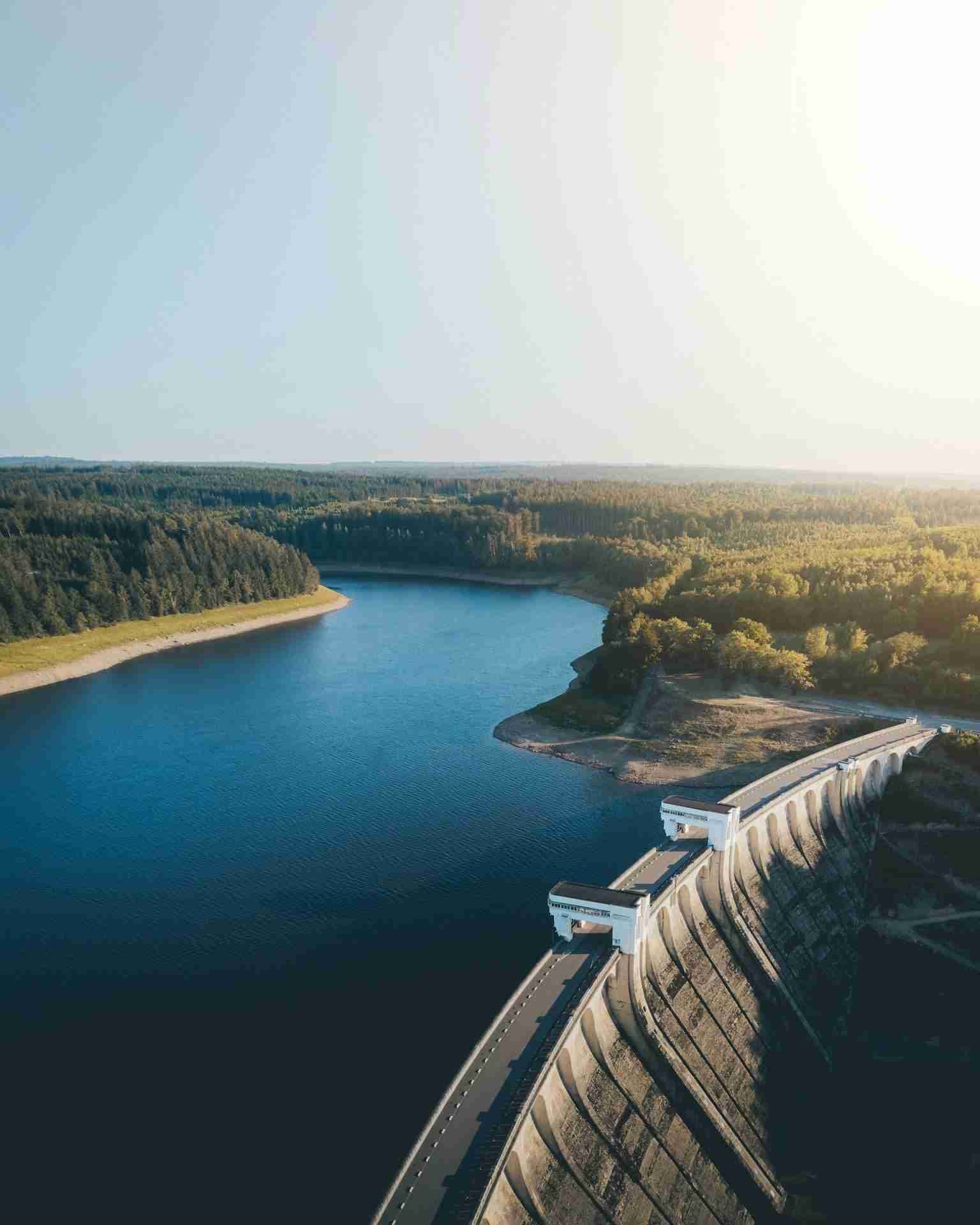
Tucked into the High Fens of eastern Belgium, Eupen Lake is a quiet reservoir surrounded by dense coniferous forests and moorland terrain. Built in the early twentieth century to supply drinking water to the region, the lake's dam and surrounding infrastructure blend seamlessly with the natural landscape. The calm surface of the reservoir mirrors the sky and surrounding pines, offering striking symmetry for landscape photographers, while the dam itself provides a stark contrast of engineered form amid an otherwise organic environment. Throughout the year, Eupen Lake changes character with the seasons—from icy calm in winter to misty mornings in spring and golden reflections in autumn. For photographers looking to combine water, forest, and structure in a single shoot, Eupen Lake provides a remarkably balanced and flexible subject.
Best Photography Opportunities
• Symmetry Across the Reservoir
: One of the lake's strongest visual features is the stillness of its surface, which on calm days reflects the forest and sky with mirror-like precision. Wide-angle compositions from the lake's eastern or southern edge allow you to use the shoreline or overhanging trees as natural frames. In the early morning, low light grazes the water and creates soft tonal gradients that are ideal for moody or minimalist shots. During foggy mornings, the reflected tree line becomes a faded double that seems to dissolve into the air. Shooting during blue hour enhances the lake's calmness, especially when paired with long exposures that smooth out any surface movement.
• Dam Architecture and Water Flow
: The Eupen Dam is not large in scale, but its clean geometry and textured stonework stand out strongly against the forested hills. Viewed from the access path or from slightly elevated trails nearby, the dam can be framed with a combination of water and retaining structures to highlight the intersection between nature and engineering. Use a mid-range zoom lens to compress the structure and its reflection for a layered composition. During periods of heavy rain or runoff, the outflow becomes visible and adds motion and contrast to an otherwise still environment. Long exposure techniques here can be used to blur the water and create a smoother texture below the spillway.
• Autumn Color and Forest Layers
: In October and early November, the beech and birch forests surrounding Eupen Lake reach peak color. The golden canopy contrasts with the deep greens of the surrounding spruce and pine, creating complex layers of tone and texture in both the foreground and background. This is an excellent time for telephoto compositions that isolate color blocks and patterns in the forest walls. Reflections of the autumn foliage on the reservoir create rich diagonals and overlapping lines that are particularly effective when shot from above. The steep banks around the lake offer multiple vantage points to experiment with layering and depth.
• Moorland Trails and Elevated Vantage Points
: A series of trails and forest roads encircle the lake and lead toward the fringes of the Hautes Fagnes plateau. These areas open up into moorland clearings that give a different perspective on the lake and allow for high angle shots. In winter or early spring, frost on the ground and low-angle light over the hills can introduce subtle gradients and a cooler, more subdued palette. Including elements like bare branches, moss-covered rocks, or trail curves in the foreground helps anchor compositions and lead the eye toward the water. These perspectives are best explored on foot, with time set aside to scout variations in elevation and tree cover.
• Night Photography and Reflected Sky
: Though light pollution in the area is moderate, Eupen Lake offers promising opportunities for night photography on clear evenings. The still water surface creates a unique opportunity to reflect the night sky, and the surrounding forest forms a clean silhouette for starry compositions. Shooting toward the south or southeast avoids the more illuminated areas near the town of Eupen. A wide-angle lens and exposures between fifteen and thirty seconds allow for detailed captures of star clusters above the tree line. In colder months, steam rising from the surface can introduce atmospheric layers to night compositions, especially in early morning hours just before sunrise.
Best Time to Visit
Eupen Lake offers year-round photographic potential, but the experience and subject matter change significantly by season. Spring and autumn are particularly rewarding, with soft light, variable weather, and dynamic skies that complement the lake's reflective surface. In spring, morning mist often drifts across the reservoir, while autumn delivers color contrast and richer light in the late afternoon. Summer is greener and more consistent, though mid-day light tends to flatten compositions unless cloud cover is present.
Early morning and late afternoon remain the best times to photograph the lake and dam, with golden hour providing warmth and side lighting that enhances texture on both water and structure. In winter, clear days bring crisp air and occasional frost or ice along the shoreline. Snowfall, when present, simplifies the landscape into strong graphical contrasts between dark water and white-covered forest. For night photography, the new moon phase in autumn or winter offers the darkest skies and the highest chance of capturing stars or sky reflections.
How to Get There
Eupen Lake is located just south of the town of Eupen in the German-speaking region of Belgium. From Eupen, follow signs to the Wesertalsperre or Eupener Talsperre, which refer to the dam and reservoir. A main access road leads to a visitor parking area at the south end of the lake, which is the best starting point for both dam photography and the surrounding trails. From there, walking paths circle the lake and lead into the woods, with several smaller side trails branching off toward moorland clearings and higher viewpoints.
Access to the lake and dam area is free of charge, and there are no permits required for non-commercial photography. The trails are well-maintained but can be muddy or icy depending on the season, so sturdy waterproof footwear is recommended. Cyclists and hikers share many of the trails, and benches and information signs are placed at key viewpoints around the lake. While the immediate area near the dam is accessible year-round, certain trails may be temporarily restricted during winter or wet seasons for safety.
Recommended Photography Gear
A versatile landscape kit works best at Eupen Lake, with an emphasis on weather resistance and stability for long exposures. A wide-angle lens in the 16 to 35 millimeter range is essential for lake-overlook shots and dam perspectives, especially when working with reflections and large sky areas. A mid-range zoom, such as a 24 to 70 millimeter lens, is perfect for tighter compositions of forest textures, stonework, and architectural details. A lightweight telephoto lens around 70 to 200 millimeters is ideal for isolating forest color layers or capturing subtle scenes across the water.
A sturdy tripod is necessary for long exposure work and essential for early morning or twilight photography. A set of neutral density filters enables control over shutter speed when working with flowing water or softening surface texture. A circular polarizer is useful for managing reflections on the water and increasing contrast in forest compositions. Waterproof boots and a light weather shell are practical for navigating damp trails and forest edges. A microfiber cloth or rain cover for your camera will help keep gear functional during foggy or rainy conditions. For night photography, bring a headlamp with a red light mode and a remote shutter release to minimize camera shake during long exposures.
Nearby Photography Locations
: Just south of Eupen Lake, this raised bog landscape offers stark open terrain, boardwalks through peatland, and long views across the fens. Especially compelling in winter and early spring, the area is ideal for minimalist compositions and moody weather shots.
: Located a short drive west of Eupen, this larger dam features a striking observation tower and sweeping views over a wide valley. The dam's massive stone face and lion sculpture add strong focal elements for photographers interested in architectural contrast.
• Raeren Castle and Surrounding Woods
: Southeast of Eupen, the restored Raeren Castle is a photogenic historic site set within a wooded parkland. It is especially appealing in autumn, when surrounding trees frame the moat and stone structures in warm color.
• Nesselsee and Eupen Forest Trails
: Closer to town, the Eupen Forest features quiet lakes, smaller reservoirs, and deeply shaded hiking paths. This area is excellent for macro photography, forest details, and low-contrast compositions in soft light.
• Mont Rigi and Signal de Botrange
: The highest point in Belgium lies within reach of Eupen and offers alpine-like scenes with moorland views, sparse trees, and wide skies. The location is particularly effective in winter when snow transforms the area into a clean, high-contrast shooting environment.
Photographing Eupen Lake is an invitation to explore calmness, reflection, and the quiet interaction between human structure and natural form. Whether working with the symmetry of still water, the linear strength of the dam, or the shifting colors of surrounding forest, this location offers a palette of light and texture that rewards return visits and patient observation.
Comments
Loading comments…