
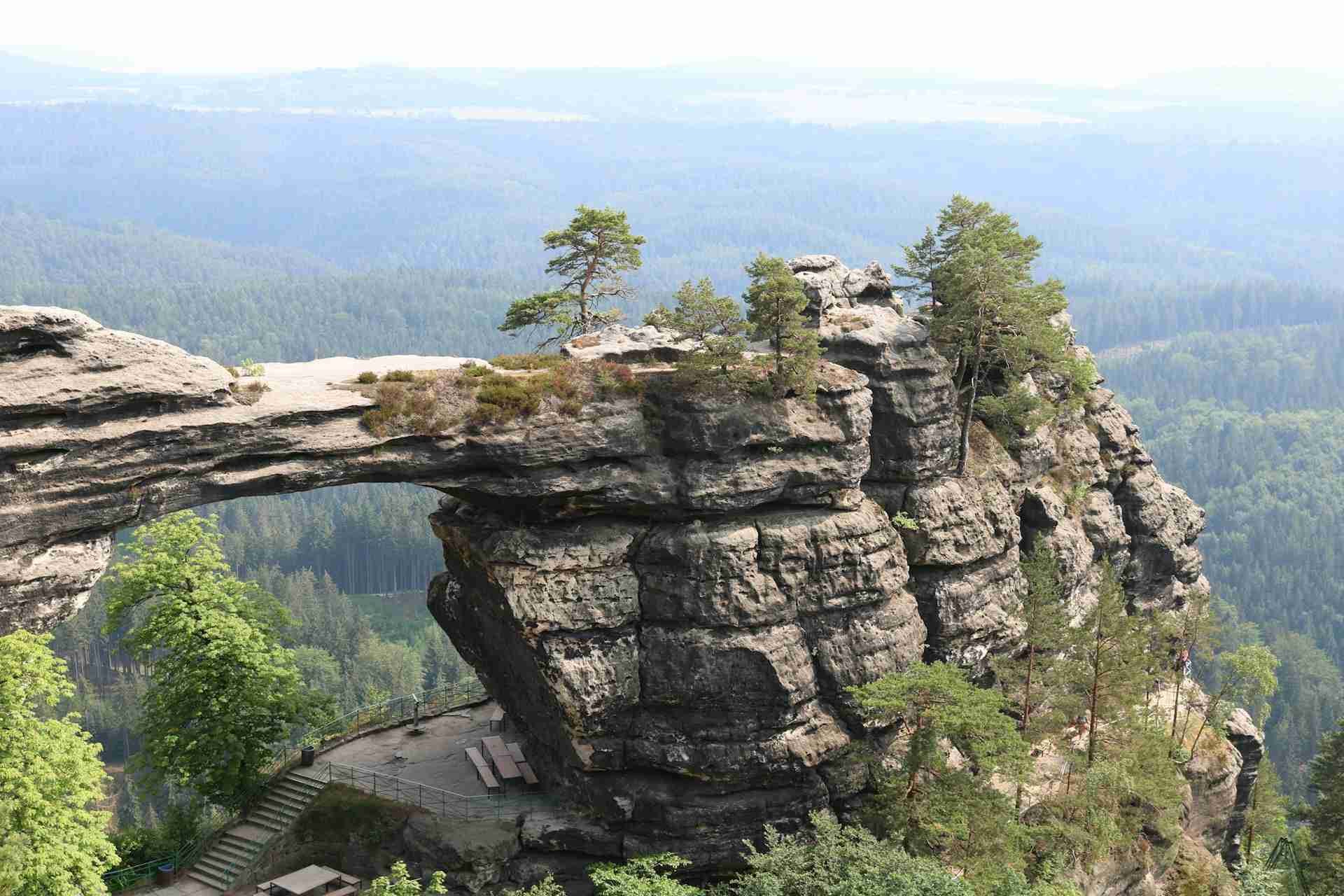
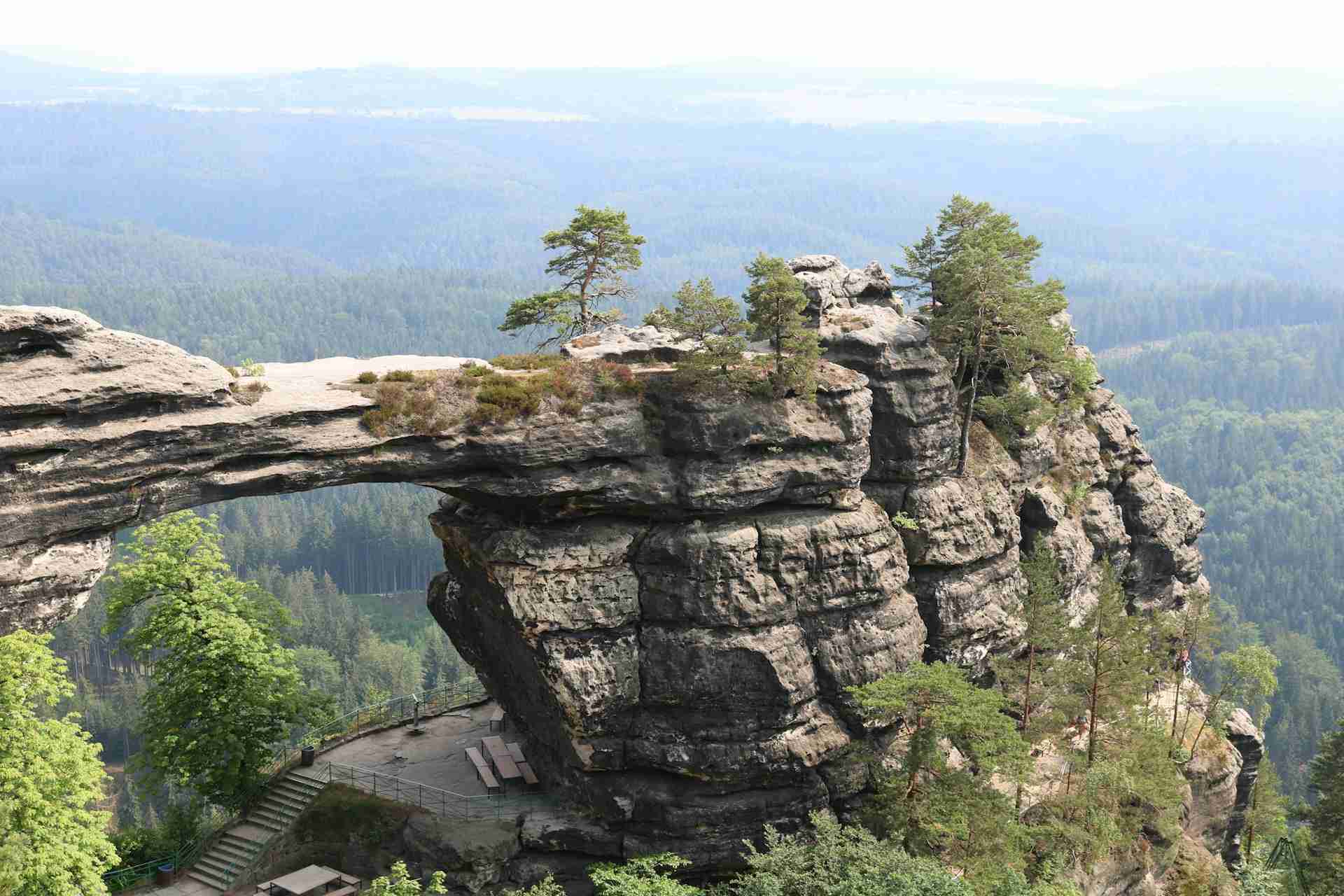
Rising from the northern Bohemian landscape near the German border, the Pravčická Archway is Europe's largest natural sandstone arch and one of the most compelling geological formations in Czechia. Towering above deep forest and sculpted by wind and water over millennia, the arch stands as a striking natural gateway carved out of the cliffside. For photographers, the location combines raw scale with compositional elegance, especially when viewed from surrounding trails and vantage points that reveal its curvature and the distant ridgelines beyond. The contrast between the soft forest canopy and the sharp mineral forms of the arch offers opportunities for both grand landscape shots and tight structural studies. The surrounding terrain is steep but accessible, and the changing light over the rock face throughout the day brings continuous variation to its form.
Best Photography Opportunities
• Main Viewpoint with Layered Composition
The most iconic vantage point is from the designated overlook near the base of the arch, where the full sweep of the formation can be framed alongside the adjacent Falcon's Nest building. This spot works particularly well with a wide-angle lens that captures the full breadth of the rock formation while including sky and forest elements for contrast. Shoot in the early morning or late afternoon for angled light that picks out the texture in the sandstone and adds warmth to the scene. The overlook railing helps stabilize your frame and provides a safe position for tripod use. Including hikers in the composition offers a sense of scale without distracting from the subject.
• Elevated Angles from Trail Switchbacks
Several switchbacks above the main path offer side-on views of the arch and the cliffs behind it. These positions are ideal for showcasing the thickness and volume of the formation, rather than just its curve. A short telephoto lens helps compress the background ridges into the frame, creating layered horizontal bands of rock, forest, and sky. In autumn, the foliage provides a contrasting color palette that emphasizes the warm, sandy tones of the arch. Be prepared to wait for light to break through cloud cover, as sudden shafts of sun can highlight the arch while leaving the background in soft shadow.
• Forest Framing from Lower Paths
As you approach the arch from below, sections of the trail offer framed views through tree trunks, branches, and foliage. These natural frames work well for mid-range focal lengths and are particularly effective in spring and autumn when leaves are colorful or sparse. Shooting through the trees adds depth and can isolate the arch within a layered, textured foreground. Use a wide aperture to create a slight blur on the foliage while keeping the arch sharp, drawing focus to the sandstone form. This technique helps reduce distractions in busy compositions and adds atmosphere.
• Detail Studies of Sandstone Texture
The surface of the arch itself, while monumental in scale, offers intricate textures and erosion patterns that lend themselves to abstract compositions. Close-up shots of the pockmarked stone, cracks, and color variation reveal the geologic history and natural weathering of the rock. Use a standard or telephoto lens and focus on small sections where light and shadow create subtle gradients. These images work well in black and white or with muted color grading to emphasize form and texture over scale. Overcast light is ideal for this kind of detail work, as it prevents harsh contrast and preserves tonal range.
• Distant Landscape Views with the Arch in Context
Some of the farther viewpoints, especially those from across the Kamenice Valley, allow you to place the arch within the larger landscape of Bohemian Switzerland. These wider views benefit from early morning fog or low-angled evening light that layers the background ridges in atmospheric perspective. A telephoto lens allows you to compress those layers and feature the arch as one distinct element within a larger geological narrative. Weather can shift quickly here, so remain flexible and revisit viewpoints throughout the day for changing light and sky conditions.
Best Time to Visit
The best seasons to photograph the Pravčická Archway are spring and autumn, when the surrounding forest is at its most visually dynamic. In spring, soft greens and wildflowers contrast with the sandstone and create a gentle light quality that works well in the early morning. Autumn offers the richest color palette, with gold, orange, and red foliage wrapping the base of the cliffs and adding warmth to the scene.
Summer brings clearer skies and more consistent weather, but also heavier foot traffic and harsher midday light. Plan early morning or late afternoon shoots to take advantage of softer shadows and fewer visitors. Winter is the quietest season and, if snow is present, the arch transforms into a stark, dramatic subject against a monochrome forest. However, trail conditions can be icy or closed in severe weather, so always check access before setting out.
The best light hits the face of the arch from mid-morning through early afternoon, particularly in spring and autumn when the sun remains at a lower angle. Early arrivals offer the chance to photograph in clean, undisturbed conditions with a greater chance of catching low mist along the treetops.
How to Get There
Pravčická Archway is located near the village of Hřensko in the Bohemian Switzerland National Park. The most common approach begins at the Mezná Dolina trailhead, accessible by foot from Hřensko or by car via Route 62. From the trailhead, the arch can be reached by a well-maintained path that gradually climbs through forested terrain for about 45 minutes.
There is no direct vehicle access to the arch itself. Entry to the archway area, including access to the main viewpoints and the Falcon's Nest lodge, requires a ticket, which can be purchased on-site. The trails are open during daylight hours, and tripods are allowed throughout the area, though space can be tight at the most popular overlooks.
During the summer season, local shuttle services operate between Hřensko and nearby trailheads to reduce traffic. If arriving by public transport, buses connect Hřensko with Děčín, which has regular train service to Prague and other major cities. Wear durable footwear, especially in autumn and winter when the path can be slippery. Water and snacks are recommended, as facilities near the arch are limited.
Recommended Photography Gear
A wide-angle lens between 16 and 35 millimeters is essential for capturing the full breadth of the arch from close vantage points. A mid-range zoom such as a 24 to 70 millimeter lens offers flexibility for both contextual shots and tighter framing from the trail. A short telephoto in the 70 to 200 millimeter range is particularly useful for landscape compression and distant views across the valley.
A sturdy tripod is recommended for sunrise, sunset, or long exposure work in forest light. A circular polarizer is helpful for managing reflections on sandstone surfaces and enhancing contrast between rock and sky. A lens hood will reduce flare when shooting toward the sun during golden hour sessions.
Since the hike includes elevation gain and uneven surfaces, pack a weather-resistant backpack with space for water, extra layers, and lens cloths to manage humidity or condensation. Lightweight hiking boots will provide needed support on the rocky trails. Extra batteries are recommended, particularly in colder months or if shooting extensively with live view or long exposures.
Nearby Photography Locations
This forested gorge features wooden boardwalks, narrow rock passages, and slow-moving water that reflect the surrounding cliff faces. Early morning is ideal for capturing soft light filtering through the trees, and long exposures can turn the river into a smooth mirror.
• Bastei Bridge, Saxon Switzerland
Located just across the German border, this dramatic stone bridge spans towering rock spires and provides panoramic views of the Elbe Sandstone Mountains. Foggy mornings and golden hour light enhance the visual drama of this well-known viewpoint.
• Jetřichovice Rock Viewpoints
These elevated platforms overlook deep valleys and sandstone pillars, offering wide open skies and complex ridge formations. The climb is steep, but sunrise and sunset light create incredible depth and shadow play across the terrain.
A short walk from Hřensko, this peaceful boat ride through a narrow gorge provides opportunities for forest reflections and moody compositions beneath high rock walls. Low-light conditions work well for slow shutter speeds and serene scenes.
• Mariina Skála Viewpoint
One of the highest accessible peaks in Bohemian Switzerland, this exposed rocky outcrop offers a 360-degree view over ridges, valleys, and forest. It is particularly effective for sunrise photography with expansive, layered scenes.
Pravčická Archway is both a geological marvel and a compositional challenge, offering sweeping views, subtle textures, and the timeless interplay of stone and forest. For landscape photographers willing to hike and wait for the right light, it remains one of Central Europe's most rewarding natural subjects.
Comments
Loading comments…