
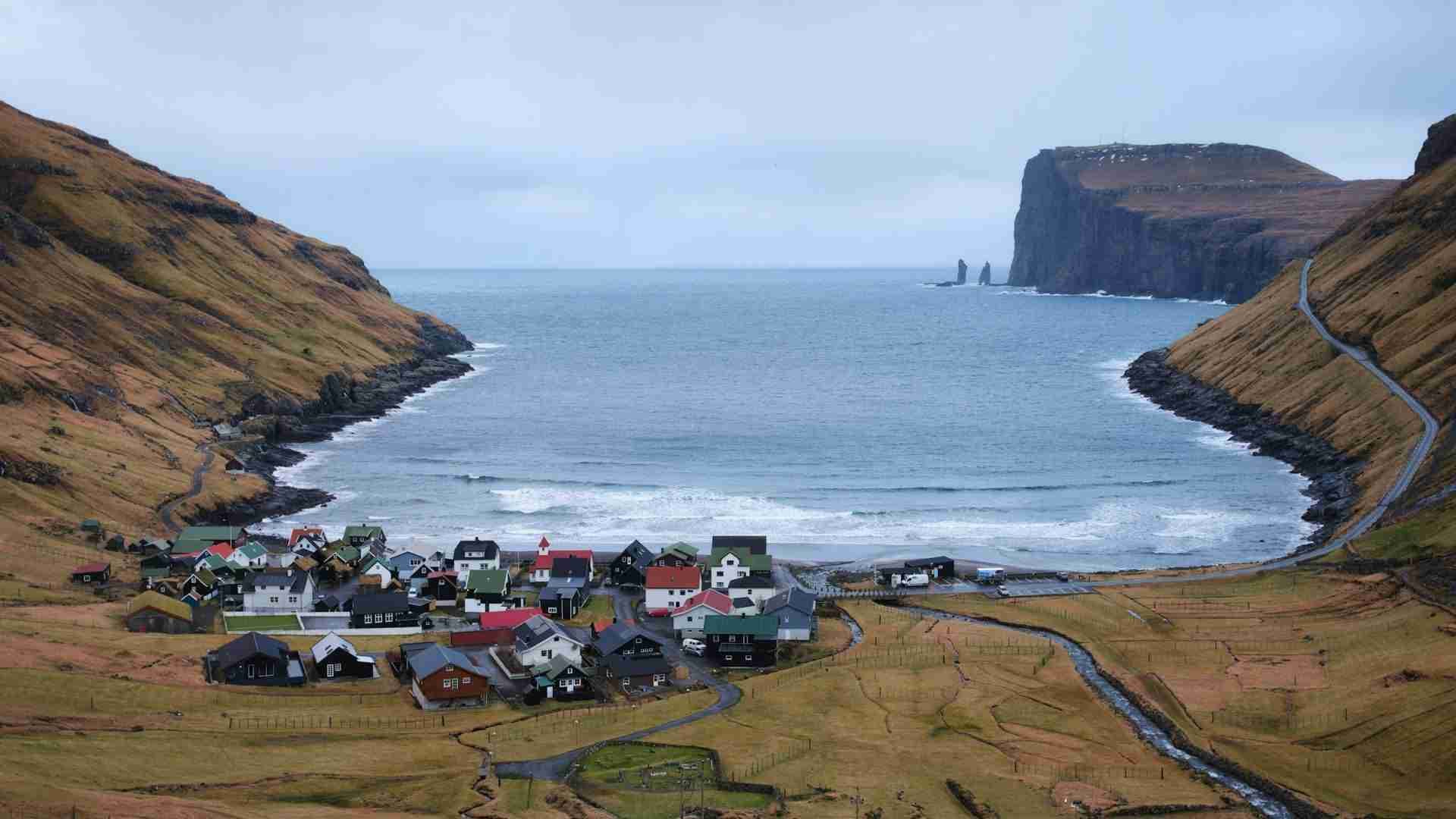
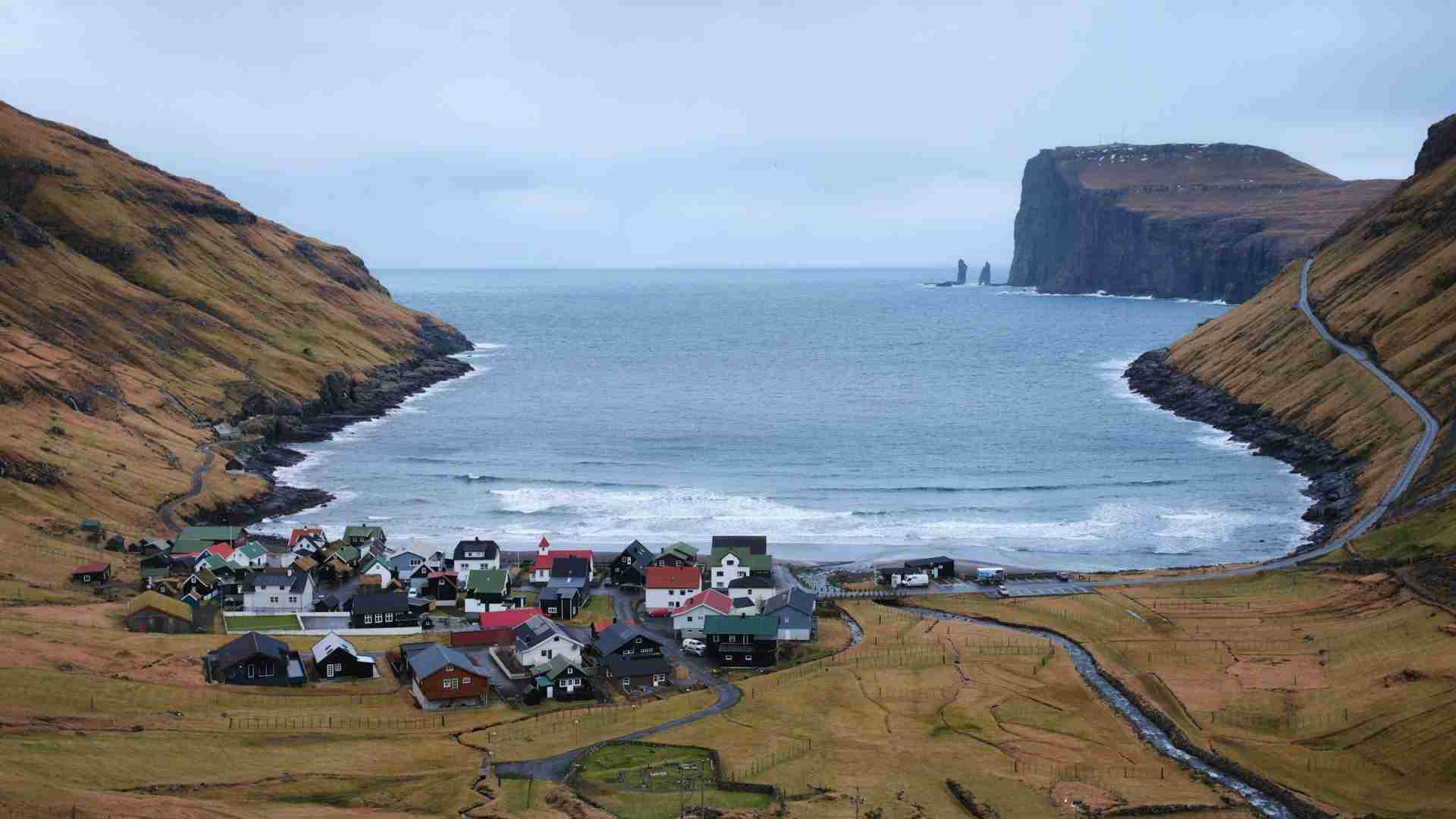
Tjørnuvík sits cradled at the northern tip of Streymoy Island in the Faroe Islands, backed by steep, grass-covered hills and facing the open North Atlantic. It feels like the end of the world in the best possible way. With only a handful of houses, a small chapel and a road that ends to a black sand beach, the village is small but visually powerful. The mood here changes by the minute with the weather, offering a mix of drama and serenity that challenges and rewards patient photographers. Whether you are drawn to rugged coastlines, sea worn rock formations, or the contrast between human settlement and natural surroundings, Tjørnuvík offers a uniquely isolated stage for expressive landscape work.
Best Photography Opportunities
• The Sea Stacks of Risin og Kellingin
Photographers flock to the black sand beach in Tjørnuvík for one main reason: the straight on view of the sea stacks known as Risin og Kellingin. These towering formations rise from the ocean just off the coast of Eysturoy and are best photographed during long exposures when the surf adds motion around their bases. From the beach, the stacks align perfectly with the open horizon, creating balanced compositions that highlight their stark isolation. Cloudy skies often hang low here, adding drama without needing to over-process your shots. If you have a telephoto lens with you, capturing the stacks compressed against shifting skies can produce haunting results, especially in the late afternoon when contrast deepens and the light direction shifts behind you.
• The Black Sand Beach and Tidal Reflections
Tjørnuvík's beach is made of volcanic black sand, and after a rainfall or during low tide, it transforms into a wide reflective surface. These mirrored pools create ideal opportunities for symmetrical compositions, especially with passing clouds or the cliffs reflected in the wet sand. Try shooting low to the ground with a wide lens to make the most of the reflections and subtle textures in the sand. The beach is also great for minimalist frames where one or two figures walking across the shoreline help emphasize the scale of the surrounding cliffs. Watch for moments when the light briefly breaks through the clouds, casting beams across the sand or lighting the face of the mountain above the village.
• Colorful Houses Framed by Cliffs and Sea
Tjørnuvík's tightly packed village offers a rewarding subject with its painted wooden houses in deep reds, whites, greens, and blacks. The contrast between the vibrant rooftops and the muted, weathered landscape makes for strong visual storytelling. From the hillside above the village, you can frame the settlement nestled between the towering cliffs and the black sand beach, with the road curving around the inlet leading the eye naturally toward the distant sea stacks. Overcast skies actually help these compositions by eliminating harsh shadows and allowing the colors of the houses to pop against the soft light. This is an ideal scene for shooting with a mid range zoom lens to find balance between village detail and the surrounding environment.
• Drone Perspectives Over the Bay and Valley
If you are flying a drone, the view from above reveals just how dramatically Tjørnuvík is shaped by its landscape. From the air, the river that runs through the village becomes a leading line drawing the eye from the valley out toward the sea stacks. Flying higher above the bay gives a chance to capture the complete shape of the cove, the road that snakes in, and the cliffs that encase the village like a natural amphitheater. Early evening light works best from the air, when the low sun grazes across the slopes and adds definition without overexposing the sea. Just be aware that wind conditions can change quickly, and there are occasional no-fly advisories depending on local wildlife or weather alerts.
• Waterfalls Along the Road to Tjørnuvík
Before you even reach the village, the drive in offers several fantastic stops. One of the best is along the mountainside where seasonal waterfalls spill directly onto the road or drop into the valley below. These waterfalls respond to recent rain, so timing your visit after a storm will give you the best chance at capturing them in full flow. Pull offs are limited but manageable with a compact vehicle. Try framing the winding road with the waterfall in the background, or zoom in on the cascading water using slower shutter speeds to smooth the motion. These are quick hit locations that can be just as satisfying as the main village if you give them proper attention.
Best Time to Visit
Summer offers the most reliable access and conditions for shooting in Tjørnuvík, with long hours of daylight from June through August. During these months, the hills surrounding the village turn bright green and the beach is more accessible without frequent rainouts. Early morning and late evening provide the best light, especially for beach and sea stack compositions where the sun lights the stacks from the side. That said, many photographers will find the shoulder seasons of May and September just as rewarding. These months bring lower sun angles all day and a greater chance of dramatic skies and shifting light. Winter is riskier in terms of weather and road closures, but if you can reach the village safely, snow on the hills and crashing waves along the black sand shore make for moody and memorable frames. Fog is common year round and can completely change your composition in a matter of minutes, so it pays to stay flexible and wait for breaks in the weather.
How to Get There
Tjørnuvík is located on the northern end of Streymoy and is accessible by car from Route 594. The drive from Tórshavn takes roughly 75 minutes and passes through beautiful terrain that becomes more dramatic as you approach the coast. The final stretch is a narrow road with blind curves and steep drop offs, so caution is important, especially in wet or windy weather. As you near the village, you will find a designated parking area since vehicles are not allowed to continue into the village center. From the parking lot, it's a short walk to the beach and surrounding viewpoints. There are no entrance fees to access the area or the beach, but drone pilots should double check for local flight restrictions before taking off. During winter storms, road access can be restricted, so always check live travel updates before heading out.
Recommended Photography Gear
Due to the variety of landscapes in and around Tjørnuvík, it is worth packing a flexible kit that can handle everything from long exposures to drone work. A sturdy tripod is essential for beach compositions and capturing smooth water effects with the sea stacks. A wide lens in the 14 to 24 millimeter range is ideal for the beach, village, and low angle shots of the cliffs. A mid telephoto, like a 70 to 200, helps compress scenes and isolate interesting architectural or landscape details, especially from the hills around the village. Neutral density filters come in handy for shooting long exposures of the waves and waterfalls. If you have a drone, bring one with solid wind resistance and always monitor weather apps for sudden changes. Waterproof covers or a weather sealed camera body are smart choices, as sudden rain showers are common even in summer.
Nearby Photography Locations
• Saksun
Located just over the mountain from Tjørnuvík, Saksun offers a completely different type of landscape. Its tidal lagoon, framed by steep cliffs and a small church, changes character depending on the time of day and tide. During low tide, you can walk out onto the sand and capture wide shots of the valley stretching toward the ocean. The light here is especially soft in the morning, and mist often clings to the slopes, creating layered depth in your compositions.
About a 20 minute drive from Tjørnuvík, Fossá is the tallest waterfall in the Faroe Islands and presents a strong vertical element in an otherwise horizontal landscape. The multi-tiered drop is best photographed from the base, where a wide lens captures the full height. After heavy rain, the volume of water is impressive and creates swirling mist that catches light beautifully. You can also climb a portion of the slope to get alternate angles of the falls crashing down the cliffs.
• Gjógv
On the neighboring island of Eysturoy, Gjógv is known for its natural gorge that runs from the village into the sea. The gorge is best photographed during overcast conditions when shadows don't overpower the scene, and long exposures can smooth the water flowing between the cliffs. The village itself has colorful homes and a quiet rhythm that's ideal for street or detail photography. From the cliffs above, you can also shoot panoramic views of the coastline in either direction.
Funningur is a quiet village tucked at the edge of a fjord, with a distinctive church perched by the water's edge. It is a great spot for moody, low light photography when the cloud ceiling is low and the reflections stretch across the inlet. The church works well as a focal point from multiple angles, especially when framed against the sharp ridges behind it. If you climb the road toward the pass above the village, you will also get one of the best high elevation views on Eysturoy.
• Klaksvík
Klaksvík is the second largest town in the Faroe Islands but still maintains strong photographic appeal thanks to its surrounding peaks and fishing heritage. The harbor is particularly striking during blue hour, when the lights of the boats and buildings reflect in the calm waters. The town also serves as a base for exploring higher terrain, including the hike up to Klakkur, which offers panoramic views across several islands. It's a good contrast to Tjørnuvík's small scale and natural isolation.
Whether you come for the sea stacks, the silence, or the shifting light, Tjørnuvík offers a powerful space for photographers willing to work with changing conditions. It's not a location you rush through. Slowing down, watching the weather unfold, and waiting for the right moment will always lead to stronger images in this remote corner of the Faroes.
Comments
Loading comments…