
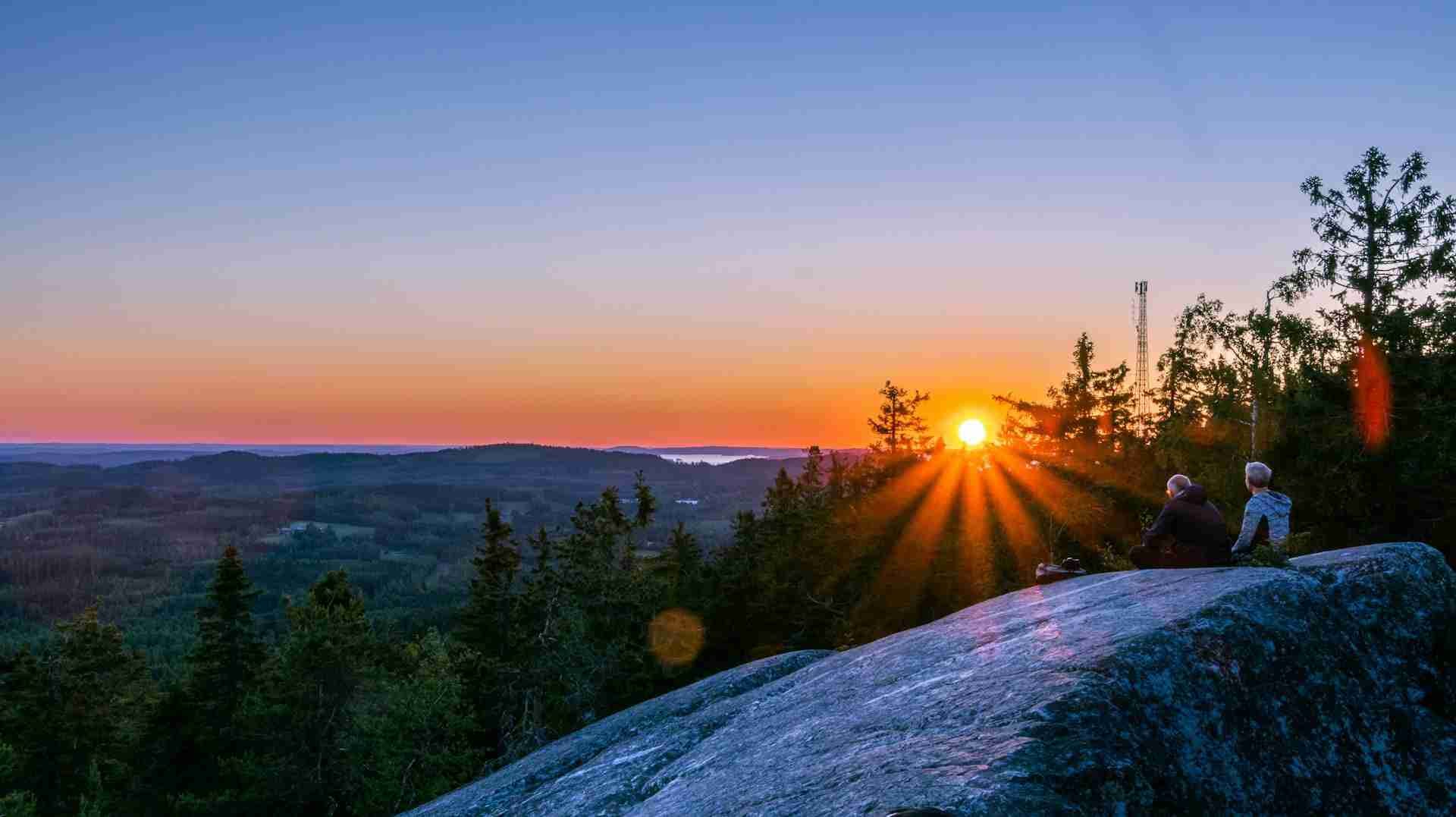
Rising above Lake Pielinen in eastern Finland, Akka-Koli Hill is a place where land, water, and sky converge in a slow-moving dance of light and atmosphere. Located within the Koli National Park, this high point of the Karelian landscape is one of Finland's most revered natural viewpoints, steeped in local mythology and favored for generations by painters and poets. For photographers, Akka-Koli offers layered forest canopies, fractured bedrock, and a sweeping view across an inland sea of islands. The scene changes by the minute; mist curls through the pines, sunlight fractures on granite, and the lake below shifts from mirror-still to wind-creased in moments. It is a place to slow down, observe carefully, and capture the quiet scale of the Nordic wild.
Best Photography Opportunities
Sunrise Over Lake Pielinen from the Hilltop Viewpoint
Akka-Koli's main overlook delivers a commanding view eastward across Lake Pielinen, making sunrise one of the most powerful moments for landscape photography. As the first light hits the treetops and islands below, mist often drifts across the lake surface, catching golden tones and creating natural diffusion. A wide-angle lens allows you to frame the granite foreground in contrast to the distant water and sky, while a telephoto lens can isolate islands or pick up details in the shifting fog. Autumn mornings are especially productive here, when the mixed forests below blaze with orange and yellow and the atmosphere is crisp and clear. Arriving well before dawn gives you time to set up and adjust compositions as the light breaks and evolves.
Mossy Rock Formations and Birch-Fir Forest Textures
Just below the summit, the terrain becomes dense with lichen-covered boulders, twisted birch trunks, and thick moss carpets. These forest floor scenes lend themselves well to intimate landscape photography or macro work that focuses on texture and contrast. Overcast days are ideal for shooting here, as they soften shadows and bring out the subtle greens and greys of the undergrowth. A macro or standard prime lens allows for clean composition without wide distortion, especially when working with shallow depth of field. These shots are a good way to complement your broader vistas with quiet, grounded frames.
Twilight and Blue Hour Over the Lake
Once the sun sets, the high vantage of Akka-Koli remains an excellent platform for long exposures during blue hour. The lake often reflects soft sky tones, while the distant silhouettes of islands and headlands stack against one another in darkening layers. A sturdy tripod is essential here, along with a remote shutter or timer to avoid vibration. Low ISO and slow shutter speeds let you pull out subtle color gradients in the sky and smooth any remaining surface ripples on the water. In winter, this is also the time when snow-covered trees glow faintly in residual light, creating an otherworldly calm.
Snow and Ice in the Winter Months
From November through March, Akka-Koli transforms into a snowbound landscape with its own photographic challenges and rewards. The lake freezes over, and the conifers take on heavy coats of snow that simplify compositions and reduce visual noise. High-contrast scenes between snow-covered rock and the blue shadows of early or late daylight can be striking, especially in monochrome or minimal color palettes. A telephoto lens is useful for picking out ice formations and distant treelines. You'll need cold-weather gear for both yourself and your equipment, as battery life and lens fogging become real considerations in subzero temperatures.
Panoramic Island Compositions with Graduated Light
On clear days with layered cloud cover, Akka-Koli's eastern view can produce beautifully graded skies. These conditions are perfect for panorama stitching, particularly when the light transitions from warm hues near the horizon to cooler tones above. Compose from a stable tripod and use manual exposure settings to ensure consistency across frames. The scattered islands below break up the surface of the lake and create a natural rhythm that guides the eye through the image. For large-format prints or digital galleries, these panoramas offer the most immersive take on the scene's depth.
Best Time to Visit
Akka-Koli is photogenic year-round, but each season brings a different palette and light quality. Autumn (late September to early October)
is the most visually dramatic period, with Finland's deciduous forests bursting into deep reds and bright golds that contrast vividly with the evergreens and grey rock. Summer
provides long days and soft late-night light, ideal for slow, exploratory photography well past sunset. Winter
is stark, cold, and quiet, but ideal for minimal compositions and snowbound landscapes, especially in January and February when the low sun casts long, golden light even at midday. Spring
brings meltwater, mist, and the return of soft greens, though trails can be muddy and weather unpredictable.
For lighting, sunrise
is the most impactful time to shoot from Akka-Koli's summit, especially on days with light mist or scattered clouds. Blue hour also works well, particularly if you're interested in long exposure or ambient twilight scenes. Midday can be harsh during summer, but in winter the sun's low arc offers usable directional light even at noon. Fog and light snowstorms often pass quickly, making it worth staying on site through changing conditions.
How to Get There
Akka-Koli Hill is located within Koli National Park
in the North Karelia region of eastern Finland, near the village of Koli. The nearest city with major services is Joensuu, roughly an hour's drive away. If arriving by car, follow signage to Koli National Park, where you'll find a visitor center and designated parking areas near the Break Sokos Hotel Koli, which sits at the base of the main summit trail. From there, a series of well-marked trails lead to Akka-Koli, with a relatively short but steep ascent to the top viewpoint.
The hill is accessible year-round, and entry to the park is free, though parking fees may apply depending on the lot. In winter, snowshoes or crampons may be necessary, as trails can be icy or deep in snow. In summer and fall, hiking boots are sufficient, and the summit is reachable in 15–20 minutes from the main trailhead. Public transport to Koli village is limited, so renting a car from Joensuu or another nearby hub is the most practical option for visiting photographers.
Recommended Photography Gear
Because Akka-Koli's strength lies in both wide landscapes and detailed natural textures, bring a flexible kit. A wide-angle lens (16–35mm or similar)
is essential for capturing the full lake view and the layered cliff lines. A telephoto lens (70–200mm)
is useful for isolating islands, compressing foggy forest scenes, or photographing wildlife such as birds gliding over the lake. A standard zoom (24–70mm)
provides versatility on the trails and in forested sections. A macro lens or close-focusing prime
is valuable for detail shots of moss, rock, and snow crystals.
A tripod
is highly recommended for pre-dawn, twilight, or long exposure shots, particularly in low light or during winter months. A polarizing filter
will help reduce glare off wet rock and deepen sky tones. Graduated neutral density filters
can be useful for managing dynamic range in sunrise or sunset conditions. In winter, carry extra batteries, as the cold can drain them quickly, and lens cloths
for condensation management. Wear layered clothing, and in all seasons, waterproof hiking boots
are a must.
Nearby Photography Locations
Just a short walk from Akka-Koli, Ukko-Koli is the most photographed viewpoint in the park and offers a slightly different angle over Lake Pielinen. The jagged rocks and wide ledge at the top make it ideal for dramatic sunrise or sunset compositions. While more popular, it's still peaceful, especially in early morning light or misty conditions.
Located south of the main park area, this wooden observation tower offers panoramic views over the Karelian forest landscape. It's an excellent spot for capturing forest layers at dawn, especially in autumn when color variation in the canopy is at its peak. The tower itself also makes for a strong compositional element in low-angle shots.
Pirunkirkko Cave
Known as the "Devil's Church," this narrow cave near Koli is steeped in folklore and makes for a unique change of pace. Inside, the light falls in slivers, and moss-covered stone walls create dramatic contrast. Ideal for photographers interested in low-light, moody interior landscapes and story-driven imagery.
For a water-level view, head to one of the park's lakeshore trails where you can shoot back toward the Koli hills. These spots offer reflection opportunities during calm weather and are excellent for sunset photography when the hills catch the last light. These perspectives help tell a more complete story of the landscape by reversing your angle on the high points.
This long hiking loop passes through dense forest, open ridgelines, and lakeside clearings. While more demanding, it offers solitude and diverse photographic subjects, from delicate forest compositions to expansive views across Karelia. It's a full-day or multi-day option for photographers seeking deeper immersion.
Akka-Koli is a location that rewards stillness, patience, and a willingness to return to the same view again and again under different skies. Whether you're capturing the delicate texture of moss at your feet or watching light roll across Lake Pielinen from above, the hill invites a slow and thoughtful photographic approach.
Comments
Loading comments…