
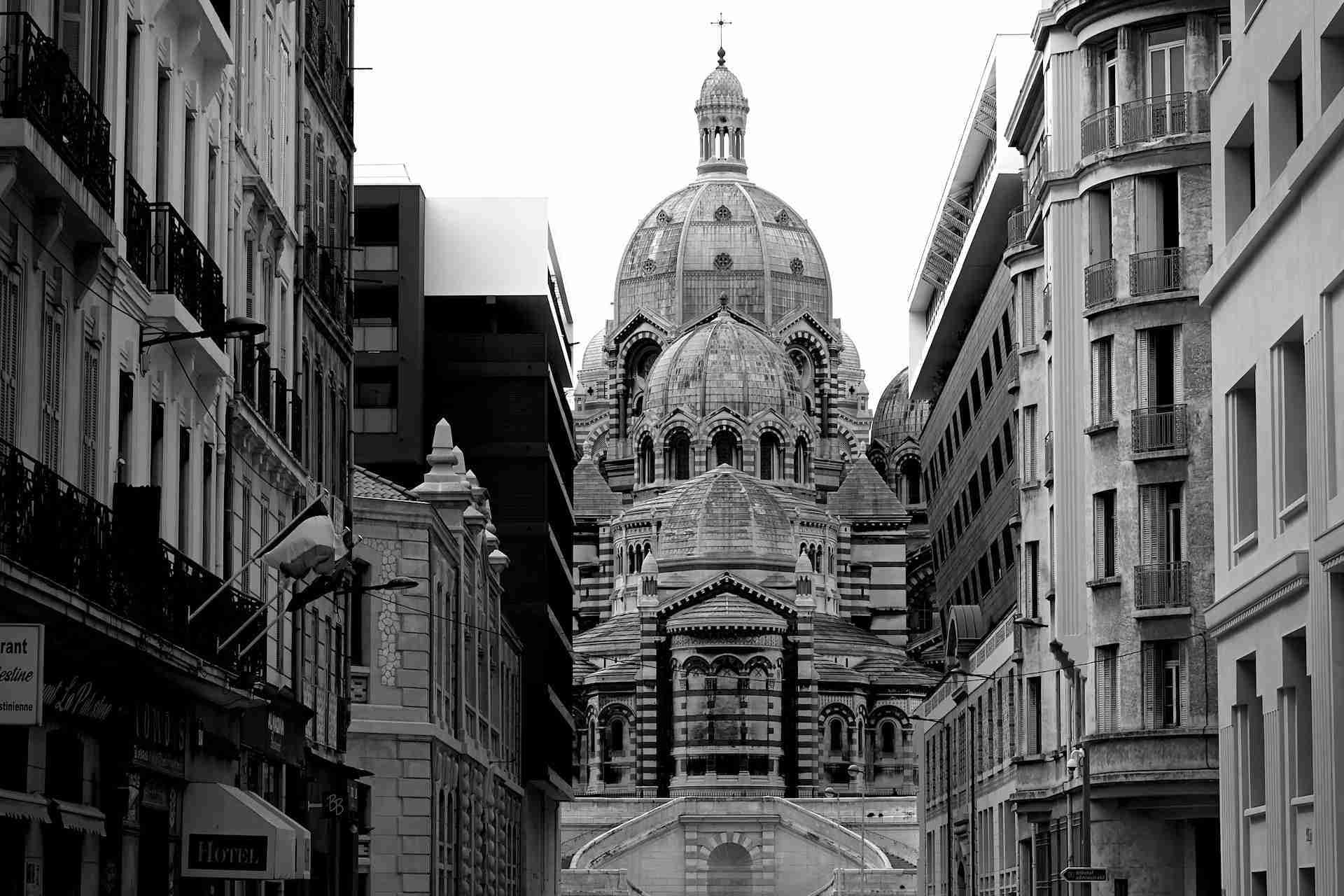
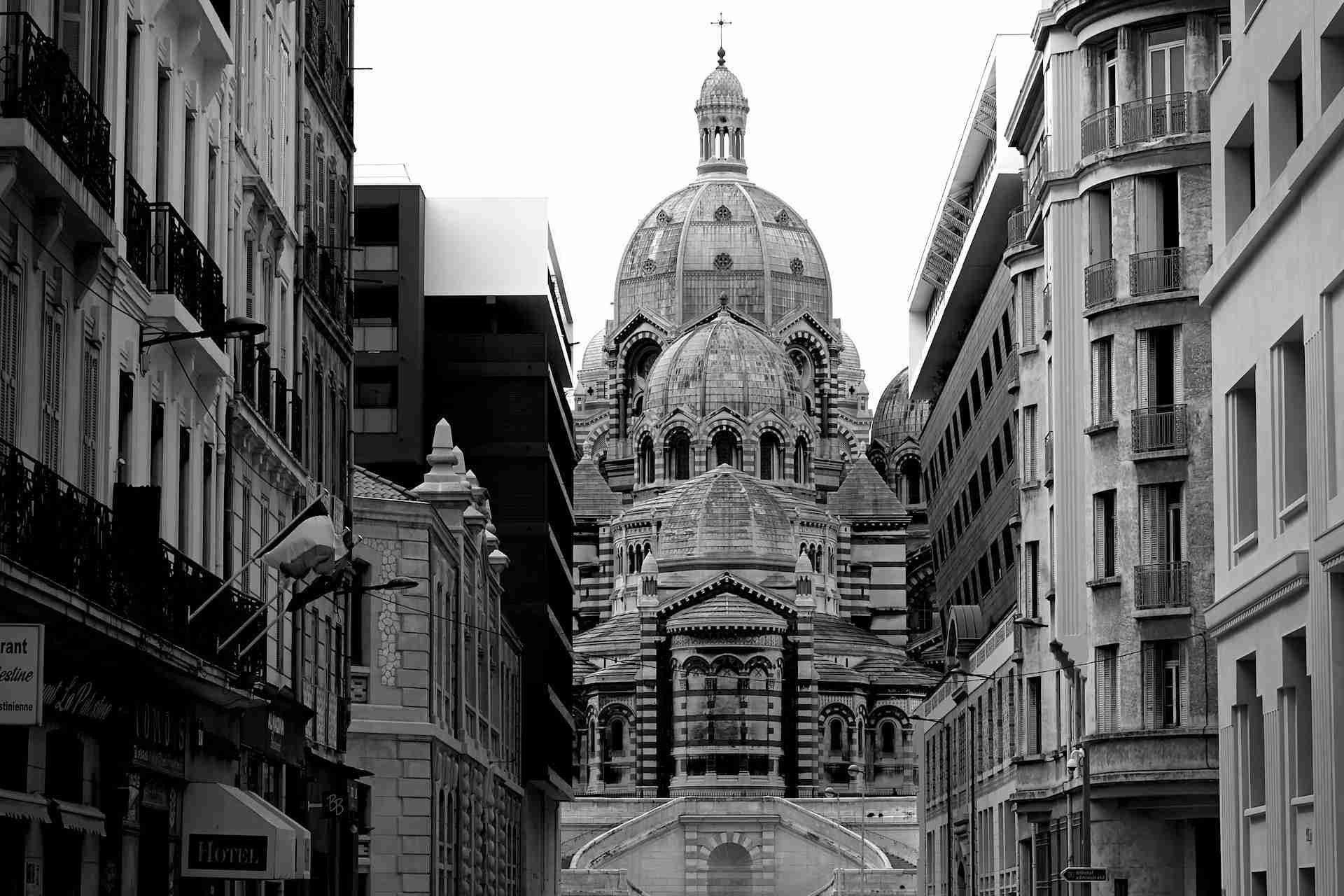
Anchoring the waterfront of Marseille with monumental presence, Cathédrale La Major (or Marseille Cathedral) is a striking blend of Romanesque and Byzantine architectural styles, built with alternating bands of white and green limestone that seem to shimmer under the Provençal sun. Located between the Vieux-Port and the modern docks, its colossal domes and ornate façade offer photographers rich opportunities for architectural geometry, texture studies, and urban contrast. Unlike more enclosed Gothic cathedrals, La Major opens generously to sea air and light, offering changing conditions throughout the day and unique spatial relationships with Marseille's skyline and harbor activity.
Best Photography Opportunities
• Wide frontal symmetry from Place de la Major
The cathedral's façade is an exercise in bold architectural balance—two symmetrical towers frame a central dome, with Romanesque arches and rich stone textures drawing the eye inward. Shooting from Place de la Major allows for a full-frontal composition that emphasizes symmetry and scale. Use a wide-angle lens (16–24mm full-frame equivalent) to incorporate the full vertical and horizontal structure, being careful with distortion—shooting slightly elevated from a step or ledge can help correct vertical lines without needing post-processing fixes. Early morning is best for soft, directional light that adds shape and depth to the masonry, while blue hour lends itself to long exposures where warm artificial light contrasts against the fading sky.
• Details of striped stonework and arches
La Major's alternating bands of white and green limestone are more than decorative—they're textural features that photograph beautifully at mid-range and close-up. Look for repeating archways, capitals carved in intricate floral and religious motifs, and the subtle curve of cornices catching angled light. These elements become a study in rhythm and repetition when captured with a 70–200mm lens or even a standard 50mm prime. Positioning yourself under the arcade along the side of the cathedral reveals vanishing-point perspectives ideal for depth-rich compositions. Overcast conditions soften shadow contrast and make color separation in the stone more pronounced—ideal for detail work.
• Interior domes, side chapels, and mosaic floors
Inside, the cathedral is no less impressive, with richly decorated domes, detailed altar work, and patterned mosaic floors that echo the exterior striping in miniature. The central nave draws the eye upward—an ideal subject for vertical framing or symmetrical ceiling shots. Because tripods are not allowed, handheld techniques are key: use fast wide primes (f/1.4–f/2.8) and push ISO where necessary to capture ambient light. Wait for quiet moments to photograph central aisles without crowds, and look for shafts of sunlight that enter from upper windows, creating luminous spots on pews or mosaic inlays. Compositionally, balance is critical—using the lines in the floor tiles or pews as guides can help align shots for a strong visual anchor.
• Modern contrast from MuCEM and the J4 Promenade
One of the most compelling aspects of photographing La Major is its setting: the cathedral's ornate, historic grandeur stands in deliberate contrast to the modern design of nearby structures. Walk toward the MuCEM to find viewpoints where you can frame the cathedral through contemporary foregrounds—glass, steel, or patterned concrete—creating visual dialogue between past and present. Reflections in the MuCEM's glass panels, angular lines from the footbridges, and the open J4 plaza allow for architectural layering that speaks to Marseille's evolution. These compositions are strongest in the late afternoon when side light warms the cathedral and the harbor wind creates atmospheric movement in flags or drifting mist.
• Evening floodlighting and blue hour perspectives
As twilight deepens, La Major is dramatically lit by spotlights that emphasize its domes, stone patterning, and vertical columns. From across the Esplanade, long exposures (10–30 seconds) capture this glow against the deepening blue of the sky. Use foreground elements like café tables, blurred passing figures, or low architectural walls to add dimension and narrative to your frame. Alternatively, shoot from an elevated position—either the upper terrace of the nearby Fort Saint-Jean or from the Rue de la République—to include streaks of traffic and the movement of people, anchoring the cathedral in Marseille's evening rhythm. Blue hour is brief, so bracket exposures and prepare your framing during golden hour for efficient transitions.
Best Time to Visit
Cathédrale La Major can be photographed effectively year-round, but certain seasons and times of day yield more favorable lighting and atmosphere. Spring and autumn offer the most dynamic sky conditions and gentler light angles, making them ideal for both exterior and interior work. In these months, sunrise and sunset align low enough to create raking shadows that emphasize the stone's relief and geometric forms.
Summer brings bright, cloudless skies and deep blue backdrops, but the sun can be harsh and flatten textures by midday. Early mornings or late evenings during this season are preferable for capturing depth and architectural drama without excessive glare. Summer sunsets over the Mediterranean also offer warm color transitions that complement the stone's pale tones.
Winter provides crisp air and fewer tourists, allowing for long exposures and more tranquil scenes around the cathedral. The lower sun angle throughout the day makes it easier to find directional light that adds dimensionality to the façade, though interior shooting may require higher ISO due to reduced ambient light.
For golden light on the western façade, aim to arrive between 8:00 and 9:00 a.m. in the cooler months, and closer to 7:00 a.m. during summer. Blue hour begins 15–30 minutes after sunset and is particularly rewarding from harbor-facing vantage points or elevated sidewalks near Fort Saint-Jean.
How to Get There
Cathédrale La Major is located in Marseille's 2nd arrondissement, just a short walk from both the Vieux-Port and the modern Euroméditerranée district. It's easily accessible via public transit. From the Marseille Saint-Charles train station, take Metro Line 2 to Joliette, then walk south along Rue de la République. The cathedral is visible as you approach the waterfront and is well signposted.
Multiple bus lines and the city tram system also stop nearby. For those arriving by car, paid public parking is available beneath the Esplanade de la Major, just steps from the cathedral. Photographers with heavy gear may appreciate the short walking distance from this lot to the main shooting spots.
The cathedral is open daily to visitors, and while interior photography is allowed, flash and tripods are generally prohibited. Visit during early morning or late afternoon for the best balance of light and minimal crowds. Access to surrounding promenades and modern museum rooftops—such as MuCEM—provides additional angles without the need for permits.
Recommended Photography Gear
For exterior architectural work, a wide-angle lens (16–35mm) is indispensable for capturing the cathedral's full façade, domes, and surrounding space without distortion. A mid-range zoom (24–70mm) provides framing flexibility for arches, mosaics, and symmetry within the square. Telephoto options (70–200mm) allow for detailed studies of stone patterns, sculptural accents, or layered juxtapositions with modern structures nearby.
Photographing interiors requires fast lenses—prime 35mm or 50mm f/1.8 or faster lenses perform well in low light without the need for stabilization. Since tripods are restricted indoors, prioritize high ISO performance and image stabilization. Handheld bracketing techniques can also be useful for post-processed HDR exposures that preserve shadow and highlight detail.
Bring a compact tripod or monopod for blue hour and night photography around the cathedral's exterior. A circular polarizer helps reduce glare on the striped stone and enhances contrast when photographing under direct light. For sunrise or sunset work, a graduated ND filter may help balance sky exposure against the darker street level.
A lightweight backpack with discreet compartments is preferable in urban environments. Protect lenses and filters from sea breeze grit and sudden weather shifts. Marseille's climate is generally mild, but spring gusts and Mediterranean humidity can affect lens clarity—carry microfiber cloths and rain sleeves if you plan to stay into the evening.
Nearby Photography Locations
• MuCEM Rooftop and J4 Esplanade
The Museum of European and Mediterranean Civilisations offers panoramic views over the sea, the harbor, and back toward the cathedral. Its latticed concrete rooftop creates patterned shadows that make striking foregrounds in wide-angle frames, while the juxtaposition of historic and contemporary architecture adds narrative depth.
Adjacent to the cathedral and overlooking the port entrance, this 17th-century fort provides elevated perspectives and strong leading lines. Capture evening compositions of the Old Port, the cathedral dome rising beyond, and golden-hour reflections from the surrounding water and stone.
Just behind La Major, the narrow alleys and pastel-toned walls of Le Panier offer endless street photography potential. Use this setting to contrast the cathedral's monumental scale with intimate, textured city life. Early morning light filtering through these alleyways provides excellent directional light.
A short walk southwest brings you to Marseille's historic harbor, where boats, reflections, and urban energy collide. Long exposures here at dusk can include La Major silhouetted in the background with blurred masts and street activity across the port basin.
• Basilique Notre-Dame de la Garde
For a commanding aerial view of the entire city—including La Major—climb or drive up to this iconic basilica. From its upper terrace, use a telephoto lens to isolate the cathedral among Marseille's rooftops, or go wide to frame it with the shimmering Mediterranean beyond.
Cathédrale La Major stands as both a symbol of Marseille's cultural layering and a masterclass in architectural form. Its striped stone, vast domes, and waterfront posture give photographers a compelling subject where light, line, and history meet. Whether you're composing geometric precision under midday sun or framing its dome as it glows in the evening haze, this cathedral offers frames filled with rhythm, contrast, and quiet strength—an essential stop for those documenting the heart of Marseille.
Comments
Loading comments…