
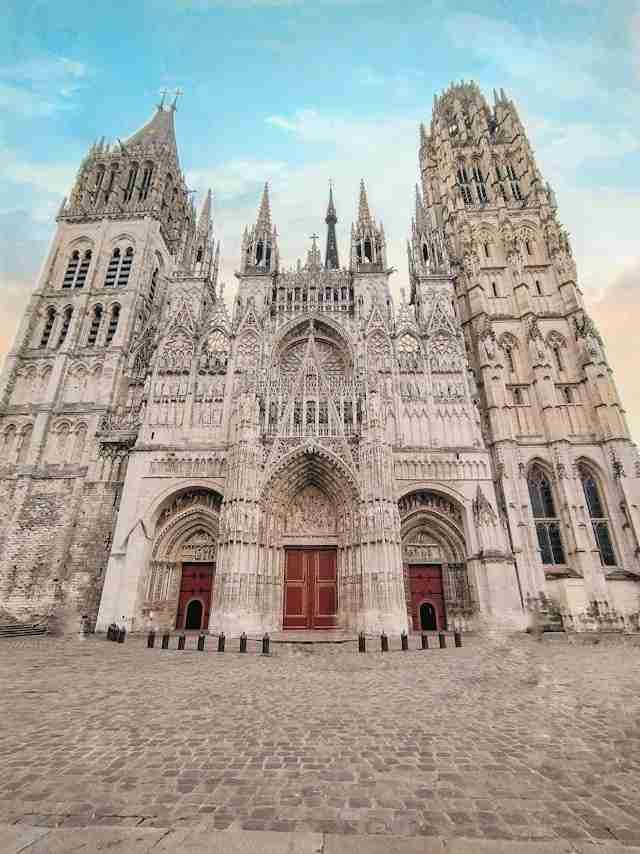
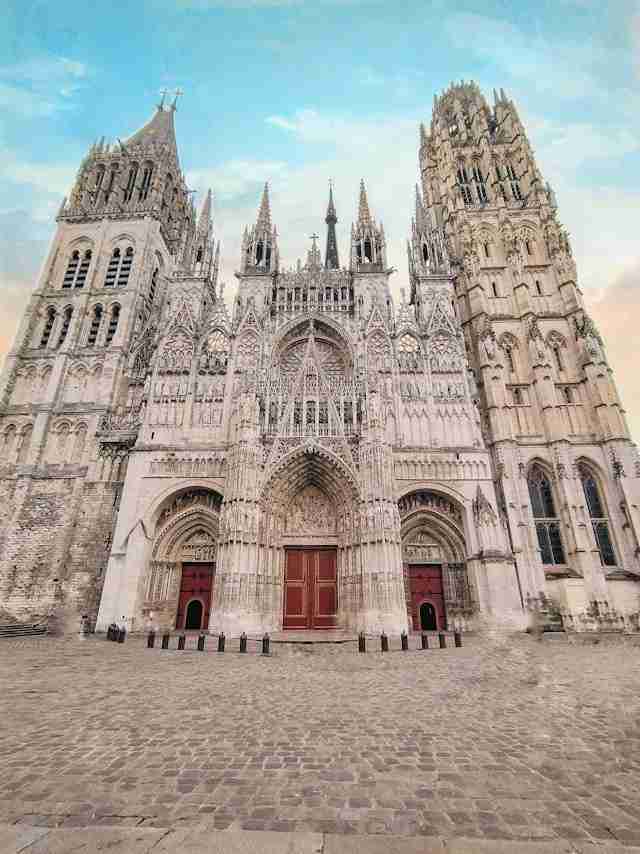
Towering over the heart of medieval Rouen, the Cathédrale Notre-Dame de Rouen is a masterpiece of Gothic architecture and one of the most visually rich religious structures in France. Its lace-like stone façade, soaring spires, and complex interplay of light and shadow have captivated artists for centuries—none more famously than Claude Monet, who painted it over 30 times from his nearby studio. For photographers, the cathedral offers an ever-changing canvas shaped by time, weather, and light. Whether you're drawn to intricate ornamentation, grand symmetry, or atmospheric interiors, this cathedral is a site of endless compositional depth and historical gravity.
Best Photography Opportunities
• West Façade and Towering Spires
: The cathedral's western face is its most celebrated view, a sculptural marvel of vertical lines, detailed carvings, and contrasting towers. The left-hand Saint-Romain Tower is a classic Gothic design, while the right-hand Butter Tower shows Flamboyant Gothic influence. Between them rises a lacy web of tracery and the delicate central spire. Use a wide-angle lens (14–24mm) to capture the full width and height of the façade from Place de la Cathédrale. Morning light from the east gently illuminates the carvings without creating harsh shadows, while late afternoon side light adds drama. Frame tightly on a specific section of the façade for abstract detail studies, or stand further back along Rue du Gros-Horloge for symmetrical full-facade compositions.
• Interior Nave and Vaulting
: Step inside to photograph the soaring nave, where ribbed vaults, clustered columns, and stained glass windows guide the eye upward and down the central axis. A tripod is essential for low-light shooting, particularly if you're working with narrow apertures to keep details sharp throughout the frame. Use a mid-range zoom (24–70mm) to compose vertical shots that accentuate the cathedral's height, or angle slightly to catch diagonal rays of light spilling through upper windows. Early morning and late afternoon produce the most atmospheric interior lighting, especially on days when sunlight filters in at a slant, igniting floating dust or reflecting off worn stone.
• Choir, Ambulatory, and Stained Glass Windows
: The eastern end of the cathedral contains some of its oldest and most intimate spaces, including the ambulatory and apse behind the high altar. This area is ideal for isolating smaller compositions with repeating arches, ornate ironwork, and deep-set stained glass windows. Use a fast prime lens (35mm or 50mm) at wide apertures to highlight texture and mood in the dim corners, or stop down for more formal, evenly focused compositions. Many of the windows date to the 13th century and feature strong reds and blues—best captured with even midday light that backlights them without flooding the space with glare.
• North Transept and Monet's Viewpoint
: Monet painted the cathedral from across the square at what is now the Office du Tourisme, and you can replicate his viewpoint by photographing from a high vantage or using a long lens to flatten the façade and emphasize subtle changes in lighting. The north transept also offers opportunities for photographing less crowded architectural elements, including flying buttresses and side chapels with rich sculptural decoration. These compositions are most effective in diffuse overcast light, which allows the stone's natural tonality to shine without deep shadows.
• Evening and Light Projections
: During summer and holiday periods, the city projects a nightly light show directly onto the cathedral's façade, animating it with color, texture, and historic narrative. These projections are best captured with a tripod and long exposures (1–10 seconds), using a mid-range zoom to frame both towers or tighter detail sections. Arrive early to claim your spot and experiment with different focal lengths as the show evolves. Outside of the light show, the cathedral takes on a glowing amber tone under streetlights—ideal for moody blue hour or nighttime photography with architectural lighting.
Best Time to Visit
The cathedral changes dramatically with the quality and direction of light. Early morning between 7:30 and 9:30 offers soft illumination on the façade, with fewer tourists and cleaner ground-level compositions. This is the best time for classic, symmetrical shots and for working undisturbed on long exposures.
Late afternoon (3:00 to 6:00) introduces directional light that brings out the depth of the carvings and stone tracery on the façade, especially during golden hour when the limestone takes on a warm hue. This is also the most photogenic time for side elevations and the towers, particularly when shot from Rue des Carmes or Place Barthélémy.
Overcast days offer the best conditions for detail photography—minimizing harsh shadows and highlighting the tonal complexity of the stonework, especially in niches, portals, and gargoyle sculptures. Interior photography is most successful from late morning through early afternoon, when ambient daylight filters in strongest through the high stained glass windows.
If you're planning to photograph the light projection show, check local schedules—typically running from late spring through early autumn. Blue hour is particularly magical, as it offers a transitional moment between natural and artificial light across the façade.
How to Get There
Cathédrale Notre-Dame de Rouen is centrally located at Place de la Cathédrale, a short walk from most of Rouen's historic core. If arriving by train, it's a 15-minute walk from Rouen-Rive-Droite Station, heading south via Rue Jeanne d'Arc and turning onto Rue du Gros-Horloge.
The cathedral square is pedestrianized, making it easy to move freely while scouting angles. Nearby streets like Rue Saint-Romain and Rue des Carmes offer additional side views and perspective variations. Public transport options include local TEOR bus lines and the city's tram system, with stops at Théâtre des Arts or Palais de Justice.
There is no admission fee for entry, and photography is allowed throughout the building. Tripods may be used respectfully, though it's best to avoid them during religious services or peak tourist hours. For commercial or editorial work, request permission in advance through the diocese or cathedral administration.
Recommended Photography Gear
A wide-angle zoom (16–35mm) is indispensable for capturing the full façade, high ceilings, and interior spaces where tight quarters require broad framing. A standard zoom (24–70mm) provides the flexibility needed for both exterior details and controlled compositions inside the nave and choir.
A fast prime (35mm or 50mm f/1.4–f/1.8) is ideal for low-light interior shots without a tripod, especially when isolating stained glass patterns or textural wall features. A long lens (70–200mm) is useful when working from distance across the square or when isolating sculptural elements on the towers or clerestory.
A sturdy tripod is recommended for interior work, long exposures, and nighttime photography—particularly during the cathedral's evening light shows. ND filters can assist with motion blur when photographing crowds, and a circular polarizer helps control glare and deepen color in windows and stone under bright skies.
Use a compact, quiet camera bag to navigate indoor spaces respectfully, and carry a microfiber cloth to manage lens fog or dust when moving between interior and exterior environments.
Nearby Photography Locations
: Just west of the cathedral, this historic street is home to Rouen's famous astronomical clock and half-timbered houses. It's a richly textured environment for street photography, especially at twilight when shop lights mix with fading natural light.
• Church of Saint-Maclou
: A few minutes east, this flamboyant Gothic church features spiky pinnacles, intricate stonework, and a more intimate scale than the cathedral. It's an excellent location for studying decorative details and layered façades.
: A rare medieval charnel house turned art space, this hidden courtyard includes ossuary carvings and atmospheric timber framing—perfect for moody compositions and architectural storytelling.
: The historic square where Joan of Arc was executed, this location combines post-war architecture, medieval remnants, and the contemporary Church of Saint Joan of Arc. Best visited in early evening light for strong contrast and architectural interplay.
• Seine River Quays and Gustave Flaubert Bridge
: For wider urban landscapes and reflections, head to the riverfront. The bridge's vertical lift design is a modern counterpoint to Rouen's Gothic skyline, especially compelling at sunset or during foggy mornings when church towers emerge from the mist.
Cathédrale Notre-Dame de Rouen is more than an architectural icon—it is a living monument to centuries of artistic ambition and sacred ritual. With every change of light or season, it reveals new facets of its character, inviting photographers to step closer, look deeper, and interpret its enduring beauty through their own creative lens.
Comments
Loading comments…