
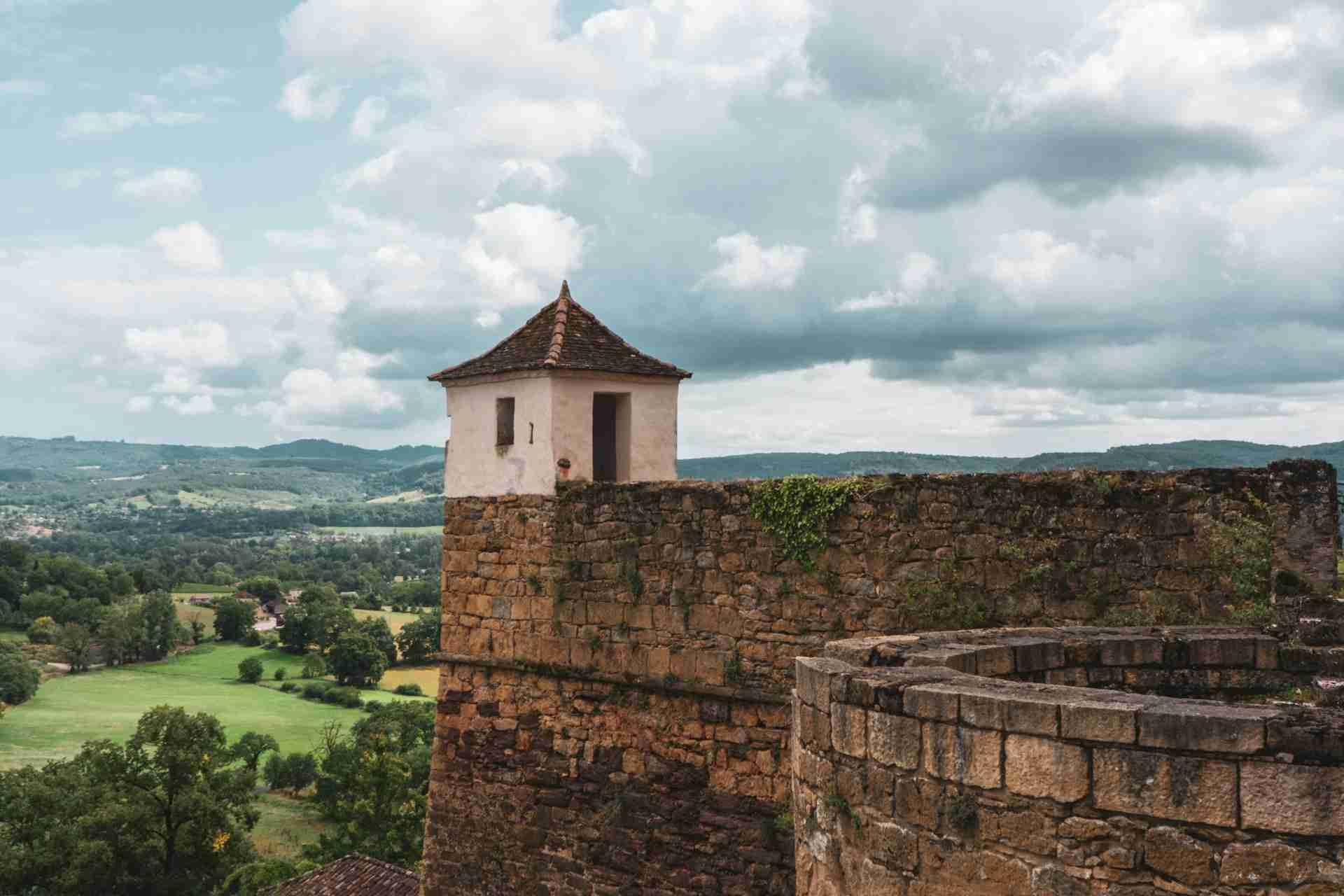
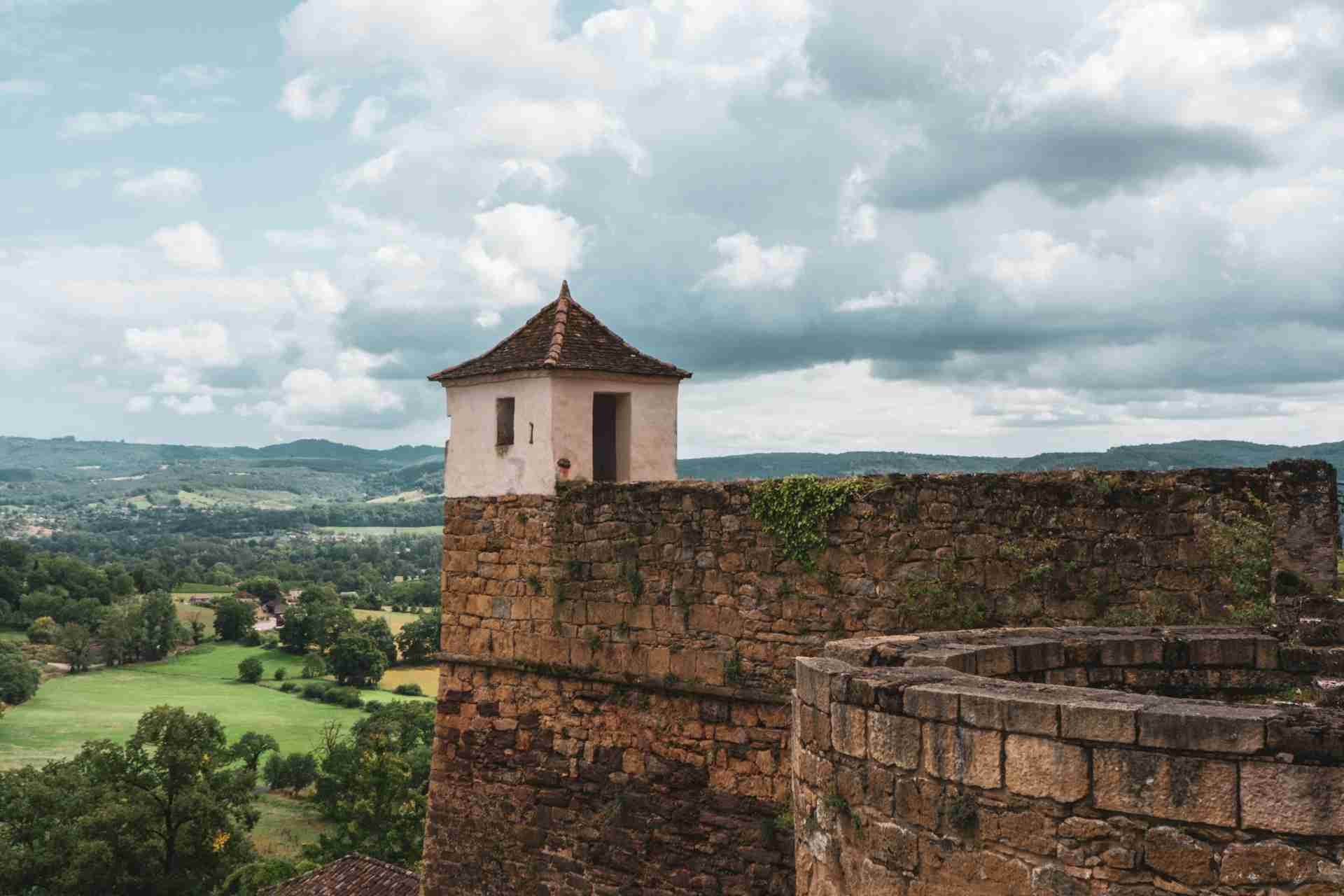
Château de Castelnau-Bretenoux rises above the northern edge of the Lot Valley with a solid, angular presence that commands the landscape. Built from deep red sandstone, the castle glows in soft light and cuts a distinctive silhouette against the hills of southwestern France. Its layout follows the natural rise of the terrain, and its towers, curtain walls, and steep roofs create strong lines from nearly every direction. For photographers, the appeal lies not only in its historical form but in the way it fits into its environment. The stone holds texture in both bright sun and soft cloud, and the surrounding village of Castelnau provides a quiet contrast with its tiled roofs and narrow passages. The castle's placement offers options for everything from grand landscape shots to close studies in light and structure.
Best Photography Opportunities
• View from the Valley Floor near Prudhomat
One of the most striking perspectives of the castle is from the valley floor, where you can shoot upward as the structure dominates the ridgeline. This angle places the towers against the sky, often with tree-lined slopes in the foreground. A telephoto lens can compress the structure with the hillside for more graphic compositions, while a wider lens includes more of the surrounding countryside. Early morning light touches the eastern walls, while afternoon light warms the entire western face. Fog sometimes gathers in the lowlands in spring, creating layered depth between the village and the base of the castle.
• Detail Work on the Towers and Masonry
Close-up shooting around the outer walls reveals fine patterns in the stone, as well as historical elements such as arrow slits, carved lintels, and heavy wooden doors. The castle's red sandstone catches side light well, giving dimension without harsh contrast. Use a mid-range zoom or short telephoto to control perspective and isolate areas of texture. These compositions work well under overcast skies when color saturation deepens and shadows soften. Focus on intersecting lines and weathered surfaces to create balanced frames that suggest the age and strength of the structure.
• Framing the Castle through Village Streets
The village of Castelnau offers strong foreground elements and natural framing options for photographing the castle from within its surrounding context. You can place rooftops, walls, or old iron railings into the frame, leading the eye toward the main towers above. Late afternoon light often strikes the rooftops and western walls together, helping tie the village into the larger scene. Use a focal length between 35 and 70 millimeters for flexibility when working around tight alleys or small courtyards. These frames give a more grounded sense of place and are useful when building a visual sequence of the area.
• Elevated Views from the Surrounding Hills
Several small roads and walking paths to the west and north of the castle lead to higher ground, allowing for full views over the entire complex. These points offer excellent conditions for early morning or golden hour photography, when the light reaches across the valley and breaks along the ridges. A wide lens is ideal for pulling in surrounding terrain, while a longer focal length helps layer distant hills behind the structure. These elevated scenes benefit from clear air and soft shadows and are especially effective during spring or autumn when low sunlight defines the landscape.
• Interior Courtyard and Stone Architecture
Inside the castle, you'll find a compact courtyard surrounded by staircases, columns, and exposed stone walls. These areas are best approached with a wide-angle lens that can handle confined space without heavy distortion. Shadow and light move through the area quickly, creating opportunities for high-contrast detail work or quiet symmetry in the architecture. Tripods may not be allowed indoors, so a fast lens or higher ISO setting will help maintain sharpness. Look for small architectural features such as arched windows, doorways, and drain spouts that show the building's layered history.
Best Time to Visit
Photography conditions are most favorable between April and October, when the site is fully open and the weather is stable. In spring, bright green grass and new leaves soften the hard lines of the stone and add tonal variation to the surroundings. Early mornings in May often bring mist or fog in the valleys, especially following a cool night, which adds atmospheric separation between foreground and background layers.
Summer offers strong contrast and warm light, with longer hours for early and late sessions. This is a good time for working with shadows and bold color, but midday sun can flatten the stone surfaces. If visiting during summer, plan your shoots for the first two or last two hours of daylight when the light moves low across the walls and rooftops.
Autumn offers excellent structure and clarity, with clean air and subtle shifts in color across the landscape. These months also bring softer light throughout the day, making it easier to shoot in mid-morning or early afternoon without harsh contrast. Winter can be less predictable. Access may be limited and the castle may be closed or open only part-time. However, when skies are clear and the sun stays low, it is still possible to photograph the exterior in excellent light with minimal interference.
How to Get There
Château de Castelnau-Bretenoux is located in the village of Castelnau, part of the commune of Prudhomat in the Lot department of southern France. From the nearby town of Bretenoux, follow the D14 west for several kilometers until signs direct you to the château. The final stretch climbs into the village and toward the hilltop where the castle sits. The road is paved and accessible to standard vehicles.
There is a dedicated parking area near the base of the site, with a short uphill walk to reach the entrance. No special permits are required for personal photography outside the grounds. An admission fee applies for interior access. Tripods are allowed outside but may be restricted inside depending on current site rules. If you plan to fly a drone, check regional regulations and avoid flight during visiting hours or near groups of people. The best times to photograph without crowds are early morning and late afternoon during weekdays.
Recommended Photography Gear
A wide-angle lens in the 16 to 35 millimeter range is useful for courtyard work, framing in tight village streets, and capturing the full height of the towers from below. A 24 to 70 millimeter zoom gives flexibility for mid-range compositions and allows quick adjustments when moving through uneven terrain. A telephoto lens from 70 to 200 millimeters will help compress scenes from the valley and isolate tower details against the surrounding hills.
Bring a tripod for use during golden hour or in shaded areas where longer exposures are needed. A polarizing filter can reduce glare on stone and increase sky separation but use it carefully when working at wider angles. A lens cloth is essential when shooting in variable weather or after light rain. Consider carrying a compact rain cover and an extra battery, especially during cold mornings or extended sessions.
Footwear with solid grip is recommended due to the stone paths and cobbled surfaces around the village. A light backpack with enough space for layers, gear, and accessories will help you move easily between interior and exterior shooting locations without needing to return to your vehicle.
Nearby Photography Locations
Located just a few kilometers south, this Renaissance-era château features ornate architecture and manicured grounds. The contrast between its symmetry and the fortified lines of Castelnau-Bretenoux makes it a strong pairing for photographers interested in both design and historical context.
This nearby village includes stone buildings, cliffside terrain, and a quiet forest trail leading to a tall waterfall. Morning is the best time to shoot, when light falls cleanly into the gorge and along the narrow streets.
• Carennac and the Dordogne River
Carennac offers layered views of stone architecture against the river, with excellent compositions from both banks. Use a telephoto lens to work across the water or a wider lens to include the abbey and river walls together in soft afternoon light.
A classic medieval village with expansive views over the surrounding countryside, Loubressac is perfect for late-day compositions that include both rooftops and the full sweep of the valley. It's especially photogenic in autumn light.
• Padirac Chasm and Countryside Trails
Though the cave itself is underground, the surrounding farmland and rolling paths provide open compositions, big skies, and pastoral balance to the denser frames around the castle. These scenes work well during midday when light is less directional.
Château de Castelnau-Bretenoux offers photographers a complete set of challenges and rewards. The structure is bold, the light is dynamic, and the setting opens out in every direction. Whether you are working with fine architectural detail, distant landscape frames, or changing weather and light, the castle holds its shape and offers a clear focal point from almost every position.
Comments
Loading comments…