
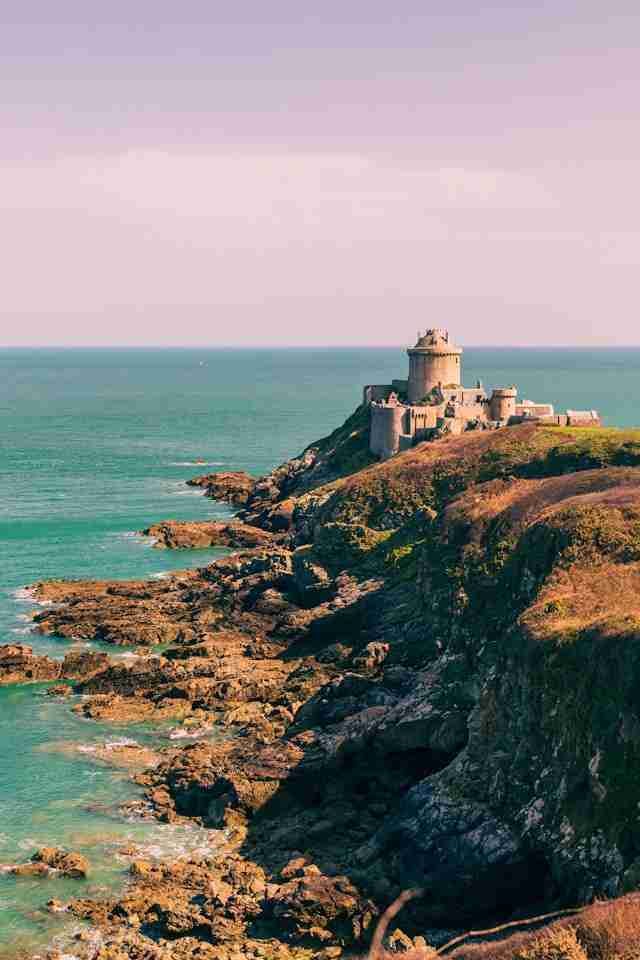
Standing proudly atop a rocky promontory on the Côte d'Émeraude, Fort la Latte, formally known as Château de La Roche Goyon, is one of France's most photogenic coastal fortresses. Built in the 14th century and later refortified in the 17th, this pink-granite stronghold rises dramatically above the churning waves of the English Channel. Connected to the mainland by a narrow stone causeway and surrounded by cliffs and heather-strewn moorland, Fort la Latte offers photographers the perfect combination of medieval architecture, rugged seascapes, and ever-changing Breton skies. Whether you're capturing its towers from a windswept bluff, its drawbridge at dawn, or its battlements silhouetted against the Milky Way, this is a location rich in texture, drama, and historical charm.
Best Photography Opportunities
• Panoramic Cliffside View from the Coastal Path
: The GR34 coastal trail, which skirts the cliffs just east of Fort la Latte, offers one of the most powerful vantage points for photographing the entire fortress in its natural context. From this elevated position, you can frame the castle sitting defiantly atop its rocky outcrop, surrounded by the vast Atlantic Ocean and backed by the distant silhouette of Cap Fréhel. A wide-angle lens allows you to include foreground elements like weathered grasses, wildflowers, or boulders, while a polarizing filter helps control glare off the water and enhance the depth of the blue sea. This location is especially dramatic in changing weather conditions—storm clouds rolling in from the west add tension and grandeur to the scene, while early morning mist softens the stone and gives the castle a mythic quality. Return at different times of day to experiment with light angles; golden hour adds dimension and warmth to the stone, while midday light brings out the pink tones in the granite.
• Drawbridge and Gatehouse Details
: Approaching the fortress along its narrow stone causeway delivers one of the most immersive perspectives. Here, the entrance towers loom larger with each step, and the drawbridge, flanked by battlemented walls, creates a natural focal point. This is an ideal spot for using symmetry and leading lines in your composition, as the path guides the viewer's eye directly into the fortress gates. Look for details: rusted iron chains, wooden portcullis beams, and the patina on the carved stone arch above the door. These elements photograph beautifully in soft light or on overcast days, which prevent harsh reflections and allow textures to dominate the frame. During early morning or late afternoon, light rakes across the cobblestone and gatehouse, casting shadows that emphasize the relief and depth of each surface. A mid-range zoom lens gives you the flexibility to capture both wide architectural shots and tighter views of details like mossy stonework or ancient hardware.
• Interior Courtyard and Tower Vistas
: Once inside the fortress, you're transported into a compact medieval world rich with photographic layers. The central courtyard, lined with weathered walls and staircases, presents multiple levels and converging lines that can be used for dynamic compositions. The spiral staircases leading up the main tower reveal increasingly dramatic views, both of the interior and of the surrounding sea. From the top platform, you can frame the walls and turrets with waves crashing below or zoom in on the mechanical details of defensive elements like arrow slits. The stone textures inside vary in hue from light pink to cool gray, depending on the lighting and time of day. Use contrast between sunlight and shadow to isolate geometric shapes created by the architecture. The courtyard is also a good place to shoot details that hint at daily medieval life: iron rings in the walls, soot-darkened fireplaces, or the subtle curvature of hand-worn stair railings.
• Sunset and Blue Hour Long Exposures
: The fortress's position on a protruding headland makes it an ideal subject for sunset photography. From the cliffs or rocky beach to the south, you can set up a composition that places the castle in silhouette against the vibrant tones of the setting sun. During golden hour, the light glides across the façade, revealing every contour and giving the granite a rich, glowing character. As blue hour arrives, the ambient light levels balance perfectly with the reflective sea and fading sky. This is the moment to switch to long exposure techniques, use an ND filter to extend shutter speeds and soften the surface of the water or create gentle motion blur in passing clouds. A 10–30 second exposure can turn the sea into a smooth, ethereal layer beneath the fortress, emphasizing the stillness and age of the structure. Light trails from distant fishing boats or reflections on wet rocks can add additional visual interest in the foreground. Use a tripod with strong footing, as wind gusts can be strong on the cliff edge.
• Astrophotography and Coastal Nightscapes
: Thanks to its isolated location and minimal light pollution, Fort la Latte is an exceptional site for night photography. On moonless nights, especially in late spring through early autumn, the Milky Way becomes visible arching above the castle's spires. The silhouette of the fortress against a dense starfield makes for one of the most dramatic compositions possible in Brittany. A fast wide-angle prime lens (such as a 14mm f/2.8) allows you to capture long exposures with sharp stars and foreground clarity. Light painting the stone gently with a filtered flashlight or LED panel adds depth without overwhelming the natural light. If the sea is calm, reflections of stars or ships' lights can be included in the frame. For more atmospheric conditions, winter skies bring crisp constellations and sometimes glimpses of the aurora borealis along the northern horizon. Star trails can be achieved by stacking multiple short exposures, using the fortress as a central anchor point in the lower third of your composition. Bring a headlamp, extra batteries, and warm clothing—conditions at night are damp and windy, but the results are worth the effort.
Best Time to Visit
Fort la Latte can be photographed year-round, but the best conditions depend on your intended subject. For landscape compositions with the full fortress in frame, spring and early summer offer lush vegetation, blooming wildflowers, and long golden hours. Sunrise and sunset during these seasons bathe the stone in amber light and often produce colorful, layered skies over the sea. In autumn, winds pick up and weather becomes more changeable, leading to dramatic skies, fleeting shafts of light, and moments of low-hanging mist—perfect for moody, cinematic work.
Winter presents harsher but visually rewarding conditions. The low sun angle casts sculptural shadows on the battlements, and frost on the surrounding grasses enhances texture in the foreground. Stormy days create crashing waves and intense cloud formations that amplify the drama of the setting. While the castle's interior may be closed or partially limited in the off-season, the exterior viewpoints remain accessible and often deserted—ideal for uninterrupted long exposures or astrophotography.
Overcast days are well suited to detail-oriented shots, as the diffused light prevents blown highlights and enriches surface textures on the stone walls and wooden gates. For night photography, visit during new moon phases in late spring or early autumn, when skies are typically clearest and the castle's silhouette is crisply defined against the stars.
How to Get There
Fort la Latte is located in the commune of Plévenon, within the Côtes-d'Armor region of northern Brittany. The site is well signposted from nearby towns, with the most direct route being via the D34 coastal road from Cap Fréhel or Erquy. From the town of Plévenon, follow signs for Fort la Latte until you reach the main parking area near the entrance to the headland.
There is a large, free public parking lot approximately 500 meters from the fortress itself. From there, a gently sloping footpath leads through low moorland and across the causeway to the entrance. This walk takes about 10 minutes and is manageable for most visitors, though the terrain can be muddy after rain. The grounds around the fortress are publicly accessible year-round, while interior access is available during regular open hours and requires a small admission fee. Exterior photography is unrestricted, but tripods may be discouraged during peak hours inside the fort due to crowding.
The coastal trail (GR34) runs past the fortress, making it an ideal stop on a broader photographic hike. For sunset or night photography, be sure to bring a headlamp for the return walk, as the area is unlit and bordered by steep cliffs. Weatherproof clothing and footwear are also essential, as the wind can be fierce and conditions change rapidly near the sea.
Recommended Kit for Capturing the Scene at Its Best
Fort la Latte presents a range of shooting conditions—from wide seascapes to tight architectural details—so a well-rounded kit is essential. A wide-angle lens (14–30mm) is ideal for capturing the castle from the coastal path or rocky cliffs, where you'll want to include both foreground and the vast sea beyond. This focal length also helps emphasize the height and scale of the fortress when shooting from directly below or near the base of the walls.
For mid-range versatility, a 24–70mm zoom covers most walking perspectives, including interior courtyards, stairwells, and drawbridge details. This is your workhorse lens for compositional balance and quick transitions from landscape to portrait orientation. A longer lens, such as a 70–200mm, is useful for isolating architectural elements like arrow slits, corbels, or textural details in the masonry. It's also effective for compressing the headland and fortress into layered scenes from a distance.
A tripod is critical for golden hour, blue hour, and night photography. Choose one that is compact and stable on uneven ground, with legs that can extend on rocks or moorland. ND filters help control exposure during daylight long exposures, while a circular polarizer can reduce glare from wet stone or enhance sky contrast. For astrophotography, a wide, fast prime (14mm f/2.8 or faster) combined with a remote shutter release will allow for star tracking or stacked exposures.
Bring a lens cloth and rain protection—Brittany's coast is known for its salty mist and frequent squalls. If you plan to shoot during sunrise or sunset, a headlamp and backup batteries are must-haves, as the area is completely unlit and prone to sudden temperature drops in the evening.
Nearby Photography Locations
: Just 5 kilometers west of Fort la Latte, Cap Fréhel is one of Brittany's most dramatic natural landmarks. Towering cliffs plunge into the sea, while the iconic lighthouse adds vertical contrast to the sweeping landscape. The heather-covered headland offers panoramic views ideal for wide-angle coastal photography, especially at sunrise when light pours over the cliffs from the east.
: A hidden cove nestled just south of Fort la Latte, this small beach is surrounded by pink granite outcrops and offers excellent compositions for low-tide reflections, intimate seascapes, and detail shots of weathered stone. Accessible by foot via the GR34 trail, it's a quiet alternative to the busier headland.
: This elegant seaside resort is known for its long beaches, boardwalk, and soft light. During golden hour, the pastel tones of the beachfront buildings and curved bay provide opportunities for architectural studies and landscape shots with gentle gradients and reflective sand.
: A charming harbor town to the east of the fort, Saint-Cast offers a mix of fishing boats, old stone quays, and sea walls ideal for detail-rich coastal photography. The viewpoint from Pointe de la Garde is particularly good at sunset, offering layered views of the Channel and surrounding cliffs.
• Les Sables Rouges at Erquy
: Known for its reddish sands and secluded feel, this beach lies within a preserved natural area and is perfect for minimalist compositions, long exposures, or textured foregrounds. It's best visited during low tide, when patterns in the sand and rock formations are most prominent.
Comments
Loading comments…