
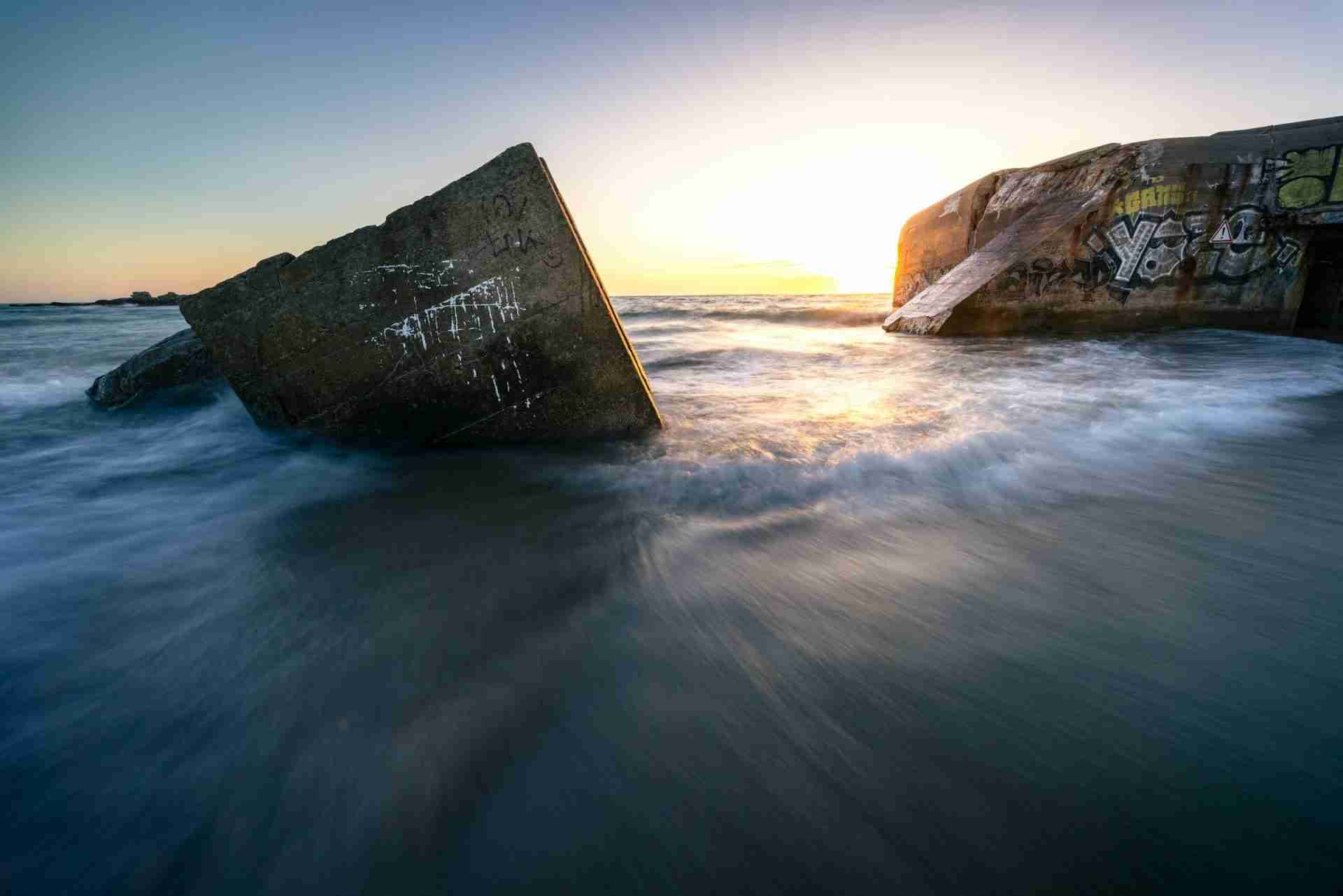
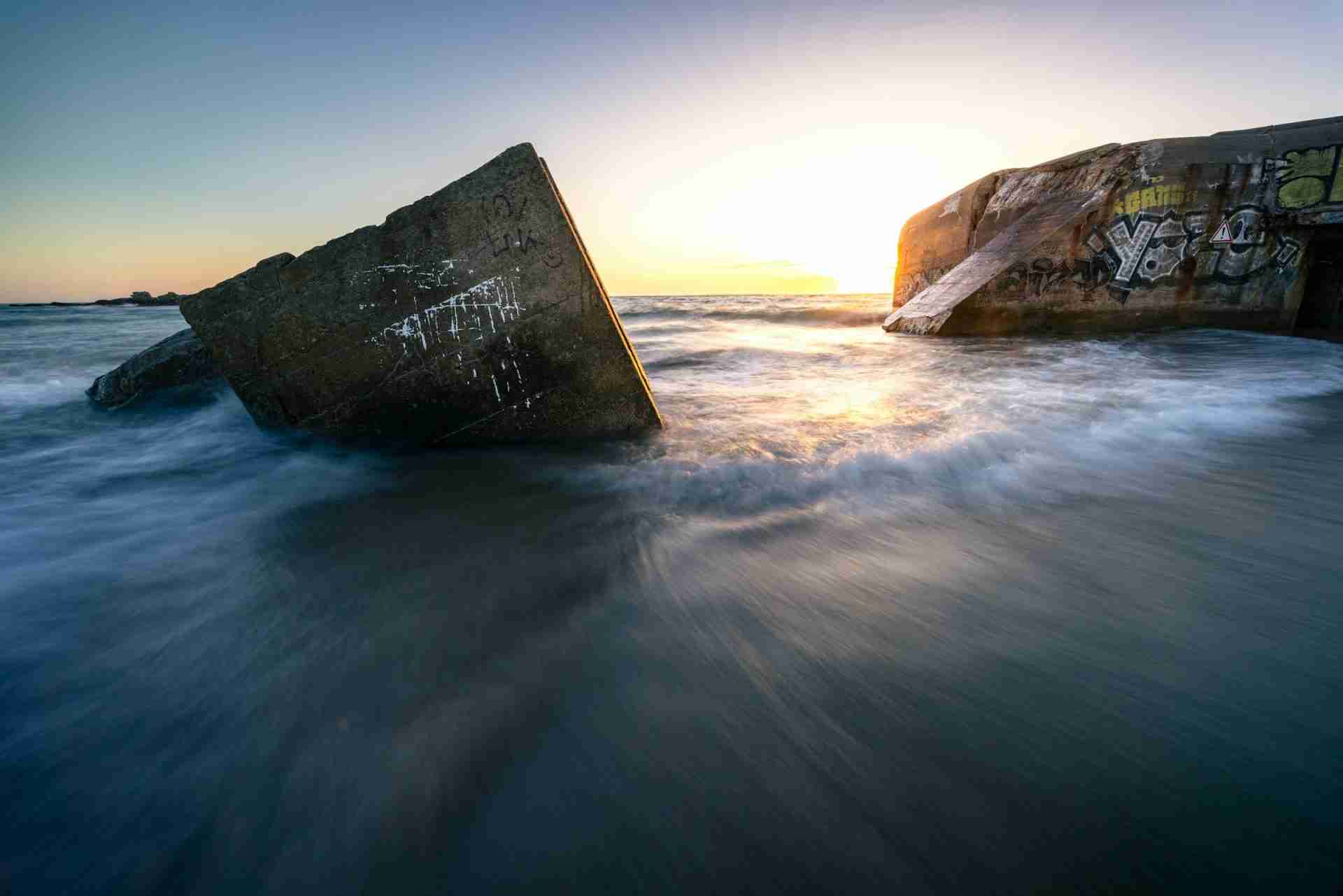
Kerouriec Beach stretches along the southern Brittany coast as a wide, wind shaped shoreline backed by dunes and scattered remnants of concrete fortifications. The bunkers here are part of the Atlantic Wall, now partially buried, tilted, and broken by decades of sand movement and tide. What makes this location compelling is the contrast between rigid military structures and a beach that feels open and constantly in motion. The bunkers are not arranged neatly or restored, and their unpredictable placement creates a variety of photographic possibilities within a relatively small area. This is a location where weather, tide, and light strongly influence the outcome, and where spending time walking and observing pays off more than rushing to obvious viewpoints.
Best Photography Opportunities
• Isolated Bunkers Against Open Sky and Sea
Several bunkers sit far enough from one another that they can be photographed as individual subjects rather than as a cluster. From the right angle, a single structure can be placed cleanly against sky or water, emphasizing shape, damage, and scale. Lower shooting positions help separate the bunker from the horizon and reduce visual clutter from dunes behind it. Early or late light adds definition to rough concrete surfaces and highlights cracks and edges. These compositions work best when you keep the frame simple and let the structure carry the image.
• Partially Buried Structures in the Dunes
Some bunkers are embedded directly into the sand, with only sections of walls or openings exposed. These make strong subjects for images that focus on how the landscape has reclaimed the structures over time. Working closer allows you to emphasize texture, erosion, and the meeting point between sand and concrete. Careful framing is important to avoid modern elements such as fence posts or footprints. This approach suits quieter light, when contrast is lower and detail is easier to hold.
• Wide Views Showing Bunkers Within the Beach Landscape
Stepping back allows the bunkers to sit within the broader context of beach, dunes, and sky. In these wider views, the structures act as visual anchors rather than dominant subjects. The openness of Kerouriec Beach makes it easier to balance foreground sand with background sea and clouds. Small shifts in position change how many bunkers appear in the frame and how they relate to one another. These images are strongest when the sky has some texture but does not overwhelm the scene.
• Low Tide Compositions With Wet Sand and Reflections
At low tide, the beach opens up and wet sand becomes a reflective surface that can be used creatively. Bunkers reflected faintly in the sand add depth without requiring perfect symmetry. Lower angles increase the impact of these reflections and help smooth out background distractions. Timing matters, as reflections appear briefly between wave sets and foot traffic. This opportunity works especially well under soft light near sunrise or sunset.
• Details of Openings, Corners, and Surface Texture
Closer studies of bunker interiors, firing slits, and broken edges offer quieter, more abstract images. These compositions focus on line, shadow, and texture rather than scale. Overcast conditions are ideal, as they prevent deep shadow from swallowing interior detail. This kind of work is useful when the wider beach feels busy or when light is flat. It adds variety to a set built around broader scenes.
Best Time to Visit
Kerouriec Beach works best early in the morning and late in the day, when light is lower and the beach is quieter. Morning often brings calmer wind and cleaner sand, which helps simplify compositions and reduce footprints. Sunset is particularly effective here, as the beach faces west and allows direct views toward the setting sun over the Atlantic. Late afternoon light adds warmth and side lighting that brings out texture in the concrete and sand. Overcast days are also well suited to this location, especially for detail work and moody wide scenes. Tide timing is important. Low tide exposes more sand and increases spacing between water and bunkers, while higher tides bring waves closer to the structures and change their relationship to the shoreline. Seasonal differences mainly affect weather and crowd levels, with spring and autumn generally offering the most workable conditions.
How to Get There
Kerouriec Beach is located in Erdeven on the coast of Morbihan in Brittany. It is accessible by car, with parking areas near the dunes followed by short walks onto the beach. Access paths are sandy but manageable with camera gear. There is no fee to access the beach or photograph the bunkers from public space. The area is open and exposed, so conditions can change quickly with wind and weather. Arriving early provides easier parking and more flexibility when choosing viewpoints. Care should be taken around unstable structures, as the bunkers are deteriorating and should not be climbed.
Recommended Photography Gear
A flexible lens setup works well at Kerouriec Beach. A standard zoom covers most situations, from wider beach scenes to tighter bunker studies. A longer focal length is useful for isolating individual structures and compressing distance when working across open sand. A tripod is recommended for early morning, sunset, and overcast conditions when shutter speeds drop. Neutral density filters can be useful for smoothing water movement at higher tides, though they are not essential. Weather protection for gear is important, as wind, sand, and salt spray are common. Comfortable footwear is also key, as moving between bunkers involves walking across soft sand.
Nearby Photography Locations
A long, open beach just south of Kerouriec, Kerhillio offers sweeping shoreline views and strong dune systems. It works well for simpler compositions focused on space and horizon.
This nearby beach features rocky sections and a different shoreline texture. It provides contrast to the sandy openness of Kerouriec.
The famous standing stones of Carnac introduce an entirely different historical subject. They are useful for extending a shoot beyond coastal themes.
Further west, the peninsula offers rugged coastline and stronger wave action. It adds dramatic contrast to the flatter beaches around Erdeven.
The estuary area provides calmer water, tidal channels, and changing light. It works well for quieter landscape work after coastal shooting.
Comments
Loading comments…