
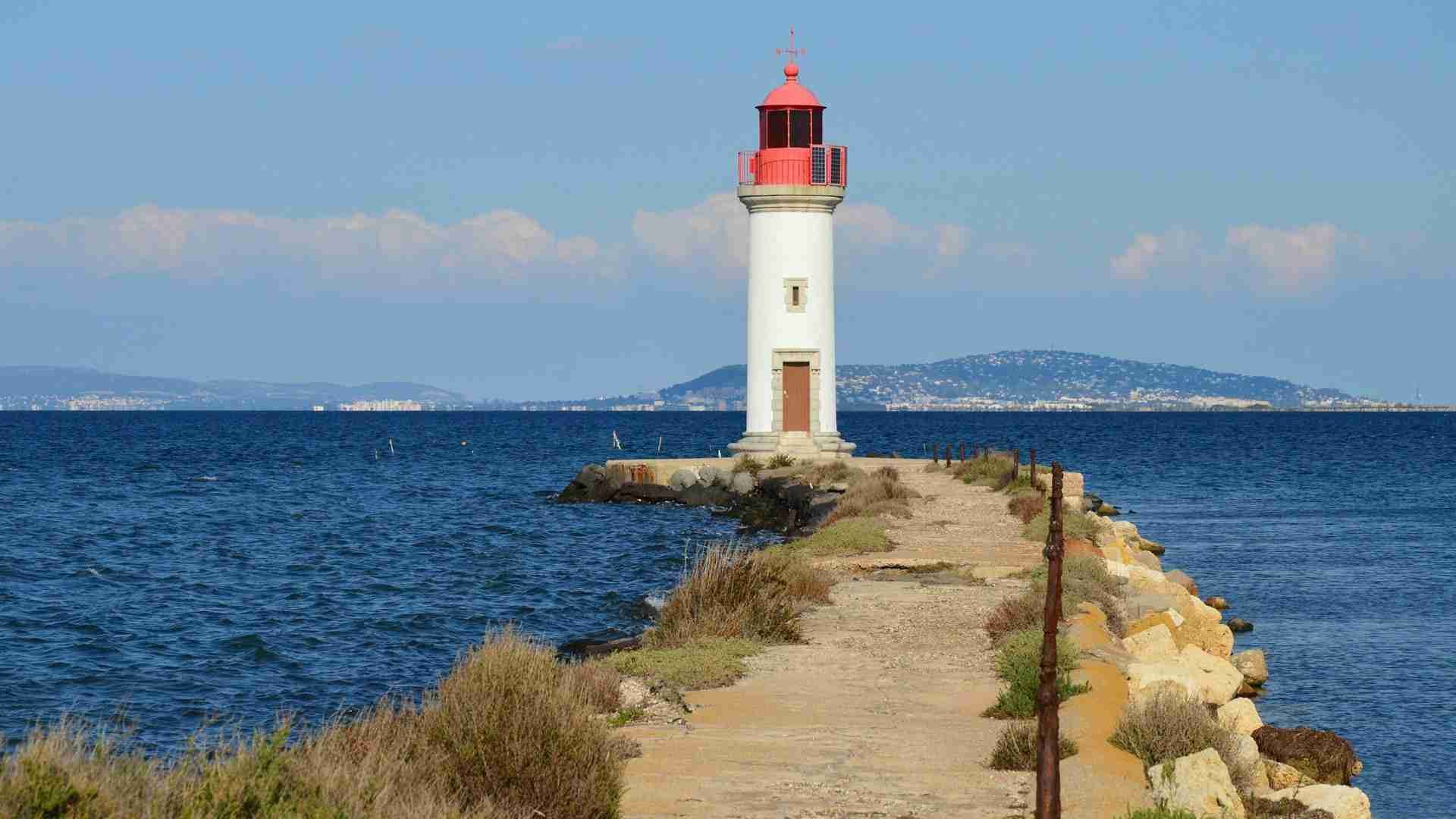
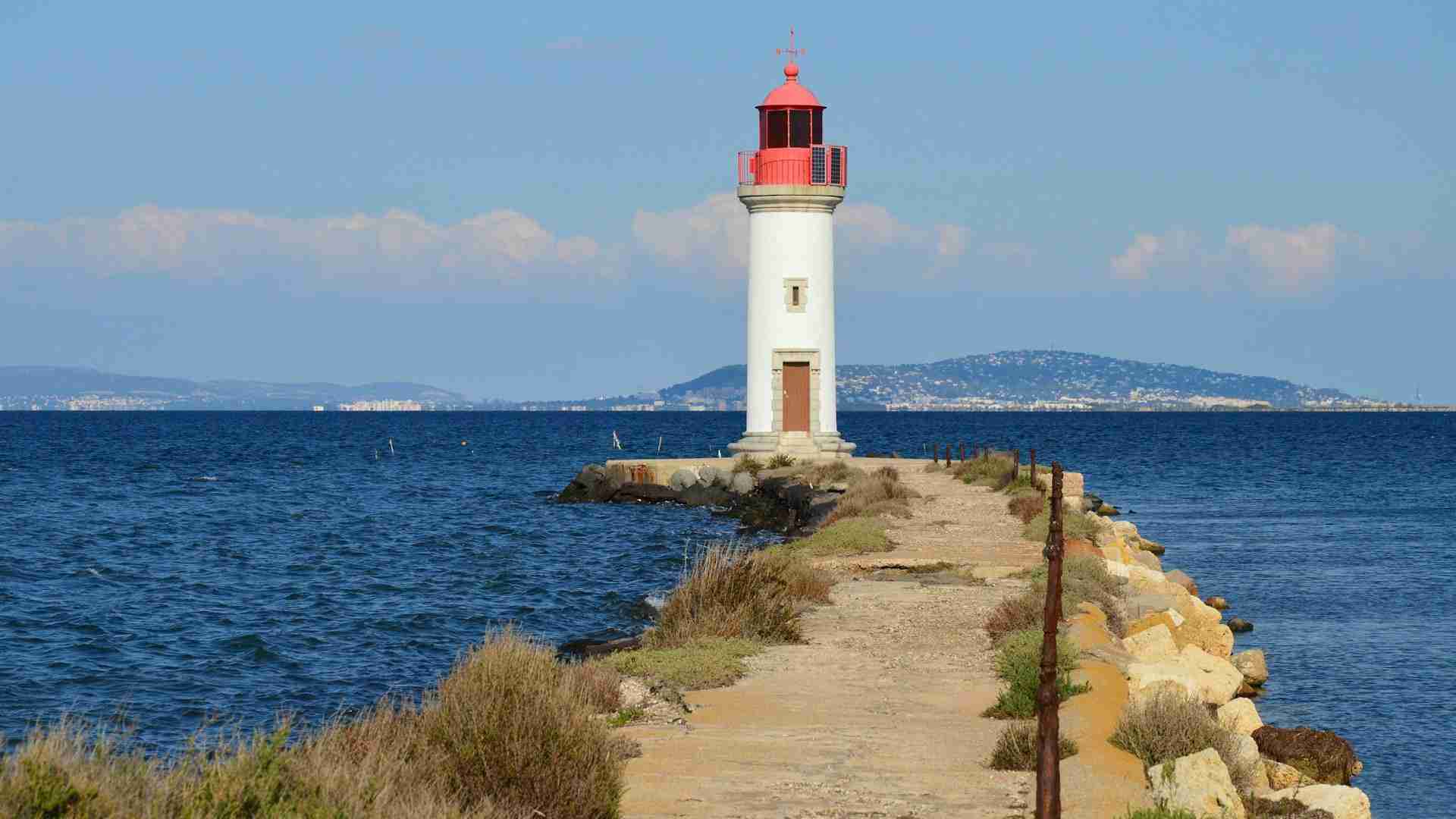
Standing at the eastern end of the Canal du Midi where it flows into the Étang de Thau, Les Onglous Lighthouse is a modest yet striking subject for coastal photography. The white cylindrical tower capped with a red lantern is small in scale, but its placement at the end of a long stone jetty gives it a sense of prominence. It marks the transition point between canal and lagoon, a location where history, navigation, and landscape come together. For photographers, the appeal lies not just in the lighthouse itself but in the open horizons, reflective waters, and surrounding views of Marseillan and the Thau basin. The site offers an ideal mix of minimalist compositions, maritime atmosphere, and wide skies that shift with every season.
Best Photography Opportunities
• The Jetty Leading to the Lighthouse
The long stone causeway that connects Marseillan to the lighthouse provides a natural leading line. Shooting from the start of the jetty with a wide-angle lens emphasizes perspective, drawing the viewer's eye toward the tower at the far end. Early morning light from the east creates soft shadows along the jetty stones, while evening light from the west bathes the lighthouse in warm tones. Including walkers, fishermen, or cyclists adds human presence without overwhelming the composition. This is also an excellent place to experiment with long exposures, smoothing the water while keeping the stones sharp.
• Minimalist Compositions from the Lagoon Shoreline
From the banks of the Étang de Thau, the lighthouse can be isolated against vast stretches of sky and water. These minimalist frames are particularly effective on calm days when reflections form in the lagoon. Using a telephoto lens compresses distance and allows you to position the lighthouse against layers of water and horizon. Overcast skies create a subdued, contemplative mood, while golden hour brings soft color gradients across the lagoon. These images work well in both color and black-and-white, depending on the light and atmosphere.
• Detail Shots of the Lantern and Structure
Though small, the lighthouse includes details worth close inspection, such as the red lantern, weathered stone base, and mooring cleats along the jetty. A standard zoom or short telephoto lens captures these elements cleanly. The best time for detail work is during diffused light or overcast conditions, when strong shadows are minimized and textures are evenly lit. These shots pair well with wider compositions, adding depth to a photographic series of the location.
• Sunset and Blue Hour Silhouettes
The lighthouse is particularly dramatic when photographed as a silhouette against the setting sun. From the jetty or the opposite shoreline, you can compose the tower against glowing skies that fade into the horizon. A tripod and long exposure are useful here, smoothing water while preserving the warm tones of sunset or the deep blue of twilight. Reflections in the lagoon add another layer of symmetry to these images. This is one of the most popular times to shoot at Les Onglous, and patience often rewards you with unique cloud formations and color variations.
• Boats and Maritime Activity
Small boats frequently enter and leave the canal near the lighthouse, providing additional subjects and a sense of scale. Shooting with a mid-range lens allows you to include both the boats and the lighthouse within the same frame. Golden hour is best for these shots, as low light enhances the sheen on the water and casts long reflections. These scenes help connect the lighthouse with its working maritime context, reminding the viewer that it continues to serve as an active navigational marker.
Best Time to Visit
Les Onglous Lighthouse can be photographed year-round, though conditions vary with season. Spring and autumn are the most balanced periods, with mild weather, changing skies, and soft light that works well for both landscape and architectural photography. Summer offers clear skies and calm water but can be crowded with visitors, particularly in the evenings. Winter brings dramatic skies, fewer people, and the possibility of strong winds that add texture to the lagoon's surface.
Time of day is equally important. Early morning is quiet and peaceful, with calm water for reflection shots and fewer people on the jetty. Late afternoon and golden hour create rich warm tones, while blue hour transitions provide excellent long-exposure opportunities. Midday is the least favorable for wide shots due to harsh overhead light, but it can be useful for detail work. Overcast conditions provide excellent light for textures, details, and moodier compositions of the lighthouse against a grey horizon.
How to Get There
Les Onglous Lighthouse is located at the eastern end of the Canal du Midi, just outside the town of Marseillan in southern France. From Marseillan, it is a short walk or cycle along the jetty to the lighthouse itself. Visitors arriving by car can park in Marseillan near the harbor and follow the pedestrian paths leading toward the water. The walk is flat and straightforward, though the jetty stones can be uneven, so good footwear is advisable.
Access to the lighthouse and jetty is free and unrestricted, and the site is open at all hours. This makes it easy to plan visits at sunrise, sunset, or even for night photography. There are no facilities at the lighthouse itself, but Marseillan offers cafés, shops, and restrooms within walking distance. Drones may be permitted, but always check local regulations, as the lighthouse sits at the edge of a sensitive lagoon ecosystem.
Recommended Photography Gear
A wide-angle lens is essential for capturing the lighthouse at the end of the jetty and for expansive compositions across the Étang de Thau. A standard zoom such as 24 to 70 millimeters is versatile for mid-range compositions, while a telephoto lens between 70 and 200 millimeters is useful for compressing distance and isolating the lighthouse against sky and water.
A tripod is highly recommended for blue hour and long exposures, especially when shooting reflections across the lagoon. A circular polarizer helps control glare on water and deepens color saturation in both sky and water. A neutral density filter is useful for extending exposure times, smoothing water surfaces, and creating cloud motion effects. A microfiber cloth is valuable for clearing sea spray from lenses on windy days.
Nearby Photography Locations
• Marseillan Harbour
The harbor itself is filled with fishing boats, moorings, and traditional maritime architecture. It is especially photogenic at sunrise, when the first light falls on the water and boats remain still.
This large lagoon stretches along the coast and offers wide horizons, oyster beds, and changing light conditions. It is best photographed at golden hour, with the calm water reflecting dramatic skies.
• Agde
A historic town a short drive away, Agde offers volcanic stone architecture, narrow streets, and riverfront scenes that contrast well with the open water of Les Onglous.
• Sète
Located across the lagoon, Sète is known for its canals, fishing activity, and panoramic views from Mont Saint-Clair. It provides excellent opportunities for urban maritime photography.
Tracing the canal inland from Marseillan provides endless opportunities to photograph shaded towpaths, bridges, and tree-lined reflections. Autumn is especially beautiful when leaves turn golden and frame the canal.
Les Onglous Lighthouse may not be grand in scale, but its setting at the threshold of canal and sea makes it a rich subject for photography. Its simplicity encourages creative framing, whether as part of a wide landscape, a detailed architectural study, or a minimalist reflection. With its ever-changing light and surroundings, it rewards repeat visits and offers quiet moments of composition at the edge of southern France's maritime world.
Comments
Loading comments…