
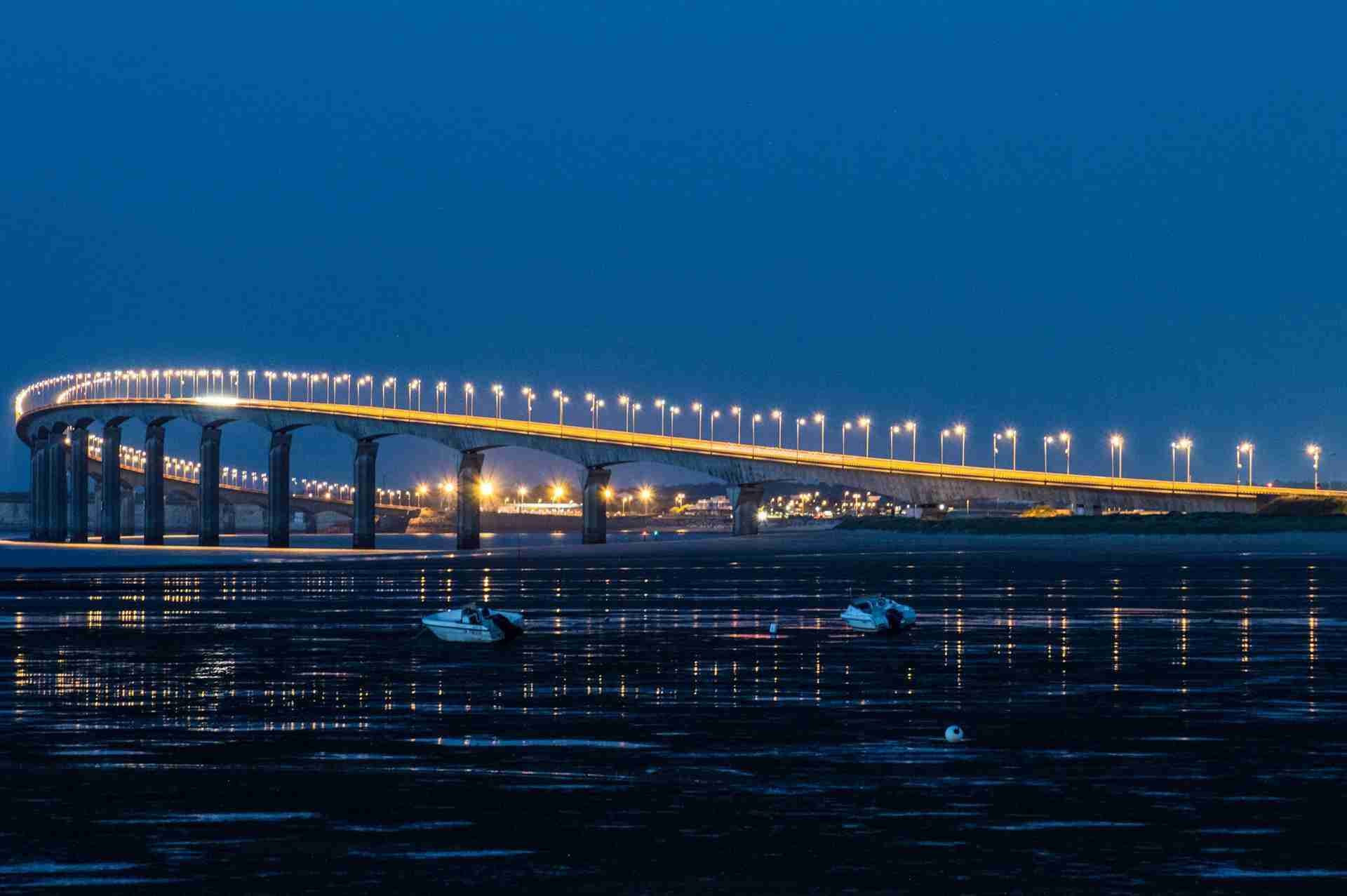
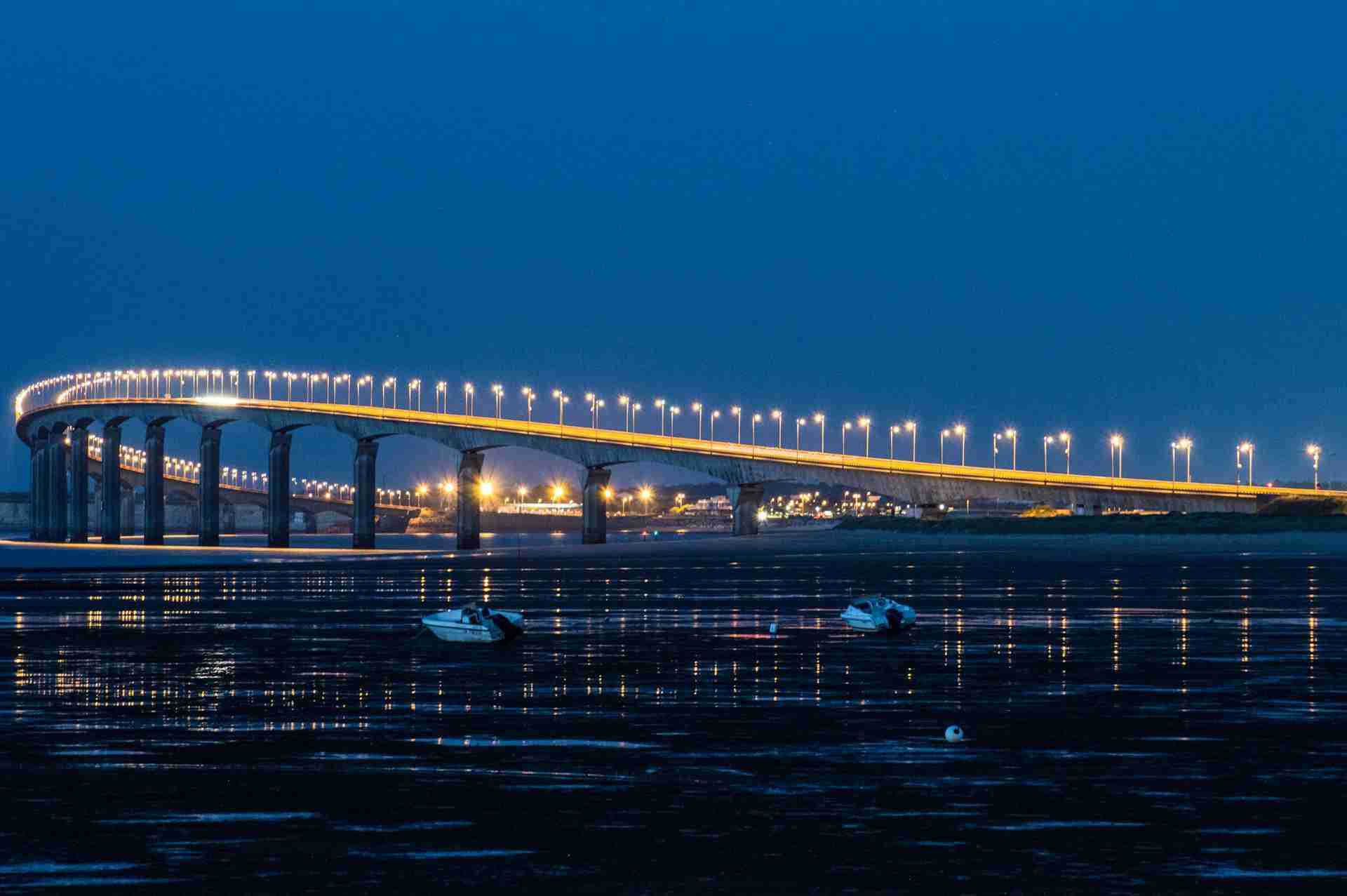
Stretching gracefully across the Pertuis d'Antioche strait, the Pont de l'Île de Ré connects the mainland city of La Rochelle to the island of Île de Ré. At nearly three kilometers long, this sweeping concrete bridge is not just an engineering marvel but also a highly photogenic subject set against coastal skies and tidal waters. Its gently curving form arcs across the seascape, creating strong lines that guide the viewer's eye into the distance. Changing tides reveal sandbanks, ripples, and boats beneath its span, while the Atlantic light adds depth and drama to its clean geometry. Whether you are capturing its minimalist lines in a modern architectural style or incorporating the surrounding coastal environment, the Pont de l'Île de Ré offers photographers a wealth of creative opportunities.
Best Photography Opportunities
• Wide compositions from Rivedoux-Plage
: The beach at Rivedoux-Plage, directly beneath the bridge, provides one of the best vantage points for capturing the structure in its entirety. A wide-angle lens allows you to emphasize the sheer length of the bridge while including foreground textures such as sand, rocks, or tidal pools. Shooting during low tide creates the opportunity to incorporate reflective surfaces and patterns left by the receding water. Golden hour light, particularly in the evening, warms the concrete and creates soft color gradients across the sky. Experiment with vertical compositions as well, which can accentuate the bridge's rise from the shoreline toward the horizon.
• Detail work beneath the arches
: Standing below the bridge, you can frame the repeating arches that march rhythmically into the distance. These repeating forms create natural leading lines and abstract opportunities that work beautifully in both color and black and white. Shadows beneath the structure are dramatic in the late afternoon when the sun cuts low across the water, carving deep tonal range into the underside of the bridge. A mid-telephoto lens can compress the arches for graphic, pattern-driven compositions. This angle also works well on overcast days, when diffused light reduces contrast and lets the shapes dominate the image.
• Drone perspectives over the strait
: If permitted, drone photography offers a striking view of the bridge's arc across the water. From above, the curve of the bridge becomes more pronounced, and you can juxtapose its clean geometry against the shifting textures of sea and sandbanks. Early morning flights reveal long shadows cast by the bridge's piers, while at high tide the water forms a continuous expanse of blue that emphasizes the bridge's span. Be mindful of wind, which is common in this coastal region, and plan flights at calmer hours of the day. Including boats or paddleboarders in the frame provides a useful sense of scale.
• Long exposures at dusk
: The bridge becomes particularly dramatic during the transition from daylight into night. From the shoreline or breakwaters, long exposures smooth the water and emphasize the reflections of fading light on its surface. The clean line of the bridge stands in contrast to the soft textures of sky and sea, producing an elegant minimalist result. A sturdy tripod and neutral density filters are essential here, especially if you want to extend exposure times into the several-minute range. The blue hour often provides the best balance between artificial light from passing cars and the natural glow lingering over the strait.
• Framing with boats and coastal activity
: The waters surrounding the bridge are busy with sailboats, fishing vessels, and recreational craft, especially in summer months. Including these elements in your composition adds both scale and narrative. A telephoto lens allows you to isolate moments where a boat passes beneath the span, creating a dynamic contrast between human activity and the permanence of the structure. In the mornings, fishermen and seabirds can also be photographed in the tidal shallows, providing lively foregrounds that balance the bridge's strong architectural line.
Best Time to Visit
The Pont de l'Île de Ré can be photographed year-round, but conditions vary significantly by season and time of day. Spring and early summer bring clear skies and softer air, with long daylight hours that allow extended shooting opportunities. Early mornings in spring often feature calm waters and subtle mist, which work especially well for reflective compositions along the beach. Summer offers the most consistent light and busy scenes with boats and coastal activity, though harsh midday sun requires careful exposure or the use of filters. Shooting early in the morning or late in the evening during these months avoids the strongest glare and heat shimmer.
Autumn brings warmer-toned skies and often dramatic cloud formations, which are ideal for long exposures and wider contextual shots. Tides during this season are especially pronounced, revealing sandbanks and tidal channels that add extra layers to foreground compositions. Winter is more challenging, with colder winds and frequent storms, but these conditions produce some of the most striking photographs. Heavy clouds and turbulent seas create dramatic contrasts against the bridge's straight, unyielding form. Night photography is possible in all seasons, though summer evenings provide the clearest skies and the most balanced transition between ambient twilight and artificial light.
How to Get There
The Pont de l'Île de Ré begins at the northern edge of La Rochelle and extends westward to the island of Île de Ré, landing at the town of Rivedoux-Plage. By car, the bridge is easily accessible via the D735 road, which connects directly to the mainland road network. There is a toll to cross onto the island, though pedestrians and cyclists are exempt, and there are dedicated bike and pedestrian lanes separated from the main traffic. For photographers, the best starting point is the beach at Rivedoux-Plage on the island side, where parking areas are available close to the shore. From there, it is only a short walk to several vantage points that offer both wide and detailed views of the bridge. On the mainland side, views are more limited, though small access roads and coastal trails allow partial perspectives. Be aware that weather changes quickly along the coast, and wind can be strong when shooting from exposed positions near the water.
Recommended Photography Gear
A wide-angle lens is essential for capturing the full span of the bridge from the beach or shoreline. A focal range between 16 and 35 millimeters will allow you to emphasize its sweeping curve while incorporating the tidal flats and coastal textures in the foreground. For isolating details such as repeating arches or passing boats beneath the span, a telephoto lens in the 70 to 200 millimeter range is extremely useful. A mid-range zoom such as a 24 to 70 millimeter is versatile for general compositions, especially if you plan to shoot both architectural forms and human activity along the water.
A sturdy tripod is critical for long exposures at dawn or dusk, and a neutral density filter will extend shutter speeds for smoothing the water and softening cloud movement. A circular polarizer is also highly recommended for cutting glare on the water and enhancing sky contrast during mid-day sessions. Drone photographers will want to ensure they have both appropriate permits and stable weather conditions, as winds across the strait can be unpredictable. Given the coastal environment, bring protective covers for your gear and a microfiber cloth to manage sea spray or mist. Comfortable waterproof footwear is helpful if you plan to explore tidal areas for foreground compositions.
Nearby Photography Locations
: Just across the water from the bridge, the Old Port of La Rochelle is rich in photographic opportunities, from its medieval towers to its bustling quays lined with fishing boats. Early morning provides calm reflections in the water, while evening is ideal for capturing the lively ambiance of the harbor lights.
: Located inland on the island, the salt pans and marshes are a beautiful contrast to the modern lines of the bridge. Their reflective surfaces at sunset provide striking color, and the patterns created by channels and dikes make for strong aerial or telephoto compositions.
At the far western tip of Île de Ré, this lighthouse offers panoramic views over the Atlantic. The spiral staircase inside creates strong interior compositions, while the surrounding coastline is best photographed at sunrise when the light falls directly across the open sea.
: South of the bridge, this long sandy beach is excellent for wide seascapes, particularly during low tide when sand ripples and tidal pools create textured foregrounds. The beach is also a productive location for sunset photography, with uninterrupted horizons and shifting color gradients.
: Accessible by ferry from the mainland, this small island offers historical fortifications, sandy coves, and expansive views back toward the Île de Ré bridge. Its slower pace and diverse coastal scenery make it a rewarding day trip for photographers looking to expand their portfolio beyond the bridge itself.
The Pont de l'Île de Ré is more than a link between land and island. It is a graceful architectural subject that transforms with every tide, sky, and season. For photographers willing to explore its angles and adjust to the shifting conditions of the Atlantic coast, it offers compositions that range from sweeping modern minimalism to layered seascapes filled with depth and movement.
Comments
Loading comments…