
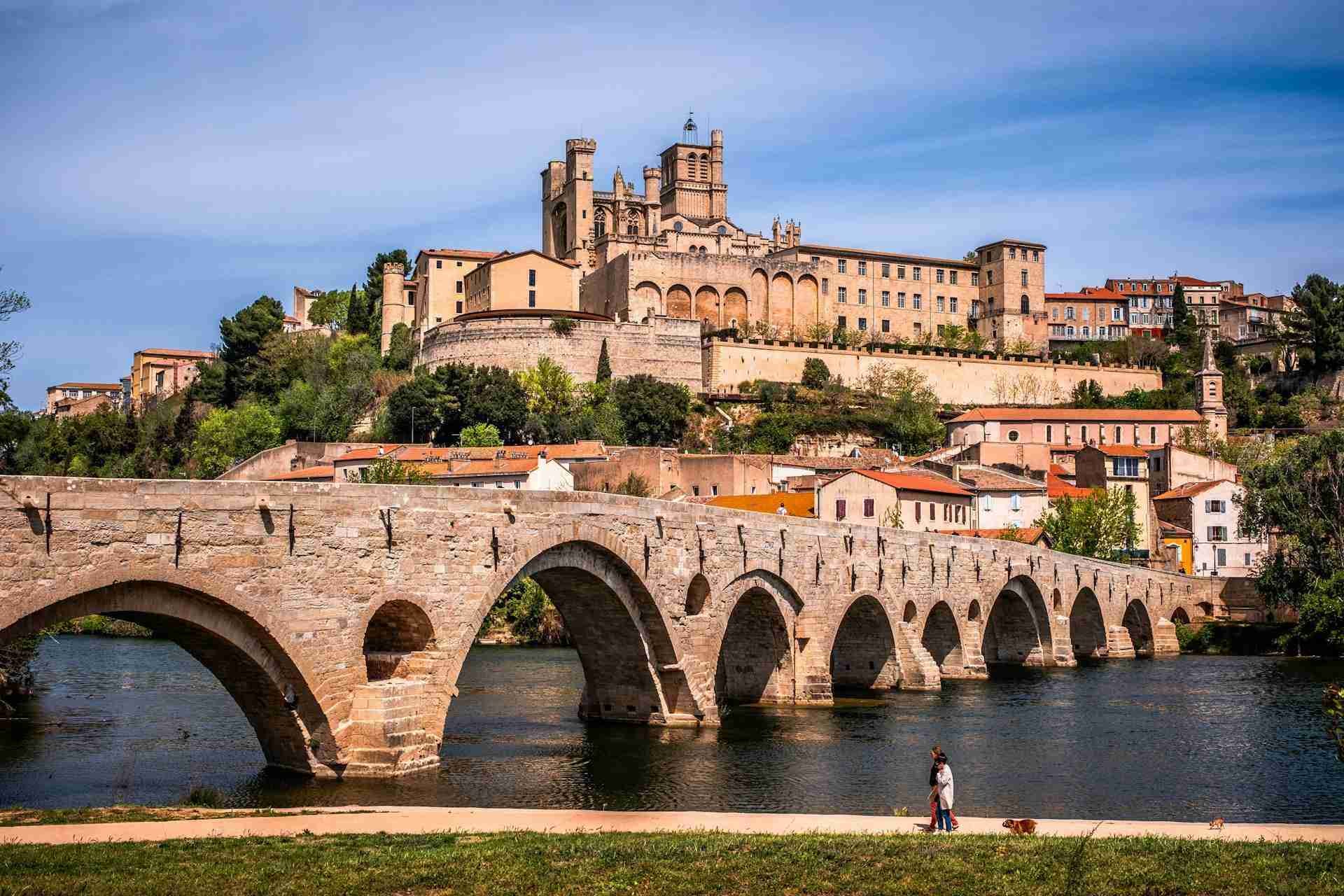
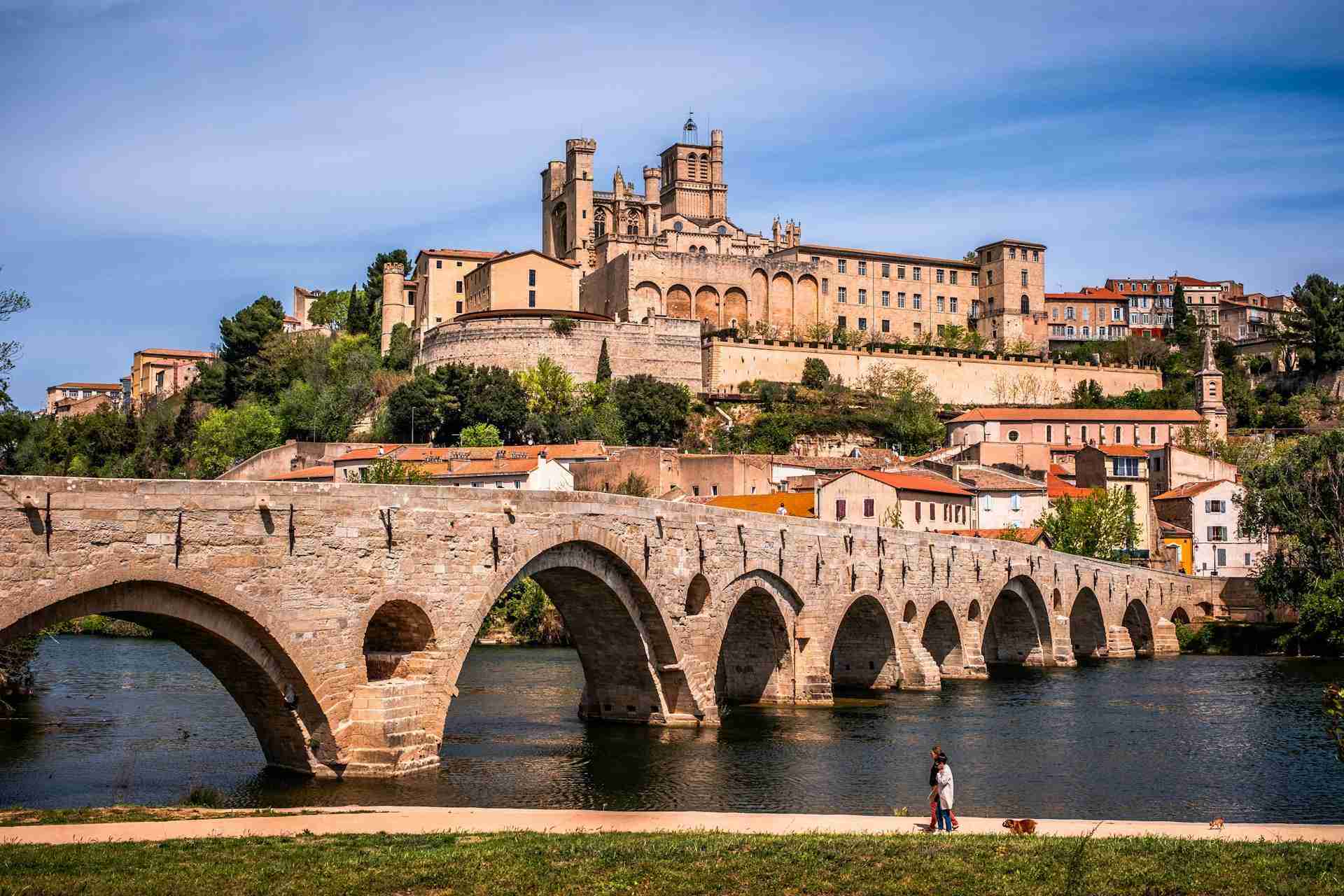
Perched above the River Orb in southern France, Béziers offers a classic cityscape for photographers where medieval architecture meets flowing water and shifting light. The Pont Vieux, a 12th-century stone bridge, leads the eye directly toward the dramatic silhouette of the Saint-Nazaire Cathedral rising above the town. Together, they form one of the most compelling historic pairings in the Languedoc region. With its rhythmic arches, textured stonework, and reflection opportunities in the river below, the bridge provides strong foreground structure, while the cathedral anchors the skyline with its commanding profile. Whether photographed at golden hour, under stormy skies, or in blue hour stillness, this location invites careful framing and a deliberate exploration of composition and light.
Best Photography Opportunities
Frontal Composition Across the River Orb
The most well-known and balanced viewpoint is from the opposite bank of the River Orb, where the full length of Pont Vieux extends across the frame toward the cathedral above. Use a wide or standard lens to keep the bridge in proportion and allow space for the sky and water to shape the mood. Early morning and late afternoon light offer warm illumination on the stone, while overcast skies bring out subtle textures and tones. When the river is calm, the bridge's arches reflect in near-perfect symmetry, creating opportunities for structured compositions that highlight geometry and balance.
Telephoto Studies of the Cathedral Above the Town
From across the river or at various spots along the banks, a telephoto lens allows you to isolate the Saint-Nazaire Cathedral above the rooftops. Shoot during late afternoon when the sun casts long shadows across the town, separating the cathedral from the lower structures. This approach emphasizes the scale and detail of the building and is effective when clouds create drama in the background. Compositions that include sloping roofs and narrow streets below help tell the story of Béziers' vertical rise from river to ridge.
Bridge Details and Arches from the Water's Edge
Closer to the bridge, the textures of stone, variations in arch size, and the aging patina of the structure make for strong graphic compositions. Walk along the lower river path to frame upward shots of the arches with sky or cathedral rising behind. These images benefit from side light that adds definition to the masonry and helps separate individual stones and mortar lines. When the water level is low, you can find spots where foreground rocks or grasses provide natural framing and lead the eye toward the structure.
Reflections and Long Exposure at Blue Hour
During blue hour, the bridge and cathedral light up while the river takes on a soft, glassy finish. A tripod is essential here to capture longer exposures that smooth the water and bring out subtle detail in the architecture. Use a wide or standard lens to include both bridge and cathedral, and experiment with vertical framing to emphasize reflection and depth. These compositions are strongest when the sky still holds some residual color or when city lights introduce warm contrast against the cool tones of dusk.
Compositions Including Trees and Riverbank Elements
Along the river's edge, there are several mature trees and walking paths that can be used to build layered compositions. In spring and summer, green foliage contrasts well with the warm stone of the bridge and cathedral. In autumn, golden tones add richness and frame the scene with seasonal texture. Use mid-telephoto focal lengths to compress the trees into the scene or place them as foreground elements for added depth. These compositions work especially well in softer morning light when shadows are long and the atmosphere remains still.
Best Time to Visit
Pont Vieux and the Saint-Nazaire Cathedral can be photographed in every season, but spring and autumn offer the most favorable light and color. Spring brings blooming trees and clear river reflections, while autumn adds warmth to the foliage and softens the overall palette. Summer light is often harsh at midday, so early morning or evening sessions are preferable. Winter is quieter, with starker tones and greater visibility through the trees.
The best times of day are sunrise and golden hour before sunset. At these times, the low sun highlights the texture of the stone and creates gentle reflections across the water. Blue hour is also rewarding, particularly when photographing long exposures of the illuminated buildings and their reflections. Avoid shooting at noon unless the sky is overcast, as the overhead light tends to flatten both the bridge and cathedral. Fog and light rain can add mood and atmosphere, particularly when using longer lenses to compress depth.
How to Get There
Béziers is located in the Occitanie region of southern France and is easily reached by train, car, or regional bus. The town lies along the main rail line between Montpellier and Narbonne, with regular service throughout the day. From the city center, the Pont Vieux is a short walk downhill through the old quarter. Follow signs toward the Orb River or the cathedral, both of which are central landmarks.
Photographers can access both sides of the river via walking paths, and several viewpoints are marked along the bank. There is no fee to access or photograph the bridge or cathedral from public areas. A small park and riverside promenade make it easy to set up a tripod or work with multiple compositions. If arriving by car, parking is available nearby, though some lots are metered. For elevated views, climb to the upper terrace near the cathedral for panoramic scenes looking back across the bridge and river.
Recommended Photography Gear
A wide-angle lens is essential for capturing the full span of the bridge and its relationship with the cathedral. A 24 to 70 millimeter lens works well for flexible framing along the riverbank or when including trees and foreground elements. A 70 to 200 millimeter telephoto is ideal for isolating the cathedral, compressing rooftops, and working with atmospheric perspective from a distance. For close studies of stonework, arches, and architectural details, a short telephoto or macro lens can help reveal texture and age.
A tripod is necessary for twilight or blue hour photography, especially when shooting longer exposures across the river. A polarizing filter can help control glare on the water and deepen sky contrast during the day. Neutral density filters are useful for slowing shutter speed when softening reflections or capturing cloud movement. Bring a lens cloth, as mist from the river can build up on your front element. Comfortable footwear is also helpful for walking the varied river paths, especially if exploring multiple angles around the site.
Nearby Photography Locations
This wide tree-lined boulevard in central Béziers offers architectural perspectives, street scenes, and shaded compositions beneath mature plane trees. It is especially effective in soft light when shadow and texture play across the pavement and façades.
A short walk from the center, this 19th-century landscaped park features winding paths, statues, and a central pond. The park is ideal for working with natural light, reflected water, and quiet compositions in the early morning or late afternoon.
Just west of Béziers, this archaeological site on a hilltop provides panoramic views over the vineyards and circular fields of the Étang de Montady. Telephoto lenses are useful here for abstract compositions of agricultural geometry and for layering distant landscape forms.
South of town, the historic Fonseranes lock system offers motion-based photography with boats, water movement, and structural repetition. Capture the interaction between engineered form and the natural slope of the land, especially during golden hour when the light catches the stonework.
For a larger-scale gothic subject, consider visiting Montpellier's cathedral an hour to the northeast. Its massive towers and arched entrances create a very different architectural presence, providing contrast to the more intimate profile of Saint-Nazaire.
Pont Vieux and the Saint-Nazaire Cathedral offer a setting where stone, river, and sky converge in quiet harmony. This is not a place for dramatic vertical scale but rather for thoughtful framing and an attention to rhythm and balance. Whether working with broad reflections, architectural detail, or layered context across rooftops and trees, this historic crossing in Béziers encourages a measured approach to composition and timing. Each season and hour reshapes the relationship between bridge and cathedral, offering new possibilities for those who return with intention and curiosity.
Comments
Loading comments…