

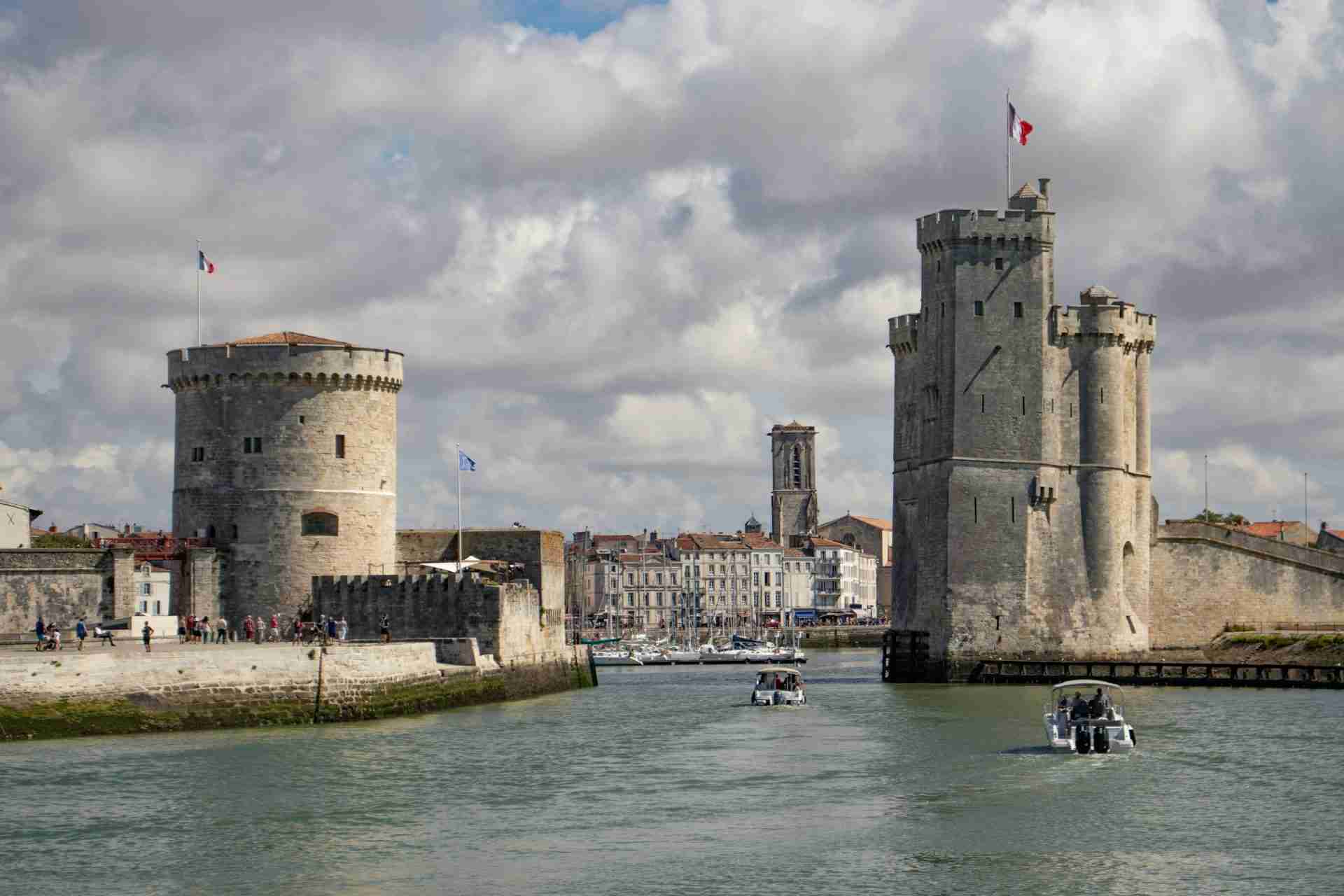
At the entrance to the historic harbor of La Rochelle stand two medieval stone towers that have watched over the city for centuries. Tour Saint Nicolas and Tour de la Chaîne form a dramatic gateway between the old port and the open Atlantic beyond. Built during the fourteenth century as part of the city's defensive system, the towers once controlled access to the harbor using a massive chain stretched between them, giving the Tour de la Chaîne its name. Today they remain among the most recognizable landmarks on the French Atlantic coast, rising above the water at the mouth of the Vieux Port. For photographers, the towers offer a mix of historic architecture, maritime atmosphere, and harbor views that change throughout the day as boats pass beneath them and light shifts across the stone walls. The towers sit on opposite sides of the harbor entrance where boats pass between them before reaching the marina and old town waterfront. Tour Saint Nicolas rises on the western side of the channel and has a tall, slightly irregular shape that leans subtly toward the harbor. Tour de la Chaîne stands across the water on the eastern side, closer to the old harbor quays and the busy marina. Together they create a dramatic architectural frame around the harbor entrance, making the area one of the most photographed locations in La Rochelle.
Best Photography Opportunities
• The Harbor Gateway View of Both Towers
One of the most recognizable photographs of La Rochelle captures both towers facing each other across the harbor entrance. From the quays of the Vieux Port, photographers can frame the channel of water that runs between Tour Saint Nicolas and Tour de la Chaîne. Boats entering or leaving the harbor pass directly between the towers, creating a natural focal point in the composition. The scene clearly illustrates how the towers once controlled access to the port. When the water is calm, reflections of the towers may appear in the harbor, adding depth to the image.
• Tour Saint Nicolas from the Western Harbor Walk
Tour Saint Nicolas stands on the western side of the harbor entrance and has a distinctive, slightly leaning silhouette. Photographing from the walkway near the tower allows the structure to dominate the frame while the harbor water and opposite tower appear in the background. The thick stone walls, narrow windows, and uneven shape reveal the defensive nature of the building. From this angle photographers can also show how the tower rises directly from the edge of the harbor. Including boats or harbor activity nearby helps provide scale.
• Tour de la Chaîne with the Marina Behind It
Tour de la Chaîne sits on the eastern side of the harbor entrance beside the busy marina of the Vieux Port. From the quays near the old harbor basin, photographers can frame the tower with rows of sailboats and masts behind it. This composition connects the medieval structure with the active harbor environment that surrounds it today. The contrast between the old stone tower and the modern marina creates a strong visual story. During calm conditions the tower often reflects clearly in the harbor water.
• Evening Light and Harbor Reflections
Sunset and early evening often provide the most atmospheric conditions around the towers. As the sun lowers over the Atlantic, warm light spreads across the stone walls and highlights the texture of the towers. After sunset the harbor lights begin to reflect in the water while the towers remain illuminated. Long exposures during blue hour can capture smooth water and glowing reflections across the harbor basin. This time of day often produces the most dramatic images of the Vieux Port.
• Views from the Harbor Promenade
Walking along the harbor promenade reveals a variety of smaller compositions that place the towers within the wider setting of La Rochelle. Harbor railings, stone quays, and rows of boats can act as foreground elements leading toward the towers. These viewpoints help connect the historic structures with the daily life of the port. Photographers can experiment with angles where masts or harbor buildings frame the towers in the distance. These scenes show how the towers remain part of an active waterfront.
Best Time to Visit
Late afternoon and evening often provide the best light for photographing the harbor entrance. As the sun lowers, warm tones highlight the stone surfaces of both towers and create longer shadows across the quays. Sunset can also produce colorful skies above the harbor when clouds move in from the Atlantic.
Blue hour shortly after sunset is particularly rewarding for photography. During this time the harbor lights begin to glow while the sky remains softly illuminated. Calm water can produce strong reflections of the towers, boats, and surrounding buildings. Early morning can also be appealing when the harbor is quieter and the water is often smoother.
How to Get There
Tour Saint Nicolas and Tour de la Chaîne stand at the entrance to the Vieux Port in the historic center of La Rochelle, France. The towers are easily reached on foot from most areas of the old town. Visitors arriving by train can walk from La Rochelle station to the harbor in about fifteen minutes. Parking areas are available near the city center for those arriving by car. Once at the waterfront, the towers are clearly visible on either side of the harbor entrance.
Both towers are managed as historic monuments and may require an admission ticket to enter and climb inside. The surrounding harbor quays and promenades are freely accessible and provide many excellent photography viewpoints.
Recommended Photography Gear
A wide lens works well around the harbor because many compositions include both towers along with the surrounding water and boats. Wide framing helps capture the relationship between the two structures across the harbor entrance. A moderate zoom lens can also be useful for isolating architectural details or capturing tighter views of individual towers.
A tripod is particularly helpful for evening and blue hour photography when longer exposures allow reflections to appear in the harbor water. A circular polarizing filter can reduce glare on the water during daylight and help deepen the color of the sky above the harbor.
Nearby Photography Locations
• Vieux Port Marina
The marina behind the harbor entrance contains rows of sailboats surrounded by historic waterfront buildings. Photographers can capture reflections of boat masts and lively harbor scenes throughout the day. The marina becomes especially atmospheric during evening when lights reflect across the water.
Located a short distance along the waterfront, this medieval tower once served as both a lighthouse and prison. Its tall stone structure stands beside the sea wall and offers strong architectural compositions. The tower also provides views across the harbor and Atlantic coastline.
• La Rochelle Old Town Streets
The historic center behind the harbor contains arcaded streets, stone buildings, and busy public squares. Photographers can explore narrow streets where arches and arcades create repeating patterns of light and shadow. These areas provide a strong contrast to the open waterfront scenes.
South of the old harbor lies one of the largest marinas on the French Atlantic coast. The area contains hundreds of sailboats and wide waterfront promenades. Photographers can capture expansive coastal views with boats and open water stretching toward the horizon.
On clear days, distant viewpoints along the coast near La Rochelle can reveal the famous sea fort known as Fort Boyard. The structure sits offshore between nearby islands and occasionally appears along the horizon. Photographers can frame the fort within wider coastal compositions.
Comments
Loading comments…