
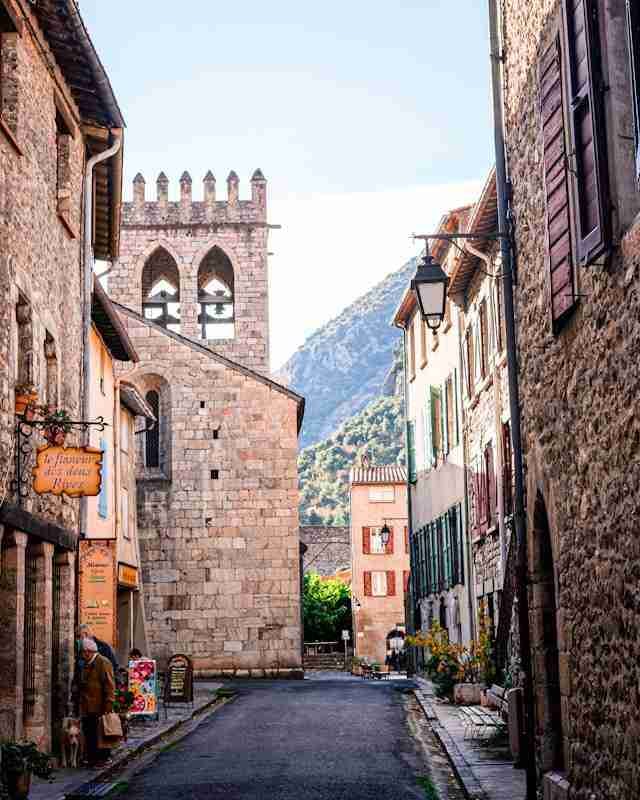
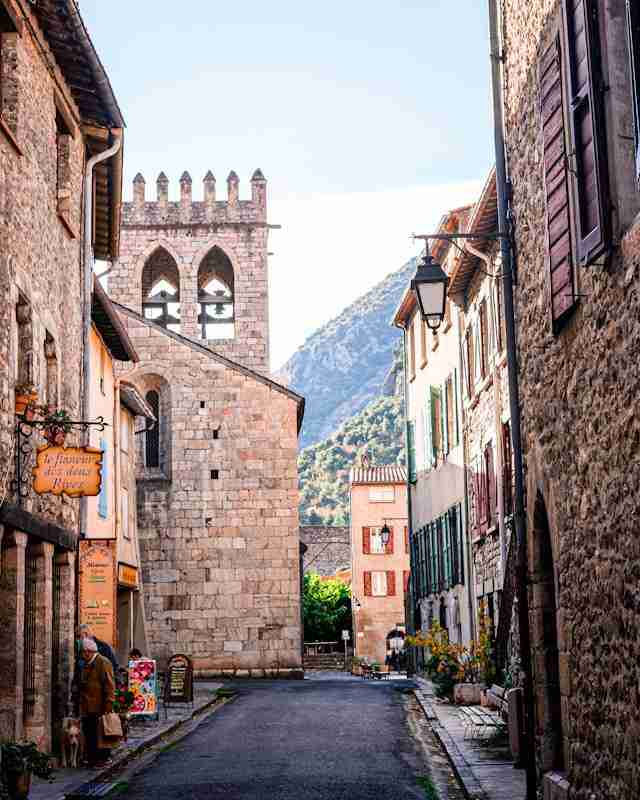
Cradled in the Têt River valley beneath the shadow of the eastern Pyrenees, Villefranche-de-Conflent is a fortified medieval town with a photographic rhythm shaped by stone, shadow, and symmetry. Its narrow alleys, high ramparts, and pink-hued marble façades tell stories in every texture and line. Once a strategic stronghold, later expanded by Vauban in the 17th century, the town today remains perfectly preserved, blending military geometry with mountain village intimacy. For photographers, Villefranche offers an exceptional variety of subjects: sharp architectural detail, moody interiors, elevated panoramas, and the changing light of a mountain valley. The town is quiet, contained, and immensely rewarding for those willing to walk slowly and see how light interacts with centuries-old stone.
Best Photography Opportunities
Golden Light on the Pink Marble Walls
The town's defensive walls and buildings are constructed from a distinctive rose-colored marble that reflects warm light beautifully. Late afternoon and early morning are the best times to photograph the outer walls, especially where sunlight strikes the stone and reveals patterns of erosion and age. Shooting at a slight angle brings out the texture and form of the surface, and side light emphasizes the material's natural tones. A wide-angle lens captures full wall segments, while a short telephoto isolates the symmetry of arrow slits or worn carvings. This is especially effective when the sky adds contrast or softness to the scene without overpowering it.
Narrow Alleys and Stone Archways
Inside the town walls, the streets are narrow, cobbled, and rich with shadow. These tight alleys curve and connect through a series of stone archways, each offering opportunities for layered compositions and natural framing. The best results come from shooting during early morning or late afternoon, when light filters softly through rooftop gaps and creates directional highlights along windows and doorways. A standard prime lens allows you to compose with clean lines, keeping distortion minimal in these close quarters. Small details like old wooden shutters, hanging flowers, and weathered doorframes complete the scene.
Fort Liberia Viewed from Above
High above the town, Fort Liberia offers a wide-angle view of the medieval grid below, as well as the valley and mountains stretching out beyond. The climb up the thousand-step trail provides changing perspectives as you ascend, though the best photographic vantage is from the top. Late afternoon light is ideal here, particularly in autumn when the foliage adds warmth to the surrounding landscape. A telephoto lens helps compress the town and its walls into layered patterns, while a wide-angle composition can frame the fort itself against the mountains behind. The view is expansive but still focused, perfect for panoramic or detail-rich landscape work.
Shadows and Detail Inside the Ramparts
The interior of the fortified walls, accessible to visitors, is filled with tunnels, stairs, and long corridors that offer strong compositional possibilities. The architecture is simple but precise, with clean lines and repeating forms that work well for abstract geometry. Light enters in controlled shafts through arrow loops and small openings, producing contrast that suits both black and white and moody color editing. A tripod is helpful in these low-light conditions, especially if you aim to capture longer exposures or bracket for shadow detail. The visual rhythm of the space rewards patience and experimentation.
The Medieval Bridge and River Reflections
Outside the town walls, the Têt River flows beneath a modest stone bridge that reflects beautifully on calm days. The bridge, with the town rising behind it, becomes a strong focal point for balanced compositions during golden hour or dusk. The best vantage is from the east bank of the river, shooting toward the ramparts with soft light filling the frame. A neutral density filter smooths the water for long exposures, while a circular polarizer helps manage glare and deepen contrast in the sky. Including foliage or stones in the foreground adds layering and depth.
Best Time to Visit
Villefranche-de-Conflent is a strong photography subject throughout the year, but the best seasons are spring and autumn. In spring, the surrounding landscape is green and fresh, with wildflowers appearing along the valley roads and stone ledges. In autumn, the mountains turn gold and ochre, and the softer light works beautifully across both architecture and landscape. Summer brings stronger light and larger crowds, which can make mid-day shooting more challenging, though early and late hours remain productive. Winter is quieter and offers long, low sun angles that suit the architectural forms, though the surrounding hills may often be overcast or misty.
For ideal lighting, early morning is best for exploring the alleys and interiors of the ramparts when shadow contrast is most manageable. Golden hour brings out the color and depth of the marble walls, especially when shooting from the riverbank or the high trail to the fort. Blue hour works especially well within the town, where lanterns and stone passages create a soft, immersive atmosphere. Fog and light rain can also enhance the medieval feel of the town when handled carefully.
How to Get There
Villefranche-de-Conflent is located in the Pyrénées-Orientales region of southern France, about fifty minutes west of Perpignan by car. It sits along the N116 road and is easily accessible by regional transport. A designated parking area is located just outside the fortified walls. Visitors must park outside and enter the town on foot, which preserves the atmosphere and integrity of the historic layout.
The town is also served by the Train Jaune, a narrow-gauge mountain railway that connects Villefranche with higher villages in the Pyrenees. This scenic train adds another layer of visual interest and provides photographers with opportunities to shoot from unique elevated positions along the route. Entry to the ramparts and Fort Liberia is ticketed, and the path known as the Thousand Steps is free to access but physically demanding. The cobbled streets inside the walls are best navigated on foot with light gear and appropriate footwear.
Recommended Photography Gear
A wide-angle lens, ideally between 16 and 35 millimeters, is essential for working within tight spaces and capturing full views of the ramparts and walls. A standard zoom such as a 24 to 70 millimeter lens is excellent for shooting street scenes, facades, and portraits of the architectural environment. A telephoto lens in the 70 to 200 millimeter range is useful for shooting from Fort Liberia and for isolating details on the town walls, such as carvings, archways, and rooflines.
A lightweight tripod is helpful for long exposures along the river or inside the ramparts. A circular polarizer is useful for water reflections and enhancing contrast in skies or stone textures. Neutral density filters, particularly six-stop or ten-stop varieties, allow for controlled long exposures of the river and ambient street scenes during twilight. Use a remote shutter or timer to minimize vibration. Since the town is best explored on foot, a small daypack or sling bag makes it easier to move through the narrow alleys without drawing too much attention or slowing down your pace.
Nearby Photography Locations
Perched directly above Villefranche, the star-shaped fort offers panoramic views of the town and valley. The interior is filled with crumbling staircases, watchtowers, and battlements that reward detail-focused photographers. The view from the top is perfect at sunset when the town below begins to glow with warm tones.
A short drive to the west, this dramatic gorge features steep canyon walls, suspended walkways, and fast-moving water. It is especially photogenic in spring when water levels are high and vegetation is rich. Long exposures and contrast-heavy compositions work well in the shaded light of the gorge.
The nearby town of Prades is a regional hub with open plazas, colorful markets, and a more relaxed pace. Market days provide opportunities for vibrant street photography and candid environmental portraits. The architecture is simpler but still offers good framing and color.
The Yellow Train offers excellent chances to shoot mountainous terrain, high viaducts, and valley views. Riding the train provides a slow-moving platform to observe and capture shifting light across rural landscapes that are otherwise inaccessible by car.
Set high in the mountains and reachable by a trail or shuttle, this Romanesque abbey is both a spiritual and visual highlight. Its stone cloisters and elevated position make for powerful compositions, especially in soft light or light fog. The hike to the site also includes several good stopping points for landscape shots of the surrounding forest.
Villefranche-de-Conflent is a town that rewards precision and patience. Its symmetry, textures, and preserved structure offer endless ways to compose frames that are both historical and personal. Whether you are chasing first light along the ramparts or walking through stone passages after dusk, the town invites you to work deliberately. It is a place where shadow and line carry just as much meaning as subject, and where every corner has a story waiting to be seen.
Comments
Loading comments…