
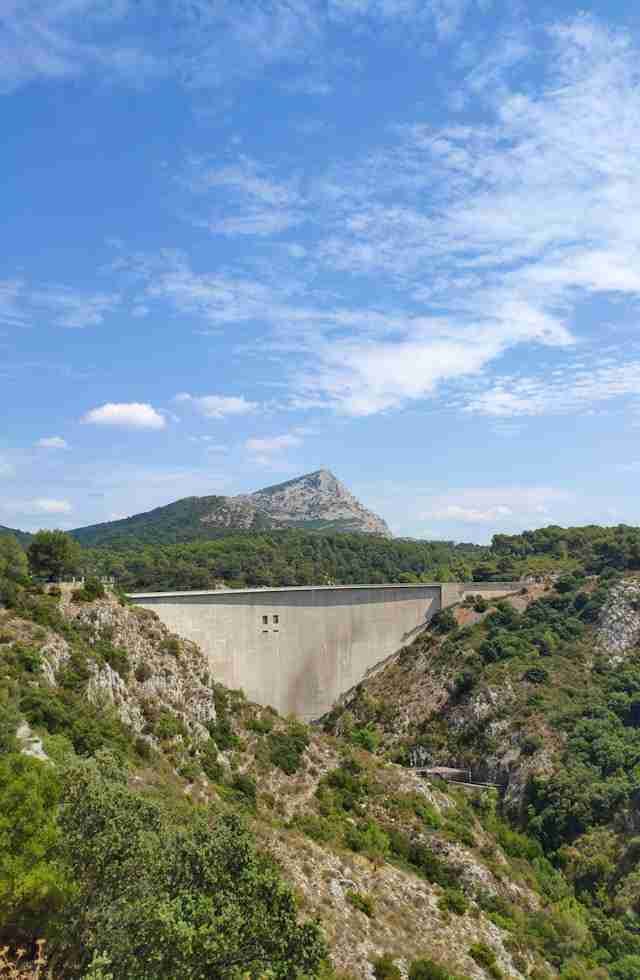
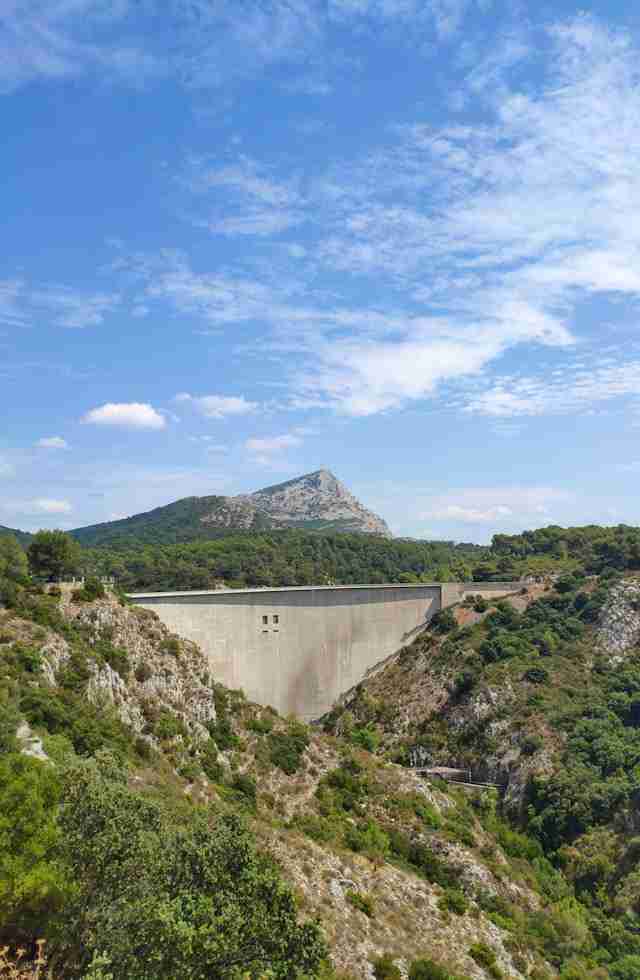
Tucked into the rugged limestone folds of southern France's Sainte-Victoire massif, Barrage Zola is more than just an engineering relic—it's a testament to 19th-century ingenuity and a strikingly photogenic fusion of nature and architecture. Built in 1854 by François Zola, the father of novelist Émile Zola, the dam was one of the earliest curved gravity dams in Europe. Today, it lies nestled in the forested hills of Le Tholonet, east of Aix-en-Provence, where it continues to quietly regulate the flow of the Infernet River. From sweeping stone curvature to tranquil reflective waters, Barrage Zola offers an ideal subject for photographers interested in architectural history, symmetry, texture, and the interplay between built form and natural setting.
Best Photography Opportunities
• Curved Crest of the Dam Wall
: The most commanding perspective of the dam is found by walking along its upper spine. From here, you can capture the entire elegant curve of the structure as it sweeps across the narrow gorge. The gentle arc is enhanced by the warm, earth-toned stonework and the way it contrasts with the cool greens of the surrounding forest. A wide-angle lens emphasizes the perspective and adds drama to the curvature. Photographing from either end of the dam allows you to lead the eye into the frame naturally, using the railings or the stone parapet to add compositional depth. In the early morning, light pours in from the east, catching the top of the dam and casting soft shadows below—perfect for high-contrast images with a sense of scale.
• Reservoir Reflections from the Western Shoreline
: Walking around to the far side of the reservoir, you'll find multiple vantage points that offer symmetrical reflections of the dam's stone arc mirrored in the water. On still days, especially early in the morning or just before dusk, the water becomes glass-like, allowing for near-perfect inversions of the structure. These reflections are especially photogenic when framed by overhanging pine branches or reeds along the shoreline. A polarizer will help manage surface glare and reveal hidden detail, while a tripod enables longer exposures that smooth the water even further. Composing vertically can accentuate the symmetry, while a wide horizontal frame brings in the context of forest and sky.
• Trail Framing Through Pines and Limestone Outcrops
: Approaching the dam through Le Tholonet's pine-lined trails gives you several opportunities to frame it naturally within the landscape. Gaps in the canopy or between stone outcrops offer moments where the dam appears almost unexpectedly—emerging from a dense screen of foliage or sunlight-speckled forest. These semi-obstructed views make excellent compositional frames, especially with a mid-range zoom (24–70mm) to compress the forest foreground and focus attention on the dam. Late afternoon light filters beautifully through the trees, adding warmth and texture while casting gentle, elongated shadows across the trail.
• Base of the Dam and Spillway Detail
: Descending below the dam via a side trail takes you to its foundation, where the structure looms overhead with impressive scale. This is where you'll find the most tactile and textured opportunities—moss-covered stone, water streaks, weathered masonry, and the spillway chute itself. From this low angle, you can shoot upward to emphasize the sheer face of the dam, or focus more tightly on the architectural features and stone patterning. Bring a 50mm or 85mm lens for isolating the aging stonework, or use a wide-angle to include the leafy forest that hugs the base. In cooler months or after rainfall, subtle water movement adds dynamic interest to otherwise rigid forms.
• Long Exposure Compositions at the Spillway Channel
: During wetter months, water occasionally flows through the narrow spillway, providing excellent conditions for long exposure work. This location lends itself well to symmetry—center your frame with the curved dam above and the gentle stream leading the viewer into the image. A tripod and ND filter are essential here to stretch shutter speeds to several seconds, turning water into smooth ribbons that contrast beautifully with the dam's solid stone facade. Compositions that include small foreground rocks, moss, or fallen leaves add texture and seasonal context. Golden hour light from behind or the side adds a soft glow to both stone and stream, completing the image with balanced warmth.
Best Time to Visit
Barrage Zola is accessible and photographable year-round, but the ideal time to capture its full visual potential is between late September and May. In autumn, the surrounding forest begins to turn golden, creating warm contrast with the cool grey stone of the dam wall. This season also brings low-angled sunlight throughout the day, which helps define the structure's curves and textures.
Spring adds subtle greens and occasional water flow over the spillway, enhancing both environmental and structural compositions. The skies during this time tend to be dynamic—often a mix of clouds and sun—offering a more expressive backdrop.
Winter, though quieter in foliage, introduces a raw, austere atmosphere, especially in fog or low light. The absence of leaves simplifies compositions and puts the focus squarely on stone and water. Snow is rare but not impossible at higher elevations, and a dusting of white along the upper dam edge transforms the scene into something more architectural.
Summer is hotter, drier, and often busier with hikers. While light can be harsh midday, morning and evening still yield great directional light. Early mornings are especially good for mist hovering over the reservoir, while golden hour accentuates warm earth tones in both the forest and the dam's stonework.
How to Get There
Barrage Zola is located in Le Tholonet, just a short drive from Aix-en-Provence in southern France. The site can be reached by car via the D17 road, which runs east from Aix toward the Sainte-Victoire massif. Parking is available at several trailheads near Le Tholonet, including at the Parking Barrage Zola or along Chemin de la Paroisse.
From the parking area, the dam is accessible via a 1.5-kilometer hike on a well-marked trail. The route is mostly shaded and moderately inclined, winding through pine forest with scenic glimpses of the hills and reservoir. The approach trail also offers multiple side paths that lead to elevated viewpoints.
There is no entrance fee to visit or photograph the dam. However, this is a protected site within a sensitive ecological area, so stay on marked trails and avoid climbing on the structure itself. Drones are not permitted without authorization, and tripods should be used with care on narrow paths.
Recommended Photography Gear
A wide-angle lens (16–35mm) is essential for showcasing the curve of the dam wall from above and for capturing broader landscape views that combine structure with natural surroundings.
A mid-range zoom (24–70mm) gives you flexibility when exploring trail perspectives, allowing you to frame both environmental scenes and tighter compositions with layered foregrounds like foliage or rock.
A telephoto lens (70–200mm) is ideal for compressing views of the dam across the reservoir, or for abstract studies of stone texture, repeating truss patterns, or architectural details.
A tripod is highly recommended for early morning or long exposure work near the base or opposite bank. A circular polarizer helps reduce reflections on the water and deepen color, while a neutral density filter is essential for smoothing water motion in spillway or long-exposure scenes.
Nearby Photography Locations
: Rising dramatically behind Le Tholonet, this mountain range offers numerous hiking trails with panoramic views over the countryside. Photographers can capture jagged limestone peaks, scattered forest, and layered atmospheric haze—especially striking at sunrise when light paints the cliffs in orange and gold. Several trailheads near Barrage Zola connect directly to ridgelines, making it easy to extend your shoot into higher elevations.
: A short drive from the dam, this ochre-colored quarry inspired many of Cézanne's paintings. The carved stone faces and dense pines offer a mix of color and form, while golden-hour light turns the rock into glowing amber. With narrow footpaths and layered terrain, it's also ideal for compositional experimentation with shadow and shape.
: This small, picturesque village offers rustic Provençal architecture and narrow winding streets lined with stone walls and cypress trees. The warm color palette and historic charm make it ideal for street photography or quiet architectural scenes. Early morning or late afternoon offers soft directional light that flatters its weathered textures.
: Located a short distance to the north, this private château once owned by Pablo Picasso is a photogenic landmark when viewed from trails in the Sainte-Victoire foothills. Although the château itself is not open to the public, the surrounding landscape provides strong compositional context, especially under dramatic skies or during the golden hour.
: Further upstream from Barrage Zola, this larger reservoir offers a more expansive body of water, perfect for panoramic reflections and wide-sky compositions. Trails along the perimeter provide elevated views of turquoise water bordered by pine forest and limestone outcrops. It's especially effective in late afternoon when warm light skims across the hills and reflects in the water.
Photographing Barrage Zola is an invitation to slow down and consider how history, nature, and design interact in subtle, often understated ways. The dam itself is a study in symmetry and texture, but its full potential is revealed only when you explore its surroundings—from mirrored waters and moss-lined trails to mountain backdrops and forest silhouettes. It's a location that rewards curiosity, patience, and an eye for both form and feeling.
Comments
Loading comments…