
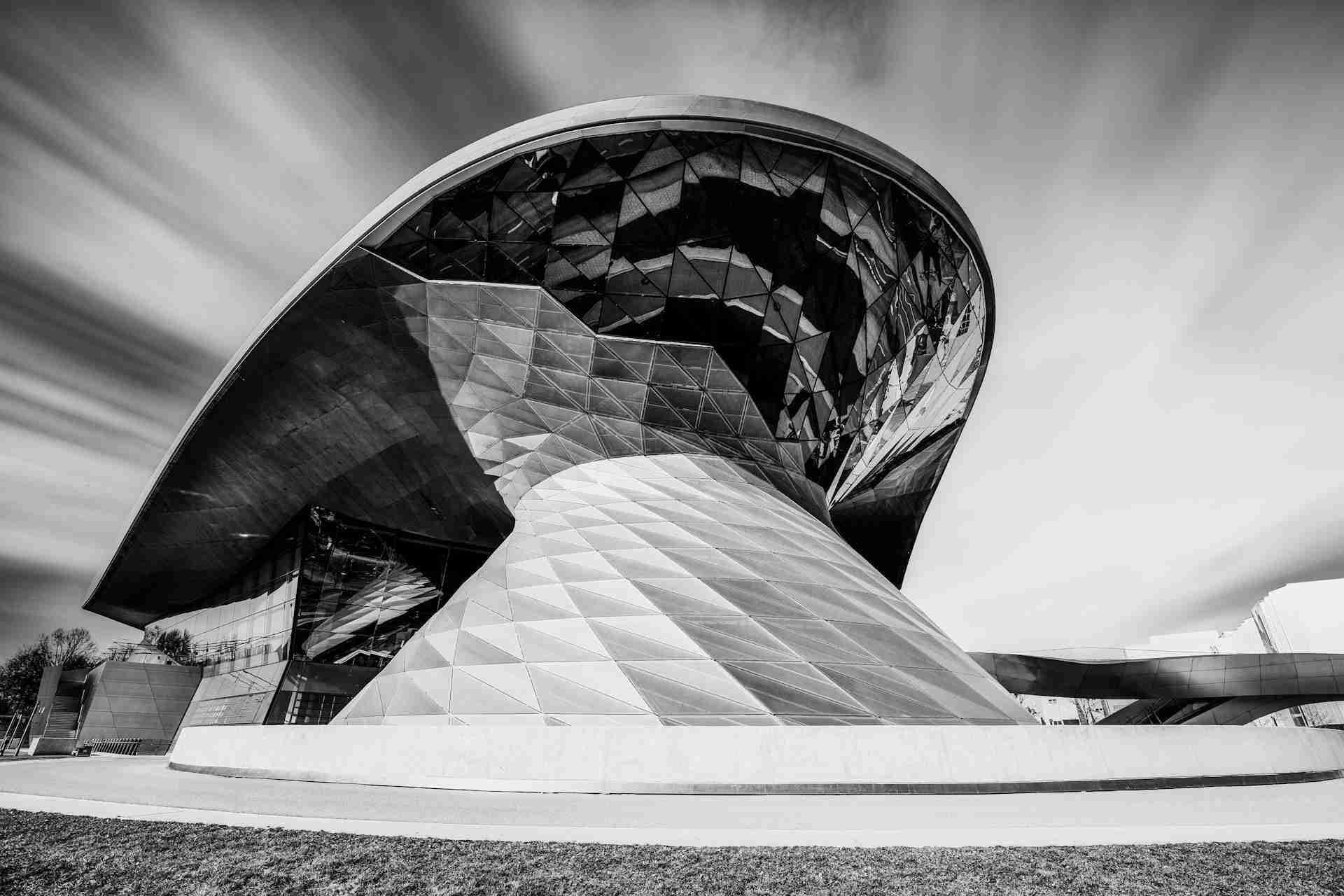
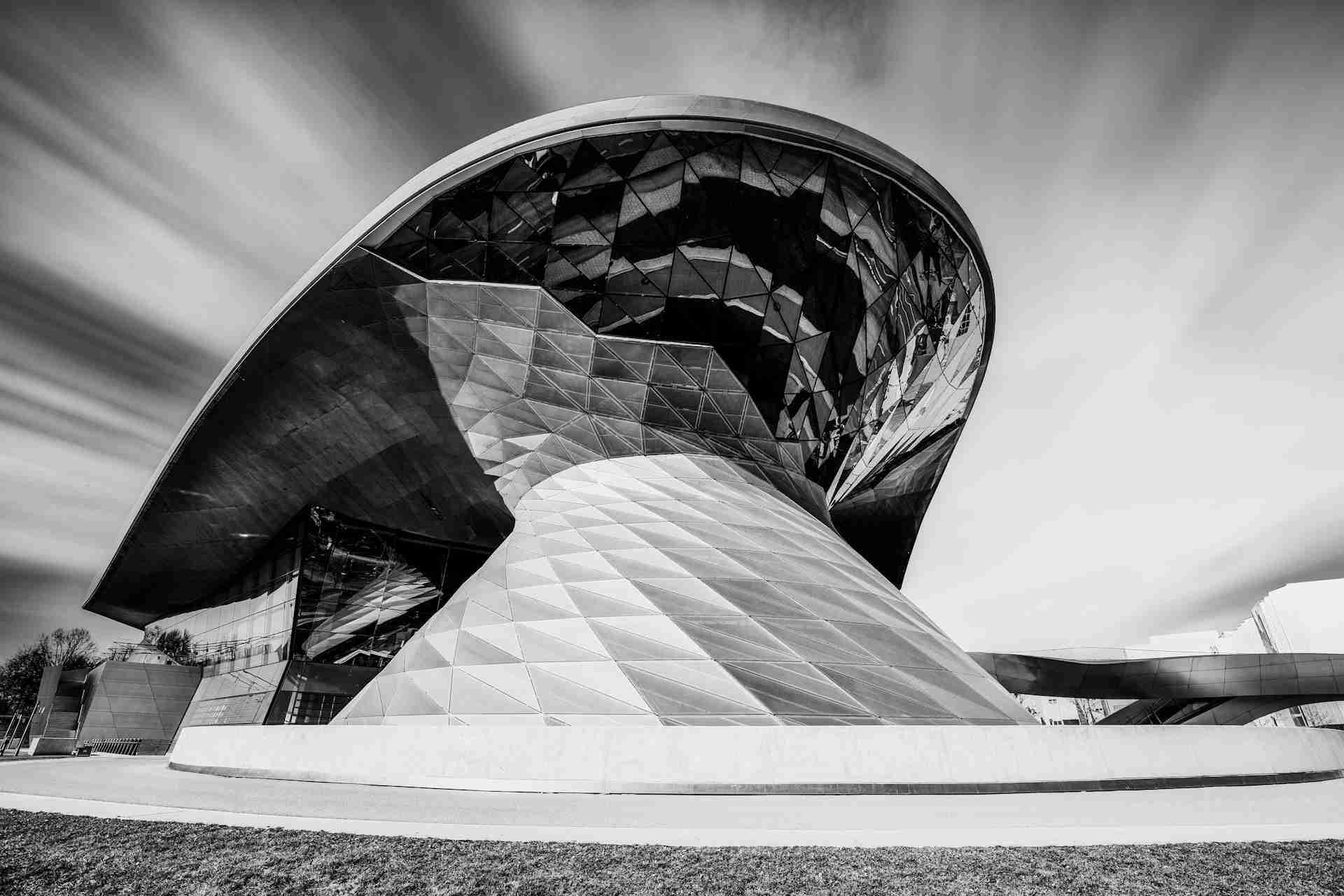
Sleek, futuristic, and designed with deliberate theatricality, BMW Welt in Munich is a masterclass in contemporary architectural photography. Located in the heart of the city's Olympiapark district, this dynamic structure isn't just a car showroom—it's an immersive brand experience housed in an engineering marvel of steel and glass. With its double-cone entrance, curving walls, and reflective surfaces, BMW Welt presents a near-endless array of photographic opportunities that shift with the light, weather, and time of day. Whether you're capturing reflections of the city skyline in its glass façade or focusing on the complex interplay of interior shapes and materials, BMW Welt offers urban photographers a feast of abstraction, geometry, and lightplay.
Best Photography Opportunities
• Twilight Exterior of the Double Cone
: The most iconic architectural element of BMW Welt is its enormous double-cone entrance, a structure of twisted steel and glass that seems to hover above the ground. At twilight, when the sky retains a gradient of deep blue and the interior lights come alive, this cone glows from within like a futuristic lantern. Shooting just after sunset allows you to balance ambient city light with the warm illumination spilling out from inside. Use a wide-angle lens to emphasize the dramatic curvature of the cone, and consider a long exposure to blur passing traffic along the nearby highway, adding dynamic motion to your frame. Reflections in the adjacent glass panels can be framed to include the Olympic Tower or passing trams, enhancing the sense of place.
• Interior Abstracts from the Upper Walkways
: Once inside, the flowing forms of BMW Welt's atrium offer compelling opportunities for abstract compositions. The upper walkways allow photographers to shoot down onto the sculptural lines of the building's interior ramps, metal skins, and structural seams. These elevated vantage points are ideal for isolating curves and edges, transforming real architecture into graphic design elements. Use a zoom lens to crop tight on overlapping lines and experiment with black-and-white conversions to accentuate the interplay of light, shadow, and texture. Midday light streaming through the skylights creates high-contrast highlights, while overcast days soften the tonal palette and encourage minimalist interpretations.
• Product Staging Bays with Concept Car Displays
: BMW Welt's rotating vehicle exhibitions feature prototype cars, concept designs, and current models displayed under theatrical lighting. These bays are typically lit from multiple angles with a focus on high-gloss surfaces and ambient effects. Photographing here allows for technical challenges—reflective surfaces, tight compositions, and spot metering—that reward patience and precise exposure control. Use a fast prime or mid-range zoom (like a 24–70mm) and shoot wide open to create shallow depth of field shots of wheel detail, emblems, or futuristic console interfaces. Reflections of surrounding architecture in the car bodies themselves can add artistic layering and interplay.
• Reflections and Symmetry in the Glass Facade
: The building's curved glass skin is not just a boundary—it's a mirror. During golden hour, the glass reflects the surrounding Olympiapark landscape and the sweeping lines of the structure itself, creating naturally occurring double exposures. A polarizing filter can help manage reflections and selectively deepen sky contrast, or be rotated to enhance surface glare for more experimental images. Position yourself near the eastern edge in the early morning or the western side in the late afternoon to catch angled sunlight glinting across the facade. These reflections are especially powerful when combined with long-lens compositions that compress structural elements against the sky or background towers.
• Evening Urban Context with Light Trails and Motion
: BMW Welt is bordered by a multi-lane road and sits near several pedestrian overpasses—perfect for night photography that incorporates motion and urban energy. From the bridge above Lerchenauer Straße, you can frame the building with light trails from passing cars, trams, and cyclists. A long exposure (15–30 seconds) at blue hour or later allows you to freeze the building in sharp detail while layering in dynamic urban movement. Including the neighboring BMW Headquarters tower—shaped like a four-cylinder engine—adds context and iconic recognition to the composition. This is also one of the best spots to show the contrast between BMW Welt's fluid architecture and the mechanical motion of the city.
Best Time to Visit
The best time to photograph BMW Welt depends heavily on your subject matter and the mood you wish to convey. For exterior architectural shots, early morning and late afternoon provide the most flattering light. In the morning, soft sunlight from the east bathes the front of the double cone and casts long shadows that define its curvature. In the afternoon and early evening, western light warms the glass and metal surfaces, intensifying the color contrast between the building and the sky. Golden hour offers a particularly rich palette, while blue hour allows for balanced exposures that blend interior lighting with deepening sky tones.
Interior shots are best during midday when skylights illuminate the atrium naturally, creating high contrast and sharp definition along structural lines. Overcast days are ideal for evenly lit interiors, especially if you're focused on abstracts or detail-oriented compositions that rely on subtle tones and reflections. Evening visits are rewarding if your focus is on light trails, motion blur, or the illuminated atmosphere of the building's exhibitions and event spaces.
Autumn and winter bring crisper air and fewer crowds, allowing for more control in your compositions—especially during blue hour or in low light conditions. Snowfall, while rare, transforms the surrounding area into a minimal monochrome backdrop that contrasts beautifully with the building's reflective surfaces. Avoid visiting on major event days if you're aiming for clean architectural shots, as crowds can block key angles and alter lighting setups.
How to Get There
BMW Welt is located in the northern part of Munich, directly adjacent to Olympiapark and easily accessible by public transportation. The most convenient method is to take the U-Bahn line U3 to Olympiazentrum station, which is less than a five-minute walk from the main entrance. Multiple bus and tram lines also serve the area, and the site is well-connected by pedestrian paths and bike lanes for those approaching from central Munich.
There is no cost to enter BMW Welt itself—it is free and open to the public, including access to most of the interior spaces, displays, and architectural features. However, certain exhibitions, guided tours, or premium events may charge an admission fee. Tripods are generally not allowed inside without prior permission, particularly in the main atrium or vehicle display areas, so handheld shooting with image-stabilized lenses or high ISO settings may be necessary. Outside, photography is unrestricted, but drone use is prohibited due to proximity to residential zones and public infrastructure. Paid parking is available on-site in an underground garage, though availability can vary during large events or weekends.
Recommended Kit for Capturing the Scene at Its Best
Photographing BMW Welt is about balance: architectural breadth, sculptural detail, and the reflective interplay of light and surface. A full-frame mirrorless or DSLR body with strong low-light performance will handle the varied lighting conditions inside and outside the structure. Begin with a wide-angle lens in the 14–30mm range for capturing the dramatic curves of the double cone, the interior atrium's vaulted ceiling, and full-building compositions from street level. Use perspective control (tilt-shift if available) to avoid distortion when shooting upward or through glass.
A mid-range zoom such as a 24–70mm f/2.8 is extremely useful for both architectural detail and product photography inside the vehicle bays. Its flexibility allows you to quickly switch from wide context to tighter compositions without swapping lenses. For fine details or close-up car elements, a fast prime (like a 50mm f/1.4 or a macro lens) will help isolate shapes and reflections, especially in low ambient light.
Tripods are essential for exterior twilight and night photography, especially when shooting long exposures of passing traffic or layered urban motion. A remote shutter release or camera app will prevent shake, and a lens hood is recommended to minimize flaring from the many point light sources surrounding the building. For reflective surfaces, carry a circular polarizer to control glare or to creatively manipulate what appears in the glass and car panels.
Interior photographers should prioritize fast lenses and vibration reduction over stabilization rigs, as space is often limited. Shooting in RAW is crucial for balancing high-contrast scenes and for managing mixed lighting temperatures inside. Lastly, bring lens wipes or cloths—BMW Welt is immaculate, but reflections, smudges, and smears on glass surfaces are a constant challenge in such a high-gloss environment.
Nearby Photography Locations
, located directly across the road, is a goldmine for architectural and landscape photography. Built for the 1972 Summer Olympics, its undulating tent-like stadium roof, sweeping walkways, and artificial lake provide dynamic compositions at all times of day. At sunset, the skyline of Munich reflected in the water adds a tranquil urban layer to your shoot.
, adjacent to BMW Welt, offers a rich interior environment of spiraling ramps, concept cars, and carefully curated exhibits beneath futuristic lighting. While tripods may be restricted, the museum's architectural flow and historical displays are ideal for detail-rich, story-driven compositions.
provides a bird's-eye view of BMW Welt, the entire Olympiapark, and the Munich skyline. This observation tower, accessible by elevator, is best visited during clear weather for panoramic cityscapes or during golden hour when shadows sweep dramatically across the park below.
, a lesser-known linear park just south of BMW Welt, features modern design elements like pedestrian bridges, sculptural benches, and long green corridors framed by urban housing blocks. It offers opportunities for minimalist compositions or street-style architectural photography with clean, repeating lines.
, a short distance west, provides a contrasting natural environment with dense groves, meandering paths, and a hilltop viewpoint known as Luitpoldhügel. From here, you can capture long-lens views of the city skyline framed by trees, or shoot ambient scenes of parkgoers and seasonal flora for a human touch.
BMW Welt is a rare architectural playground where form, function, and brand converge in a space designed to be both interactive and inspiring. Whether you're capturing sweeping structural curves bathed in twilight, isolating chrome-and-glass reflections inside a concept vehicle bay, or integrating motion and modernity with Munich's surrounding urban energy, this location invites creative experimentation. It's a must-visit not just for car enthusiasts, but for any photographer who thrives on geometry, scale, and the constant interplay between light and surface.
Comments
Loading comments…