
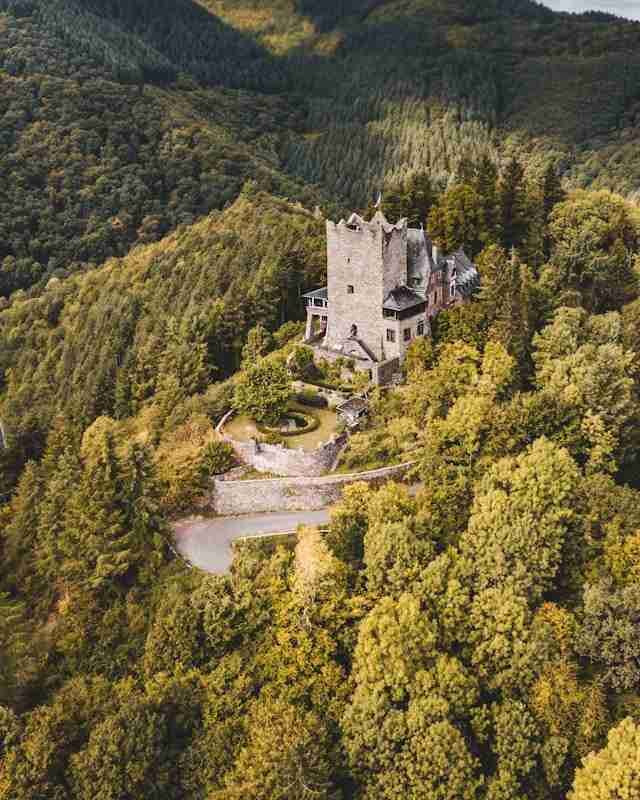
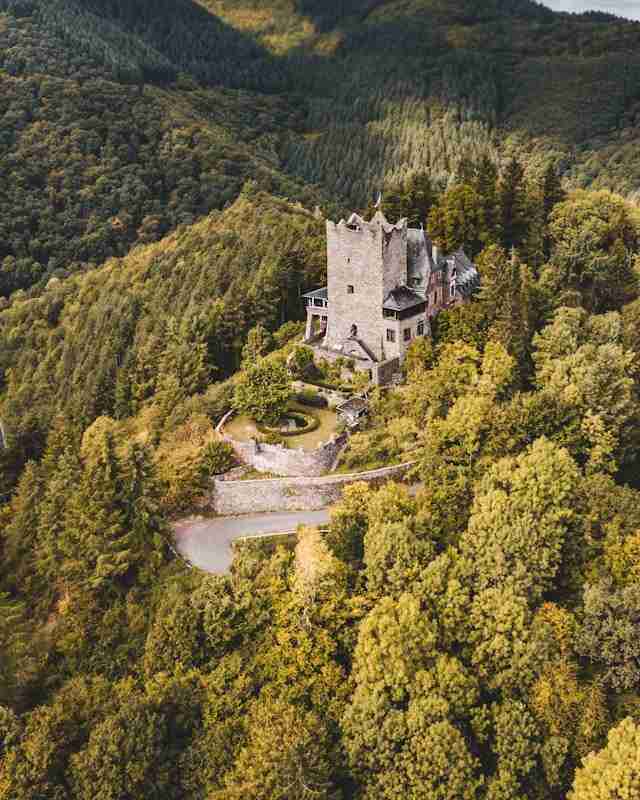
Burg Arras stands watch above the village of Alf, high on a wooded hill above a bend in the Moselle River. With its commanding view over vineyards and valley, this castle blends medieval weight with a sense of living continuity. Though fortified in the 12th century and damaged by war, it has been carefully restored and now houses a hotel and museum. For photographers, it offers more than a single iconic angle. The structure itself is layered and expressive, surrounded by forest paths, sloped terraces, and textured walls that respond differently depending on time of day and season. The surrounding Moselle landscape adds depth and variation, with river curves and vineyard lines leading the eye through your frame. This is a place where stone, light, and landscape all work together.
Best Photography Opportunities
• Distant View from Across the Moselle
From the opposite riverbank, you can frame the entire castle nestled into its hillside, surrounded by trees and vineyards. This angle is strongest in the early morning or late afternoon, when warm light catches the south- and west-facing walls. A mid-range telephoto lens helps compress the slope and pull the castle closer into the frame while retaining vineyard textures. Mist rising from the river can soften the forested background and highlight the silhouette of the structure. Including a section of the river or a row of grapevines in the foreground adds visual layering and natural depth.
• Courtyard and Inner Walls
Once inside the castle, the quiet central courtyard becomes a strong location for detail-rich compositions. Arched walkways, half-timbered balconies, and aged stone create leading lines and repeating shapes. Soft overhead light brings out textures in the wood and brick without harsh shadows, making this an excellent setting for handheld architectural work. A 35mm or 50mm prime lens gives you flexibility in tight spaces while preserving natural proportions. These scenes benefit from mid-morning light, when the sun has risen enough to add warmth but not yet created contrast that's too deep.
• Vineyard Approaches and Clifftop Paths
The narrow roads and footpaths winding up to Burg Arras offer unique perspectives as the castle rises through the treetops or appears framed by vineyard rows. These walking views work best in the hour after sunrise, when light comes from the east and rakes across the terraced slopes. Shooting from a low angle along a vineyard row allows you to place the castle at the head of a natural leading line. This technique works with both wide and telephoto lenses, depending on the distance and foreground elements. These compositions are especially rich in spring and autumn, when vineyard color adds contrast to the dark rooflines.
• Stone and Sky from the Watchtower
Climbing to the upper platform of the castle's tower allows you to shoot down into the courtyard or out over the Moselle Valley. The rooftop views give you a chance to create symmetrical top-down images or use the river curve as a compositional anchor. A wide-angle lens helps emphasize the steep drop and long view, while early evening light adds warmth to the rooftops and treetops below. Including the crenellations or tower walls in the frame creates a sense of place and structure. This perspective is strongest in clear or lightly clouded conditions when distance visibility is high.
• Castle Lit at Twilight
After sunset, exterior lighting warms the stone and highlights the architecture against a deep blue sky. Shooting from below the entrance or on nearby trails allows you to frame the glowing castle against a darkening forest or sky. A tripod is necessary for long exposures, and a small aperture helps keep detail sharp across the structure. Balancing the artificial light of the building with the fading ambient light requires careful exposure control, so shoot during blue hour rather than full night. These compositions work well in all seasons, but are especially striking in winter when the trees are bare and the structure feels more exposed.
Best Time to Visit
Burg Arras can be photographed year-round, but each season brings different opportunities and conditions. Spring brings fresh greens to the surrounding forest and new growth in the vineyards, with clear skies and warm early morning light. This is the best time for photographing the distant views from across the river and for working with vineyard compositions at sunrise.
Summer provides the longest days and the fullest vegetation, giving the castle a lush, enclosed feel. Mornings are often hazy, which can soften distant views but bring mood to early compositions. The inner courtyard and shaded paths are particularly photogenic during summer's high sun, offering contrast between shadowed architecture and bright overhead skies.
Autumn transforms the area with deep gold and red foliage. The vineyards and forest around the castle become part of the composition, and low-angled light helps pull texture from the stone walls and rooftops. This is one of the most dynamic seasons for photographing the entire landscape as a unified whole.
Winter strips the forest bare and sometimes adds frost or snow, highlighting the geometry of the castle and surrounding land. Visibility across the Moselle Valley improves, and light remains soft throughout the day. Though the castle itself may close parts of its interior in colder months, exterior views and trails remain accessible and rewarding.
How to Get There
Burg Arras is located just above the village of Alf in Rhineland-Palatinate, Germany. The nearest major town is Zell, approximately fifteen minutes away by car. From Alf, follow signs up a narrow winding road that leads to the castle entrance. A small parking area is available near the site, with overflow parking along the approach road. Access is open to the public during daytime hours, and while there is an entry fee for the museum and tower, outdoor areas and lower paths can be visited without charge.
Photographers should arrive early to make the most of directional light and quieter conditions. The castle sits high enough to catch sunrise and sunset light but is surrounded by forest, so plan your compositions accordingly. Access to interior areas may vary seasonally. Tripods are allowed in outdoor spaces, but check with staff if planning to shoot inside the museum areas. Drone use is not permitted directly over the castle due to its use as a hotel and private site, but check local regulations for adjacent airspace if shooting from a distance.
Recommended Photography Gear
To photograph Burg Arras effectively, pack a mix of wide, mid-range, and telephoto lenses. A wide-angle lens such as a 16–35mm is essential for interior spaces, courtyard shots, and working with the tight spaces on the tower walkways. A 24–70mm zoom is ideal for general exterior shooting, particularly when composing castle and landscape scenes from surrounding trails or vineyard rows. A 70–200mm telephoto allows you to compress distant views from across the river or isolate castle details within the broader scene.
A tripod is strongly recommended for low-light shooting, especially if you are planning twilight or interior shots. A polarizing filter is useful for managing glare on windows and deepening sky tones when shooting the castle against bright clouds. Graduated ND filters help balance exposures where sky brightness exceeds shaded stone or forest elements. Bring spare batteries and a cleaning cloth, as weather can shift quickly and mist or light rain are common in the region.
Comfortable walking shoes are essential, particularly if you plan to explore off-path areas or vineyard slopes. A camera bag that allows quick access without needing to set gear down is helpful in tight courtyard spaces or narrow staircases. During spring and autumn, pack for cool mornings and variable temperatures.
Nearby Photography Locations
One of the most photogenic Moselle villages, Beilstein sits along the riverbank with tightly packed houses, a hilltop ruin, and perfect reflections at dawn. Its cobbled streets and wine terraces offer a strong contrast to the more isolated setting of Burg Arras.
This larger riverside town features half-timbered architecture, bridges, and classic vineyard views. From the slopes above, you can capture wide panoramas of the Moselle's winding path through the valley.
• Marienburg
Just across the river from Alf, this hilltop church offers panoramic views back toward Burg Arras and the surrounding vineyards. The site is accessible by road and works well at sunset when light falls behind the river curve.
Larger and more elaborate, this castle sits dramatically above the Moselle and offers complex compositions of spires, towers, and town below. A good counterpart to Burg Arras for those interested in comparing architectural styles and positions.
A tall observation tower near Pünderich, this platform gives photographers a commanding view of a full Moselle bend with vineyards, river traffic, and hilltop ruins all in one sweeping frame. Ideal for sunrise or long-lens studies of vineyard geometry.
Photographing Burg Arras is a matter of balance: between stone and forest, between river light and shadowed paths, between broad view and close detail. The castle holds its presence quietly but firmly in the Moselle landscape, rewarding photographers who take time to explore both its historic shape and its relationship with the land around it. Whether lit by sunrise mist or glowing against twilight, it remains a subject of strength, shape, and story.
Comments
Loading comments…