
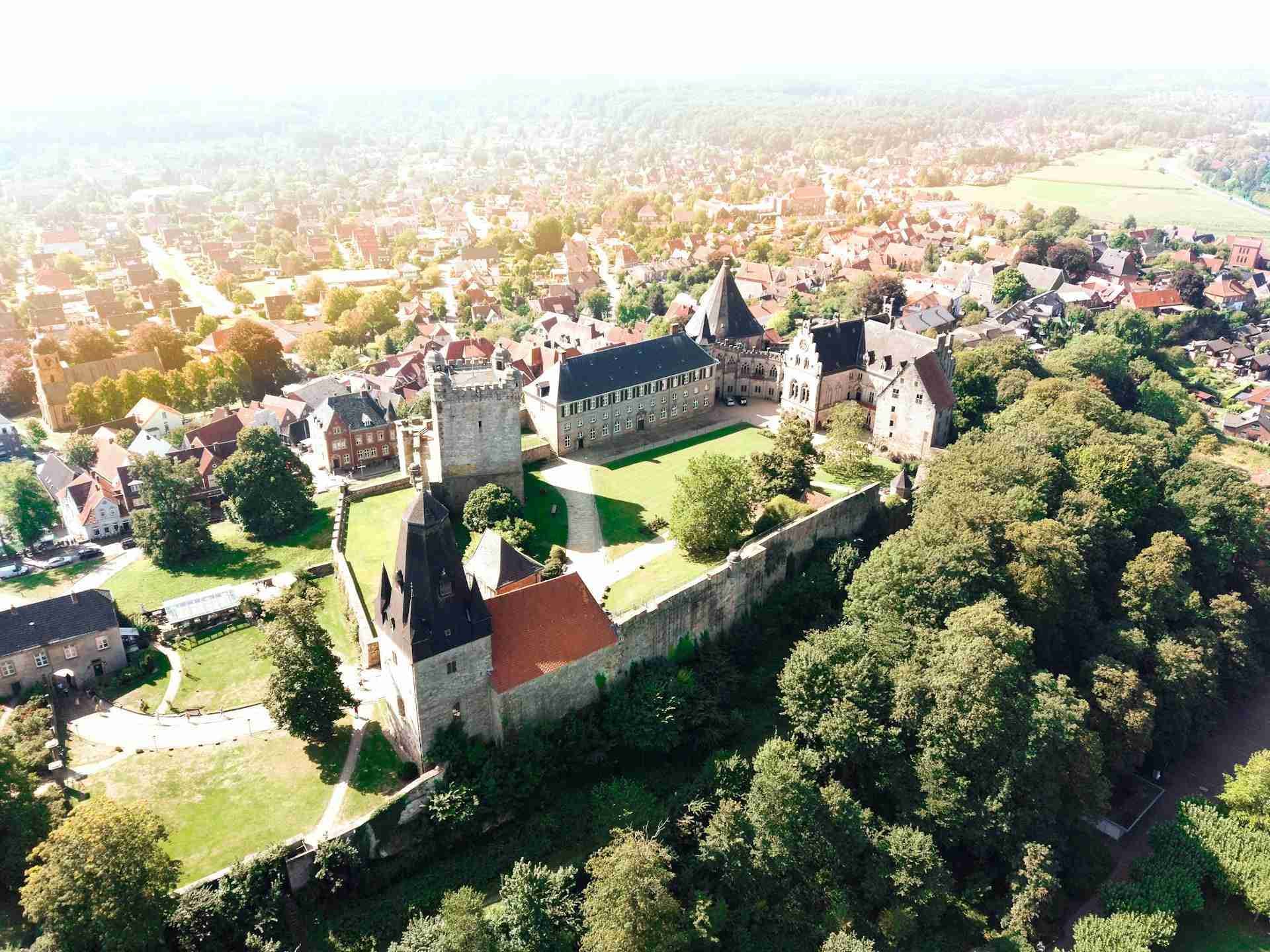
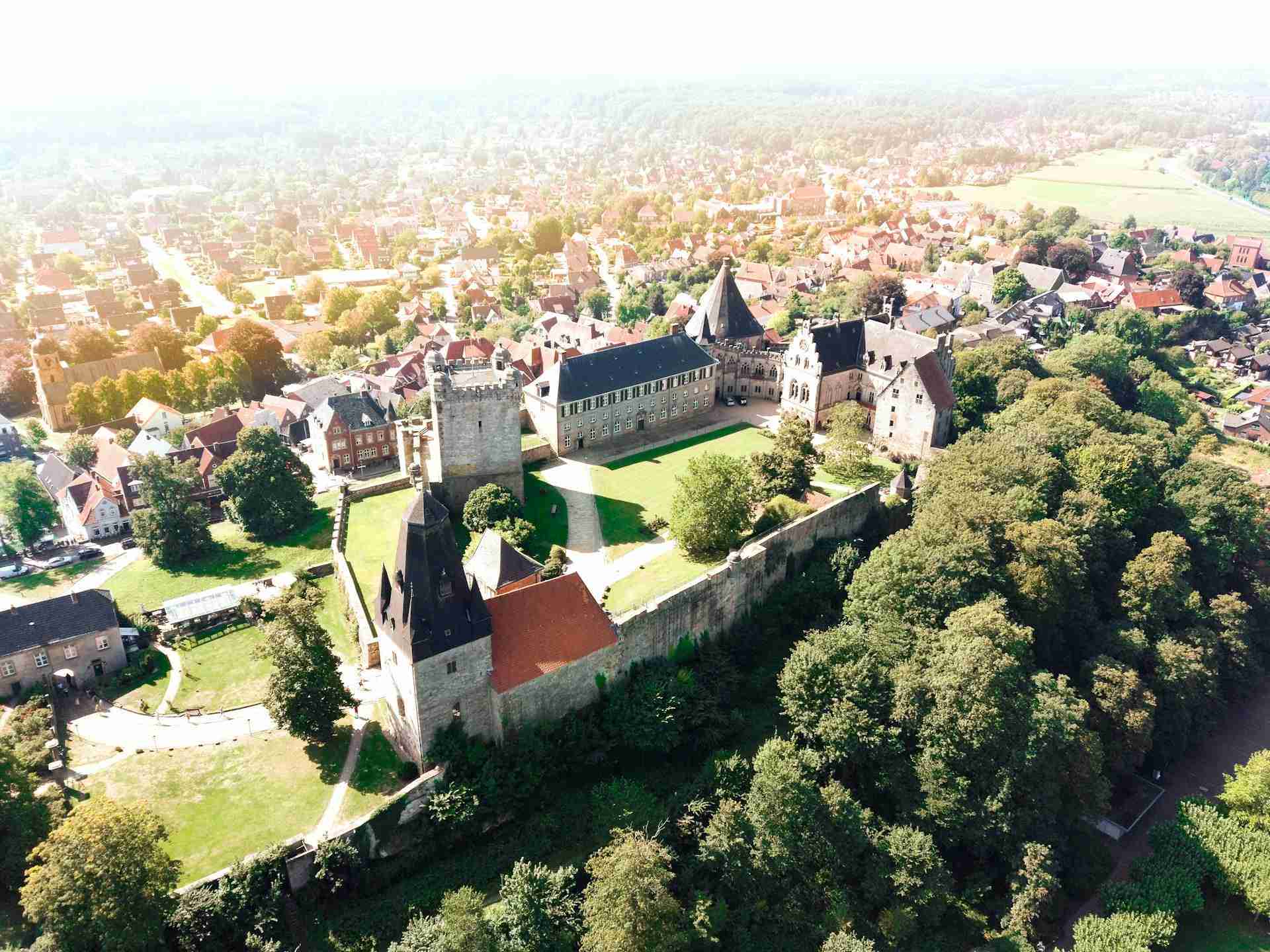
Rising abruptly from a sandstone outcrop in the heart of Bad Bentheim, Burg Bentheim is one of Germany's most visually commanding hilltop castles. Its pale, weathered stone walls, arched passageways, fortified towers, and high courtyard form a dense architectural network that has evolved since the 11th century. The castle's elevated position allows it to dominate the skyline from nearly any angle in town, while inside the walls, narrow stairways, vaulted rooms, and open terraces provide endlessly shifting perspectives. Photographers will find rich contrasts between rugged textures and refined architectural forms, especially as light moves across the crenellations and through arched windows. Whether composing from below the walls or within the keep itself, Burg Bentheim delivers layered, dynamic subjects that blend architectural history with bold natural settings.
Best Photography Opportunities
• Town-Level Perspectives with Framed Silhouette
From several locations in the old town, you can frame Burg Bentheim rising above the rooftops and trees. These compositions are most effective near sunrise or sunset when directional light warms the sandstone and softens the shadows beneath the battlements. Use a telephoto lens to compress layers of tiled roofs, tree branches, and castle towers. Look for natural framing elements such as archways, lamp posts, or narrow alleys that guide the eye toward the castle. Fog or overcast mornings can flatten the light but lend a quiet, atmospheric mood, particularly in autumn or early spring.
• Castle Courtyard and Structural Layers
Inside the castle grounds, the central courtyard offers a mix of angles and overlapping buildings that photograph well in both wide and narrow compositions. A wide-angle lens allows you to capture the spatial relationship between towers, walls, and outbuildings while maintaining visual coherence. Early morning light casts long shadows across the courtyard's stone flooring, adding texture and rhythm. Details such as window arches, weathered staircases, and carved stonework stand out in soft light, especially during golden hour. Overcast days are well-suited for isolating structural detail without harsh contrast.
• Tower Views and Surrounding Landscape
Climbing the main tower gives access to panoramic views of Bad Bentheim, the surrounding lowlands, and the patchwork of forest and farmland beyond. These elevated views are especially strong in autumn, when the treetops explode with color, or in winter when frost adds crisp contrast to the landscape. Use a mid-range zoom or short telephoto to pull out distant church spires or align the ridgelines in strong horizontal compositions. Shoot through narrow tower windows for a natural vignette effect that hints at the historical function of the space.
• Detail Studies of Stone and Craftsmanship
Throughout the castle, close inspection reveals carved heraldry, inscriptions, worn stair treads, and textured walls that have absorbed centuries of weather. These details lend themselves to tight compositions that focus on line, form, and material. A standard prime lens like a 50 millimeter gives you clean framing and natural perspective without distortion. Work with natural window light or diffused outdoor conditions to enhance texture and suppress harsh shadows. These detail shots are ideal for black-and-white conversions that emphasize grit and grain.
• Dramatic Night Photography with Uplighting
After dark, portions of Burg Bentheim are illuminated by warm uplighting that casts strong shadows and brings out the geometry of towers and parapets. A tripod is essential for long exposures, particularly when working from town-level vantage points looking up at the castle. Framing against a deep blue hour sky or low clouds helps the structure stand out while avoiding blown-out highlights. Use a lower ISO and stop down for edge-to-edge sharpness. Light trails from occasional traffic below can add motion and contrast beneath the stillness of the stone walls.
Best Time to Visit
Spring and autumn offer the most favorable light and seasonal interest at Burg Bentheim. In spring, fresh foliage and long shadows create contrast between the surrounding greenery and pale stone. Autumn brings rich color throughout the trees that frame the base of the hill, while the lower angle of the sun extends golden hour across the facades. These seasons also offer manageable crowds and softer mid-day light.
Summer provides the longest daylight, but harsh sunlight can create high-contrast conditions and crowd the castle interior during peak hours. Arrive early or plan evening sessions to make the most of directional light. Winter is quieter, with possible snow or frost that enhances texture and simplifies compositions, especially around architectural details.
The castle opens to visitors during posted hours, but the surrounding town viewpoints and outer walls are accessible year-round. Morning light from the east side of town offers full illumination of the western towers, while evening compositions benefit from sidelight that accentuates stone texture and structural depth.
How to Get There
Bad Bentheim is located near the Dutch border in Lower Saxony and is easily accessible by car or train. The town is well-connected by regional rail lines, with the Bad Bentheim train station just a short walk or taxi ride from the castle. For those arriving by car, public parking is available at several locations within walking distance of the old town and the castle entrance.
The castle itself is situated atop a natural sandstone outcrop and is reached via cobbled streets that wind through the village. Entry to the interior requires a ticket, which includes access to the main tower, courtyard, and museum spaces. Tripods are allowed outdoors but may be restricted in certain interior areas, depending on visitor volume and exhibition spaces.
Early arrival offers the best chance to photograph without crowds, especially in summer and on weekends. The surrounding parkland also provides open space for photographing the castle's exterior from multiple elevations.
Recommended Photography Gear
A wide-angle lens (16 to 35 millimeters) is ideal for capturing the courtyard, walls, and interior spaces where space is limited but vertical elements dominate. A mid-range zoom like a 24 to 70 millimeter offers flexibility between architectural studies and distant framing from town-level viewpoints. A short telephoto (70 to 200 millimeter) is especially useful for compressing layers and isolating features from surrounding rooftops or towers.
A tripod is highly recommended for low-light conditions, bracketed exposures, and blue hour shooting around the castle's illuminated exterior. A polarizer can be useful when shooting in mixed conditions to manage reflections on stone and glass, though it should be used with care to avoid uneven skies at wider angles. A lens hood will help when shooting into the sun during backlit morning or evening sessions.
For interior details, a fast prime lens such as a 35 or 50 millimeter f/1.8 will allow handheld shooting in dim conditions while maintaining sharpness and shallow depth of field. Carry a microfiber cloth to keep lenses free from dust or condensation when transitioning between outdoor and indoor spaces.
Nearby Photography Locations
The surrounding town offers half-timbered houses, stone walls, and narrow streets that frame the castle in numerous ways. Early morning is best for quiet scenes and soft light on the façades. Architectural photographers will find endless compositions in the contrast between medieval and baroque styles.
A network of trails just beyond the town leads through pine and deciduous woodlands with occasional clearings that frame the castle from below. These are especially photogenic in autumn or winter, and long lenses help pick out the structure through the trees.
Located on the southern slope, this park provides open green space and elevated views of the castle towers with fewer obstructions. Sunrise sessions here can highlight morning mist and glowing stone under fresh light.
• Gildehaus Quarry Lookout
A short drive from town, this elevated viewpoint offers panoramic views of the surrounding region and glimpses of the castle in the distance. It's ideal for wide landscape compositions at sunset or under dramatic skies.
• Villa Koppel and Kurpark
South of the old town, this 19th-century villa and its adjoining park offer garden compositions, stone staircases, and shaded forest paths. It's a quieter scene for more reflective shooting, especially in spring bloom.
Burg Bentheim is a rare combination of rugged historical architecture and a surrounding townscape that supports endless compositional variety. Whether focusing on structural strength or subtle detail, the castle offers something for every photographer willing to walk its edges and wait for the right light.
Comments
Loading comments…