
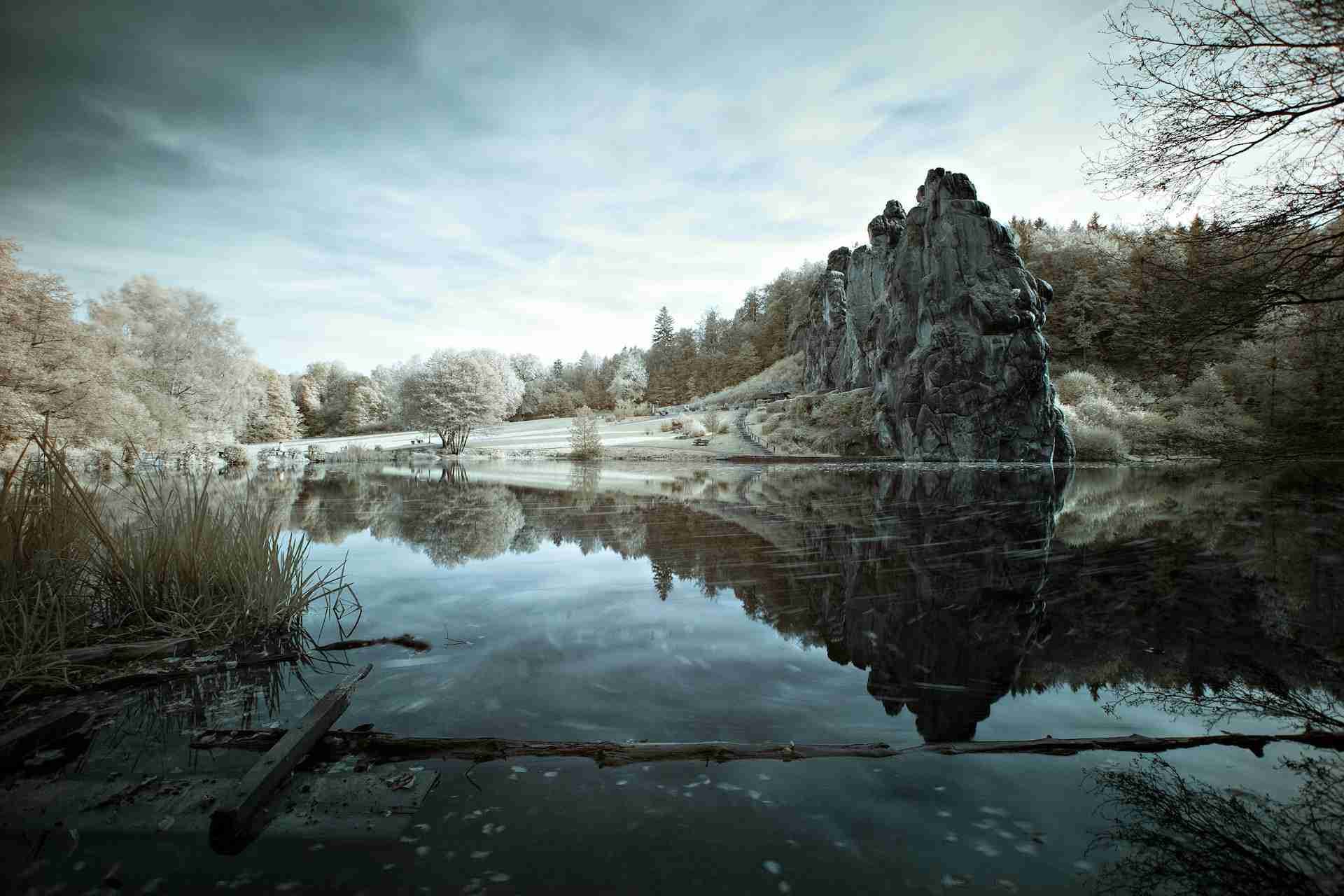
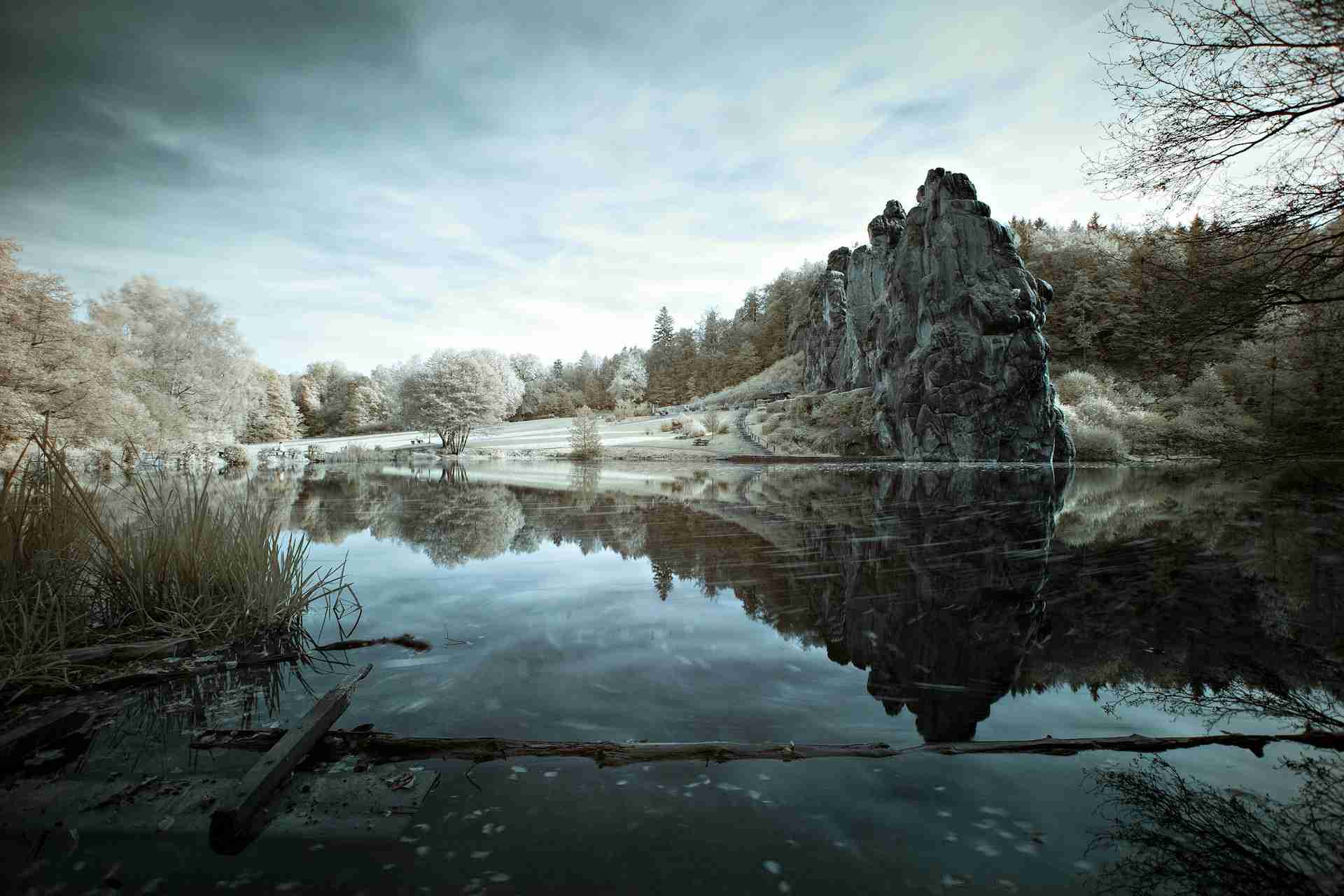
Rising abruptly from the rolling landscape of the Teutoburg Forest near Horn-Bad Meinberg, the Externsteine are a cluster of towering sandstone pillars that have inspired awe for centuries. Shaped by natural erosion and later marked by human use, these dramatic rock formations are both geological wonders and cultural landmarks. Their vertical walls, carved staircases, and elevated viewing platforms offer photographers a blend of natural power and historical intrigue. The surrounding forest and small reflective pond expand the creative possibilities, allowing compositions that range from wide landscapes to intimate textures. Whether framed against dawn mist, glowing under evening light, or silhouetted beneath the stars, the Externsteine stand as some of Germany's most photogenic natural monuments.
Best Photography Opportunities
• Classic lakeside reflection
: The small pond at the base of the Externsteine provides one of the most iconic perspectives. From the opposite bank, the entire formation is mirrored in the still water, creating symmetry that works well in both color and black and white. Early morning is best, when the air is calm and the surface undisturbed. A wide-angle lens captures the full scope of rock and reflection, while a polarizing filter helps manage glare. Autumn adds a fiery frame of forest color around the stones, while winter offers stark contrasts when ice and snow are present.
• Detail of carved staircases and chapel
: Several of the pillars feature narrow staircases cut directly into the stone, leading to viewing platforms and a small medieval rock chapel. These features make excellent subjects for architectural detail photography within the natural setting. Telephoto or mid-range lenses isolate staircases zigzagging across sheer faces, while wider compositions place them in context with the cliffs. Diffused light on overcast days brings out subtle textures in the sandstone, reducing harsh shadows and enhancing carvings. Close-ups of weathered stone surfaces, handholds, or carvings provide an intimate counterpoint to the sweeping exterior views.
• Elevated panoramas from the platforms
: Climbing the stone staircases rewards photographers with expansive views across the Teutoburg Forest. From the platforms, you can shoot wide panoramas of treetops stretching into the distance, with the rolling landscape punctuated by the dramatic forms of neighboring pillars. Sunset from these vantage points is particularly rewarding, as golden light grazes the forest canopy. A tripod is useful for stitching panoramas, though space is limited, so a lightweight setup is best. Including sections of the stone railing or platform in your frame can add scale and context.
• Abstract studies of texture and form
: The weathered sandstone is filled with cracks, striations, and patterns that lend themselves to abstract photography. Using a telephoto lens or macro perspective, you can isolate sections of rock to highlight shadowed grooves, mineral variations, or organic shapes. Side lighting at sunrise or late afternoon enhances relief and contrast. These abstract frames work well in monochrome, emphasizing tone and texture without distraction from color. Combining these details with wider environmental shots builds a fuller visual narrative of the site.
• Night photography and star trails
: The Externsteine's isolated forest location reduces light pollution, making it a strong site for astrophotography. The pillars stand powerfully as foreground silhouettes, while long exposures capture stars wheeling above. Summer is ideal for Milky Way compositions, with the galactic core visible above the horizon. Winter nights provide clearer air and sharp constellations. A wide, fast lens and sturdy tripod are essential, along with patience to balance foreground lighting with celestial exposure. A subtle touch of low-level lighting on the rocks can bring out detail without overpowering the night sky.
Best Time to Visit
The Externsteine reward photography in every season, but conditions vary dramatically. Spring brings fresh green foliage to the surrounding forest, creating bright contrasts against the muted tones of the sandstone. Summer offers long days and warm evening light, though crowds can be heavier. Arriving early in the morning ensures calmer conditions and fewer visitors. Autumn is one of the most rewarding times, as the forest blazes with red, gold, and orange, providing a colorful frame around the gray stone pillars. Misty mornings in this season add atmosphere, softening the background and isolating the rocks in ethereal light.
Winter strips the trees bare, leaving stark silhouettes and emphasizing the vertical geometry of the stones. Frost or snow adds texture and contrast, while low sun angles provide long, dramatic shadows. The best daily windows for shooting are early mornings, when the pond is calm and light is soft, and evenings, when warm tones highlight the rock faces. Midday light can be harsh, but it works well for detail studies of texture and carvings. Overcast skies are particularly useful for photographing staircases and carvings, as the diffused light enhances stone detail without harsh shadow.
How to Get There
The Externsteine are located near the village of Holzhausen-Externsteine, part of the municipality of Horn-Bad Meinberg in North Rhine-Westphalia. By car, the site is accessible from the B1 highway, with clear signage directing visitors toward the parking areas. From Paderborn, the drive takes about 30 minutes. Public transportation is available via regional trains to Horn-Bad Meinberg, followed by local buses to the Externsteine stop. A short walk leads directly from the parking and bus stop to the base of the rocks. Entry to the site is free, but there is a fee for climbing the staircases to the viewing platforms. Paths are well maintained, though uneven in places, so sturdy footwear is advisable. Tripods are generally allowed, but be mindful of limited space on the narrow platforms when setting up.
Recommended Photography Gear
A wide-angle lens in the 16 to 35 millimeter range is essential for capturing the entire rock formation with its reflections in the pond. A mid-range zoom, such as a 24 to 70 millimeter, is ideal for balancing context with detail when shooting staircases, carvings, or people climbing the rocks. For isolating patterns, cracks, and carvings, a telephoto lens up to 200 millimeters is highly effective. A macro lens can also reveal fine details in the sandstone surfaces.
A sturdy tripod is indispensable for dawn, dusk, and night photography, especially when working with long exposures. A polarizing filter helps manage glare on the pond and intensify sky contrast. Neutral density filters extend shutter speeds for smoothing reflections and cloud movement, particularly effective for minimalist interpretations of the stones. Comfortable, supportive shoes are important for exploring paths and climbing staircases, and a compact camera bag allows easy maneuvering in tight spaces. For astrophotography, a wide, fast prime lens such as a 14 or 20 millimeter f/2.8 is recommended, along with an intervalometer for shooting star trails.
Nearby Photography Locations
: Just a short drive from the Externsteine, this monumental statue of Arminius commemorates the Battle of the Teutoburg Forest. Surrounded by trees and elevated above the landscape, it offers wide views and opportunities for both documentary and creative perspectives.
: Located in the town of Detmold, this Renaissance residence features elegant architecture and landscaped grounds. The symmetry of the palace works well for classical compositions, particularly in golden hour light.
: One of Europe's oldest bird of prey centers, situated in the Teutoburg Forest. Photographers can capture eagles, hawks, and owls in flight demonstrations, framed against the forest backdrop.
: The highest points of the Teutoburg Forest, the Velmerstot peaks provide panoramic views across the surrounding countryside. Sunrise and sunset are particularly rewarding, with low light grazing the forested hills and valleys.
: Further west, this medieval cathedral combines Romanesque and Gothic architecture with an atmospheric cloister. Its soaring interior and intricate details provide a very different, urban complement to the natural drama of the Externsteine.
The Externsteine combine raw natural presence with layers of history, offering compositions that range from quiet reflections to bold vertical studies. For photographers, they are a place where geology, culture, and light converge in endlessly varied ways, rewarding those who return in different seasons and times of day with new perspectives on these ancient stone giants.
Comments
Loading comments…