
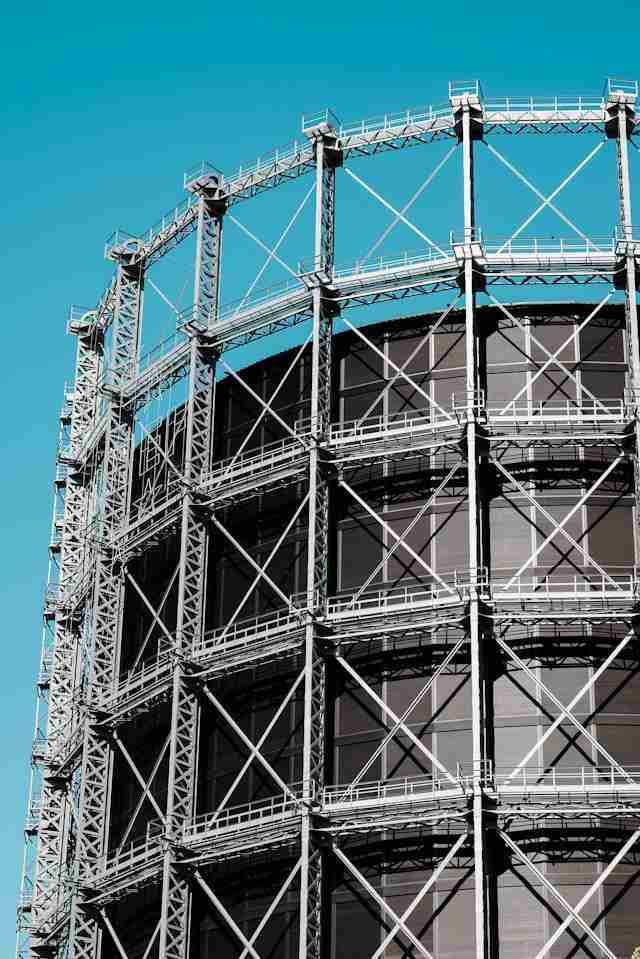
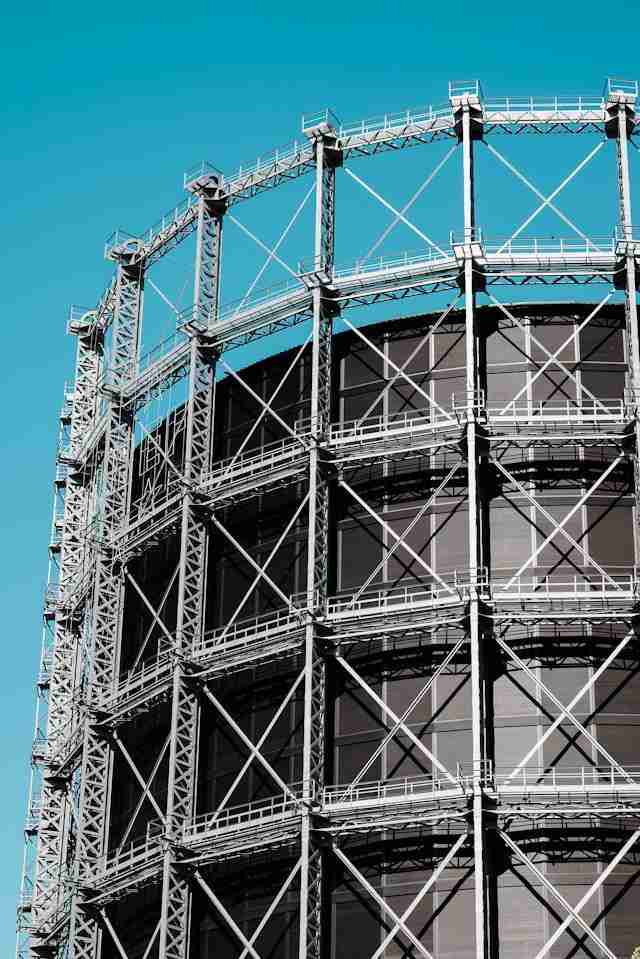
The Gasometer Schöneberg rises over Berlin's Tempelhof-Schöneberg district as a striking fusion of industrial heritage and modern adaptation. Once used to store natural gas, this massive steel framework has been repurposed into a multifunctional space that now houses a conference and event center, as well as the Sky Lounge, a rooftop terrace located roughly 66 meters above the ground, offering panoramic views across the city. Its open structure still retains its powerful visual presence, making it a compelling subject for photographers interested in geometry, urban renewal, and Berlin's shifting skyline. With light slipping through its latticework and the surrounding city in constant motion, the Gasometer is no longer a relic. It is a living part of the capital's creative and cultural fabric.
Best Photography Opportunities
• Silhouette at Sunset from Torgauer Straße
The Gasometer's skeletal steel frame is ideal for creating sharp silhouettes against the sky. As the sun lowers in the west, its circular form becomes graphically defined, especially when photographed from Torgauer Straße where views are uninterrupted. A mid-telephoto lens compresses the form and lets you isolate the structure against colorful evening skies. Cloud cover or layered haze can enhance contrast and bring depth to the background. Including the urban skyline at the lower edge of your composition helps contextualize the scene within Berlin's landscape, giving a sense of place to the abstract silhouette.
• Framing Through Trees at Natur-Park Südgelände
This nearby park, filled with rewilded industrial structures, offers natural frames of the Gasometer through foliage, old train lines, and rusting platforms. Spring and autumn offer the best color variation, while summer gives full green contrast against the steel. Use a 50mm or 85mm lens to compress midground growth with the distant frame. Shooting through the vegetation adds texture and layering, which helps break up the structure's regular geometry. These compositions are strongest in soft morning or evening light, when shadows are long and the contrast between metal and nature is most pronounced.
• Blue Hour from Dominicusstraße Overpass
As twilight deepens, the Gasometer glows subtly under street lights and the surrounding city starts to pulse. From the Dominicusstraße pedestrian overpass, long exposures allow you to incorporate traffic light trails beneath the circular frame. A wide-angle lens lets you emphasize the structure while drawing in the motion below. Framing the installation between the bridge's railings or street lamps can enhance depth and lead the eye. These scenes work best just after sunset when the ambient light matches the artificial sources and the sky retains rich color.
• Architectural Detail with Vertical Emphasis
Close-range photography of the support beams, cross-bracing, and bolted joints offers a more abstract architectural study. The best light for this work is strong mid-morning or late afternoon sun, which casts directional shadows and highlights steel texture. Composing with vertical emphasis can exaggerate the height and repetition within the frame. Look for angles where intersecting beams or curves create symmetrical or repeating patterns that fill the frame. This style of image is ideal for black-and-white processing, where form becomes the subject and the industrial heritage feels timeless.
• City Views from the Sky Lounge Terrace
Access to the rooftop Sky Lounge offers a rare panoramic vantage point over Berlin. From this height, you can photograph the urban grid, green corridors, and city landmarks through the open ring of the structure. Golden hour light brings warmth to the rooftops and softens the distant skyline, which can otherwise appear harsh under midday sun. The ring of the Gasometer itself becomes a compositional tool, framing portions of the horizon or creating contrast between steel and sky. Night views are especially dynamic when city lights flicker on, and the glow of the skyline stretches to the horizon.
Best Time to Visit
Spring and autumn offer the most dynamic lighting and color contrast. In spring, the surrounding parks and trees bloom with fresh greens that pair well with the cool steel of the structure. Light is crisp in the morning and balanced in the evening, giving good range for silhouettes and long exposures.
Autumn brings more warmth to the color palette and lengthens the golden hour. Late October often features dramatic skies, low sun, and richly colored leaves in the nearby Südgelände Park. These conditions make both wide views and tighter architectural compositions more vibrant.
Winter reveals the structure most clearly, free from foliage and often set against high-contrast skies. Snow can add graphic value to street-level images or to rooftop views. Short daylight hours mean golden light is more accessible, and the blue hour comes quickly.
Summer allows for long shooting windows and activity on the rooftop terrace. While haze may soften skyline views, twilight sessions in warm weather are some of the most visually rich. Evening events in the Sky Lounge provide chances for architectural and human-focused photography.
How to Get There
The Gasometer Schöneberg is located along the busy Sachsendamm corridor in Berlin's Schöneberg district. The nearest major transit stop is Südkreuz S-Bahn station, just a ten-minute walk away. From there, follow signs or map apps to Torgauer Straße or EUREF-Campus, where the gasometer is located. For drivers, street parking is available but fills quickly during work hours and events.
The Gasometer is now part of the EUREF-Campus, a hub for innovation, sustainability, and urban design. Public access to the exterior is available from nearby sidewalks and green spaces, and interior access, including the rooftop Sky Lounge, may be available during conferences, guided tours, or special events. Tripods are permitted outside the fenced campus area, but interior use may require prior permission.
Recommended Photography Gear
A well-rounded kit includes a 24–70mm lens for general views, a 70–200mm for detail and compression, and a wide-angle 16–35mm for architectural perspectives and low-angle shots. A sturdy tripod is essential for long exposures, twilight work, and skyline panoramas.
A polarizing filter is useful when shooting during the day to reduce glare and add saturation to the sky and building surfaces. For twilight scenes from the rooftop terrace, consider bringing a fast prime lens to capture handheld shots in fading light. ND filters may be useful when working with traffic trails or cloud movement from elevated viewpoints.
Bring a microfiber cloth for keeping lenses clean, especially in wind or after rain. A small backpack or sling bag will allow for movement between street-level and elevated positions. If visiting the rooftop, confirm ahead of time whether camera gear is allowed during the specific event or tour.
Nearby Photography Locations
This rewilded industrial area is filled with rusted rail bridges, old machinery, and forest overgrowth. It is a strong location for textured compositions, environmental contrast, and forgotten infrastructure turned into art.
Just east of the Gasometer, this enormous former airfield now serves as Berlin's most expansive open space. Ideal for minimalist compositions, cloudscapes, and long-lens people watching from a distance.
Combining raised train lines, modern architecture, and angular design features, this park connects with Berlin's contemporary side. Excellent for photographing light, shadow, and repeating structure.
A rare hillside in the city, this park features a cascading artificial waterfall, monuments, and views across rooftops. It is ideal for soft sunrise or evening compositions that bring nature and city together.
• Schöneberg Rathaus and John-F.-Kennedy Platz
Historical architecture, Berlin history, and open civic space offer more traditional urban compositions. Strong symmetry and architectural framing can be found under the right light.
Comments
Loading comments…