
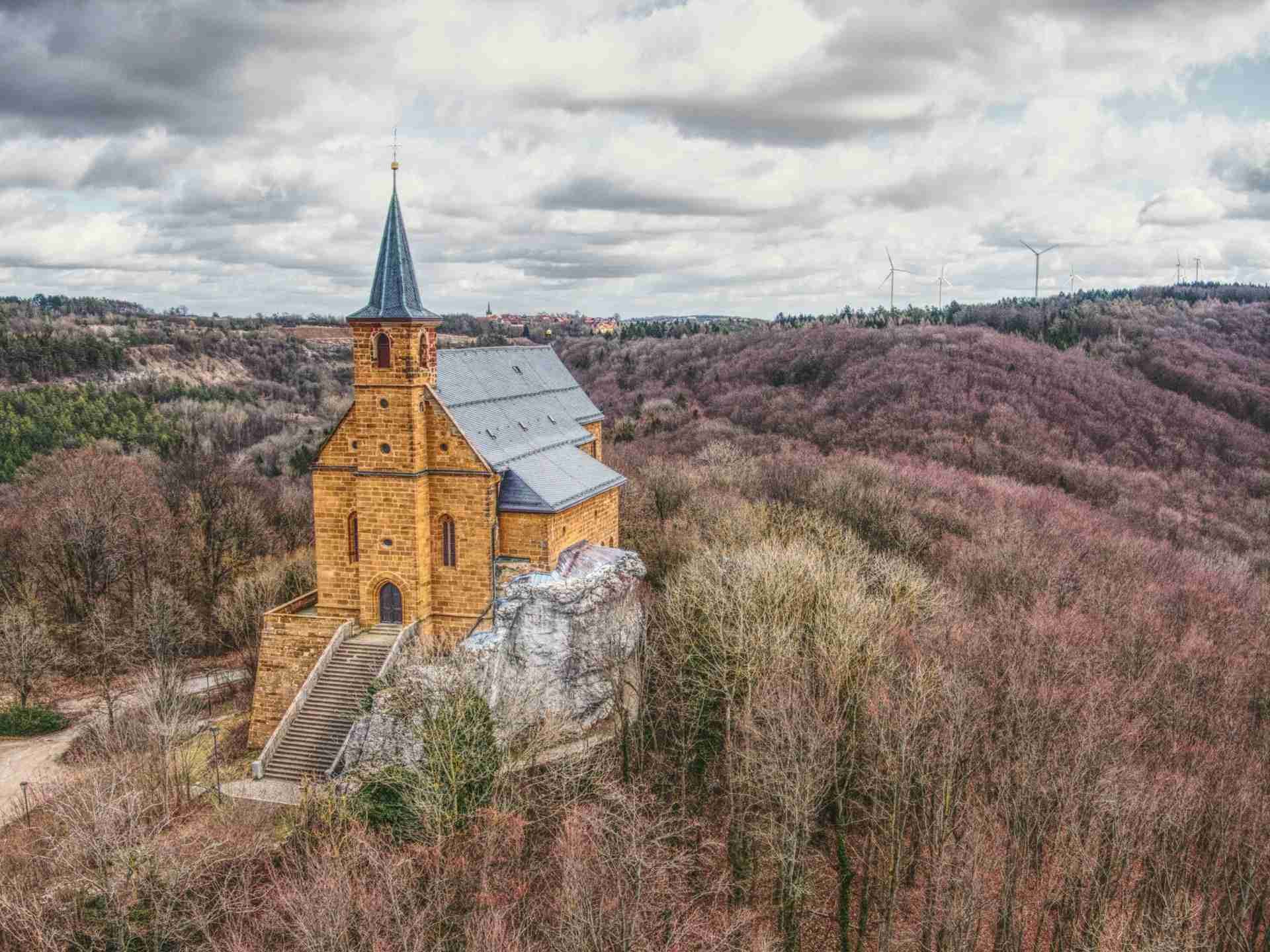
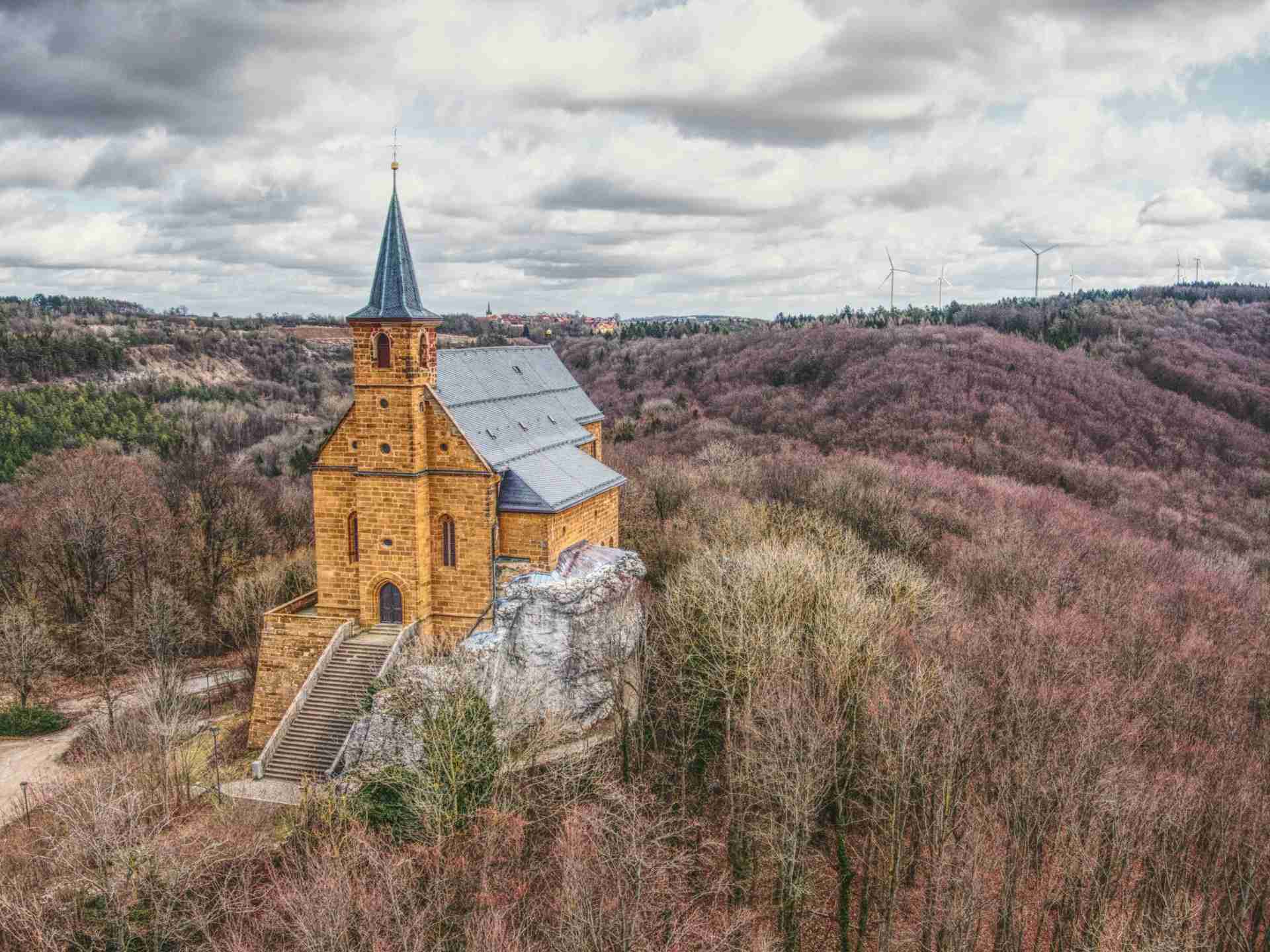
Gügelkirche St. Pankratius is a dramatic hilltop pilgrimage church perched on a limestone outcrop near the town of Scheßlitz in northern Bavaria. Built from warm toned sandstone and surrounded by the rolling Franconian landscape, the church stands out both for its elevated location and its striking single tower capped by a steep spire. From below, the steep staircase creates a strong leading line that pulls your eye directly toward the structure. From above or beside, it opens to sweeping views of forest, field, and sky, especially beautiful during early light or in autumn when color spreads across the treetops. Its unique position makes it ideal for photographers who enjoy combining architectural subjects with broad landscape backdrops.
Best Photography Opportunities
• Staircase Approach
One of the most compelling views of the church is from the base of the staircase. The steep rise of stone steps leads cleanly to the central door and tower, forming a natural vertical frame that emphasizes height and draws focus toward the entrance. Early morning or late afternoon side light adds shadow detail along the stairway and brings out the sandstone's warm texture. A wide angle lens helps exaggerate the incline and lets you include more of the trees or sky above. This approach shot is best taken on overcast or lightly clouded days to avoid overly harsh contrast between light and shadow.
• Elevated Views with Landscape Backdrop
From behind or slightly above the church, you can capture expansive views that include the building in the foreground with wide forested hills stretching beyond. These compositions are strongest in autumn, when the surrounding woodland shows varied color and the light is low enough to create depth in the land. Shooting wide allows you to include foreground elements like stone walls or brush that add texture. Golden hour adds richness to the sandstone tones while keeping the sky balanced with soft pastels. A tripod is useful here if you're working in low light or want to build HDR frames for extended dynamic range.
• Architectural Detail and Material Texture
The sandstone construction of Gügelkirche holds up well in close up images, especially around the tower base, arched doorways, and corners where the stone catches warm directional light. You can frame the spire against sky or trees, depending on your angle, and isolate elements like window frames or rooflines with a telephoto lens. Moss and wear on the stone add character, especially in soft light or after rainfall. These details work well in black and white or muted color, depending on your style. Shooting early in the day helps avoid high contrast along the facade.
• Wide Angle Landscape Compositions
Given its hilltop setting, the church can be used as a foreground anchor for wide angle shots of the surrounding region. Composing the church to one side of the frame lets you balance man made and natural elements without crowding the image. During sunrise or sunset, light moves quickly across the valley and changes the atmosphere from warm to cool tones in a short time. This location is excellent for capturing light transitions, especially when low mist sits in the trees below. A lens in the 14 to 35 millimeter range will help make the most of these broader compositions.
• Seasonal and Weather Driven Mood
Because of its exposed location, the church changes character with the weather. In autumn, the trees around the base turn orange and yellow, creating strong color contrast with the stone. In winter, the structure stands in sharp contrast to snow-covered ground or frosted branches. Overcast conditions add a soft, timeless quality, while fog transforms the church into a more isolated and moody subject. All of these conditions offer creative possibilities and benefit from repeated visits. Be prepared to adjust your framing depending on how much of the valley is visible under shifting light.
Best Time to Visit
Gügelkirche is most photogenic in early morning and late afternoon when the sun is low enough to highlight the texture of the stone and define the terrain around it. Sunrise light from the east works particularly well for illuminating the stairs and the front of the church, while sunset is best for capturing wider scenes with warm light across the valley. Autumn is a standout season for this location, with color in the trees and cooler air that often brings mist to the landscape below.
Spring is also excellent for clean light and subtle greens, while winter offers stark compositions and quiet atmosphere if conditions allow. The area is relatively quiet throughout the year, but early hours are ideal if you want to avoid foot traffic and have time to experiment with framing.
How to Get There
Gügelkirche is located just outside Scheßlitz in the Franconian region of northern Bavaria. It is accessible by car, with nearby roadside parking available at the base of the hill. From there, it's a short but steep walk up the paved path and staircase to the church itself. The trail is well maintained and walkable year round, but may be slippery in rain or winter conditions. There are also forest trails that lead to alternate viewpoints above or behind the church. No fees or permits are required for photography on the grounds.
Recommended Photography Gear
A wide angle lens is essential for capturing the church in context with the stairs or the landscape. A standard zoom helps with architectural detail and environmental portrait-style compositions. A tripod is useful during golden hour or low light conditions, especially if you are photographing the church as part of a larger landscape. A circular polarizer can help manage glare from the stone and deepen sky tones when conditions are clear. A lightweight telephoto lens is helpful for isolating the spire or compressing the view over the valley. Weather protection is a good idea if visiting in cold or changing weather.
Nearby Photography Locations
Located on a nearby hilltop, Giechburg offers panoramic views of the surrounding region and a completely different architectural subject. The ruins are photogenic at golden hour and pair well with a trip to Gügelkirche for a full day of elevated landscape work.
Just a few minutes away, the town features half-timbered buildings, cobbled streets, and quiet corners for architectural photography. It's a good option for shooting in diffused light or exploring texture and form in a historic village setting.
• Franconian Forest Trails
Extending in multiple directions from the hill, the local trail system provides access to forest clearings, ridge lines, and natural scenes. These trails are particularly appealing in early morning fog or autumn color.
Roughly a 25-minute drive away, Bamberg's canals, bridges, and historic architecture offer a completely different kind of photographic environment. It's best visited at sunrise or during blue hour for clean reflections and low crowds.
• Staffelberg Plateau
A bit farther south, this limestone plateau rises above the Main River and offers wide open landscape views, dramatic sky opportunities, and ancient ruins. It's ideal for photographers who enjoy shooting expansive scenes with strong sky movement or layered hills.
Gügelkirche St. Pankratius offers the kind of combination that many photographers seek but rarely find in one location; strong architectural form, a commanding natural setting, and changing light that brings the scene to life throughout the day and year. Whether you're focusing on the play of light on stone, the symmetry of the staircase, or the view beyond the hilltop, the location is one that encourages deliberate composition and patient observation.
Comments
Loading comments…