
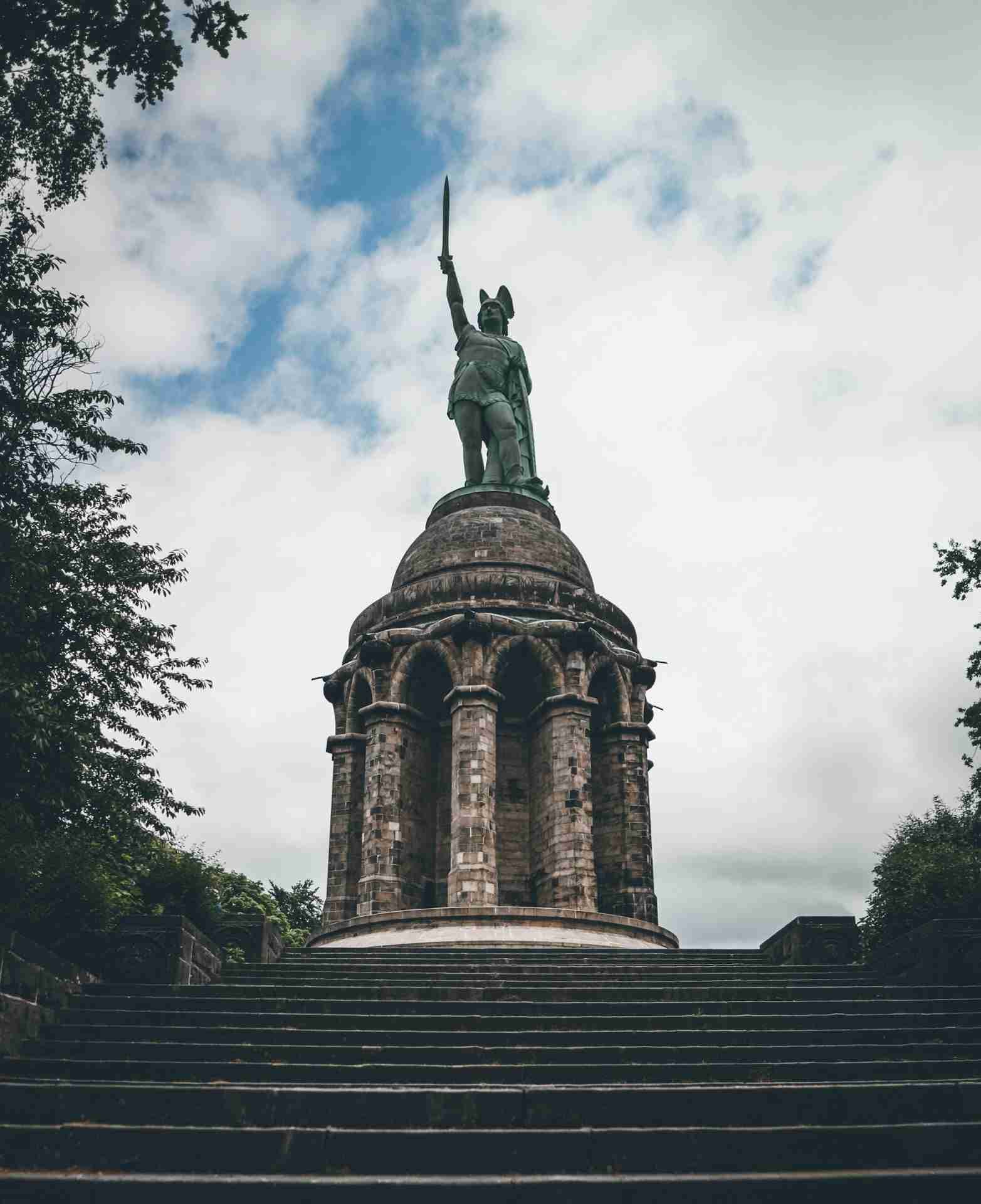
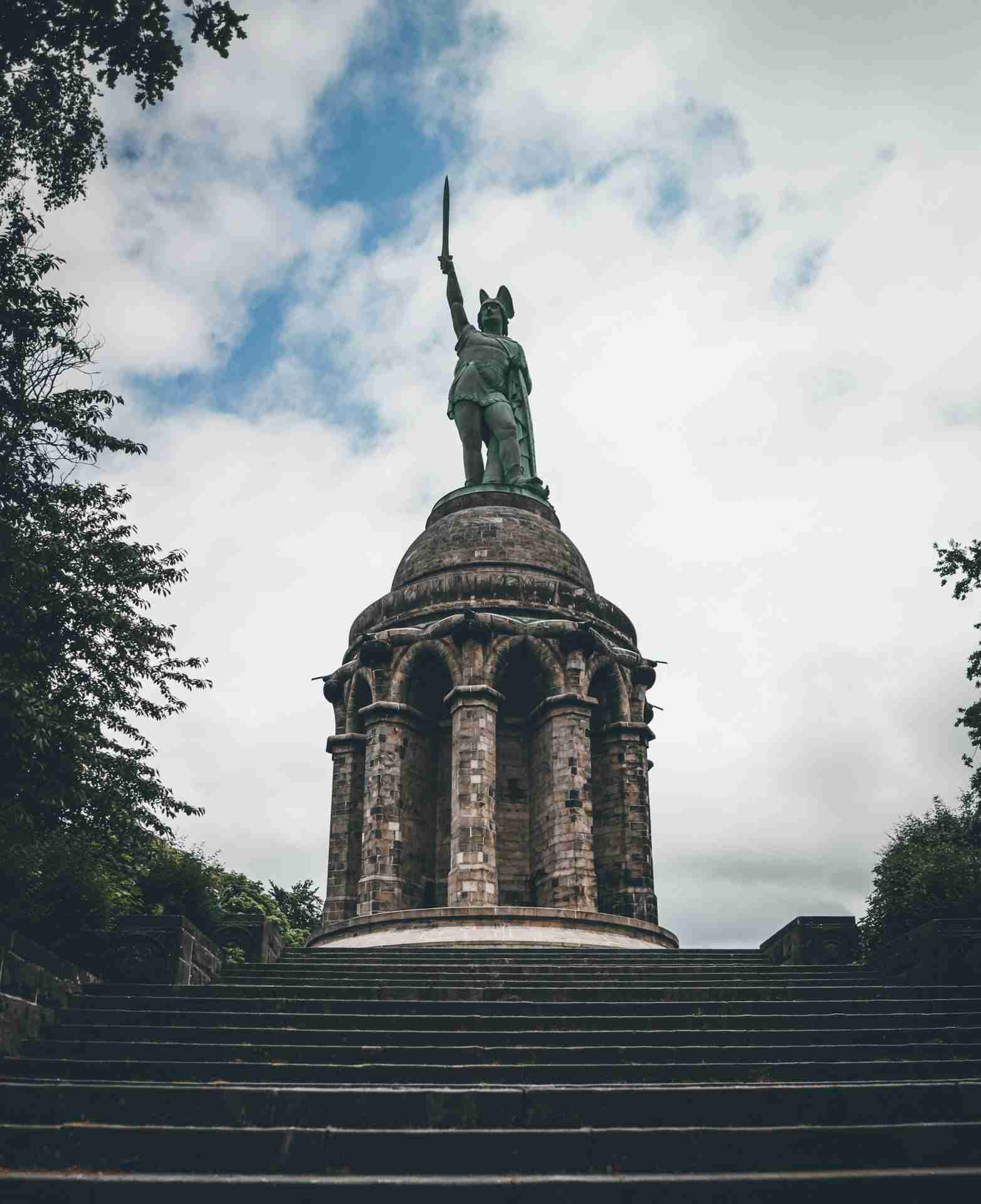
Rising above the Teutoburg Forest near Detmold in North Rhine-Westphalia, the Hermannsdenkmal (Hermann Monument) is one of Germany's most dramatic monuments and a commanding subject for photographers. Dedicated to Arminius, the Cheruscan leader who defeated the Romans in the Battle of the Teutoburg Forest in 9 AD, the statue towers more than 50 meters high, including its pedestal. Hermann's sword points skyward, gleaming above the treetops, while the stone base combines with the towering figure to create a structure that dominates the forested ridge. For photographers, the monument offers a compelling blend of historical symbolism, monumental scale, and natural surroundings. Views from below emphasize its height and power, while distant perspectives reveal it rising mysteriously from the dense Teutoburg woodland.
Best Photography Opportunities
• Monument from the base
: Standing directly at the foot of the Hermannsdenkmal emphasizes the scale of the bronze figure and pedestal. A wide-angle lens exaggerates perspective, making the statue loom dramatically overhead while still capturing architectural details in the base. Early morning or late afternoon light highlights the patina of the bronze while casting soft shadows on the stonework. Including visitors in the frame helps communicate scale, while long exposures smooth moving crowds and emphasize the monument's permanence. Overcast skies are also effective, reducing glare on the bronze surface.
• Sword against the sky
: The raised sword of Arminius is one of the monument's most striking details. Isolating it with a telephoto lens against the sky creates minimalist compositions that highlight form and symbolism. This approach works particularly well at sunset, when the sword is silhouetted against fiery skies, or at dawn, when pastel light softens the outline. Shooting from lower angles exaggerates the sword's reach toward the heavens, underscoring its symbolic role as a statement of freedom and victory.
• Framed by the Teutoburg Forest
: From more distant trails and clearings in the forest, the Hermannsdenkmal emerges above the canopy. These viewpoints offer balanced compositions where the monument is partially obscured by foliage, appearing as a guardian watching over the landscape. A telephoto lens compresses the forest layers, emphasizing the statue's vertical dominance. Autumn is particularly rewarding for this perspective, as colorful foliage surrounds the monument in reds, oranges, and yellows, contrasting with the bronze and stone. In winter, bare trees simplify the scene, giving a starker, more dramatic impression.
• Detail studies of base architecture
: The stone pedestal includes arches, columns, and stairways that lend themselves to architectural photography. Shooting upward through arches frames the statue above, creating layered compositions that connect the human scale of the architecture with the monument's towering figure. Diffused light on cloudy days enhances the textures of the stonework, while oblique light at golden hour casts long, dramatic shadows. Close-ups of carvings or weathered surfaces add intimacy to an otherwise monumental subject.
• Night photography and illumination
: The Hermannsdenkmal is often illuminated after dark, transforming the statue into a glowing sentinel above the forest. Long exposures capture the interplay of artificial lighting on bronze and stone, while star trails or the Milky Way can be framed above the figure in clear conditions. A tripod and low ISO are essential here, and experimenting with both wide and telephoto perspectives can produce striking results. Night fog drifting through the forest adds atmosphere, softening the monument's lighting into a mystical glow.
Best Time to Visit
The Hermannsdenkmal can be photographed year-round, but each season offers unique qualities. Spring brings fresh greenery to the forest, contrasting with the weathered bronze and stone of the monument. Summer provides long days and clear skies, though crowds are larger, making early mornings and evenings the best times to shoot. Autumn is one of the most rewarding seasons, as the forest canopy bursts with color, framing the monument in vibrant tones. Winter offers crisp air and low sun angles that highlight surface detail, with occasional snow adding contrast and atmosphere.
For daily timing, mornings offer soft light from the east, illuminating the front of the monument and producing calm forest settings with minimal visitors. Sunset from the western side is equally effective, especially when the sky glows behind the raised sword. Overcast conditions work well for detail and architectural studies, while clear nights are ideal for astrophotography. The flexibility of the location means photographers can return at different times of day and season to build a varied portfolio of images.
How to Get There
The Hermannsdenkmal is located just southwest of Detmold in North Rhine-Westphalia. By car, it is easily accessible via local roads, with well-marked signs leading to a large visitor parking area near the monument. From the parking lot, it is only a short walk uphill to the base. Public transport is also available, with buses running from Detmold to the monument area. The site is open year-round, and while the surrounding grounds can be visited freely, entry to the interior stairways of the pedestal requires a small fee. From the upper platform, photographers can enjoy elevated views across the Teutoburg Forest. The paths are well maintained, though sturdy footwear is advisable for exploring surrounding trails that provide alternative perspectives.
Recommended Photography Gear
A wide-angle zoom such as a 16 to 35 millimeter lens is essential for capturing the monument from its base, where space is limited but scale must be emphasized. A mid-range zoom, like a 24 to 70 millimeter, provides versatility for balanced compositions of the full monument and its architectural base. A telephoto lens up to 200 millimeters is useful for isolating details such as the sword, facial expressions, or distant perspectives through the forest canopy. A tripod is invaluable for long exposures at dawn, dusk, or night, particularly when photographing the illuminated monument.
Filters also play an important role. A polarizer reduces glare on the bronze statue and deepens the greens of the forest. Neutral density filters extend shutter speeds for smoothing clouds or capturing soft motion in passing crowds. Weather protection for gear is advisable in this forested environment, where sudden rain showers are common. A compact backpack makes navigating staircases and trails easier, while sturdy footwear allows exploration of forest paths for alternative viewpoints.
Nearby Photography Locations
: Located about 20 kilometers from Detmold, this dramatic sandstone rock formation rises vertically from the forest. Reflections in the small lake and abstract studies of rock texture make it one of Germany's most photogenic natural landmarks.
: In the heart of the city, this Renaissance-era residence combines elegant architecture with landscaped grounds. Its symmetry and historic details contrast beautifully with the natural drama of the Hermannsdenkmal.
: One of Europe's oldest bird of prey centers, situated in the nearby Teutoburg Forest. Photographers can capture dynamic shots of raptors in flight demonstrations against forested backdrops.
: A forest observation tower offering panoramic views over the Teutoburg landscape. Sunrise and sunset from this elevated position create layered compositions of hills, forest, and distant villages.
The highest peaks in the Teutoburg Forest provide sweeping views across valleys and ridges. Autumn mist often lingers in the lowlands, creating atmospheric layering when photographed from the summit.
The Hermannsdenkmal is more than a monument to history. It is a towering presence that connects human achievement with the vastness of the surrounding forest. For photographers, it offers a rich combination of monumental architecture, symbolic detail, and natural context, rewarding those who explore both the immediate site and its broader landscape.
Comments
Loading comments…