
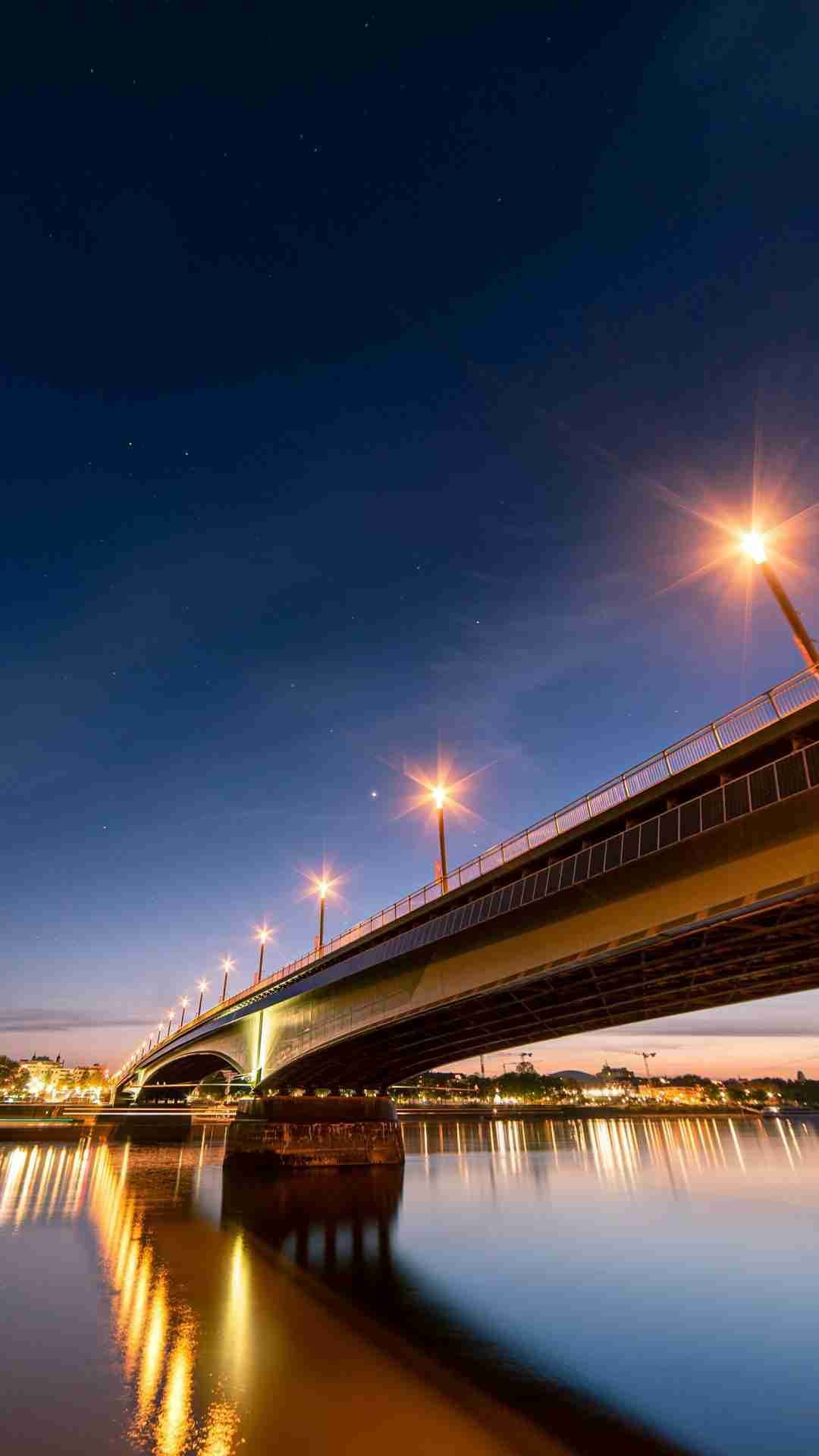
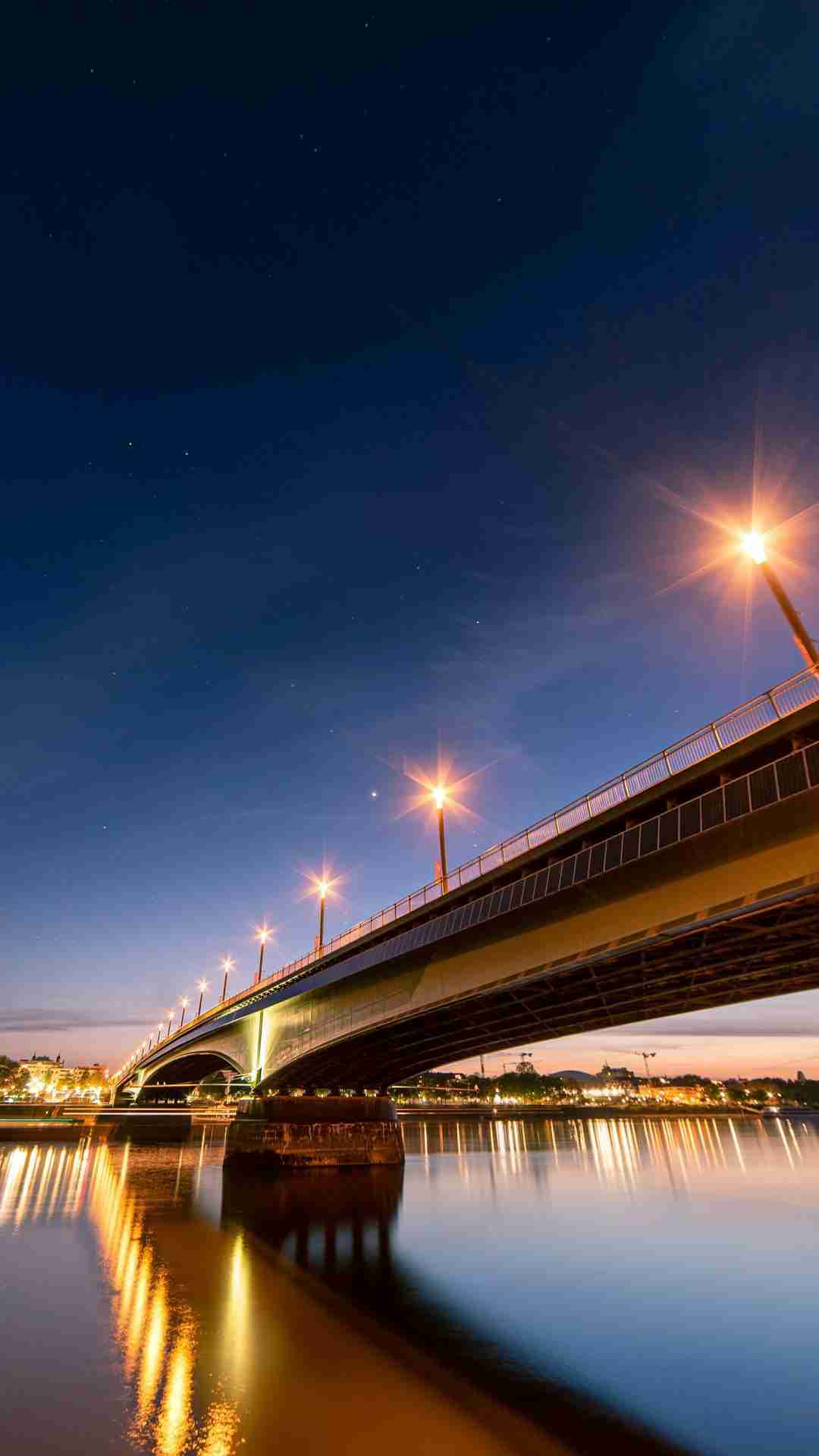
Crossing the Rhine with a quiet sense of purpose, the Kennedybrücke in Bonn is less about grandeur and more about rhythm, light, and scale. This concrete and steel bridge links the city center with the Beuel district and serves as both a vital transit corridor and a dynamic photographic subject. The bridge's long, clean lines stretch across one of Europe's most storied rivers, offering a chance to explore how infrastructure interacts with water, sky, and motion. For photographers, the Kennedybrücke is not a singular view. It is a place to work with repetition, shifting reflections, and the steady passage of boats, clouds, and commuters. Whether viewed from the riverbanks, beneath its spans, or from a passing tram, it provides a steady anchor point within a constantly moving environment.
Best Photography Opportunities
• Side Profile from the Beuel Riverside Path
From the Beuel side of the Rhine, the bridge's full profile can be captured in clean symmetry. Early morning light from the east brings out the texture of the bridge supports and highlights the metal framework beneath the roadway. A mid-range zoom lens helps adjust composition based on river traffic and shifting sky. Including elements like passing boats, cyclists, or tree branches in the foreground adds context and movement. This angle works particularly well under layered clouds when the soft reflections in the water mirror the lines of the structure.
• Underneath the Bridge near the Central Piers
Walking down to the riverside paths directly beneath the bridge reveals a completely different composition focused on symmetry, vanishing points, and concrete geometry. Use a wide-angle lens to exaggerate the perspective of the repeating supports, especially when shooting directly down the center. Late afternoon light casts deep shadows and bright highlights across the surfaces, adding graphic contrast. These compositions work well in both black and white and color depending on the mood and quality of the light. This is also a strong location for abstract studies and pattern-focused framing.
• Long Exposures from the Western Bank near Bonn Opera House
The promenade near the Bonn Opera House offers a broad view of the bridge from a slight angle, making it perfect for long exposure work during blue hour. Using a tripod and ND filter, you can smooth the water and capture light trails from boats or the glow of city lights across the river surface. This angle also allows you to include reflections of the bridge's lights and moving clouds, which add drama and visual flow. A 24–70mm lens provides flexibility to isolate parts of the bridge or include more of the surrounding skyline.
• Tram Tracks and Street Activity on the Bridge Deck
The Kennedybrücke carries both vehicular traffic and trams, which creates unique opportunities for dynamic street photography directly on the bridge. Early morning or dusk allows for motion blur of passing trams with crisp background detail. Use a fast lens around 35mm or 50mm to maintain a natural perspective and capture fleeting light. Reflections on the wet roadway after rain can double your composition and add an unexpected layer to your frame. This is a great place to explore rhythm, color, and human movement within the confines of a fixed structure.
• Aerial or Elevated View from the Rheinaue Park Side
If you have access to a drone or an elevated position on the Beuel side, the aerial view shows how the Kennedybrücke cuts cleanly across the Rhine, connecting two sides of the city. From above, the geometry becomes more apparent, and the patterns of boats, currents, and shoreline structures can be composed with precision. Sunrise or sunset offers the most dynamic light, casting long shadows and enhancing the contrast between the warm tones of the city and the cool surface of the water. Keep the composition simple and emphasize the line of the bridge as it anchors the image.
Best Time to Visit
The Kennedybrücke is photogenic year-round, but the most interesting light and atmospheric variation occur in spring and autumn. In spring, clear skies and cool morning temperatures create soft reflections on the Rhine and low haze that adds visual depth across the frame. Early mornings are typically quiet and allow you to work undisturbed along the riverside or directly on the bridge. Autumn brings more dramatic skies and warmer tones across the city, especially around golden hour and into blue hour. These conditions are ideal for capturing long exposures, tram motion blur, or layered cloud formations moving behind the bridge.
Summer has longer daylight hours and warmer tones, but the light can become flat and contrast-heavy during midday. Early evening and sunrise sessions are best, particularly when river traffic increases and reflections dance across the water. Winter provides stark, minimalist scenes. Bare trees, low sun, and fog on the river can create moody compositions with a documentary or abstract edge. Overcast days also help reduce glare from the concrete and make it easier to balance exposures between sky and structure. Regardless of season, weekday mornings and Sunday evenings tend to be the quietest times to photograph without much interruption.
How to Get There
The Kennedybrücke is centrally located in Bonn and is easily accessible from both sides of the city. From the Bonn Hauptbahnhof, it is a short walk to the western entrance of the bridge near the opera house. On the Beuel side, multiple tram and bus stops provide access to riverside paths and viewing areas. Cyclists and pedestrians can access the bridge via dedicated paths that run alongside the tram and car lanes, offering flexible shooting spots across the span.
If driving, parking is available in nearby garages or along residential streets on either side of the river, though it is generally easier to explore the area on foot. Tripods are allowed and not an issue in public spaces, though setting up directly on the bridge should be done with caution and awareness of pedestrian flow. For drone photography, be sure to follow German airspace regulations, particularly in urban zones. The area is well-lit at night, making it suitable for evening and long-exposure work even during winter.
Recommended Photography Gear
A 24–70mm zoom lens will handle most compositions at and around the Kennedybrücke, from street-level scenes on the bridge to skyline views from the riverbank. For more immersive or abstract images beneath the structure, a wide-angle lens in the 16–35mm range is essential. A short telephoto or 70–200mm lens can help compress architectural elements and isolate details from farther away, especially if you are working across the water or with layered city scenes.
A tripod is highly recommended for evening, long exposure, and under-bridge shots where sharpness and stability are crucial. ND filters will allow for motion blur in both water and sky, while a polarizer helps control reflections on the water and enhance contrast under mixed lighting. A compact drone adds flexibility for elevated perspectives, but always check for any local flight restrictions. Keep your kit lightweight and adaptable. The location shifts from tight structural spaces to wide urban environments, and moving between them quickly is key.
Nearby Photography Locations
• Beethovenhalle and the Riverfront
Just downstream, the area around the Beethovenhalle offers clean modernist architecture and wide views of the river with tree-lined paths. This location is best during golden hour or at night when architectural lights reflect off the water.
• Alter Zoll and the University Terrace
Perched above the river on the Bonn city side, this terrace provides elevated views of the Kennedybrücke with the Siebengebirge hills in the background. Sunset is especially dramatic here as the sky lights up over the distant peaks.
A few minutes south of the bridge, this sprawling park includes artificial lakes, long walking paths, and open views of the city skyline. Foggy mornings or late-afternoon light offer excellent conditions for serene, minimalist landscape photography.
• Beuel Riverside Promenade
The walkway on the eastern bank offers quieter shooting conditions and long perspectives of the city skyline with the bridge as a mid-ground anchor. It is a prime location for blue hour skyline shots with reflections stretching across the water.
In the city center just west of the bridge, the cathedral and surrounding square offer a completely different architectural tone. Look for strong vertical compositions, architectural contrast, and shadow studies during late afternoon.
The Kennedybrücke may not immediately call attention to itself, but that is part of its strength. It offers photographers a chance to slow down, study movement, and work with structure in a living urban environment. Here, the river is always in motion, and the bridge provides form to everything flowing beneath it.
Comments
Loading comments…