
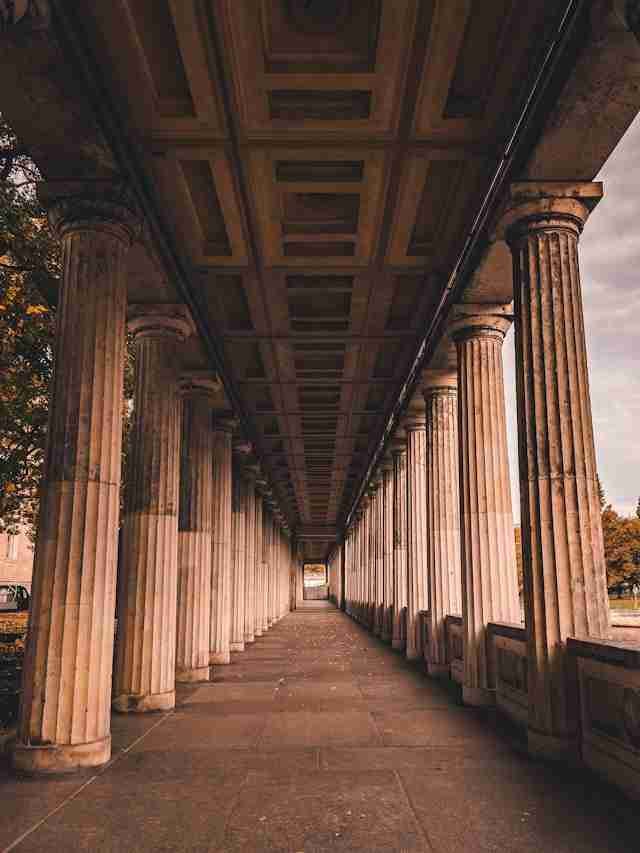
Tucked between the grand buildings of Museum Island and bordered by the Spree River, the Kolonnadenhof offers a calm, geometric retreat in one of Berlin's most visited cultural quarters. Surrounded by stately columns and open walkways, this open-air courtyard blends neoclassical architecture with thoughtfully arranged greenery and sculpture. For photographers, the space provides controlled symmetry, filtered natural light, and refined framing opportunities that contrast sharply with the urban rhythm just beyond its edges.
Best Photography Opportunities
• Symmetry and depth through the colonnades
The defining feature of the Kolonnadenhof is its long row of classical columns, which create perfect vanishing points and a consistent rhythm of light and shadow. Use a wide-angle lens to emphasize the lines, or a mid-range zoom to compress the space and isolate repeating patterns. Early morning offers cleaner frames with fewer visitors.
• Statues framed by architecture
The open lawn includes several well-placed sculptures that can be framed between columns or layered against the museum façades. These work well in both wide and narrow compositions, particularly when the light is low and directional. A telephoto lens allows you to play with depth and create tighter abstractions.
• Reflection shots after rain
After rainfall, the polished stone and shallow puddles on the grounds create subtle reflections that double the structure and add interest. Wait for breaks in the clouds to allow soft light back into the frame. A polarizer can help manage reflections or enhance color depending on your composition.
• Seasonal contrast with trees and plantings
In spring and summer, soft foliage softens the lines of the colonnades, while autumn brings golden tones that complement the pale stone. Even winter has its own minimal charm, with bare branches and longer shadows. Consider returning in different seasons to explore how natural elements change your perspective.
• Blue hour and subtle uplighting
As daylight fades, the surrounding buildings and walkways are gently lit by ambient lighting. This low-level illumination is subtle but effective for architectural scenes, and the columns take on a warm glow against the blue sky. Use a tripod and long exposure to balance shadow detail and capture soft evening color.
Best Time to Visit
The Kolonnadenhof is accessible year-round and offers different visual rewards in every season. Spring brings flowering trees and balanced temperatures for long shoots. Summer can be busy during peak hours but has strong light contrasts and lush green framing. Autumn is particularly photogenic, as warm-toned leaves contrast beautifully with the stone architecture. Winter light is low and clean, ideal for stark minimalist compositions.
Morning light works best when photographing the eastern edge of the colonnades, while late afternoon provides side illumination across the lawn and western walkways. Midday can create harsh shadows, but overcast skies soften the scene and provide even exposure for architectural details. Blue hour is short but visually rewarding with ambient lighting from nearby museums.
How to Get There
Kolonnadenhof is located on Museum Island in central Berlin, easily accessed from the city's public transport network. The closest station is Hackescher Markt (S-Bahn), just a 5-minute walk away. Berlin Hauptbahnhof is also within walking distance across the river. Trams and buses stop nearby at Lustgarten and Kupfergraben.
Entry to the outdoor space is free and open at all hours, though the area is best enjoyed during daylight. The colonnades are public space, and photography with handheld gear is unrestricted. Tripods may draw attention during busy times but are generally tolerated in early morning or evening hours. Avoid weekends for the most uninterrupted compositions.
There are benches throughout the space, as well as public restrooms and cafés nearby. The grounds are flat and paved, making them fully accessible for rolling gear or mobility aids.
Recommended Photography Gear
A wide-angle lens (16–35mm) is perfect for capturing the full scale of the colonnades and fitting larger structures into your frame. A mid-range zoom (24–70mm) helps frame individual statues or isolate architectural details. A short telephoto (70–200mm) is useful for compressing long perspectives and isolating repeating patterns between columns.
A tripod is helpful for blue hour and low-light scenes but should be used discreetly to avoid disrupting foot traffic. A circular polarizer enhances contrast in stone textures and controls glare from wet surfaces. A cleaning cloth is handy for shooting after rain or during misty mornings.
Pack light if moving between museums, but bring backup batteries and a weather-resistant bag in case of showers. A compact remote or timer is useful for long exposures and minimizing vibration.
Nearby Photography Locations
directly adjacent to the Kolonnadenhof, offers both exterior compositions and access to a rooftop view across Museum Island and the city.
, with its modern architecture and clean lines, creates interesting contrasts with the classical colonnades, particularly in side-by-side compositions.
, located just south, provides open lawns, tree cover, and wide views of the cathedral and Altes Museum, best shot at sunrise or early golden hour.
, a modernized palace interior just across the canal, offers minimal architecture, symmetrical features, and strong contrasts in color and texture.
• Monbijoupark and the opposite bank of the Spree
, where you can shoot reflections of Museum Island's facades and capture the full scale of the colonnades from across the water.
Comments
Loading comments…