

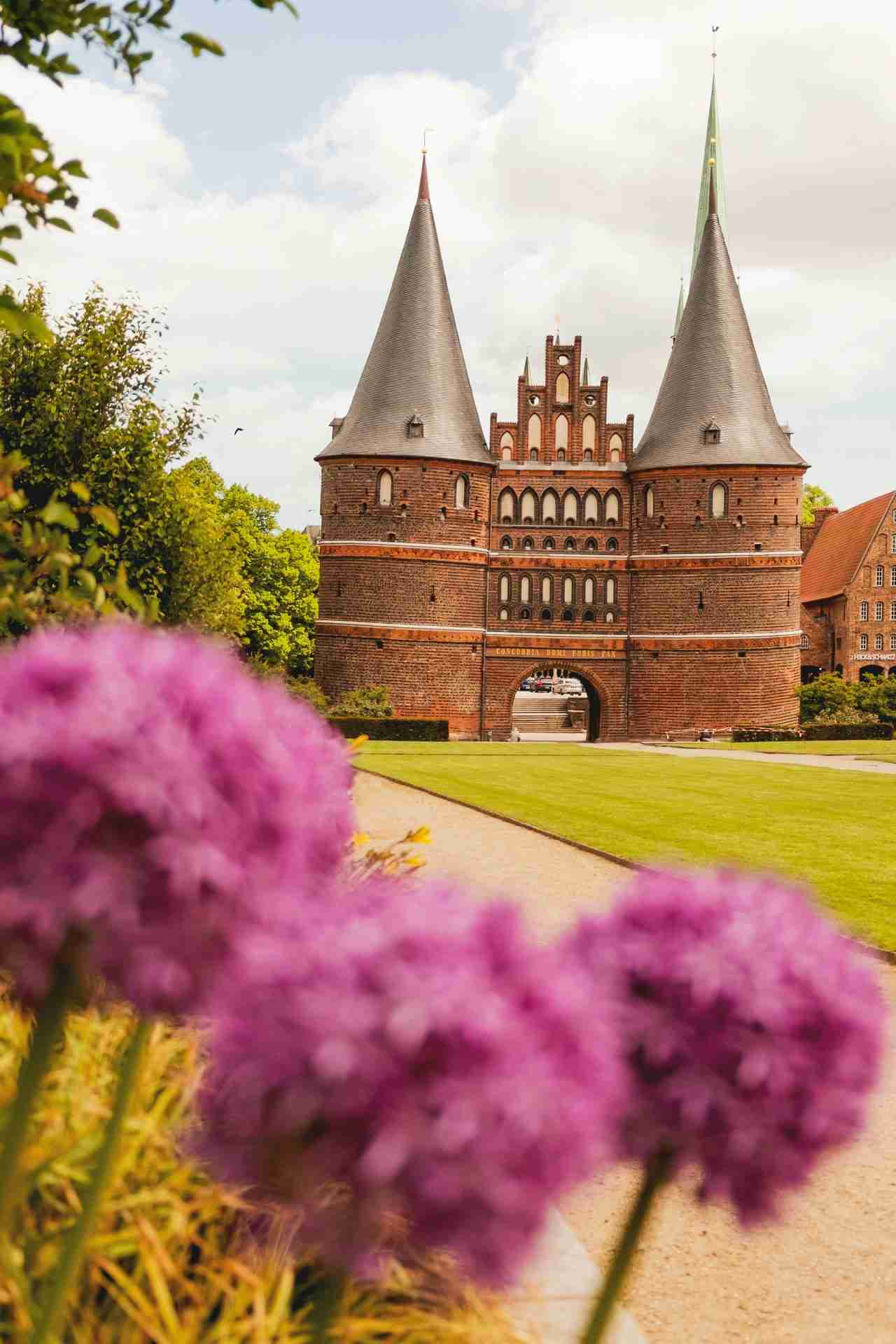
Holstentor stands at the edge of Lübeck's old town as one of the most recognizable medieval gates in Germany. Built in 1464 as part of the city's fortifications, the structure features two large round towers connected by a central arch, all constructed in deep red brick. Its slightly leaning form and thick walls give it a sense of weight and history that is immediately noticeable when you see it in person. In front of the gate, an open green space creates breathing room, allowing the building to stand out without obstruction. The surrounding area blends historic and modern elements, with the old town just beyond the gate and the river nearby adding another layer to the setting. It is a location that feels both like an entry point and a focal point, drawing attention from multiple directions. The space around it is easy to navigate, making it simple to move between viewpoints and experiment with different compositions. Whether you are photographing it up close or from a distance, the structure holds its presence in a very direct way.
Best Photography Opportunities
• Symmetrical Compositions
The front of Holstentor naturally lends itself to centred compositions, with the two towers framing the central arch. By positioning yourself directly in line with the entrance, you can create a balanced image that emphasizes the structure's symmetry. Keeping your camera level helps maintain clean vertical lines and avoid distortion. Including a small amount of foreground space can ground the image and prevent it from feeling too tight. Timing is important, as people often pass through the archway. This is one of the most classic and recognizable ways to photograph the gate.
• Angled Views For Depth And Structure
Moving to either side of the gate allows you to break symmetry and introduce depth into your composition. From these angles, the thickness of the walls and the shape of the towers become more apparent. Including the surrounding buildings or trees can help place the gate within its environment. This approach adds a sense of dimension that is not visible from a straight on perspective. Small changes in position can significantly affect how the structure is layered within the frame. It is a useful way to create more varied images.
• Foreground Framing From The Green Space
The open lawn in front of Holstentor provides space to build compositions with foreground elements. Grass, pathways, or slight elevation changes can be used to lead the viewer's eye toward the structure. Shooting from a lower angle can emphasize the foreground while still keeping the gate as the focal point. This approach works well when you want to create a stronger sense of depth. It also gives you flexibility to adjust your framing without obstruction. The openness of the area makes experimentation easy.
• Detail And Texture In The Brickwork
The red brick construction offers plenty of texture and detail, especially when photographed up close. Focusing on sections of the towers or the arch allows you to highlight patterns, weathering, and subtle variations in the surface. Light direction plays an important role, as it brings out depth in the brick. This approach works well when the wider scene feels busy or when you want to add variety to your images. Isolating smaller sections can create more focused compositions. It is a good way to explore the structure beyond its overall shape.
• Evening Light
As the light fades, Holstentor is illuminated, creating a different atmosphere compared to daytime. The warm lighting enhances the colour of the brick and helps the structure stand out against the darker surroundings. Longer exposures can be used to smooth movement in the scene or capture light trails from nearby streets. Positioning yourself to include both the gate and parts of the surrounding area can create more layered compositions. This is a strong option if you want a different look from the same location. Staying into the evening can add another set of images to your shoot.
Best Time to Visit
Early morning is one of the best times to photograph Holstentor, offering softer light and fewer people around the area. This makes it easier to work with clean compositions and capture the structure without distractions. Late afternoon provides warmer tones that enhance the colour of the brick and add depth to the scene.
Midday light can be harsher, reducing contrast and making the structure feel flatter. Overcast conditions can work well by softening shadows and creating even lighting across the surface. Evening and night photography offer a different perspective, with artificial lighting adding contrast and mood. The location can be photographed year round, though seasonal changes will affect the surrounding greenery.
How to Get There
Museum Holstentor is located in Lübeck at the edge of the old town and is easily accessible on foot from most central areas. The city is well connected by train, making it straightforward to reach from other parts of Germany. Once in Lübeck, the gate is a short walk from the main station and clearly visible as a landmark.
There are no fees required to photograph the exterior, as the surrounding area is public and open. Entry to the museum inside the gate requires a ticket, but this is optional for photography purposes. The open space in front and the surrounding paths make it easy to move between viewpoints. It is a simple and practical location to include in a wider walk through the city.
Recommended Photography Gear
A standard zoom lens in the range of 24 to 70mm works well for capturing both full views of the gate and more focused compositions. A wider lens can help emphasize the structure's scale, especially when shooting from closer positions. A longer lens can be useful for isolating details or compressing elements within the frame.
A tripod is recommended for evening photography, particularly if you plan to use longer exposures. A polarizing filter can help manage reflections and enhance contrast during the day. Because the location is easy to access, you have flexibility with your gear, but keeping it simple will allow you to move quickly between angles.
Nearby Photography Locations
The old town island offers narrow streets, historic buildings, and a strong sense of place. It provides opportunities for both architectural and street photography. The area is compact and easy to explore on foot.
The Salzspeicher warehouses sit along the river with a row of stepped gable buildings that create strong repeating patterns. They work well for both wide and detail oriented compositions. The setting along the water adds reflections and depth.
St. Mary's Church features large brick architecture and an impressive interior space. It offers a different scale compared to Holstentor, with strong vertical lines and open interiors. This adds variety to your photography.
The Trave River runs alongside the old town and provides open views with water reflections. It is a good location for more relaxed compositions and changing light conditions. The path makes it easy to explore different angles.
• Burgtor
Burgtor is another historic gate in Lübeck with a different design and setting. It offers a quieter alternative to Holstentor while still maintaining strong architectural interest. This makes it a useful addition for comparison.
Comments
Loading comments…