
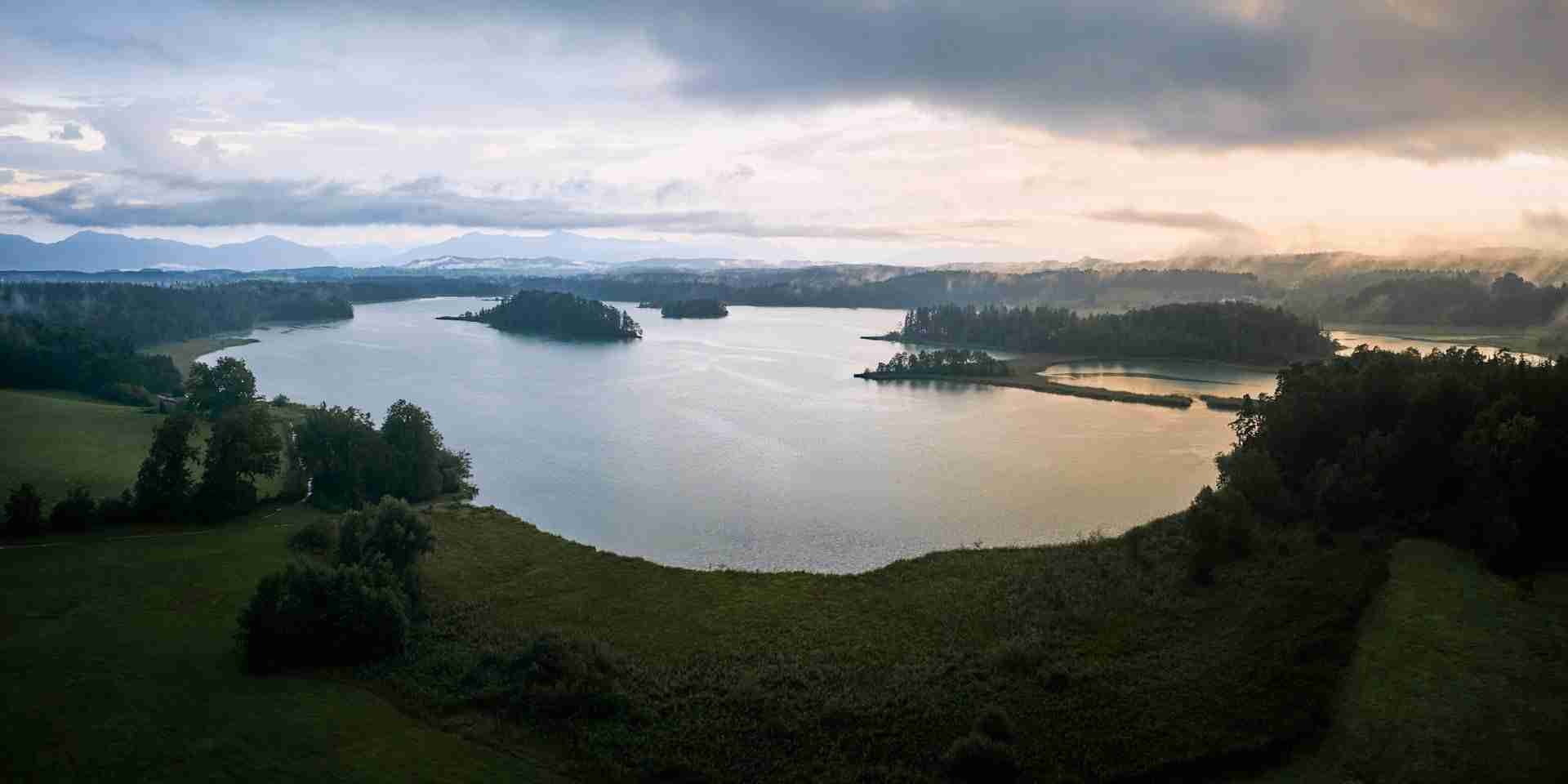
South of Munich and just west of the more famous Lake Starnberg lies Osterseen, a network of over 20 interconnected lakes that unfold across a quiet, glacially carved landscape near the village of Iffeldorf. This lesser-known freshwater labyrinth is a haven for photographers seeking mood, reflection, and fine compositional detail. Framed by reed beds, peat bogs, forested peninsulas, and gently sloping Alpine foothills, the Osterseen ("Eastern Lakes") offer a rare combination of mirror-like water, layered backgrounds, and subtle seasonal color. Misty mornings, delicate light, and unhurried solitude define this location—making it an ideal destination for landscape, nature, and abstract photographers drawn to stillness over spectacle.
Best Photography Opportunities
• Morning Reflections and Mist
: At dawn, the smaller lakes often produce lingering ground fog that hovers just above the water's surface, creating ethereal reflections of reeds, trees, and distant farmhouses. From the Iffeldorf side, multiple footpaths lead to quiet inlets where the shoreline forms a natural frame. Use a wide-angle or mid-range lens (24–70mm) to balance foreground reeds with softly mirrored backgrounds. The best results come in early spring and autumn, when cool air and warm water create stable fog patterns.
• Abstract Reeds and Water Texture
: Many of the Osterseen's edges are lined with dense reed beds that create rhythmic vertical patterns against the still surface of the lake. With a telephoto lens (100–400mm), you can isolate sections of reeds and their reflections into near-abstract compositions. Early or late light emphasizes shape and contrast, while soft overcast days reduce glare and simplify color for black-and-white conversion. Watch for birds threading through the reeds—they can add dynamic punctuation to an otherwise minimalist frame.
• Seasonal Color in Forest Backdrops
: The eastern lakes, such as Fohnsee and Schiffhüttensee, are backed by mixed woodlands that turn golden and crimson in autumn. From elevated paths on the west side, you can shoot across the water and capture full reflections of the forest canopy, especially in windless conditions. A polarizer helps control glare and enhance color saturation, particularly when shooting midday or under patchy cloud cover. These compositions benefit from moderate focal lengths to compress tree lines and flatten mirrored symmetry.
• Frozen Lake Studies in Winter
: When temperatures drop, the smaller lakes freeze in patches, often leaving patterns of open water, thin ice, and snow-dusted surfaces. This creates strong geometric contrasts ideal for minimalist photography. Use a telephoto lens to compress these patterns or a drone to shoot from directly above for high-impact abstracts. Early and late light reflects off the ice at low angles, enhancing surface texture and drawing out subtle blues and silvers.
• Evening Light at Großer Ostersee
: The largest of the Osterseen, Großer Ostersee, stretches toward the Alps and offers broad western views—perfect for photographing the last light of day as it casts long shadows over the hills and onto the lake. This is one of the few vantage points in the region where you can shoot backlit trees silhouetted over open water with the faint profile of the Zugspitze range visible on clear evenings. A tripod and graduated ND filter help manage exposure in scenes with bright skies and shadowed foregrounds.
Best Time to Visit
The Osterseen are at their most photogenic in spring and autumn, when the interplay of mist, color, and soft light is most pronounced. In spring (April to early June), fresh growth, morning fog, and blooming shoreline vegetation create a luminous, painterly quality in the early hours. Wildlife is also most active at this time, with waterfowl and songbirds adding dynamic interest to natural scenes.
Autumn (late September to early November) brings rich foliage across the woodlands surrounding the lakes. Still mornings during this season offer mirror-perfect reflections, while low sun angles provide warm side lighting and long shadows ideal for texture-focused compositions. Autumn also tends to have the clearest air, providing rare opportunities to frame distant Alpine peaks above the lake lines.
Summer (June through August) sees increased recreational use, with bathers, canoes, and hikers frequenting the area—especially on weekends. For photography, early morning remains the best time to avoid disruption and harsh light. The tall reeds and green forest canopy provide excellent color, and early sunrise hours are often surprisingly tranquil.
Winter transforms the Osterseen into a quiet, near-monochrome environment. Snow-draped trees, partially frozen surfaces, and heavy fog lend themselves to minimalist compositions and black-and-white studies. Accessibility can be limited after snowfall, so check trail conditions in advance and dress for cold, damp weather. Despite the chill, the mood in winter is often at its most profound and meditative.
How to Get There
Osterseen is located just outside the village of Iffeldorf in Upper Bavaria, approximately 45 minutes south of Munich by car. From Munich, take the A95 autobahn toward Garmisch-Partenkirchen, exiting at Seeshaupt/Iffeldorf. From the exit, it's a short 5-minute drive into Iffeldorf, where free and paid parking options are available near the nature reserve entrances and trailheads.
If traveling by train, the Iffeldorf station is on the Munich–Kochel rail line and is only a 10-minute walk from the lake trails. Local signage leads clearly from the station to various access points, with the main trailhead located just beyond the Kirche St. Vitus (Iffeldorf's parish church).
There is no entrance fee to visit the Osterseen, as the area is part of a protected nature reserve open year-round to the public. However, visitors are asked to remain on marked paths, avoid disturbing wildlife, and refrain from swimming outside designated areas. Dogs must be leashed, and drone use may be restricted or discouraged in wildlife-sensitive zones—check with local authorities or posted signs before launching.
Facilities are minimal: there are toilets and picnic areas near the parking lots, but no food vendors on-site. Plan to bring water and snacks, especially for early morning or extended visits. Starnberg and Seeshaupt are nearby towns with lodging, cafes, and shops for resupply or post-shoot rest.
Recommended Gear and Shooting Tips
Given the diversity of subjects—from sweeping reflections to intricate natural detail—the Osterseen reward a versatile kit. A wide-angle lens (16–35mm) is ideal for lakeside scenes and reflection-heavy compositions, especially when including foreground reeds or driftwood. A standard zoom (24–105mm) covers most midrange work and is especially useful for layering backgrounds and working with shifting weather.
Telephoto lenses (100–400mm) allow for pattern isolation, distant detail, and wildlife without intrusion. A macro lens or close-focusing prime is helpful for frost textures, water surface patterns, or shoreline flora. A drone offers excellent opportunities for geometric and abstract compositions, particularly in winter or from above narrow channels—but check restrictions before flying.
A lightweight but stable tripod is a must, especially for dawn and dusk work. Bring ND filters (3- and 6-stop) for smoothing lake surfaces and creating atmosphere under changing sky conditions. A circular polarizer helps control water glare and enhances leaf and sky color, though it should be used carefully when shooting across wide reflective surfaces.
Waterproof footwear is recommended—shorelines are often marshy, particularly in spring. Gloves and a microfiber cloth help in cold or misty conditions, as fog and dew can accumulate on lens elements quickly. Always carry a small towel or mat for kneeling at the water's edge.
Scout the area by foot to find compositions away from the main paths—many of the best angles require a few minutes of quiet exploration along the narrower trails or clearings between lakes. The mood here is contemplative, and your photography should follow suit. Be patient, let the light settle, and the lakes will give you images that feel more like memories than documentation.
Nearby Photography Locations
• Lake Starnberg (Starnberger See)
: Just a few kilometers north, Lake Starnberg offers a broader vista with grander reflections, boathouses, and views of the Zugspitze on clear days. The north shore near Tutzing and the wooden piers at Ambach provide iconic lakefront compositions, especially at sunrise and sunset.
: South of Osterseen, Riegsee is a small lake backed by distant Alpine silhouettes, ideal for telephoto work and quiet morning reflections. Nearby Murnauer Moos—the largest contiguous wetland in Central Europe—provides open sky, winding paths, and vast, moody peatland scenes that change character with the light.
: A hidden gem near Murnau, this small lake is perfect for tranquil dawn scenes and minimalist compositions. It's often overlooked, but the reed beds and mirror-flat water create conditions ideal for atmospheric and contemplative photography.
• Staffelsee and the Village of Seehausen
: West of Murnau, Staffelsee offers boat houses, tiny islands, and historic Seehausen village along its shore. The blend of cultural and natural elements makes it a well-rounded destination for landscape and travel photographers alike.
• Karwendel Mountains and Lake Walchensee
: Farther south, the Karwendel range and Walchensee provide a dramatic shift in tone—crystal-clear mountain water, towering ridges, and richly colored alpine scenes. It's the perfect counterpoint to the stillness of the Osterseen and a worthy addition to any multi-day itinerary.
Osterseen is a place that doesn't need grandeur to impress. Its beauty is quiet, layered, and enduring—an invitation to slow down, walk the shoreline, and notice how the world reflects when the water is still. For photographers who value nuance, mood, and subtle color, it offers not just images, but moments of real presence.
Comments
Loading comments…