
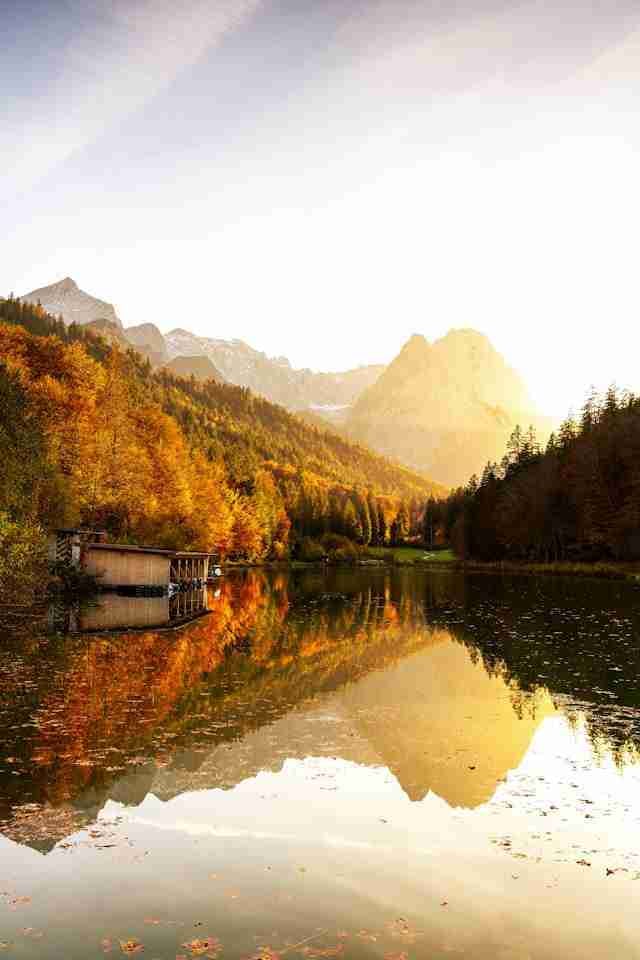
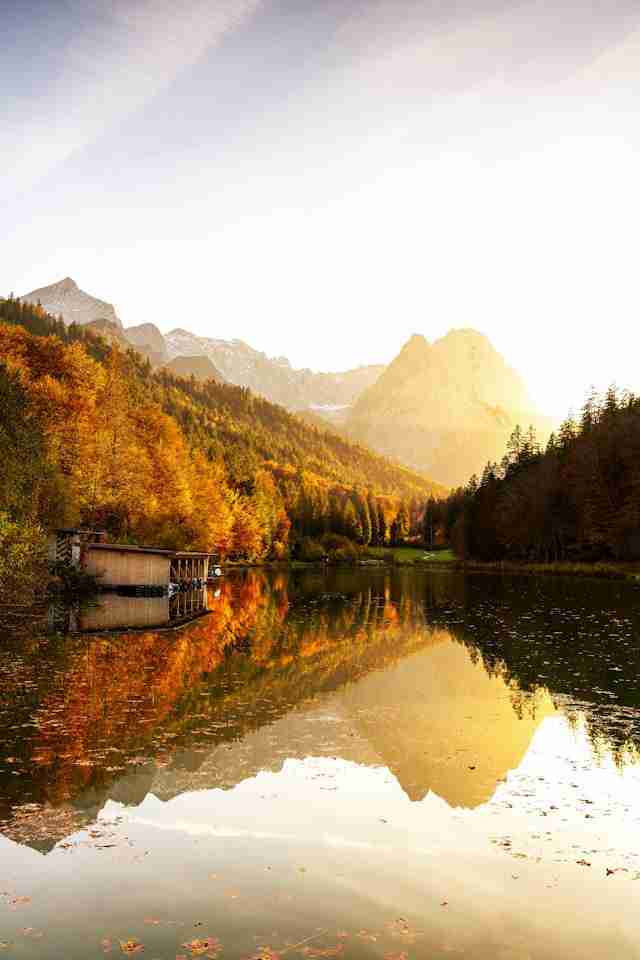
Nestled just south of Garmisch-Partenkirchen in the Bavarian Alps, Rießersee is a small mountain lake surrounded by forested slopes and open views toward Germany's highest peak, the Zugspitze. With calm, mirror-like water and a peaceful setting that rarely draws crowds at sunrise, the lake offers one of the most quietly photogenic spots in the region. While it lacks the dramatic scale of larger alpine lakes, Rießersee's charm lies in its balance: wooded hills, glassy reflections, rustic boathouses, and a distant skyline of jagged peaks all framed within a short walk. The scene is particularly suited to photographers who work with natural light and symmetry, and who appreciate subtle compositions where mood and clarity take precedence over scale. In the early hours, when mist clings to the tree line and the first light brushes the Zugspitze, Rießersee rewards stillness and simplicity.
Best Photography Opportunities
• Sunrise reflections of the Zugspitze
are the primary draw at Rießersee. On windless mornings, the lake surface becomes an ideal mirror, capturing the outline of the mountains and the slow spread of morning color across the sky. Positioning at the northeast edge of the lake gives you a clean angle toward the Zugspitzmassiv, with enough open water to fill the foreground. Using a tripod and remote release allows you to bracket exposures as the light changes quickly in the first fifteen minutes after sunrise. The best shots often come before the sun breaks the ridge, when the sky glows softly and the mountain remains in silhouette.
• Misty mornings along the forested shoreline
provide a moody, textural subject that works well with longer lenses and black-and-white processing. The lake is often cooler than the surrounding air, especially in spring and autumn, which creates low fog that lingers between the trees. Shooting across the water with a 70 to 200 millimeter lens lets you isolate sections of pine or catch the fading light as it filters through the mist. These conditions rarely last long, so arriving before dawn and scouting the shoreline is essential.
• Boathouses and dock reflections
on the west side of the lake offer strong horizontal lines and architectural details that work well in still conditions. These wooden structures are positioned close to the waterline and catch side light beautifully in the early morning. Reflections here are especially clean in the first hour after sunrise. Compositions can be made tight, focusing on texture and symmetry, or wide enough to include the tree-covered hill that rises behind them. This area also works well in overcast conditions, where the contrast between wood and water softens without losing definition.
• Winter snow and ice compositions
turn the lake into a nearly monochrome setting, with the mountains and pines adding layered contrast. When the lake freezes, reflections disappear, but new compositions become possible with footprints, snow-covered logs, or frozen surface textures. The Zugspitze often holds snow through spring, and in late winter, golden hour light hits the peak with clear air and little haze. Use a wide lens to place the lake in the foreground and work with the sky to keep balance in exposure.
• Twilight and blue hour shooting
work particularly well from the southern tip of the lake, where the elevation allows for a slightly raised perspective over the water. As the light fades, the tree line turns to silhouette while the sky reflects in deeper blue and purple tones. Long exposures from this angle can smooth the lake entirely, leaving only shape and color to define the composition. A strong tripod and patience are key here, as light levels drop quickly and small adjustments to framing can make a large impact on balance.
Best Time to Visit
Rießersee is most photogenic in the early morning during spring and autumn. These seasons bring the clearest air and most frequent fog or mist along the lake surface. Sunrise light is soft and directional, creating separation between the tree-covered hills and the snow-dusted Zugspitze in the distance. The angle of the sun in these seasons also reflects directly across the water, producing vibrant color transitions between water, sky, and mountain.
Summer offers longer shooting windows and access to trails surrounding the lake, but also introduces more visitors during mid-morning and afternoon. To avoid interference in the water from swimmers or paddleboats, it is best to arrive just before dawn. Evening shooting is possible in summer, though the light falls behind the ridge sooner than expected and deep shadows set in quickly after golden hour.
Winter creates a stark and minimal environment with fewer compositional options but very clean lines. Sunrise remains the best time to work here, especially after fresh snowfall. Temperatures often drop well below freezing, so battery performance and gear protection become part of the planning. Late winter can bring mirrored skies and frost on the shoreline, making it a good time for low-angle ground shots with soft ambient light.
How to Get There
Rießersee is located just three kilometers from the center of Garmisch-Partenkirchen and is easily accessible by car, bike, or foot. From the town center, follow Rießersee Straße south until it transitions into a narrower mountain road. There is a small public parking area near the hotel on the lake's western side, which offers immediate access to the water's edge. Parking is typically free in the early hours but may require a fee later in the day.
For those without a vehicle, a footpath from the Partenkirchen district leads uphill to the lake in about twenty minutes. The route is well maintained and suitable for carrying photography gear. In winter, the road and paths are regularly cleared, though snow and ice may still make certain trails slippery.
There are no access restrictions to the lake itself, and tripods are permitted anywhere along the shore. Boathouse areas and small piers are public and provide stable ground for setting up shots. Early visits are advised to avoid foot traffic or water movement, especially if long exposures are planned. Drone use is permitted with adherence to local aviation rules and altitude restrictions, though nearby hotels and forested slopes may limit launch sites.
Recommended Photography Gear
For the best results at Rießersee, bring a combination of wide and telephoto lenses. A 16 to 35 millimeter wide-angle lens is essential for capturing full reflections and working with foreground elements at the lake's edge. A 24 to 70 millimeter zoom helps bridge scenes between the shoreline and distant peaks, especially when the light changes rapidly. A 70 to 200 millimeter lens is valuable for picking out details in the trees, mountain ridges, and fog banks across the water.
A sturdy tripod is critical for low-light work before and after sunrise, and for composing precise reflections or long exposures. Filters are useful in this setting, especially a circular polarizer to manage glare on the lake's surface and a three-stop ND filter for slowing down shutter speed without losing color depth.
Nearby Photography Locations
lies just south of town and offers one of the most dramatic natural scenes in the Bavarian Alps. The narrow stone gorge and fast-flowing water are best photographed in diffused light or early morning before it fills with visitors. Long exposures here can produce rich texture and movement between the vertical walls.
• Eibsee
, located beneath the Zugspitze, is a much larger lake with emerald-colored water and panoramic mountain views. It offers multiple angles, small islands, and crystal-clear conditions that work especially well for drone photography and wide panoramic landscapes.
, accessible via cable car or footpath, provides high-elevation views over Garmisch-Partenkirchen, Rießersee, and the surrounding valleys. Sunset and twilight are particularly strong from this location, with long-range visibility and layered light on the peaks.
, known as the AlpspiX, extends over a dramatic drop and offers unmatched views of the Wetterstein mountains. This is a more technical shooting location but rewards careful framing and low-light work at altitude. It is best visited early or late for dramatic skies.
• Historic Partenkirchen Village
presents quieter street scenes with traditional architecture, painted façades, and narrow pedestrian alleys. It is especially good for soft overcast days or blue hour photography, offering contrast to the natural landscapes around the area.
Rießersee may not make loud claims, but for those who wait quietly in the early light or watch the fog lift over mirrored water, it offers a perfectly balanced frame of alpine stillness and subtle reflection. It is a location that rewards photographers who pay attention to calm and clarity over spectacle.
Comments
Loading comments…