

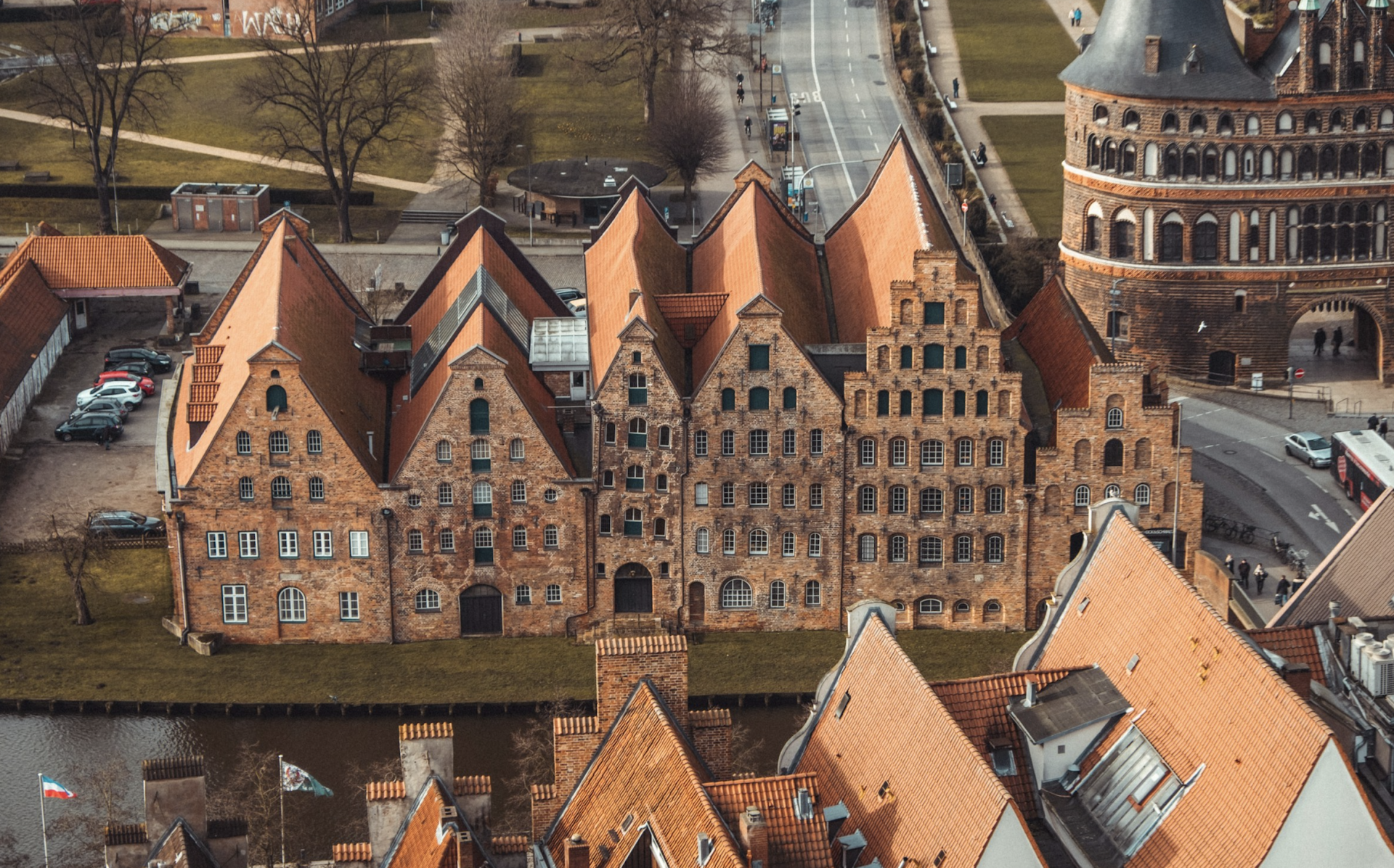
The Salzspeicher Lübeck is a row of historic salt storage warehouses lining the Trave River, built between the 16th and 18th centuries when the city was a major trading hub. These buildings were once used to store salt, one of the most valuable goods of the time, and their solid construction reflects that purpose. Today, they stand as a continuous line of brick structures with distinctive stepped gables that are just begging to be photographed. Set along the river's edge, the warehouses are easy to view from multiple angles, whether you are standing nearby or across the water. The spacing and repetition of the buildings create a sense of rhythm that immediately stands out, while the surrounding area remains open enough to keep compositions clean. It is a location that feels structured and consistent, making it easy to focus on alignment, balance, and subtle variations in perspective as you move around.
Best Photography Opportunities
• Shooting From Across The River
One of the strongest ways to photograph the Salzspeicher is from the opposite bank of the Trave River. This position allows you to capture the entire row of warehouses in a single frame, emphasizing their repeating forms and uniform design. Shooting from a slight angle can add depth, preventing the buildings from appearing too flat. Including the water in the foreground helps anchor the composition and adds another visual layer. Adjusting your position along the riverbank changes how the buildings overlap and interact. This is the most complete way to present the location.
• Reflections And Symmetry In The Trave River
When the water is calm, the warehouses reflect clearly on the surface of the river, creating opportunities for balanced compositions. Positioning yourself lower and closer to the water can strengthen this effect and bring more of the reflection into the frame. Even when the surface is slightly disturbed, it can still add texture and contrast. Light direction plays a key role in how visible the reflections are. Early morning or late evening often provides the best conditions. This approach adds depth without complicating the scene.
• Stepped Gables And Repeating Patterns
The stepped gables are one of the defining architectural features of the Salzspeicher. By focusing on the upper sections of the buildings, you can create compositions that highlight repetition and shape. Cropping tighter allows you to remove distractions and concentrate on the rhythm of the design. Slight changes in angle can alter how the gables align within the frame. This works well for more graphic, pattern based images. It is a simple way to emphasize the character of the buildings.
• Close Up Brick Texture And Details
Moving closer to the warehouses allows you to explore the texture and detail in the brickwork. Variations in colour, aging, and construction techniques become more visible at this range. Light helps define these textures, so positioning yourself where shadows fall across the surface can improve depth. Isolating smaller sections can create more focused compositions. This approach adds variety beyond wider shots. It is especially useful when the area is busier.
• Evening Light And Waterfront Atmosphere
As the light fades, the scene along the river becomes more atmospheric. The buildings take on deeper tones, and lights from the surrounding area begin to reflect on the water. Longer exposures can smooth the river surface and create a calmer foreground. Positioning yourself to include both the warehouses and their reflections can produce more layered images. This is a good time to experiment with different exposures. The transition into evening offers a different perspective on the same location.
Best Time to Visit
Early morning is one of the best times to photograph the Salzspeicher, offering softer light and calmer water for reflections. It is also quieter, making it easier to find clean compositions without interruption. Late afternoon and early evening provide warmer tones that bring out the colour of the brick and add depth to the scene.
Midday light can be harsher, flattening some of the detail and reducing contrast. Overcast conditions can work well by softening the light and creating more even tones across the buildings. The location works year round, though seasonal changes may affect the surrounding environment and light conditions. Planning around light and weather will improve your results.
How to Get There
The Salzspeicher are located along the Trave River in Lübeck, close to the edge of the old town. They are easily accessible on foot and can be reached within minutes from major landmarks like Holstentor. The riverbanks on both sides provide clear access to multiple viewpoints.
There are no fees required to photograph the buildings from the outside, as the surrounding areas are public. The layout is straightforward, making it easy to move between positions along the river. Its central location makes it a convenient stop as part of a wider exploration of Lübeck. You can combine it with nearby locations without needing additional travel.
Recommended Photography Gear
A standard zoom lens in the range of 24 to 70mm works well for capturing both wide views of the full row and tighter architectural details. A wider lens can help include more of the scene when shooting from closer positions. A longer lens can be useful for isolating patterns or compressing the buildings into a more abstract composition.
A tripod is recommended for evening photography and longer exposures, especially if you want to smooth the water. A polarizing filter can help manage reflections and enhance contrast during the day. Because the location is easy to access, you can work comfortably with a flexible setup.
Nearby Photography Locations
Holstentor is one of Lübeck's most recognizable landmarks, with its twin towers and central arch. It offers strong symmetrical compositions and detailed brickwork. The open space around it makes it easy to photograph from multiple angles.
The old town island features narrow streets, historic buildings, and a wide range of architectural details. It is ideal for both street and architectural photography. The compact layout makes it easy to explore on foot.
St. Mary's Church provides a different scale with its large brick structure and expansive interior. It offers opportunities for both exterior and interior photography. The vertical lines contrast with the horizontal layout of the warehouses.
The river walk offers extended views along the water with changing perspectives of the city. It is a good place for wider compositions and reflections. The path makes it easy to move between different viewpoints.
• Burgtor
Burgtor is another historic gate in Lübeck, offering a quieter setting compared to Holstentor. It provides a different architectural style and composition. This adds variety to your photography in the city.
Comments
Loading comments…