
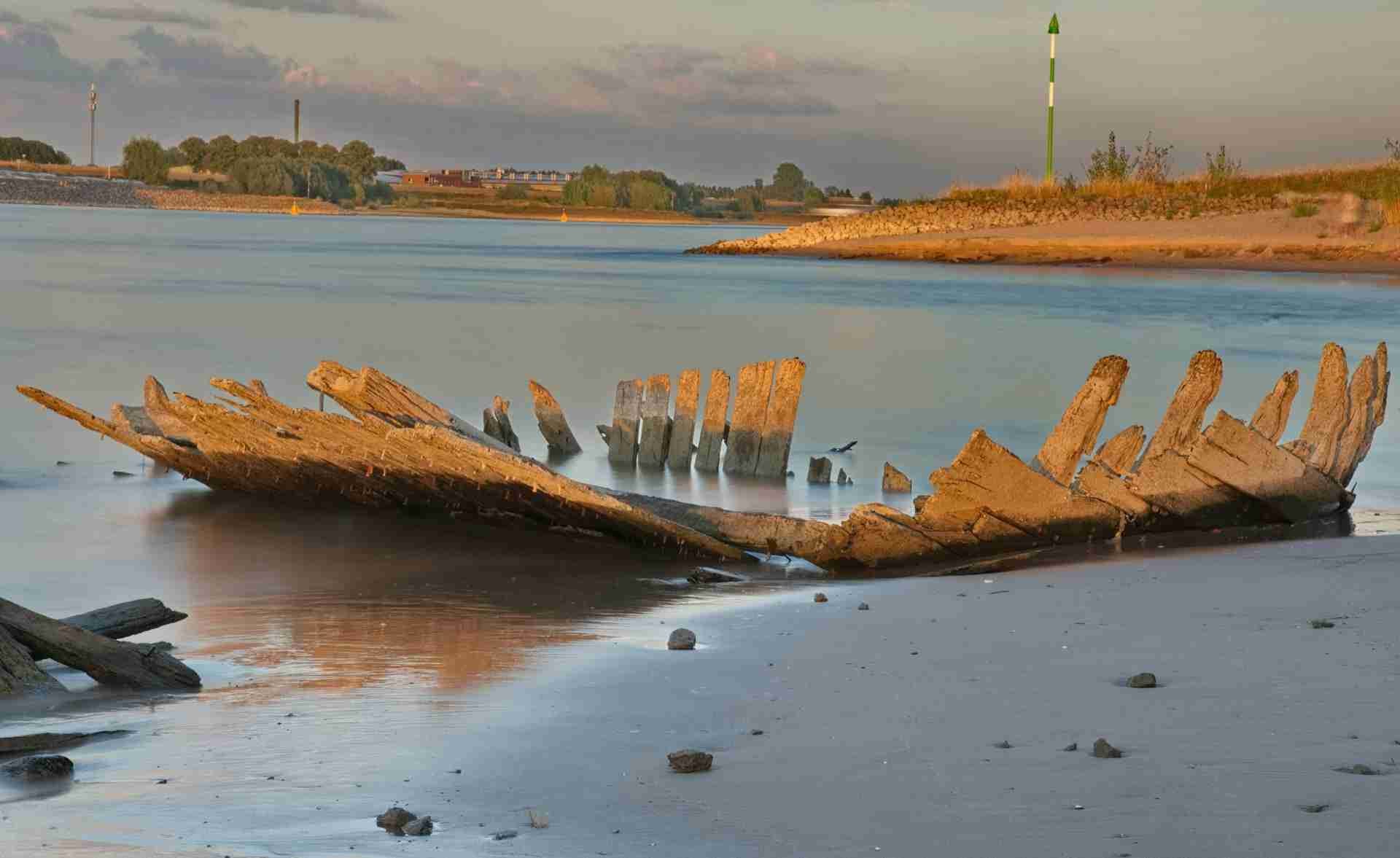
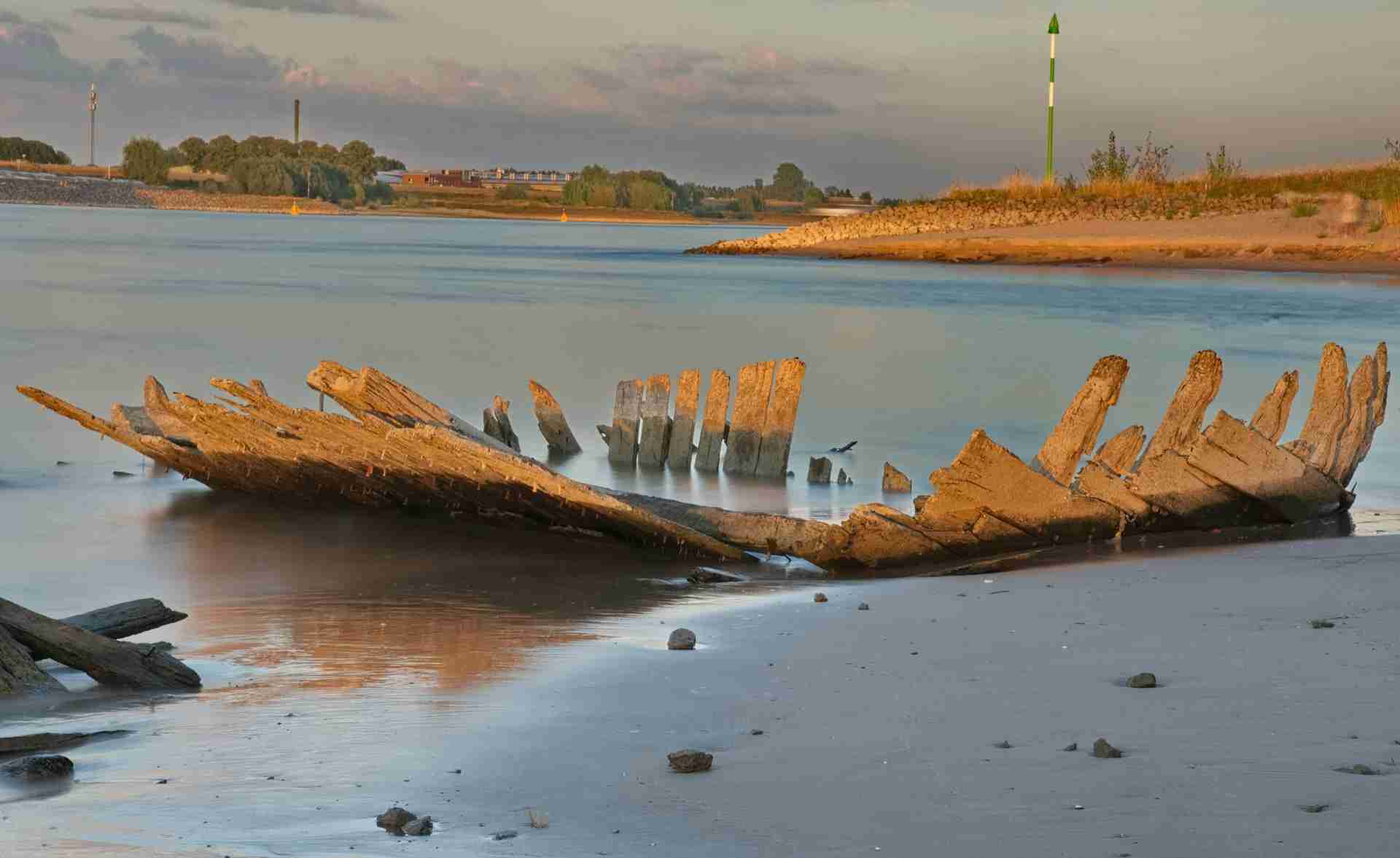
Along a quiet stretch of the Rhine River near the Dutch-German border, the Schiffswrack De Hoop surfaces only when the water retreats. Located just north of Kleve in North Rhine-Westphalia, this wooden shipwreck is rarely seen but well worth the effort for photographers willing to track river conditions and wait for the right moment. Likely dating from the early 20th century, the remains of De Hoop sit embedded in the riverbed, slowly revealed by the ebbing current. As the hull reemerges, it becomes more than a relic; it becomes a subject rich in texture, time, and contrast. Its worn timbers and skeletal form rise against the flow of the Rhine, offering a fleeting but powerful opportunity for documentary, landscape, and detail-focused photography.
Best Photography Opportunities
• Exposed Hull and Weathered Texture
: When water levels drop enough to reveal the full curve of the hull, the shipwreck becomes an intricate surface study of age, decay, and construction. The wood, smoothed and worn from decades of river abrasion, displays complex grain, rivets, and joints that reward close inspection. A macro or short telephoto lens allows you to isolate these patterns while controlling depth of field to direct attention. Side lighting, especially in the early morning or late afternoon, emphasizes every ridge and groove and turns structural decay into visual storytelling. Black and white conversions work well here, particularly in overcast conditions, to highlight texture without the distraction of color.
• Wreck in Context with River and Floodplain
: Wider compositions that place De Hoop within the surrounding river landscape offer opportunities for storytelling and contrast. During low water, the exposed riverbed often features cracked mud, stones, and dried vegetation that form natural foreground layers. Framing the wreck with the flowing Rhine in the background or including elements like driftwood, reeds, or waterfowl can build a sense of place and season. A wide-angle lens used with a low shooting position helps establish scale and draws attention to the relationship between the wreck and its environment. Morning fog or diffused light adds further depth and separation between subject and background.
• Aerial Views and River Geometry
: If drone use is permitted in the area, aerial photography can dramatically enhance your understanding of the wreck's layout and its placement within the curving channel of the Rhine. From above, the contrast between natural water movement and the rigid geometry of the sunken hull becomes more apparent. This perspective is especially effective in midday light when the wreck casts a defined shadow and color separation between water and sediment is strongest. Shooting at higher altitudes reveals the nearby dikes, agricultural fields, and meandering trails that mark the river's presence in the landscape. Always check local regulations before flying and remain aware of protected zones and airspace rules.
• Silhouette and Long Exposure Work
: At sunrise or sunset, the skeletal frame of De Hoop creates an excellent silhouette against the brightening or darkening sky. Placing the wreck along the horizon with the reflective surface of the river catching the last light produces striking minimalist compositions. A tripod and neutral density filters allow for long exposures that smooth the water and emphasize the stillness of the wreck in contrast with the surrounding movement. These images balance simplicity with narrative and suggest both time passed and time standing still. When clouds or mist are present, they add another layer of softness that enhances the mood without overwhelming the subject.
• Seasonal Shifts and River Conditions
: Because De Hoop only appears during low water events, each visit may reveal something new or nothing at all. After dry summers or extended drought, the wreck may be almost fully exposed for days or even weeks. In wetter years it can remain hidden beneath the water for entire seasons. Returning under different seasonal conditions, such as early autumn fog or spring thaw, adds depth to a visual record of the Rhine's shifting behavior. For photographers interested in building a series or capturing change over time, this subject is particularly well suited to slow, observational work.
Best Time to Visit
The most important factor in photographing De Hoop is not the season but the water level of the Rhine. The wreck only becomes visible when water levels drop significantly, most often during late summer and early autumn when dry conditions are more common. Monitoring the Rhine's real-time gauge readings near Kleve is essential and will provide the most accurate information for planning. Once exposed, the best times of day to shoot are early morning and late afternoon, when the light falls at an angle and enhances both texture and contrast.
Morning shoots often include low mist or soft light that helps separate the wreck from the background and adds mood to wide compositions. Evening light warms the tones of the riverbank and the wood, and offers a chance to work with silhouettes if conditions are clear. Overcast skies are excellent for texture studies and close-up work, as they minimize glare and flatten the contrast. If your goal is long exposure or reflection-based photography, visiting during windless conditions is equally important to ensure surface clarity around the wreck.
How to Get There
The Schiffswrack De Hoop is located just north of Kleve in the state of North Rhine-Westphalia, along the eastern side of the Rhine River near the village of Schenkenschanz. Access is available on foot via riverside paths and dike roads from either Düffelward or Schenkenschanz. From the town of Kleve, a short drive or bicycle ride leads to public parking areas near the dike system. From there, walking paths take you toward the riverbank where the wreck becomes visible during low water.
The site is unmarked and natural. There are no constructed viewing platforms or visitor services in the area. Terrain can be soft or muddy depending on recent rainfall and river movement. Sturdy waterproof footwear is highly recommended, as well as clothing that can withstand wet or windy conditions. There are no entry fees, permits, or restrictions for photography on the public riverbank, but visitors should remain respectful of the environment and any posted signs related to protected areas or private property. Always check the weather and water level forecasts before making the trip, as access changes quickly.
Recommended Photography Gear
Capturing De Hoop effectively requires a thoughtful selection of gear suited to both landscape and close-up photography in rugged outdoor conditions. A wide-angle lens in the range of 16 to 35 millimeters is ideal for showing the wreck in its full context and working with leading lines in the foreground, especially on cracked mud or patterned sand. A mid-range zoom like a 24 to 70 millimeter lens offers flexibility for shooting both detail and environment without the need to switch lenses frequently in damp or dusty conditions. A telephoto lens between 85 and 200 millimeters is helpful for isolating elements of the wreck from a distance or compressing space with the surrounding river and dikes.
A tripod is necessary for long exposures at twilight or in low light. Look for one with good leg spread and stability for setting up on soft or uneven surfaces near the river. A set of neutral density filters is important if you plan to blur water or clouds during longer shutter speeds. A polarizing filter will reduce glare off the wood and help manage reflections in wet surfaces or shallow pools. A shutter release cable or wireless remote will ensure minimal vibration during longer exposures.
Because the site is fully exposed to the elements, your gear should be protected from moisture and dust. Use a weatherproof camera bag or dry bag insert to carry your equipment and pack lens cloths and sensor-safe brushes for regular cleaning. Waterproof hiking boots, a breathable outer shell, and layers suited to shifting temperatures will make your shoot more comfortable. If you plan to use a drone, bring extra batteries and confirm you are operating within local regulations, especially since this location is near an international border and wildlife reserves.
Nearby Photography Locations
• Reichswald Forest and War Cemetery
: Southeast of Kleve, this expansive forest offers filtered woodland light, quiet trails, and a contemplative atmosphere that is well suited to slower, mood-driven work. The nearby war cemetery adds a layer of historical context and visual solemnity, especially under fog or morning frost.
: Just across the border in the Netherlands, this rewilded river landscape features wild grazing animals, seasonal grasses, and a dynamic floodplain that shifts with the water. Ideal for sunrise work or long-lens wildlife photography, it provides a complementary contrast to the industrial calm of the Rhine near De Hoop.
: For architectural and urban texture, the historic town of Kleve offers narrow streets, layered rooftops, and elevated views from the castle tower. The best time to shoot is late afternoon or early evening, when golden light warms the old buildings and frames the distant landscape.
• Keeken and the Rhine Polders
: This rural area along the river features long irrigation canals, fields, and windbreaks that work well for minimalist and graphic compositions. It is especially photogenic in low winter light or under heavy skies that flatten the land into soft gradients.
• Spy Tower at the Spoykanal
: For a more modern perspective, this viewing platform above the canal system provides long sightlines over the port infrastructure and water routes leading back toward the Rhine. Ideal for compressed compositions with strong vertical and horizontal lines, it is best shot during golden hour or just after sundown.
Photographing De Hoop is an exercise in patience and timing. Its appearance is never guaranteed, and its beauty lies not only in the wreck itself but in the river's decision to show or hide it. For those who pay attention to light, water, and weather, this forgotten hull offers a rare and powerful subject that connects history with landscape in quiet but lasting ways.
Comments
Loading comments…