
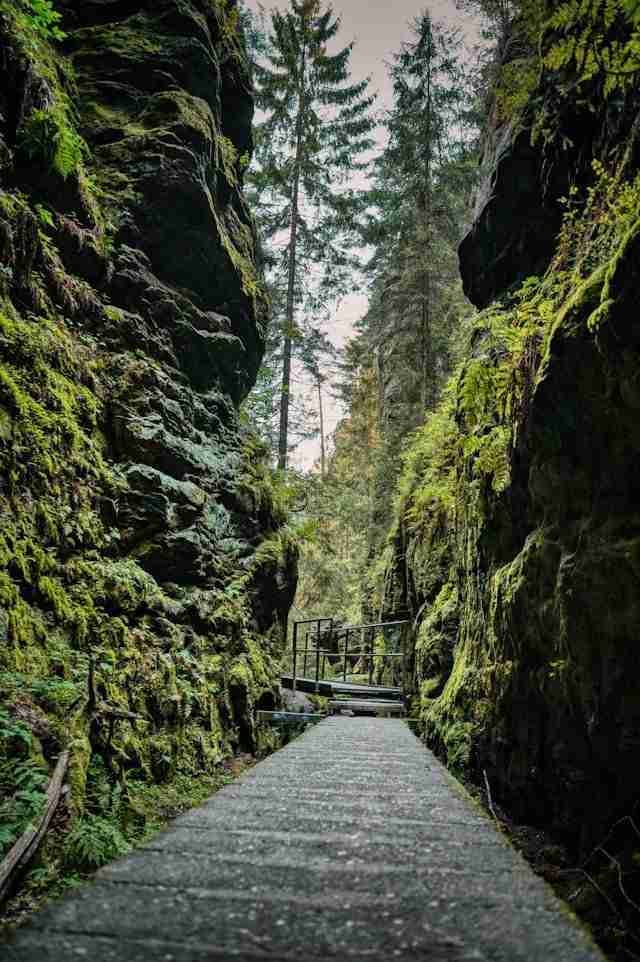
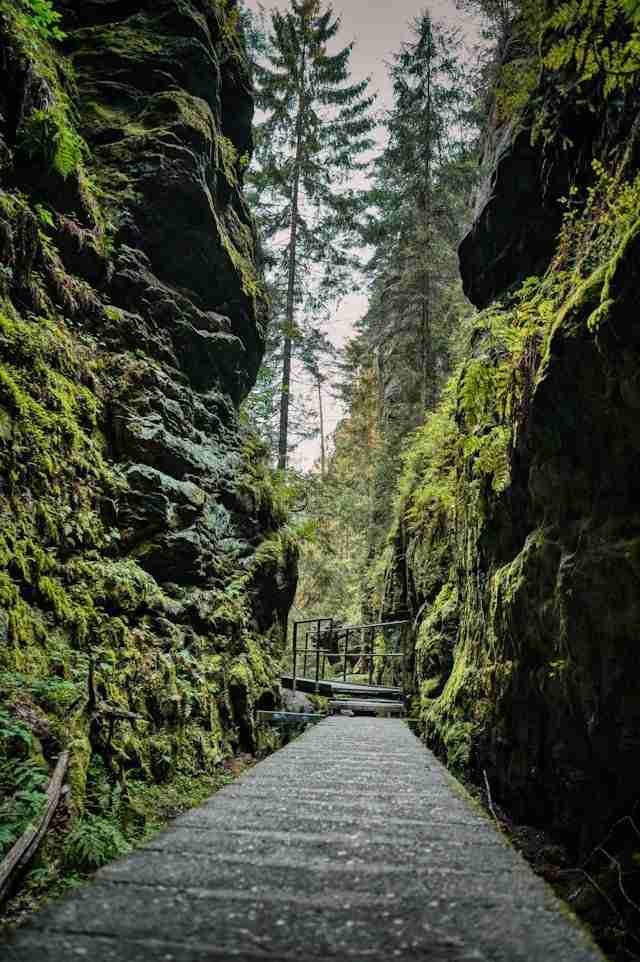
Deep within the forested sandstone cliffs of Saxon Switzerland National Park lies the narrow gorge known as Schwedenlöcher. Carved over millennia by water and weather, this ravine winds between towering stone walls, draped in moss and filtered light, and connected by more than 700 steep, twisting steps. It's one of the most visually striking hiking routes in the Elbe Sandstone Mountains—dense with texture, shadow, and vertical drama.
Located near the Bastei Bridge and accessible from the town of Lohmen or the Elbe valley, Schwedenlöcher offers a rich variety of compositional elements. Sheer rock faces, dripping ledges, tangled roots, mist-filled hollows, and green-drenched canyon walls make this a dream environment for photographers seeking moody woodland scenes or quiet geological grandeur. The narrowness of the gorge and the complexity of its forms reward patience, slow shooting, and an eye for subtle, layered compositions.
Best Photography Opportunities
• Stairways Carved into Stone
The winding staircases that traverse Schwedenlöcher are not just functional—they're highly photogenic elements in their own right. Shoot from below to emphasize the vertical climb, using the steps to lead the viewer's eye into the frame. Early morning or late afternoon light filtering through the gorge's narrow openings creates soft highlights on the stone surfaces, while long exposures can blur hikers for a ghost-like sense of motion.
• Narrow Passages and Vertical Walls
The canyon's most dramatic sections feature towering, near-vertical sandstone walls, often so close they block the sky entirely. These narrow corridors work best in diffused light—on overcast or foggy days—when the textures of the stone are revealed without harsh contrast. Use a wide-angle lens to exaggerate perspective and emphasize height, especially when shooting from the gorge floor.
• Moss and Root Textures
The damp, shaded environment encourages thick layers of moss, lichens, and twisted tree roots that grip the rock faces and trail edges. These details make excellent foregrounds or standalone compositions. Shoot low to the ground or alongside the canyon walls to isolate these natural textures, especially in soft light or after rain when surfaces appear more saturated and reflective.
• Framing with Overhangs and Arches
Several natural rock formations in the gorge form overhead ledges or semi-enclosed openings. These make excellent framing elements for environmental portraits, hiker silhouettes, or moody landscape frames. Position the camera to shoot through these gaps toward a distant patch of forest or sky, using the contrast between dark stone and bright light to create visual tension.
• Seasonal and Atmospheric Variations
Schwedenlöcher changes character with the seasons. In autumn, golden and red foliage contrast dramatically with the gray sandstone. In spring, new growth softens the rocky terrain. Winter brings icicles and frost to the rock faces, adding sharp texture and a sense of silence. Fog and light rain amplify the gorge's atmospheric qualities, muting sound and light while emphasizing depth and mood.
Best Time to Visit
Photographically, Schwedenlöcher is most rewarding in the early morning or during overcast days. Morning light filters gently into the gorge and illuminates its mossy walls with a subtle glow, while mist often hangs in the lower sections after cool nights, creating ethereal scenes. Because of the narrowness of the canyon, direct sunlight can create harsh, high-contrast lighting that is difficult to control, so softer light is generally preferred.
Autumn is one of the most visually striking times to visit. The contrast between the golden foliage and dark stone creates vivid, dramatic compositions. Spring brings fresh greenery and active waterfalls along the trail edges, especially after snowmelt. Winter is quieter and more stark—perfect for monochrome or abstract texture-focused photography, especially if there's snow or frost on the steps and ledges.
Avoid midday in summer when the trail can become crowded, and harsh light filters unpredictably through the gaps in the cliffs. Shoulder season weekdays are ideal for solitude, soft light, and slower shooting without interruption.
How to Get There
Schwedenlöcher is located in Saxon Switzerland National Park, in the Elbe Sandstone Mountains near the town of Lohmen. The most common access point is from the Bastei Bridge area. From the Bastei parking lot, it's about a 20-minute walk to the top entrance of the gorge trail. The descent begins just past the bridge area and winds down into the forest via the marked trail.
You can also approach Schwedenlöcher from below by starting in the village of Rathen, accessible by train and ferry from Dresden. From Rathen, follow the marked trail signs through the forest and uphill into the gorge. This approach provides the benefit of climbing the stairs and seeing the rock walls gradually rise around you.
The trail is well-maintained but involves over 700 steps and can be slippery after rain. Good hiking boots and a daypack with waterproof gear protection are essential. The trail is open year-round but may be closed temporarily after heavy storms or ice—check local conditions before your visit.
Recommended Gear and Shooting Tips
A wide-angle lens (16–35mm) is essential for working in the confined spaces of the gorge and capturing vertical compositions of the stone walls and staircases. A 24–70mm lens is useful for mid-range framing or detail work involving textures, tree trunks, and forest elements. A macro lens or telephoto in the 70–200mm range can isolate rock patterns, ferns, or passing wildlife like birds and squirrels that frequent the shaded canopy.
A tripod is helpful, particularly in the low light of the gorge floor, where slow shutter speeds may be required even during daylight hours. Consider a 3–6 stop ND filter for long exposures if you're working with moving subjects like water or fog, and use a polarizer to control reflections and enhance saturation in damp foliage and moss.
Because of the narrow trail and high foot traffic during busy times, a lightweight, collapsible tripod is best, and take care not to block paths. If shooting handheld, increase ISO slightly to maintain sharpness without sacrificing too much detail in shadowed areas. Be mindful of changing conditions—shifting cloud cover can create pockets of high contrast that are best met with exposure bracketing or careful spot metering.
Shoot in RAW to handle the subtle tonal transitions of rock, mist, and moss. This environment rewards patience—often the most atmospheric images emerge not from grand vistas, but from the quiet details along the trail edge or the way light bounces between the cliffs.
Nearby Photography Locations
• Bastei Bridge
Just above Schwedenlöcher, this iconic sandstone bridge offers sweeping views of the Elbe River and surrounding formations. Ideal at sunrise, especially with low fog in the valley and strong side light across the cliffs.
• Rathen and the Elbe Riverbanks
A peaceful village below the cliffs, perfect for photographing traditional Saxon architecture, ferry crossings, and river reflections. Early morning offers still water and soft light along the embankments.
A table-top mountain visible from many parts of the park, reachable by a steep hike with rewarding panoramic views of the Elbe valley. Sunset offers side light across the sandstone landscape and dramatic cloud play.
One of Europe's largest hilltop fortifications, with commanding views over the surrounding countryside. Strong architectural lines contrast beautifully with natural elements—ideal for combining history and landscape.
To the southeast, the Kirnitzsch Valley offers forest trails, waterfalls, and a charming vintage tram—excellent for moody forest compositions and long-exposure water scenes in quieter surroundings.
Schwedenlöcher is not just a hike—it's a carved corridor of silence and shadow, shaped by water and time. For photographers drawn to mood, intimacy, and the interplay of natural architecture and forest atmosphere, it's one of Saxony's most rewarding places to work slowly, thoughtfully, and with all senses tuned to the quiet drama of the gorge.
Comments
Loading comments…