
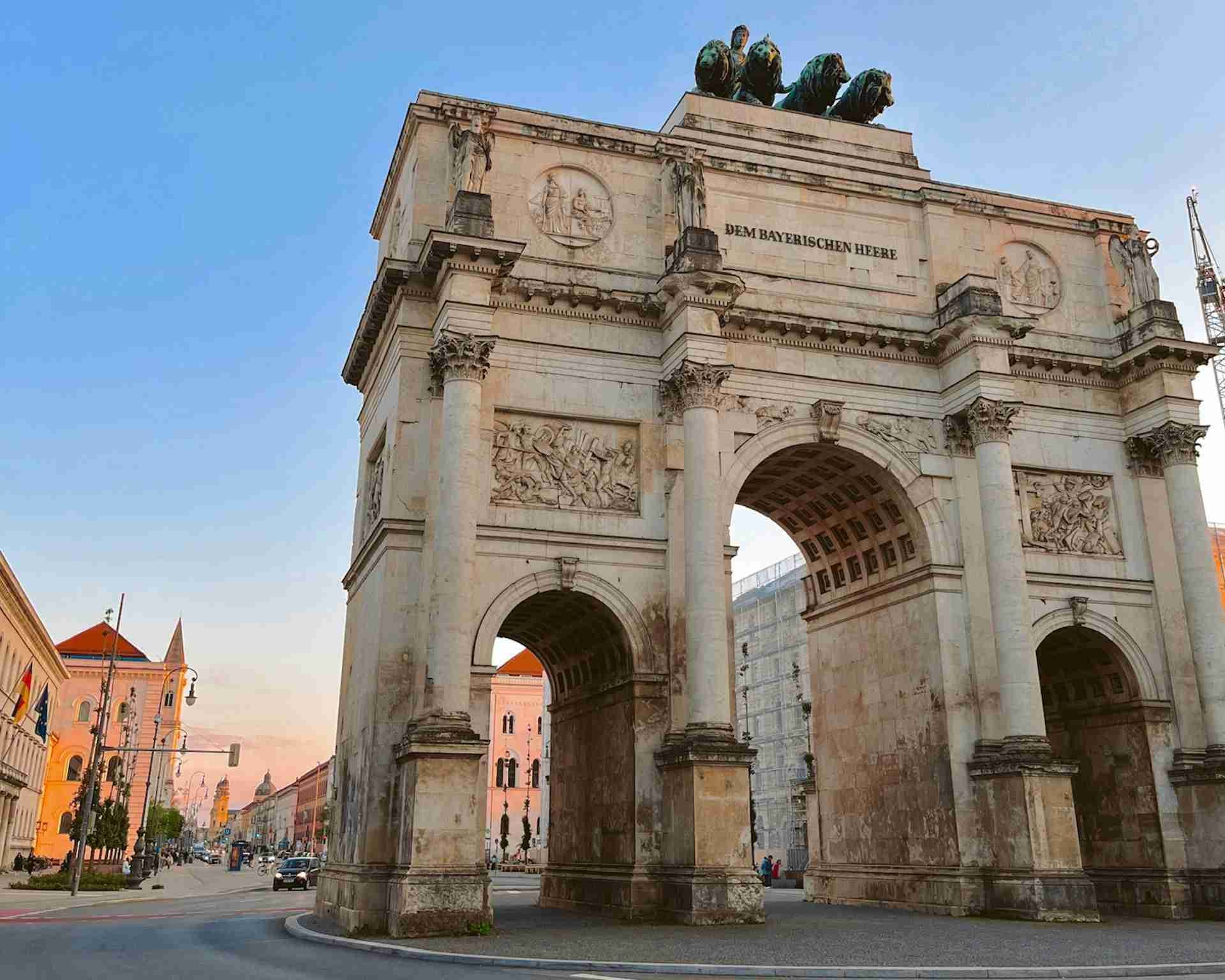
Standing at the intersection of Leopoldstraße and Ludwigstraße, the Siegestor is one of Munich's most commanding urban monuments. Originally built in the mid-19th century as a tribute to the Bavarian army, this triumphal arch now carries a more reflective tone, inscribed with the post-war message "Dem Sieg geweiht, vom Krieg zerstört, zum Frieden mahnend" ("Dedicated to victory, destroyed by war, a reminder of peace"). Photographically, it anchors a stretch of regal neoclassical architecture and offers a mix of strong symmetry, street-level drama, and changing ambient light throughout the day. Whether framed against the dynamic bustle of urban life or isolated in the calm of early morning, the Siegestor rewards careful timing, thoughtful angles, and responsive technique.
Best Photography Opportunities
• Head-on architectural symmetry at street level
The southern view down Ludwigstraße provides the strongest symmetrical composition. Shooting directly into the monument's central axis allows the three arches to frame layers of structure, street, and sky. A wide-angle lens helps include the surrounding urban context, while early morning ensures minimal pedestrian and vehicle interference. Late in the day, the light warms the stone and highlights its sculptural reliefs. Blue hour reveals the interplay of artificial light and lingering sky color, particularly when long exposures capture blurred headlights beneath the arch.
• Compressed perspectives with urban layering
Standing farther south along Ludwigstraße and using a telephoto lens creates compression between the Siegestor and background architecture. This perspective flattens the scene, bringing visual weight to the lion quadriga and compressing layers of traffic, facades, and pedestrians. Late afternoon side light brings texture to the stone and enhances depth. Including elements like cyclists or blurred trams provides scale and motion within an otherwise static architectural frame.
• Passing motion and street life beneath the arches
Vehicles, cyclists, and pedestrians flow continuously through the monument's three arches. This traffic can be integrated into compositions as motion blur, silhouettes, or candid urban scenes. Use a tripod and slower shutter speed to blur cars while keeping the arch sharp. Alternatively, pan with a subject to freeze a single cyclist or pedestrian in motion beneath the central arch. These compositions are strongest during rush hour or twilight, when directional light or artificial glow adds drama.
• Evening light and architectural illumination
The Siegestor is lit from below by warm, even floodlights. As blue hour deepens, these lights pull detail from the monument's figures and stonework. Photograph from either side to capture the glow against a deepening cobalt sky. Rain or wet pavement enhances reflections, allowing symmetrical compositions with doubled light and form. Use a tripod for 10–30 second exposures depending on ambient conditions and light levels.
• Details and textures of the stonework
The arch's limestone bears subtle color variation and preserved war damage on its northern face. Close-up studies reveal sculptural motifs, Latin inscriptions, and weather-worn cornices. Shoot from oblique angles to emphasize texture and surface relief. Overcast skies are ideal for reducing glare and maximizing tonal gradation. A short telephoto or standard prime lens provides enough reach to isolate reliefs while maintaining sharpness and control over depth of field.
Best Time to Visit
The Siegestor is most photographically accessible early in the morning, when traffic is light and natural side lighting enhances the eastern and southern faces. From April through October, sunrise delivers directional light that sculpts the monument and its reliefs. Shadows stretch across the avenue, and the air is typically clear enough for long sightlines.
Blue hour provides excellent contrast between the lit monument and darkening sky. This is most effective in late autumn through winter, when twilight occurs earlier and the surrounding urban lights add layers of color. Light from streetlamps and passing vehicles can be incorporated into long exposures for a sense of movement and energy.
Winter brings added minimalism, with occasional snow highlighting the structure's geometry. Low sun angles extend golden hour, especially on clear mornings. Wet conditions during colder months can add atmosphere through mist or reflections. In summer, light lingers late, but early morning and late evening remain the best times to avoid crowds and capture balanced illumination.
How to Get There
The Siegestor stands at the northern end of Ludwigstraße, bridging the Maxvorstadt and Schwabing districts. It is easily reached by U-Bahn: Universität station (U3/U6) exits directly onto Ludwigstraße, just a short walk south of the monument. Buses and trams also service nearby stops along Ludwigstraße and Leopoldstraße.
For pedestrians and cyclists, the monument is centrally located within Munich's urban core and accessible from the Englischer Garten or Odeonsplatz by foot. Photographers arriving early or late will find bike or foot access especially convenient given traffic limitations.
Tripods can be safely used from the sidewalk or pedestrian islands along the avenue. When shooting from the median or street edge, take care to remain aware of traffic. Nearby university buildings and plazas provide clean sightlines and additional architectural backdrops.
Recommended Photography Gear
Urban monument work at the Siegestor benefits from a three-lens setup. A wide-angle zoom (16–35mm) is essential for shooting close-range symmetry or wide environmental scenes at the base of the arch. A mid-range zoom (24–70mm) provides flexibility for framing vertical compositions, capturing motion within the arches, or isolating structural relationships.
A telephoto lens (70–200mm) allows for compressed perspectives down Ludwigstraße, cropped details of sculpture and inscription, and layered framing with passing figures or urban architecture. A lightweight tripod is critical for blue hour and long exposure street photography. A cable release or timed shutter helps maintain sharpness when working on uneven pavement or with slow exposures.
Use a polarizer sparingly—it can help cut reflections on wet pavement but may darken skies unevenly when working with wide compositions. A neutral density filter is helpful if blurring daytime movement or lengthening shutter speeds to reduce foot traffic visibility. A weather-sealed bag and microfiber cloth are useful during winter or rainy sessions when salt spray or mist may affect optics.
Nearby Photography Locations
This grand boulevard offers strong axial perspectives, rhythmic colonnades, and stately facades. Early morning side light adds depth and pattern to repetitive elements. It's an excellent complement to the vertical mass of the Siegestor.
Just ten minutes south, this monumental plaza features a large loggia, lion statues, and dramatic stonework. The symmetry and scale of the Feldherrnhalle echo the Siegestor's structure, making for strong paired compositions.
A short walk to the northeast, this vast park contrasts the Siegestor's stone and symmetry with organic paths, forested shadows, and water reflections. Use it for varied natural light studies or lifestyle compositions.
Adjacent to the Siegestor, the Ludwig-Maximilians-Universität complex includes formal courtyards and stone passages. Its clean geometry and lower human traffic levels make it ideal for minimalist architectural shots.
West of the Siegestor lies this circular square centered on a tall black obelisk. Best photographed during golden hour or twilight, it provides alternative urban geometry and moody counterpoints to the brighter Siegestor compositions.
The Siegestor is more than a gateway—it's a layered monument that bridges history, architecture, and motion. For the photographer, it offers not just grand form, but a rich context of light, structure, and symbolic weight. Whether rendered as stark silhouette, quiet detail, or central axis of a bustling boulevard, it remains one of Munich's most resonant visual subjects.
Comments
Loading comments…