

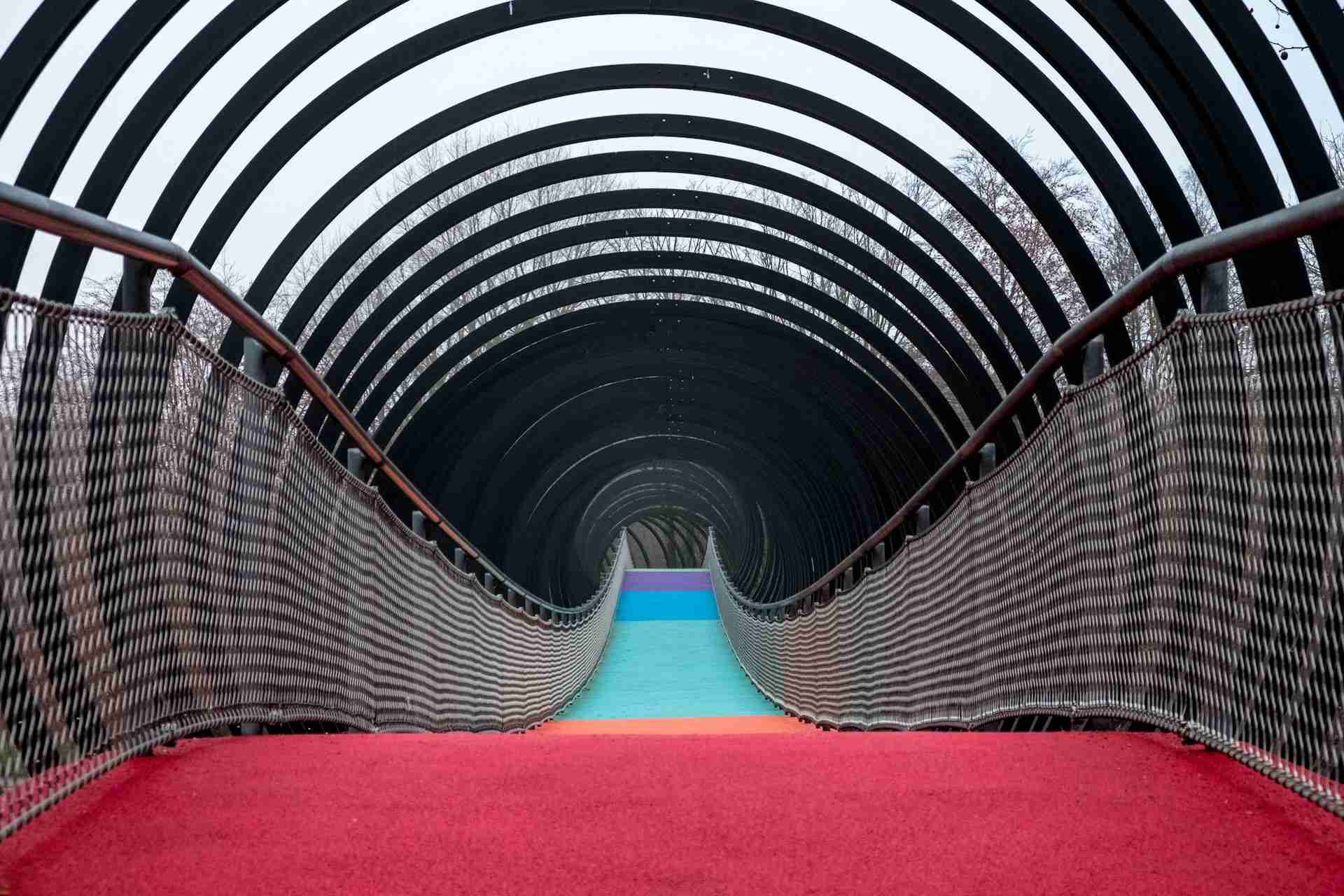
Slinky Springs to Fame is a pedestrian bridge in Oberhausen that crosses the Rhine Herne Canal with a design that feels more like a sculpture than a bridge. Its looping metal arches form a continuous spiral, painted in bright colours that immediately stand out against the surrounding industrial landscape. As you walk across, the rings repeat and overlap, creating shifting patterns that change depending on your position. Below, the canal adds another layer, reflecting parts of the structure and giving you additional angles to work with. The bridge connects easily into the wider network of paths along the canal, making it simple to approach from different directions. It is a location that feels open and accessible, with no barriers or restrictions, so you can take your time moving between viewpoints. Whether you are on the bridge itself or down at water level, the structure offers something different from each angle. It is playful without feeling chaotic, and structured enough to support more deliberate compositions
Best Photography Opportunities
• Repetition And Framing Through The Rings
The most distinctive feature of the bridge is the series of looping arches that repeat along its length. As you move through them, each ring frames the next, creating a natural tunnel effect that works well for layered compositions. By adjusting your position slightly, you can control how tightly the rings align and how much overlap you introduce. This makes it possible to create both clean, symmetrical images and more dynamic, off centre frames. Including a person within the rings can help define scale and add a focal point. The structure does most of the compositional work for you, but small adjustments still make a big difference.
• Abstract Patterns And Color Studies
The combination of bright colours and repeating shapes makes this an ideal location for more abstract photography. By focusing on smaller sections of the bridge, you can remove context and build images around colour, curve, and repetition. Changing your angle slightly can shift how the colours interact, especially where rings overlap. Light plays a key role here, as softer conditions help prevent the colours from becoming too harsh. This approach works well if you want to experiment beyond traditional compositions. It is a location that encourages creative framing.
• Full Bridge Compositions From Canal Level
From the paths along the canal, you can step back and capture the entire structure in a single frame. This gives you a clearer sense of the bridge's spiral form and how it sits within the surrounding environment. Positioning yourself at a slight angle helps show depth rather than flattening the shape. Including the water in the foreground adds another layer and can introduce reflections when conditions are calm. This perspective is essential if you want to show the full design rather than just sections of it. It provides a more complete view of the location.
• Reflections And Symmetry In The Water
When the canal is calm, the bridge can reflect clearly on the surface, creating opportunities for more balanced compositions. Shooting from a lower position near the water helps strengthen this effect and bring the reflection into the frame. Even when the water is slightly disturbed, it can still add texture and contrast to the image. Timing matters, as reflections are strongest during quieter conditions earlier or later in the day. Aligning the bridge with its reflection can create a more structured and intentional result. This adds variety without needing to change location.
• Evening Light And Bridge Illumination
As the light fades, the bridge can take on a different character, especially if the lighting is switched on. The colours begin to stand out against a darker background, and the overall scene feels more contained. Longer exposures can help smooth the water and create a cleaner foreground. Positioning yourself to include both the bridge and its reflection can produce more striking results at this time. The transition from daylight to evening offers a range of looks within a short period. It is worth staying longer to take advantage of this shift.
Best Time to Visit
Early morning is a strong option if you want softer light and fewer people moving through the bridge. The colours are easier to manage under these conditions, and reflections in the canal are more likely to be clear. Late afternoon and early evening provide warmer tones and the chance to work into blue hour, when the bridge lighting can add another layer to your images.
Midday light can be more challenging, as the bright colours can become too intense and shadows can break up the clean patterns. Overcast conditions are often ideal here, as they soften contrast and help balance the colours across the structure. The location can be photographed year round, though calmer weather will generally give you more control over reflections and overall conditions.
How to Get There
Slinky Springs to Fame is located in Oberhausen and crosses the Rhine Herne Canal near the CentrO area. It is easily accessible on foot or by bike, with paths running along both sides of the canal. If you are arriving by car, there are parking options nearby, particularly around the CentrO complex, followed by a short walk.
Public transport connections are also available, with routes linking the area to Oberhausen Central Station. There are no fees required to access the bridge, and it is open at all times. The surrounding paths make it easy to move between different viewpoints, allowing you to explore both the bridge itself and the canal level perspectives without restriction.
Recommended Photography Gear
A standard zoom lens in the range of 24 to 70mm works well for most situations, allowing you to move between wider views and tighter compositions within the rings. A wider lens can help emphasize the curvature of the structure, especially when shooting from close range. A longer lens can be useful for isolating patterns or compressing the repeating arches.
A tripod is worth bringing if you plan to shoot in lower light or want to experiment with longer exposures during the evening. A polarizing filter can help manage reflections on the water and control glare on the painted surfaces. Because the location is easy to move around, keeping your setup lightweight will help you explore different angles more efficiently.
Nearby Photography Locations
Gasometer Oberhausen is a massive industrial structure that offers a completely different subject with strong, simple geometry. It works well for both exterior shots and interior photography if you choose to go inside. The contrast between its scale and the playful design of the bridge makes them a good pair.
• CentrO Oberhausen
CentrO provides a more modern urban environment with clean lines, open spaces, and reflective surfaces. It is a useful location if you want to shift toward more contemporary compositions. The area is close enough to combine easily with the bridge.
• OLGA Park
OLGA Park combines open green space with remnants of industrial structures, creating a mix of natural and built elements. It offers more space to experiment with wider compositions. The setting feels quieter compared to the busier canal area.
Kaisergarten is a large park with open lawns, pathways, and a small zoo area. It provides a softer, more natural environment that contrasts with the strong lines of the bridge. It is useful for a change of pace within the same area.
• Ludwiggalerie Schloss Oberhausen
This gallery is set within a historic building surrounded by parkland, offering a more traditional architectural setting. It works well for more structured compositions with clean lines and symmetry. The contrast between this and the modern bridge adds variety to a photography session.
Comments
Loading comments…