
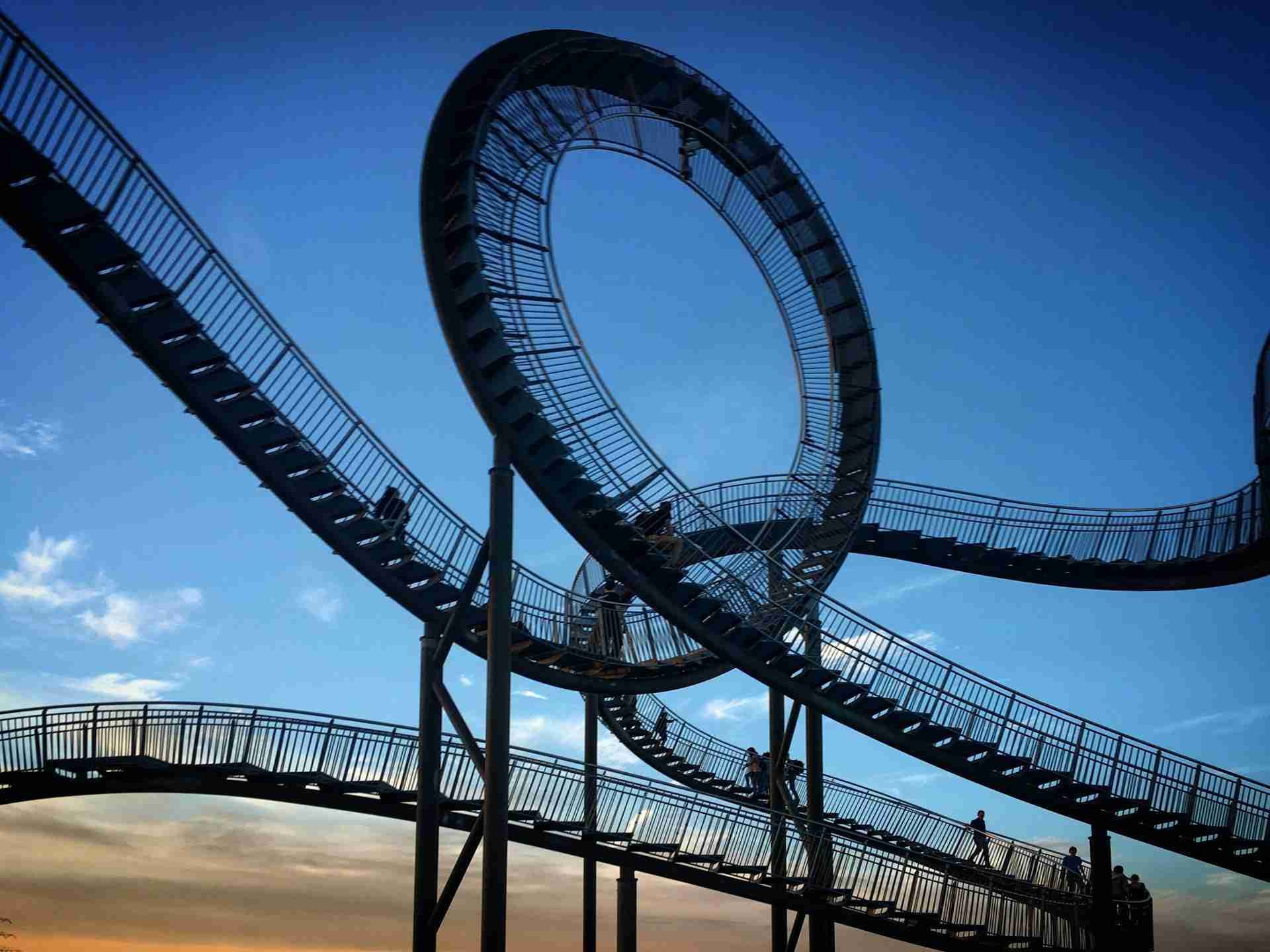
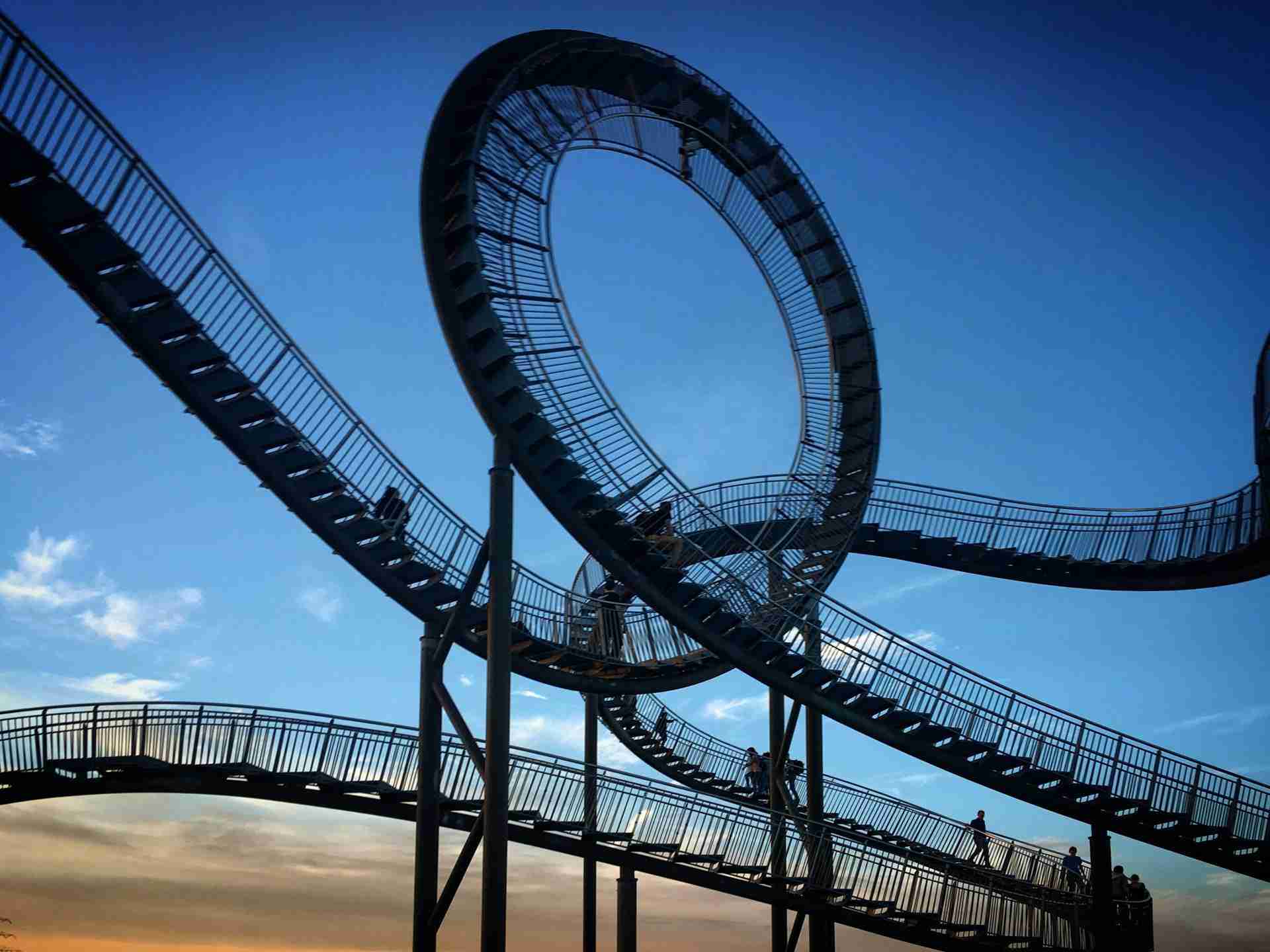
Rising unexpectedly from an industrial hilltop in Duisburg, the Tiger and Turtle – Magic Mountain art installation is a sculptural loop of walkable steel track that bends, climbs, and coils like a frozen rollercoaster. Perched atop a former zinc slag heap in North Rhine-Westphalia, it offers both striking modern form and panoramic views across the Ruhr region. This is a location that rewards architectural photographers, long exposure enthusiasts, and creative explorers alike. Light plays an essential role here. As the sky changes, the sculpture becomes reflective, silhouetted, or glowing, especially when lit from within at night. For those drawn to photographing movement through structure or structure in stillness, Tiger and Turtle is a subject that never quite sits still.
Best Photography Opportunities
• Golden Hour Silhouettes from Below
From the base of the hill, you can shoot upward at the looping shape of the sculpture as it twists against the open sky. During golden hour, the low sun backlights the structure, creating crisp silhouettes that emphasize form and contrast. A mid-telephoto lens helps isolate parts of the installation without background clutter, especially when shooting from lower slopes. Compose with a low angle to let the sculpture dominate the sky, and use partial cloud to add texture behind the steel frame. This view is especially dramatic when the sun aligns with the central loop or walkway.
• Wide-Angle Twilight Compositions with City Lights
As dusk settles, the sculpture lights up from within, casting a soft white glow along the handrails and emphasizing the snaking curves. Use a wide-angle lens from halfway up the hill to include both the glowing installation and the industrial cityscape in the background. This composition works best during blue hour, when there's enough ambient light to retain foreground detail but also strong contrast between the sculpture's lighting and the sky. A tripod is essential here, allowing you to extend exposure time and smooth the urban background into soft glow and shape.
• Long Exposure Light Trails with Walkers
Because the sculpture is walkable, you can incorporate human movement into your shots. With a long exposure and low ISO, visitors walking the illuminated paths leave light trails and soft ghosting that contrast with the still steel frame. Position yourself slightly uphill or perpendicular to the motion for best trail visibility. A shutter speed between 10 and 30 seconds is usually effective, depending on ambient light and traffic. This technique is particularly effective in the evening when the installation is lit and the surroundings are dark.
• Architectural Abstraction with Detail Focus
Tiger and Turtle's metalwork provides endless opportunity for tight compositions that emphasize geometry, shadow, and intersection. Use a 70–200mm lens to isolate stairs, supports, or curves that echo architectural or mechanical forms. These images are strongest in hard light or under street lighting at night, when sharp shadow lines define the form. Try shooting from directly beneath spiral points or over the shoulders of one loop into another to find new visual relationships between parts of the sculpture.
• Panoramic Landscapes with Sculpture as Foreground
From higher on the installation's path or nearby ridgelines, the Ruhr valley unfolds behind the structure. Shooting with a wide or mid-length lens allows you to place the sculpture in the foreground while still capturing factory lights, smokestacks, or layered clouds behind. Sunset and post-sunset skies often add soft pinks and oranges that contrast with the metallic tones of the sculpture. These compositions benefit from balancing exposure between the lit structure and the ambient landscape, so bracket shots or use graduated filters when necessary.
Best Time to Visit
Tiger and Turtle is most photogenic in the early evening and after dark, when its built-in lighting transforms the steel track into a glowing, fluid form. Blue hour offers a strong balance of natural and artificial light, and the hour just after sunset gives you a deepening sky that pairs well with the sculpture's reflective surfaces.
During winter, low sun angles and crisp skies bring clarity and color to golden hour images, while snow or frost add new texture to the path and surroundings. In summer, long twilight hours give more time for light trails and layered urban scenes, but haze can reduce distant visibility.
Mornings offer a quieter experience, but the lighting is typically less dramatic than in the evening. If you're interested in shooting the structure in silhouette, dawn can still work well—especially under cloud-streaked skies.
Lighting is active in the evenings and stays on until late, but the installation is open at all times, so night photography is always possible. Overcast or rainy conditions can actually enhance the look of the steel by deepening color and adding reflections, but care must be taken on wet surfaces.
How to Get There
Tiger and Turtle is located in the Angerpark in the southern part of Duisburg. The closest address for navigation is Ehinger Straße, 47249 Duisburg. Parking is available nearby along Ehinger Straße, with a short, paved path leading up to the hilltop installation. The walk is moderate in incline but manageable for most visitors. Public transportation is also available via the Duisburg-Hüttenheim S-Bahn station, followed by a 15-minute walk.
There is no entrance fee and the site is open 24 hours a day. The staircase structure is closed only in hazardous weather such as high winds or ice, but exterior access for photography is not restricted. Tripods are permitted and recommended for night or long exposure work. The path is well-lit and maintained, though carrying a flashlight for late sessions is advised. The surrounding area is safe but sparsely populated at night, so plan accordingly if working alone.
Recommended Photography Gear
Bring a wide-angle lens (16–35mm) for full structure shots and landscape scenes, and a mid-range zoom (24–70mm) for versatile compositions around the paths and silhouette opportunities. A 70–200mm telephoto lens is valuable for detail work, isolating curves, and shooting compressed compositions from across the slope.
A sturdy tripod is essential for blue hour, long exposure, and light trail work. Consider using a remote shutter or self-timer to avoid vibration. ND filters are not needed unless you're working in bright daytime conditions and want to smooth cloud or pedestrian motion.
A circular polarizer can help reduce reflections on the steel under sunlight, but be cautious with its effect on wide-angle skies. Bring a lens cloth, especially in misty or humid weather, as condensation or light rain can build on your lens quickly. Weather-resistant shoes are also helpful, particularly if you're setting up in grassy areas below the structure.
Nearby Photography Locations
An enormous former steel mill turned public park, this site is full of industrial structures, staircases, pipes, and towers now overgrown with nature. Night lighting adds deep color and shadow, making it ideal for both abstract and documentary shooting.
• Innenhafen Duisburg (Duisburg Inner Harbor)
With modern buildings, bridges, and restored warehouse facades, this waterfront area provides sleek urban compositions and long reflections. Best visited in early morning or evening for calm light and water.
This converted gas holder is now a cultural venue, with an impressive interior space and panoramic rooftop views across the Ruhr area. Great for both interior architectural work and broad industrial landscapes.
• Zeche Zollverein in Essen
A UNESCO-listed coal mine and coking plant, this site offers iconic red steel structures and geometrically rich industrial forms. Ideal for architectural photography and strong directional light.
• Rhine Promenade at Düsseldorf
For a mix of old-world and contemporary riverfront views, Düsseldorf offers long paths, bridges, and skyline scenes that contrast sharply with the industrial character of Duisburg.
Photographing Tiger and Turtle is a study in movement and stillness, light and shape. It is both an object and a path, a sculpture and a lookout. Whether you approach it as a modern art form, an architectural curve, or a nighttime performance of light and steel, it offers endless chances to compose, recompose, and watch how form changes with the hour.
Comments
Loading comments…